Mishkin • Instructor’s Manual for The Economics of Money, Banking, and Financial Markets, Twelfth Edition 65
Chapter 3
ANSWERS TO QUESTIONS
1. Why is simply counting currency an inadequate measure of money?
Since a lot of other assets have liquidity properties that are similar to currency but can be
2. In prison, cigarettes are sometimes used among inmates as a form of payment. How is it
possible for cigarettes to solve the “double coincidence of wants” problem, even if a
prisoner does not smoke?
Even if he or she were a non-smoker, since the prisoner knows that others in the prison will
3. Three goods are produced in an economy by three individuals:
Good Producer
Apples Orchard Owner
Bananas Banana Grower
Chocolate Chocolatier
If the orchard owner likes only bananas, the banana grower likes only chocolate, and the
chocolatier likes only apples, will any trade between these three persons take place in a
barter economy? How will introducing money into the economy benefit these three
producers?
Because the orchard owner likes only bananas but the banana grower doesn’t like apples, the
banana grower will not want apples in exchange for his bananas, and they will not trade.
Similarly, the chocolatier will not be willing to trade with the banana grower because she
4. Why did cavemen not need money?
5. Most of the time it is quite difficult to separate the three functions of money. Money performs
its three functions at all times, but sometimes we can stress one in particular. For each of the
following situations, identify which function of money is emphasized.
a. Brooke accepts money in exchange for performing her daily tasks at her office, since she
knows she can use that money to buy goods and services.
b. Tim wants to calculate the relative value of oranges and apples, and therefore checks the
price per pound of each of these goods as quoted in currency units.
c. Maria is currently pregnant. She expects her expenditures to increase in the future and
decides to increase the balance in her savings account.
Maria is contemplating the store-of-value function of money. As a medium of exchange
6. In Brazil, a country that underwent a rapid inflation before 1994, many transactions were
conducted in dollars rather than in reals, the domestic currency. Why?
7. Was money a better store of value in the United States in the 1950s than in the 1970s? Why
or why not? In which period would you have been more willing to hold money?
8. Why have some economists described money during a hyperinflation as a “hot potato” that
is quickly passed from one person to another?
9. Why were people in the United States in the nineteenth century sometimes willing to be paid
by check rather than with gold, even though they knew there was a possibility that the check
might bounce?
10. In ancient Greece, why was gold a more likely candidate for use as money than wine?
11. If you use an online payment system such as PayPal to purchase goods or services on the
Internet, does this affect the M1 money supply, the M2 money supply, both, or neither?
Explain.
Neither. Although PayPal and many other e-money systems work as other forms of money
do to facilitate purchases of goods and services, it does not count in the M1 or M2 money
12. Rank the following assets from most liquid to least liquid:
a. Checking account deposits
13. Which of the Federal Reserve’s measures of the monetary aggregates—M1 or M2—is
composed of the most liquid assets? Which is the larger measure?
14. It is not unusual to find a business that displays a sign saying “no personal checks, please.”
On the basis of this observation, comment on the relative degree of liquidity of a checking
account versus currency.
The degree of liquidity of an asset is measured by considering how much time and effort
(i.e., transaction costs) are needed to convert that asset into currency. Currency is by
15. For each of the following assets, indicate which of the monetary aggregates (M1 and M2)
includes them:
a. Currency
16. Assume that you are interested in earning some return on the idle balances you usually keep
in your checking account and decide to buy some money market mutual funds shares by
writing a check. Comment on the effect of your action (with everything else the same) on M1
and M2.
Your actions will reduce your checking account balance and increase your holdings of
money market mutual fund shares. Considering this transaction only, M1 will decrease as
17. In April 2009, the growth rate of M1 fell to 6.1%, while the growth rate of M2 rose to 10.3%.
In September 2013, the year-over-year growth rate of the M1 money supply was 6.5%, while
the growth rate of the M2 money supply was about 8.3%. How should Federal Reserve
policymakers interpret these changes in the growth rates of M1 and M2?
During the period in question, the M1 growth rate fell by 0.4%, while the M2 growth rate
18. Suppose a researcher discovers that a measure of the total amount of debt in the U.S.
economy over the past twenty years was a better predictor of inflation and the business cycle
than M1 or M2. Does this discovery mean that we should define money as equal to the total
amount of debt in the economy?
Not necessarily. Although the total amount of debt has predicted inflation and the business
ANSWERS TO APPLIED PROBLEMS
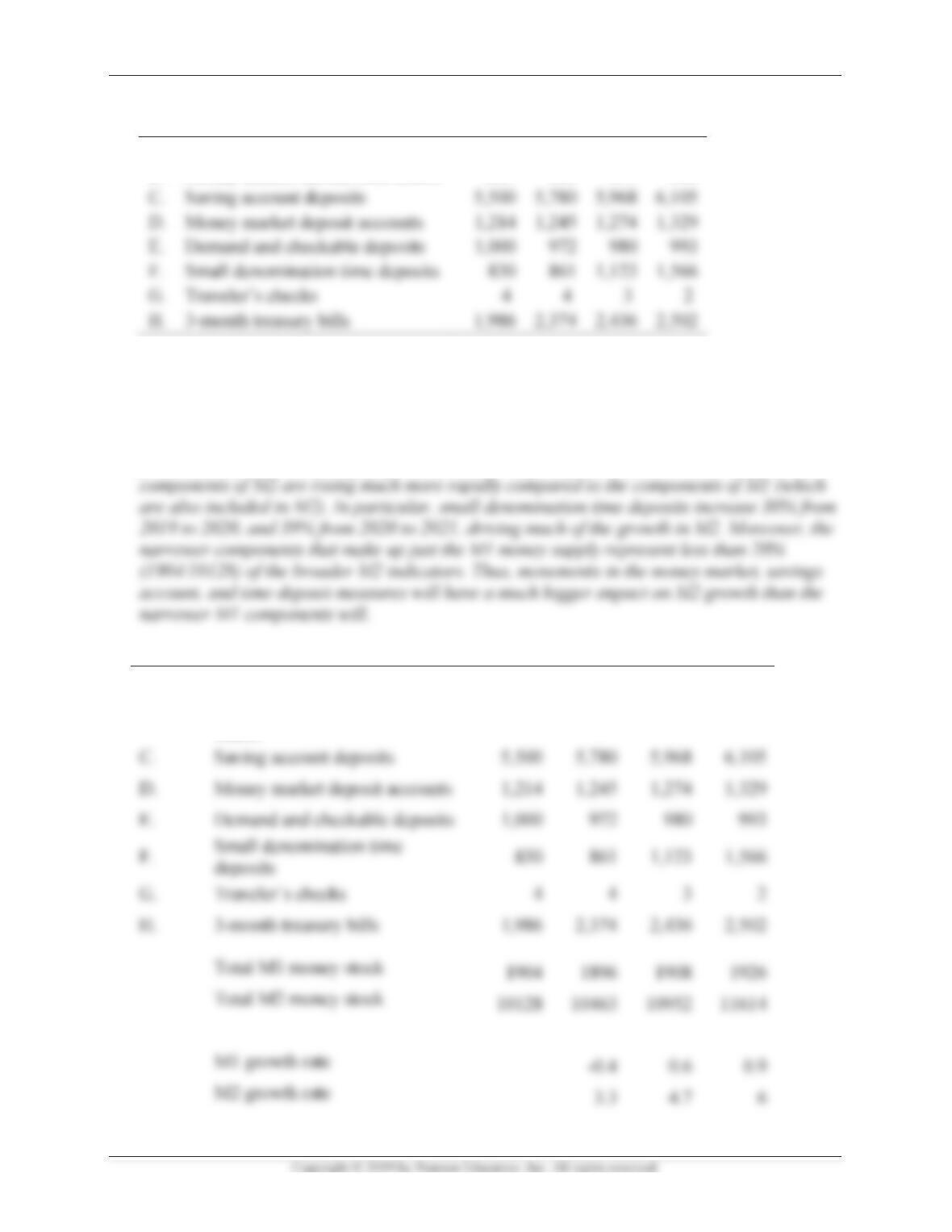
Q.19 The table below shows hypothetical values, in billions of dollars, of different forms of
money.
a. Use the table to calculate the M1 and M2 money supplies for each year, as well as the
growth rates of the M1 and M2 money supplies from the previous year.
b. Why are the growth rates of M1 and M2 so different? Explain.
Mishkin • Instructor’s Manual for The Economics of Money, Banking, and Financial Markets, Twelfth Edition 70
2018 2019 2020 2021
A. Currency 900 920 925 931
B. Money market mutual fund shares 680 681 679 688
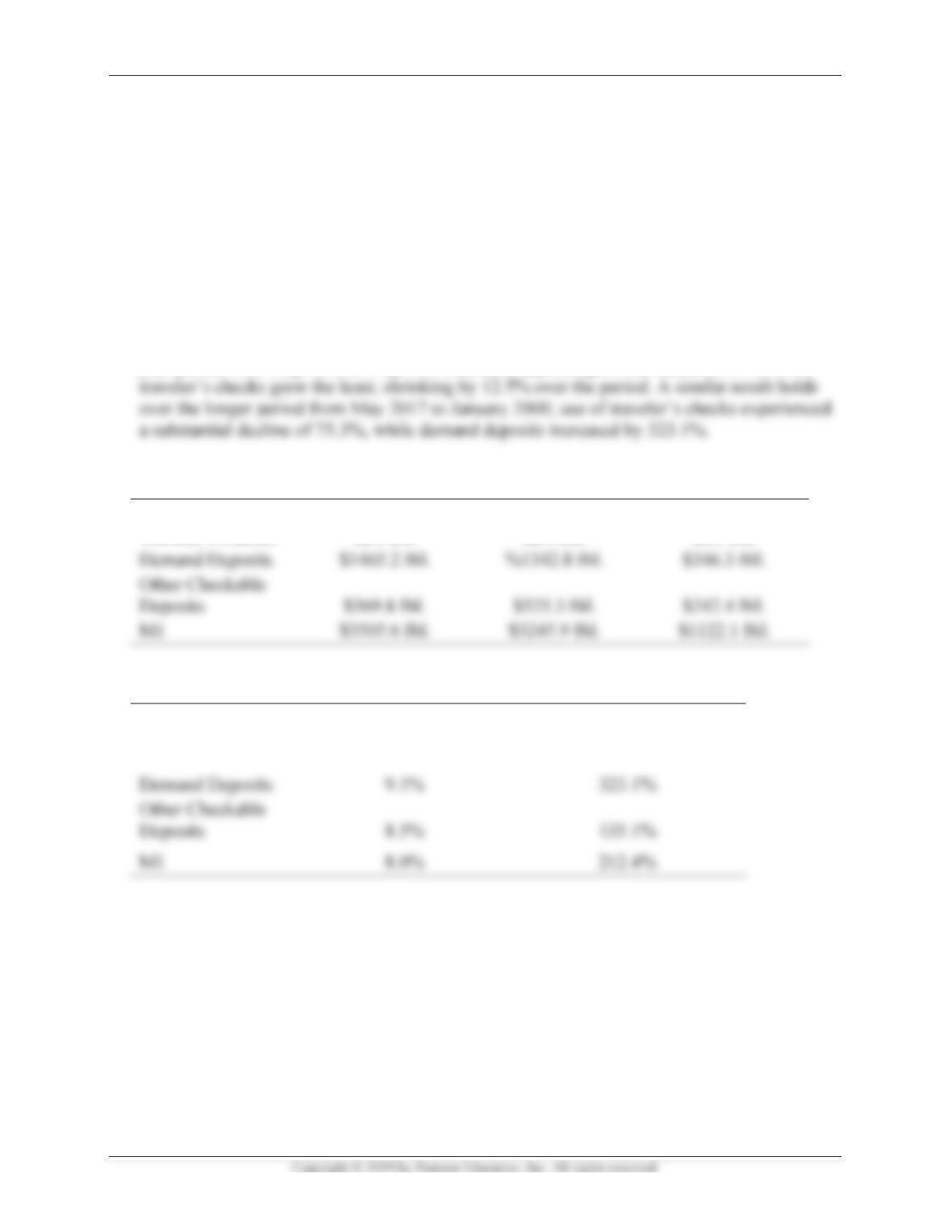
19. The M1 money supply is the sum of rows A, E, and G for each year. The M2 money supply is
the sum of all components A–G for each year. Note that 3-month treasury bills are not
considered part of the M1 or M2 money supply, even though they are fairly liquid assets. The
table below shows the M1 and M2 money supplies, along with the growth rates from the
previous year. Note that while the M1 money supply is relatively flat (and slightly negative
for 2019), the M2 money supply grows at a much higher, positive rate. This is because the
2018 2019 2020 2021
A. Currency 900 920 925 931
B. Money market mutual fund
shares 680 681 679 688
Mishkin • Instructor’s Manual for The Economics of Money, Banking, and Financial Markets, Twelfth Edition 71
ANSWERS TO DATA ANALYSIS PROBLEMS
1. Go to the St. Louis Federal Reserve FRED database and find data on currency (CURRSL),
traveler’s checks (TVCKSSL), demand deposits (DEMDEPSL), and other checkable deposits
(OCDSL). Calculate the M1 money supply, and calculate the percentage change in M1 and
in each of the four components of M1 from the most recent month of data available to the
same time one year prior. Which component has the highest growth rate? The lowest growth
rate? Repeat the calculations using the data from January 2000 to the most recent month of
data available, and compare your results.
See tables below, showing calculations from the May 2017 benchmark period. Over the one
year period from May 2016 to May 2017, demand deposits grew the fastest at 9.1%, while
May 2017 May 2016 January 2000
Currency $1468.5 Bil. $1375.4 Bil. $524.9 Bil.
Traveler’s Checks $2.1 Bil. $2.4 Bil. $8.5 Bil.
May 2016 to May 2017 January 2000 to May 2017
Currency 6.8% 179.8%
Traveler’s Checks í12.5% í75.3%
2. Go to the St. Louis Federal Reserve FRED database and find data on small-denomination
time deposits (STDSL), savings deposits and money market deposit accounts (SAVINGSL),
and retail money market funds (RMFSL). Calculate the percentage change of each of these
three components of M2 (not included in M1) from the most recent month of data available to
the same time one year prior. Which component has the highest growth rate? The lowest
growth rate? Repeat the calculations using the data from January 2000 to the most recent
month of data available, and compare your results. Use your answers from question 1 to
determine which grew faster: the non-M1 components of M2 or the M1 money supply.
Mishkin • Instructor’s Manual for The Economics of Money, Banking, and Financial Markets, Twelfth Edition 72
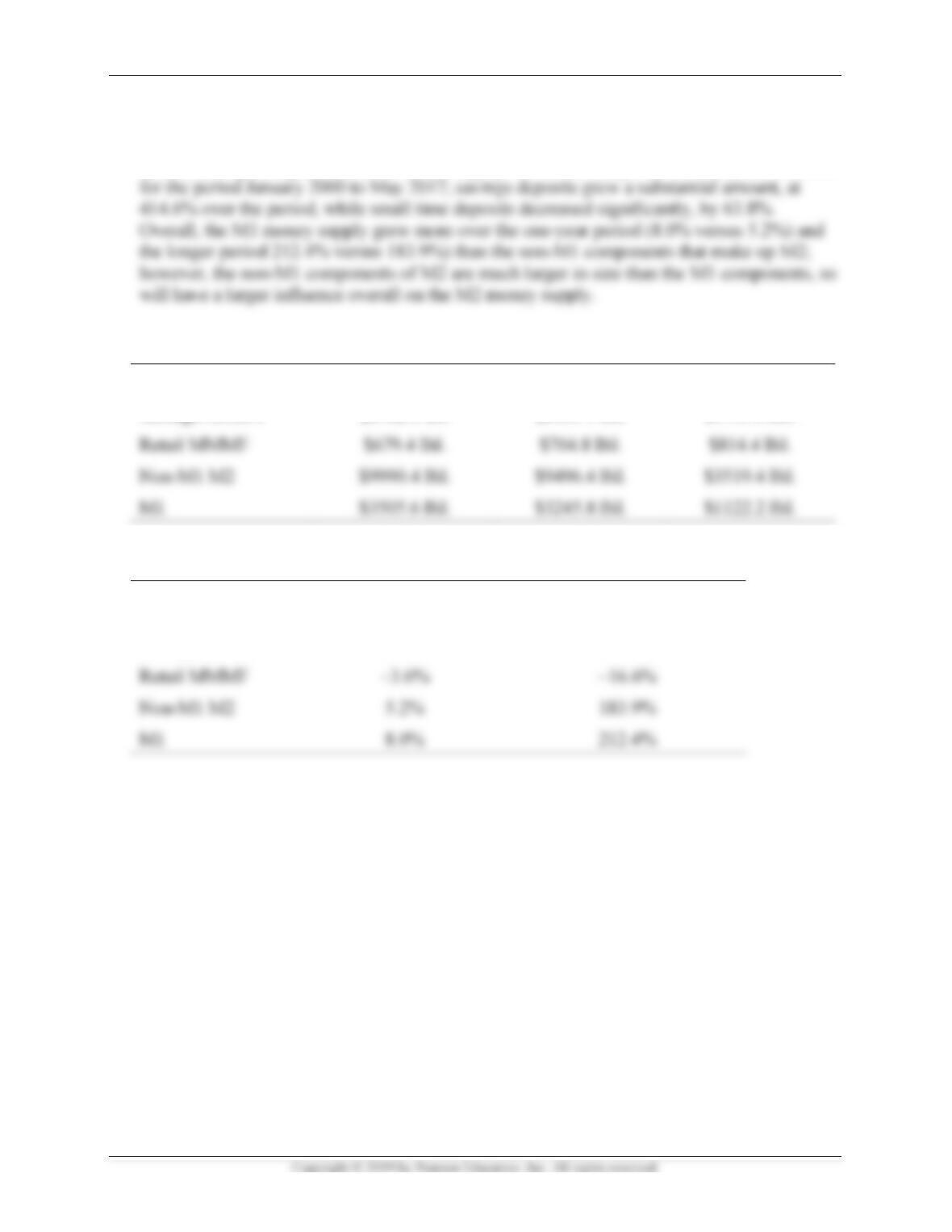
See tables below, showing calculations from the May 2017 benchmark period. Over the one
year period from May 2016 to May 2017, savings deposits grew the fastest at 6.6%, while
small time deposits grew the least, decreasing by 9.5% over the period. A similar result holds
May 2017 May 2016 January 2000
Small Time Deposits $349.0 Bil. $385.7 Bil. $963.4 Bil.
Savings/MMDA $8962.0 Bil. $8405.9 Bil. $1741.6 Bil.
May 2016 to May 2017 January 2000 to May 2017
Small Time
Deposits 9.5% 63.8%
Savings/MMDA 6.6% 414.6%