Chapter 03 – Demand, Supply, and Market Equilibrium
3-12
Answers:
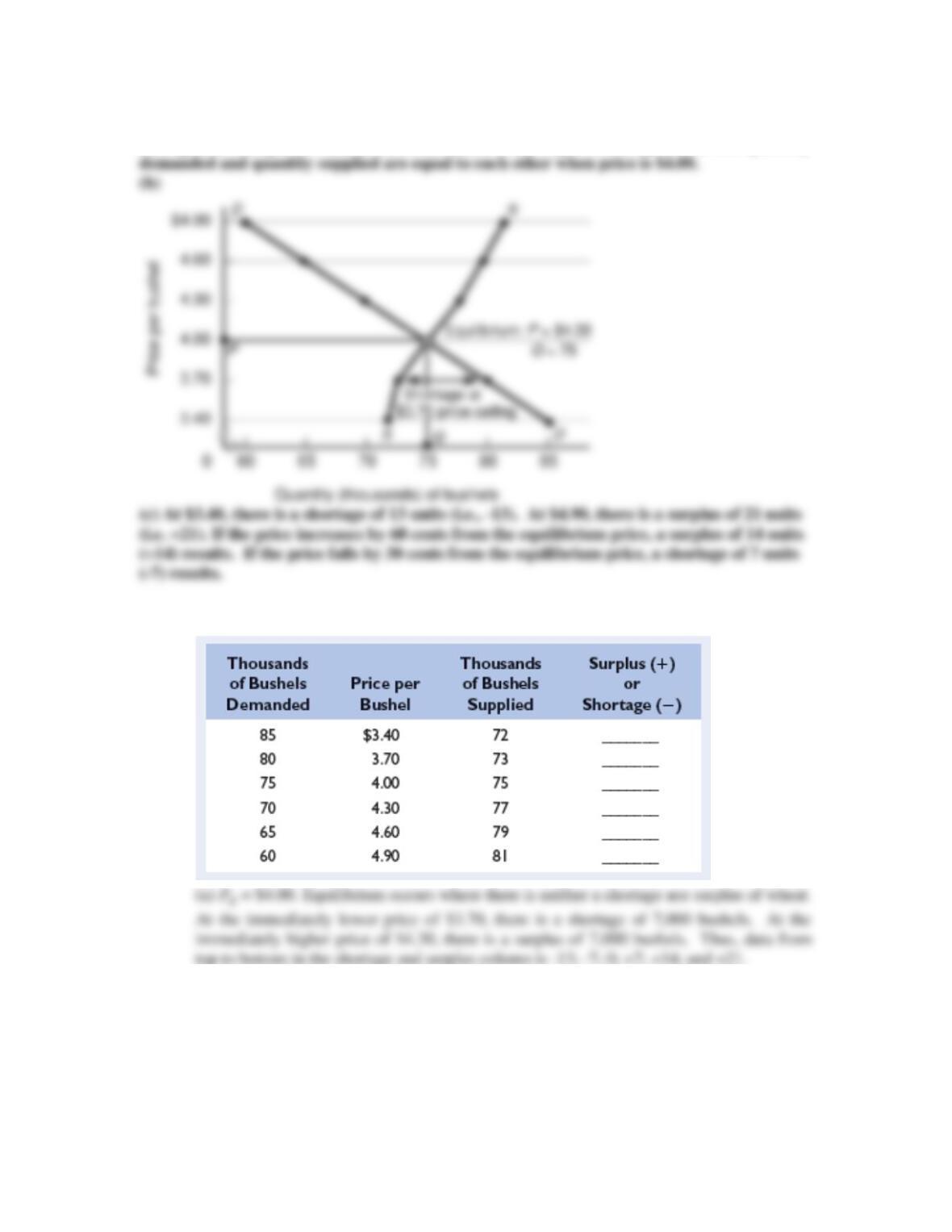
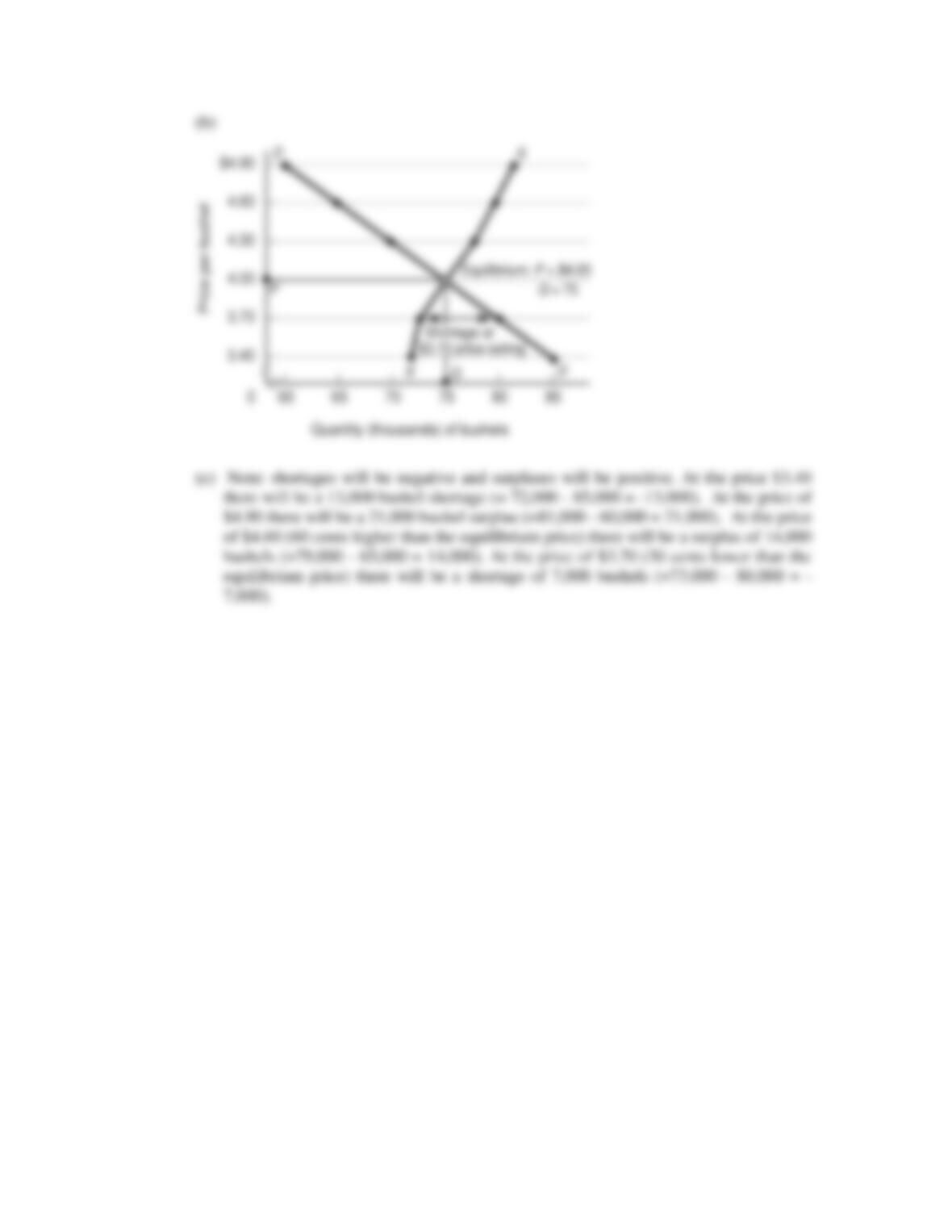
(a) Equilibrium price = $4.00. There is neither a shortage nor a surplus at $4.00. Quantity
Feedback: Consider the following data.
Chapter 03 – Demand, Supply, and Market Equilibrium
3-13
4. How will each of the following changes in demand and/or supply affect equilibrium price and
equilibrium quantity in a competitive market; that is, do price and quantity rise, fall, or remain
unchanged, or are the answers indeterminate because they depend on the magnitudes of the
shifts? Use supply and demand to verify your answers. LO4
a. Supply decreases and demand is constant.
b. Demand decreases and supply is constant.
c. Supply increases and demand is constant.
d. Demand increases and supply increases.
e. Demand increases and supply is constant.
f. Supply increases and demand decreases.
g. Demand increases and supply decreases.
h. Demand decreases and supply decreases.
Chapter 03 – Demand, Supply, and Market Equilibrium
3-14
Answers:
(a) Price up; quantity down;
Feedback:
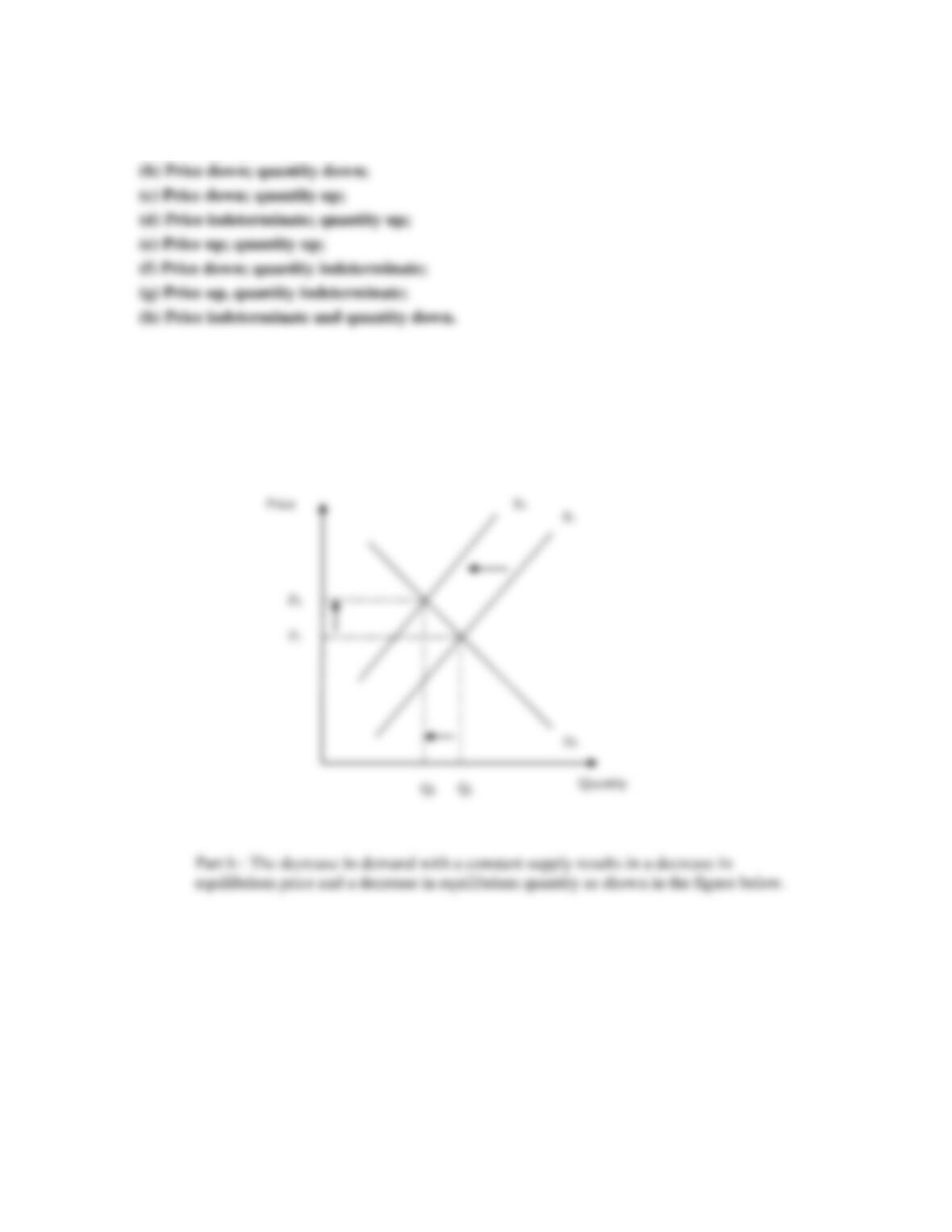
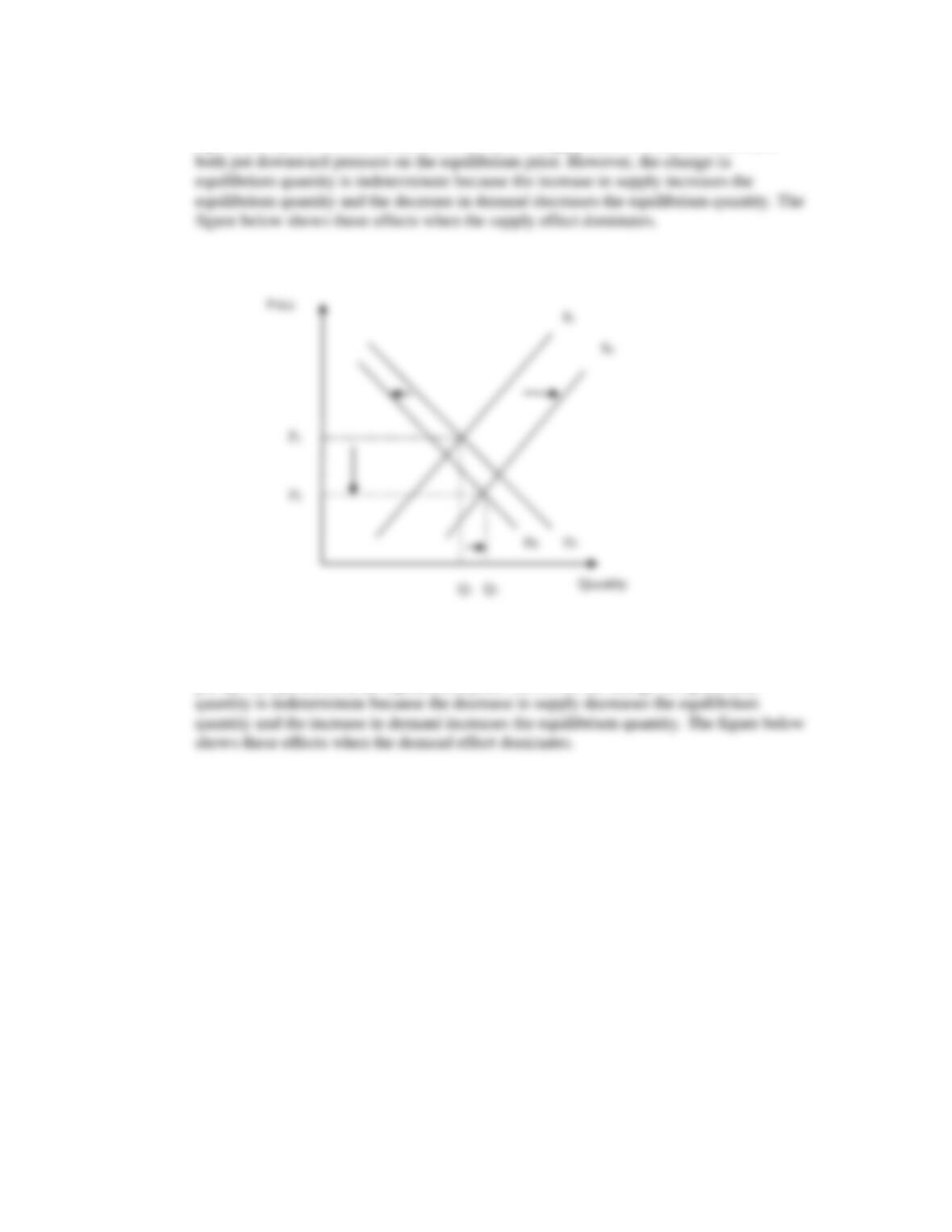
Part a: The decrease in supply with a constant demand results in an increase in
equilibrium price and a decrease in equilibrium quantity as shown in the figure below.
Chapter 03 – Demand, Supply, and Market Equilibrium
3-15
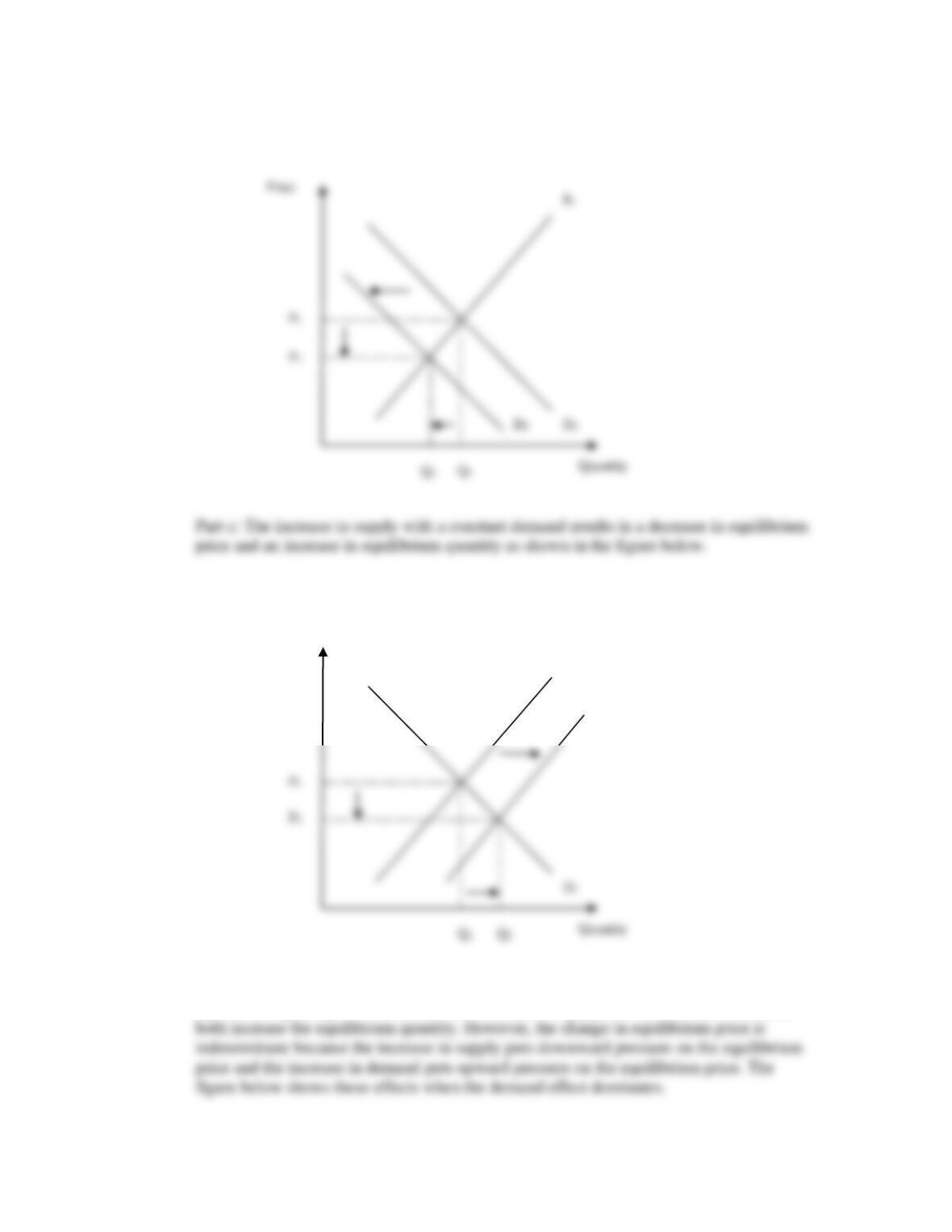
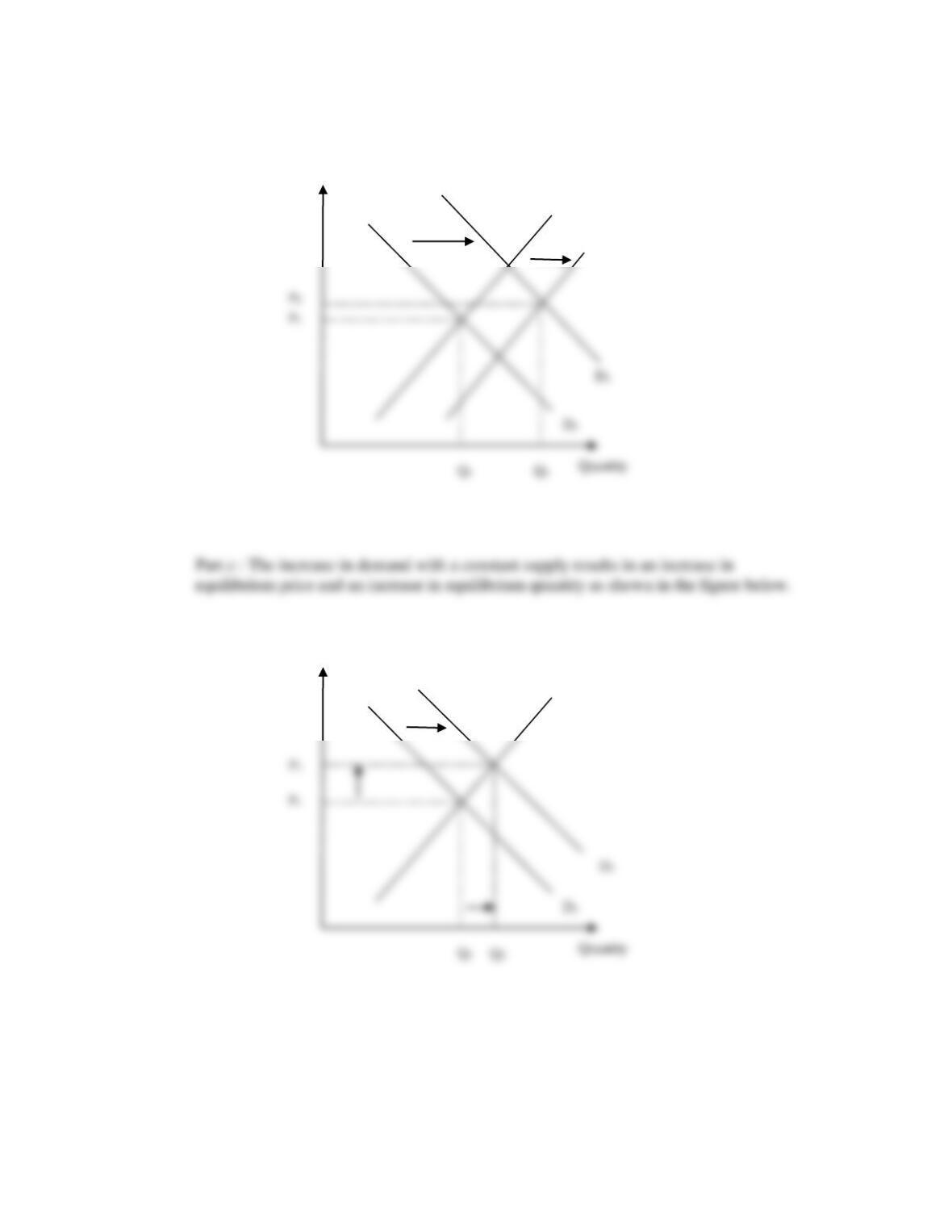
Part d: The increase in supply and the increase in demand unambiguously increases the
equilibrium quantity. This is because the increase in supply and the increase in demand
Price
S2
S1
S1
Chapter 03 – Demand, Supply, and Market Equilibrium
3-16
Price
S1
Price
S2
S1
Chapter 03 – Demand, Supply, and Market Equilibrium
3-17
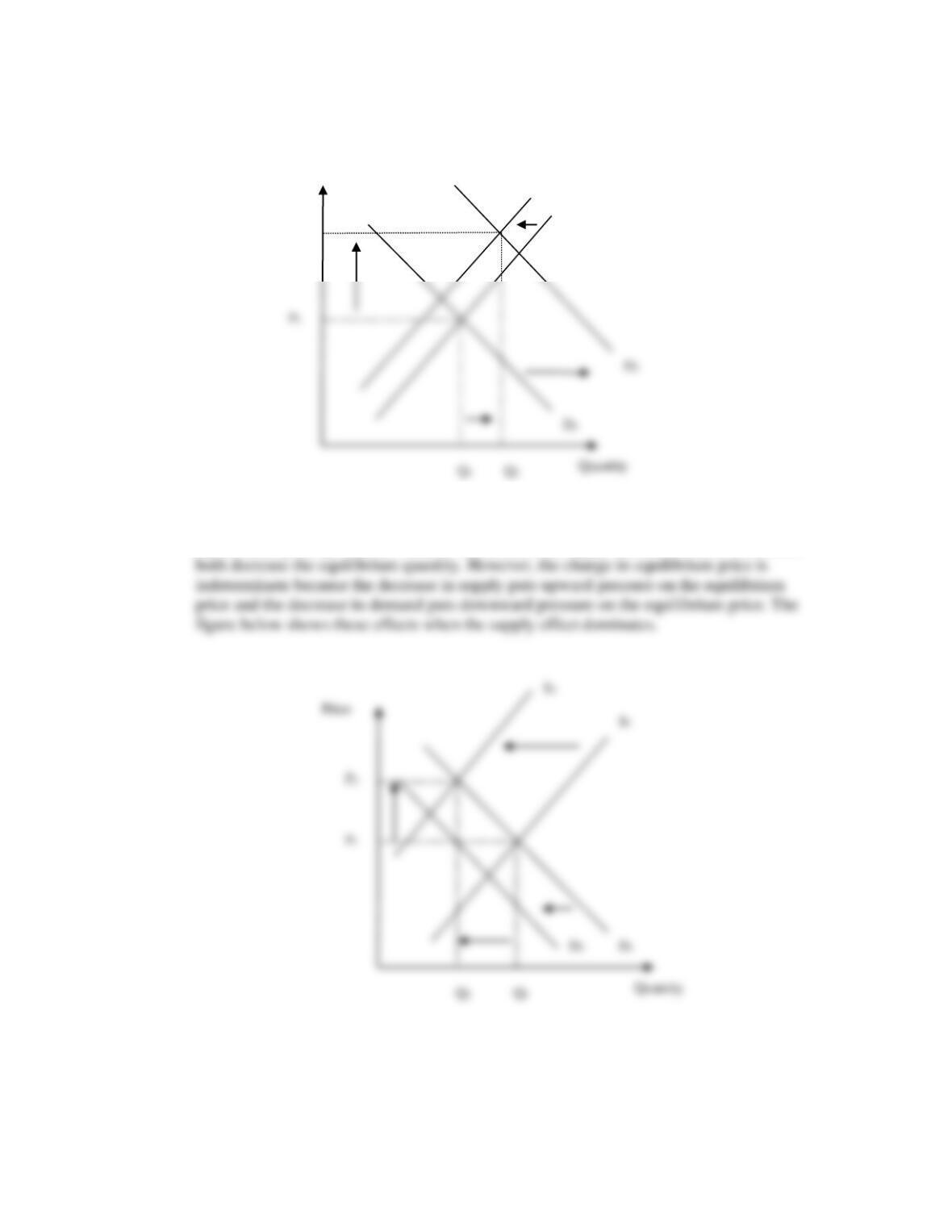
Part f: The increase in supply and the decrease in demand unambiguously decreases the
equilibrium price. This is because the increase in supply and the decrease in demand
Part g: The decrease in supply and the increase in demand unambiguously increases the
equilibrium price. This is because the decrease in supply and the increase in demand both
put upward pressure on the equilibrium price. However, the change in equilibrium
Chapter 03 – Demand, Supply, and Market Equilibrium
3-18
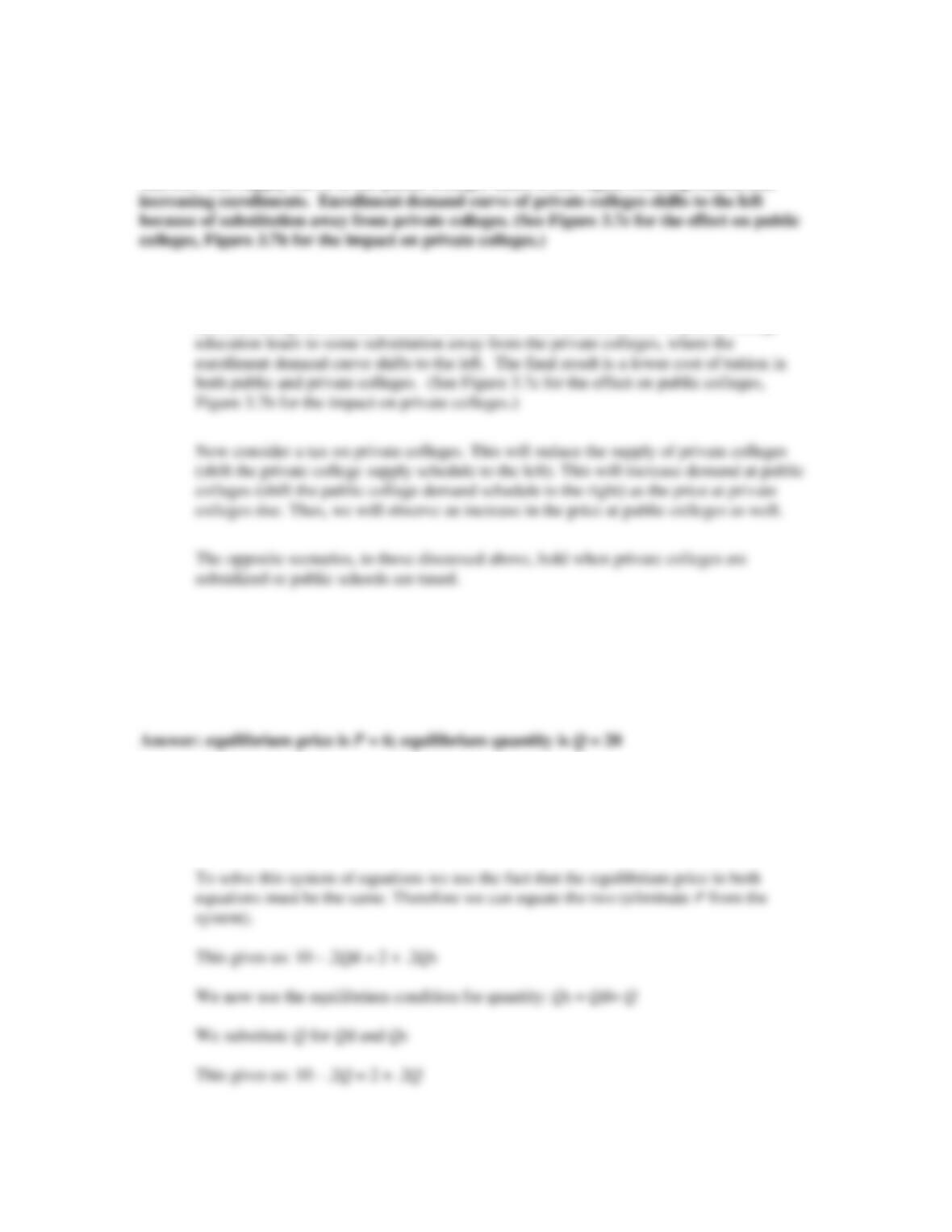
Part h: The decrease in supply and the decrease in demand unambiguously decreases the
equilibrium quantity. This is because the decrease in supply and the decrease in demand
Price
S2
S1
P2
Price
S1
Chapter 03 – Demand, Supply, and Market Equilibrium
3-19
5. Use two market diagrams to explain how an increase in state subsidies to public colleges might
affect tuition and enrollments in both public and private colleges. LO4
Answer: The supply curve of the public colleges shifts to the right, reducing tuition and
Feedback: Consider the case of subsidies to public colleges. The state subsidies to public
colleges shift the supply curve of the public colleges to the right, thus reducing tuition
and increasing enrollments in these institutions. The decreased cost of public college
6. ADVANCED ANALYSIS Assume that demand for a commodity is represented by the
equation P = 10 – .2Qd and supply by the equation P = 2 + .2Qs, where Qd and Qs are quantity
demanded and quantity supplied, respectively, and P is price. Using the equilibrium condition Qs
= Qd, solve the equations to determine equilibrium price. Now determine equilibrium quantity.
LO4
Feedback: Consider the following equations:
demand for a commodity is P = 10 – .2Qd
supply of the commodity is P = 2 + .2Qs
Chapter 03 – Demand, Supply, and Market Equilibrium
3-20
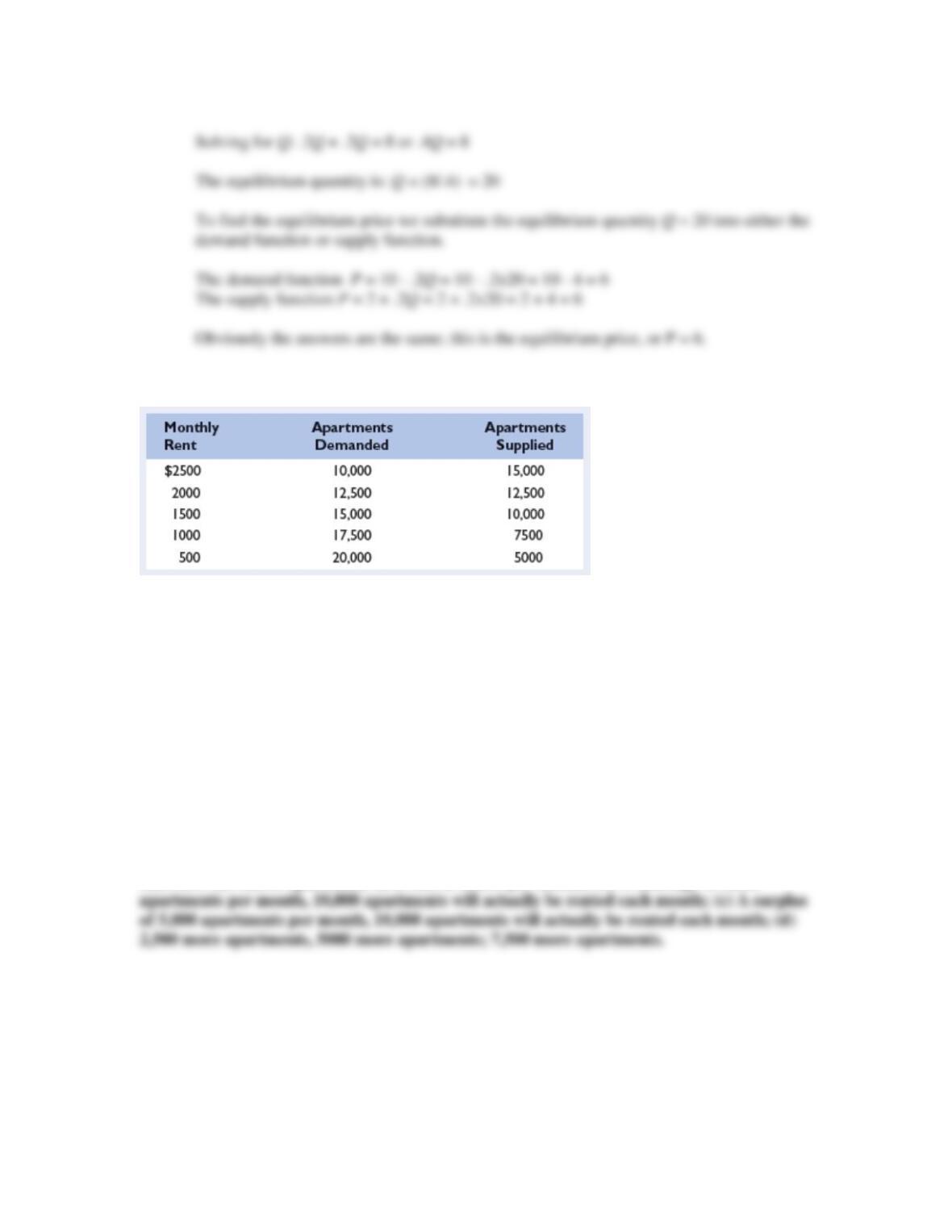
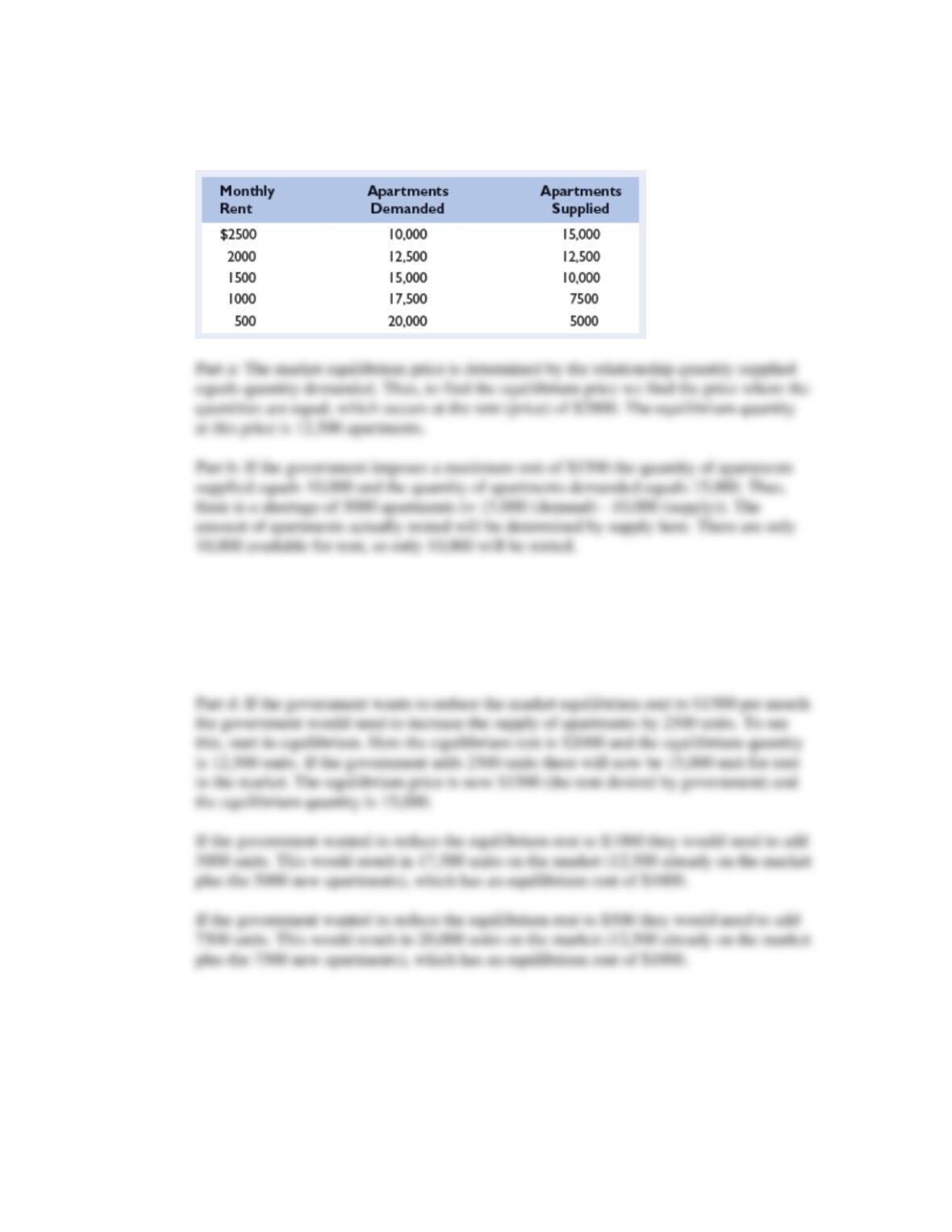
7. Suppose that the demand and supply schedules for rental apartments in the city of Gotham are
as given in the table below. LO5
a. What is the market equilibrium rental price per month and the market equilibrium number of
apartments demanded and supplied?
b. If the local government can enforce a rent-control law that sets the maximum monthly rent at
$1500, will there be a surplus or a shortage? Of how many units? And how many units will
actually be rented each month?
c. Suppose that a new government is elected that wants to keep out the poor. It declares that the
minimum rent that can be charged is $2500 per month. If the government can enforce that price
floor, will there be a surplus or a shortage? Of how many units? And how many units will
actually be rented each month?
d. Suppose that the government wishes to decrease the market equilibrium monthly rent by
increasing the supply of housing. Assuming that demand remains unchanged, by how many units
of housing would the government have to increase the supply of housing in order to get the
market equilibrium rental price to fall to $1500 per month? To $1000 per month? To $500 per
month?
Answers: (a) 12,500 apartments at a rent of $2000 per month; (b) A shortage of 5,000
Chapter 03 – Demand, Supply, and Market Equilibrium
3-21
Feedback: Consider the following demand and supply schedules:
Part c: If the government imposes a minimum rent of $2500 the quantity of apartments
supplied equals 15,000 and the quantity of apartments demanded equals 10,000. Thus,
there is a surplus of 5000 apartments (= 15,000 (supply) – 10,000 (demand)). The amount
of apartments actually rented will be determined by demand here. There are only 10,000
households that want to rent, so only 10,000 will be rented.