Chapter 3
The Classical Model of International Trade
This chapter spells out the classical model of international trade as developed by Smith, Ricardo, Torrens,
Mill, and others. It first points out how absolute advantage can serve as a determinant of the direction of
international trade. It then illustrates how theories of trade based on absolute advantage are dominated by
can be convinced of the general truth of these propositions, then this may well establish in their minds
the relevance of economics to understanding real world phenomena. Thus, the chapter emphasizes this
material heavily, and we would urge that your lectures do likewise.
If you would like to supplement the material in this chapter with some additional data, you might consider
“Manufacturing Productivity and Labor Costs in 14 Economies,” by Arthur Neef and Christopher Kask in
Monthly Labor Review December 1991, pp. 24–37. This article calculates unit labor costs for the United
States and many of its major trading partners. A very interesting chart in this article plots relative U.S. unit
◼ Chapter Outline
Introduction
Absolute Advantage as a Basis for Trade: Adam Smith’s Model
Comparative Advantage as a Basis for Trade: David Ricardo’s Model
The General Equilibrium Solution of the Classical Model
The Gains from International Trade
Global Insights 3.1: Japan’s Gains from Entry into World Trade in 1858
Trade and Wages
10 Husted/Melvin • International Economics, Ninth Edition
Exercises
◼ Suggested Answers for the End-of–Chapter Exercises
1. For each of the following cases below determine the following:
Case 1:
a. in country A, PS/PT = 6/2 = 3
Case 2:
a. in country A, PS/PT = 10/4 = 2.5
Case 3:
a. in country A, PS/PT = 1/2
Case 4:
a. in country A, PS/PT = 2
2. Show that if country A has absolute advantage in S while country B has absolute advantage in T, A
has comparative advantage in S and B has comparative advantage in T.
Suppose we write the labor inputs for S and T in both countries as in the table below.
A
B
S
las
lbs
3. Show that if a country has comparative advantage in good S, it has comparative disadvantage in
good T.
4. Using the data from Table 3.3, show the effect on world output if each country moved toward
specialization of its comparative-disadvantage good.
In the example given in Table 3.3, A has a comparative advantage in S and B has a comparative
Per Unit Gain
In Production of S
In Production of T
In A
−1
+1/2
5. Suppose that there are 20,000 hours of labor available in country A. Five hours of labor are required
to produce 1 unit of S, while 4 hours are required to produce 1 unit of T. Find the shape and
dimensions of A’s PPF.
6. Use the information in Exercise 5 plus the following additional data to graph A’s trade triangle:
world relative price = 2; A’s imports = 2000; A’s exports = ?
Since the world relative price line is steeper than the autarky relative price, we know that country A
7. Evaluate the following statements:
a. Developed countries have nothing to gain by trading with developing countries.
This is generally untrue. When relative prices differ between countries, either developed or
developing, a country can be better off by increasing production of its comparative advantage
b. Developed countries get all of the gains from trade when they trade with developing countries
because they can dictate their prices to these countries.
This is also generally untrue. Gains from trade come about from the exposure to prices that are
8. Show that less than complete specialization in production leads to a lower level of welfare than
complete specialization.
9. Suppose that the technologies available to A and B are given by the following table:
A
B
S
4
8
T
2
4
Are there any incentives for trade in this example? Explain.
10. For case 2 in Exercise 1, which country would prefer an international terms of trade of 1.1 rather than
an international price of 2? Explain.
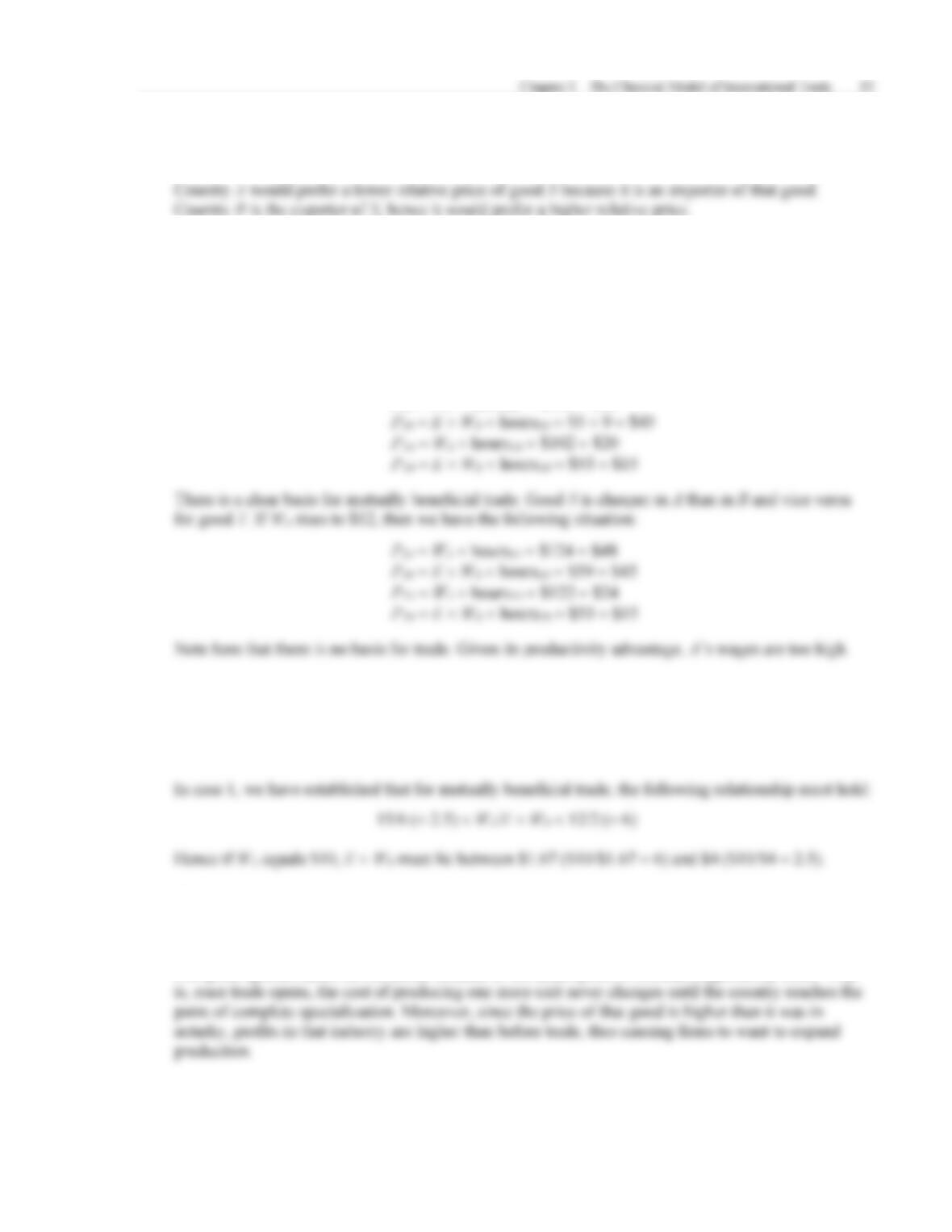
11. Consider two countries, A and B, with the technologies given by case 4 in Exercise 1. Suppose that
wage rate in A, WA, equals $10 per hour and the wage rate in B, when measured in dollars, E WB,
equals $5 per hour. Calculate the pretrade price of S and T in both A and B. Is there a basis for
mutually beneficial trade? Why or why not? Suppose that WA rises to $12 per hour. Everything else
held constant, what would happen to trade patterns? Why? What options are available to A to resolve
this situation?
Pretrade prices:
PSA = WA hoursSA = $104 = $40
12. Consider two countries, A and B, with the technologies given by case 3 in Exercise 1. Suppose that
wage rate in A, WA, equals $10 per hour; then, for mutually beneficial trade to occur, the wage rate
in B, when measured in dollars, E WB, must lie in a range from $X to $Y. Calculate X and Y and
explain your answer.
13. The classical model predicts that countries will completely specialize in the production of their
comparative-advantage good. Explain why the opportunity to engage in international trade would
lead to this result.
Complete specialization comes about because of the assumption of constant opportunity costs. That
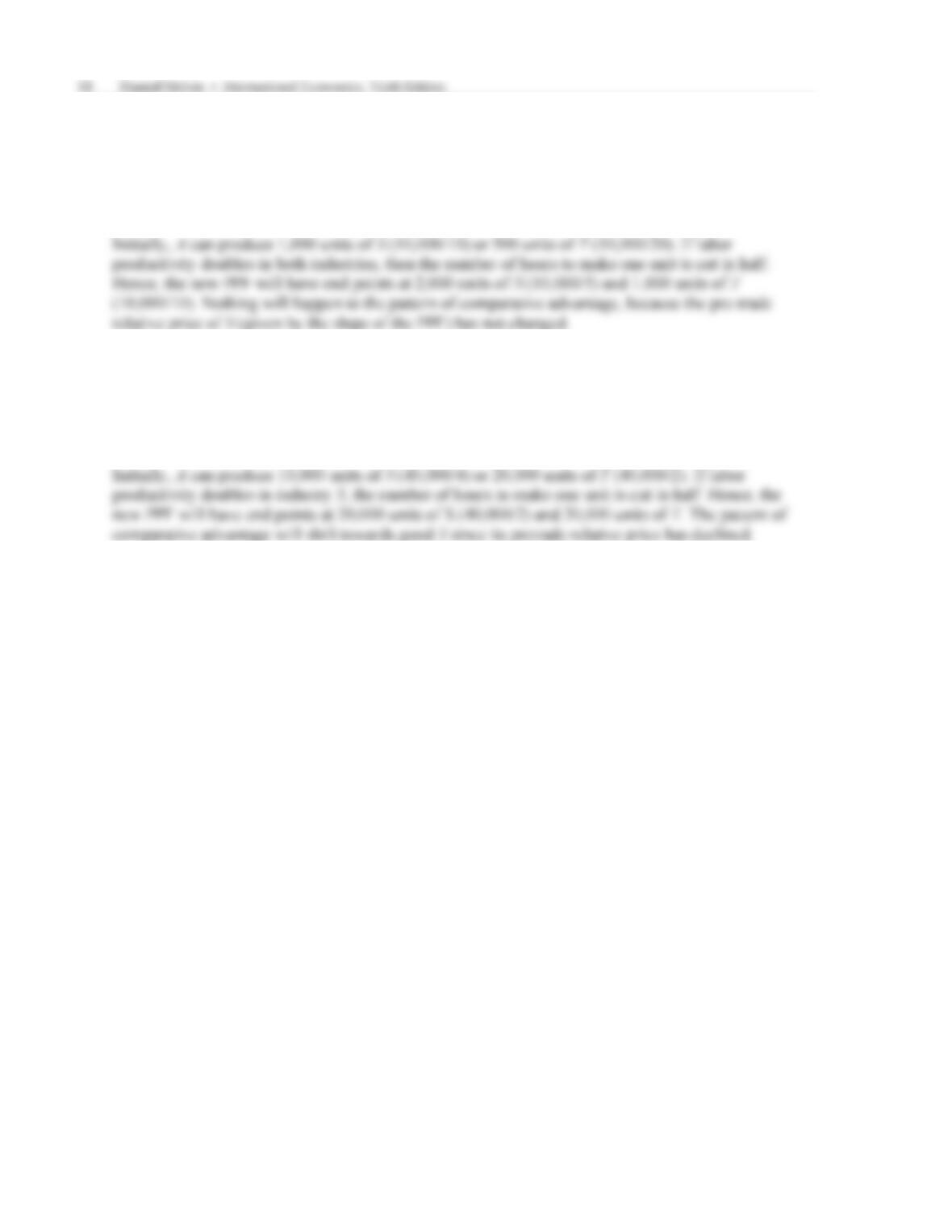
14. Suppose that country A has 10,000 worker-hours available for production and that it initially has
the technology given by case 3 of Exercise 1. Derive its PPF and determine its exact dimensions.
Now, suppose that scientists in A develop a technology that doubles labor productivity in both
industries. What would happen to A’s PPF? Derive and explain. What would happen to the pattern
of comparative advantage? Derive and explain.
15. Suppose that country A has 40,000 worker-hours available for production and that it initially has the
technology given by case 4 of Exercise 1. Derive its PPF and determine its exact dimensions. Now,
suppose that scientists in A develop a technology that doubles labor productivity in producing good S.
What would happen to A’s PPF? Derive and explain. What would happen to the pattern of
comparative advantage? Derive and explain.