
Chapter 3: Financial Statements, Cash Flow, and Taxes
Learning Objectives
23
Chapter 3
Financial Statements, Cash Flow, and Taxes
Learning Objectives
After reading this chapter, students should be able to do the following:
◆ List each of the key financial statements and identify the kinds of information they provide to
corporate managers and investors.
◆ Estimate a firm’s free cash flow and explain why free cash flow has such an important effect on firm
value.
◆ Discuss the major features of the federal income tax system.

24
Lecture Suggestions
Chapter 3: Financial Statements, Cash Flow, and Taxes
Lecture Suggestions
The goal of financial management is to take actions that will maximize the value of a firm’s stock. These
actions will show up, eventually, in the financial statements, so a general understanding of financial
statements is critically important.
Note that Chapter 3 provides a bridge between accounting, which students have just covered,
and financial management. Unfortunately, many non-accounting students did not learn as much as they
should have in their accounting courses, so we find it necessary to spend more time on financial
statements than we would like. Also, at Florida and many other schools, students vary greatly in their
knowledge of accounting, with accounting majors being well-grounded because they have had more
intense introductory courses and, more importantly, because they are taking advanced financial
accounting concurrently with finance. This gives the accountants a major, and somewhat unfair,
advantage over the others in dealing with Chapters 3 and 4 on exams. We know of no good solution to
this problem, but what we do is pitch the coverage of this material to the non-accountants. If we pitch
the lectures (and exams) to the accountants, they simply blow away and demoralize our non-
accountants, and we do not want that. Perhaps Florida has more of a difference between accounting and
non-accounting students, but at least for us there really is a major difference.
What we cover, and the way we cover it, can be seen by scanning the slides and Integrated Case
solution for Chapter 3, which appears at the end of this chapter’s solutions. For other suggestions about
the lecture, please see the “Lecture Suggestions” in Chapter 2, where we describe how we conduct our
classes.
DAYS ON CHAPTER: 3 OF 56 DAYS (50-minute periods)
Answers to End–of–Chapter Questions
3-2 Bankers and investors use financial statements to make intelligent decisions about what firms to
3-3 No, because the $20 million of retained earnings would probably not be held as cash. The
3-4 The balance sheet shows the firm’s financial position on a specific date, for example, December
31, 2019. It shows each account balance at that point in time. For example, the cash account
shown on the balance sheet would represent the cash the firm has on hand and in the bank on
3-5 Investors need to be cautious when they review financial statements. While companies are
required to follow GAAP, managers still have quite a lot of discretion in deciding how and when
to report certain transactions. Consequently, two firms in the same operating situation may
3-6 a. The average American household’s financial position increased slightly from 2004–2007, but
declined sharply from 2007–2010. Over this period, mortgage and installment loan balances
increased, total assets decreased due to the decline in cash in bank accounts and the values
of retirement savings and personal homes, and income declined slightly. At the end of 2010,
3-7 Free cash flow is the amount of cash that could be withdrawn without harming the firm’s ability
to operate and to produce future cash flows. It is calculated as after-tax operating income plus
3-8 Yes. Negative free cash flow is not necessarily bad. Most rapidly growing companies have
3-9 MVA is the difference between a firm’s market value and the book value of its equity. The higher
a firm’s MVA, the better the job management is doing for the firm’s shareholders. EVA is the
3-10 This statement means that the higher one’s income, the larger the percentage paid in taxes.
3-11 Double taxation refers to the fact that corporate income is subject to an income tax, and then
stockholders are subject to a further personal tax on dividends received. In fact, because of
double taxation Congress was motivated to reduce the tax rate on dividends to the same rate as
long-term capital gains. In 2018, the maximum tax rate on qualified dividends and long-term
3-12 Although the deductibility of interest paid is limited under the new tax law, dividend payments
are still not deductible, so the after-tax cost of debt is lower than the after-tax cost of equity.
Chapter 3: Financial Statements, Cash Flow, and Taxes
Answers and Solutions
27
Solutions to End-of-Chapter Problems
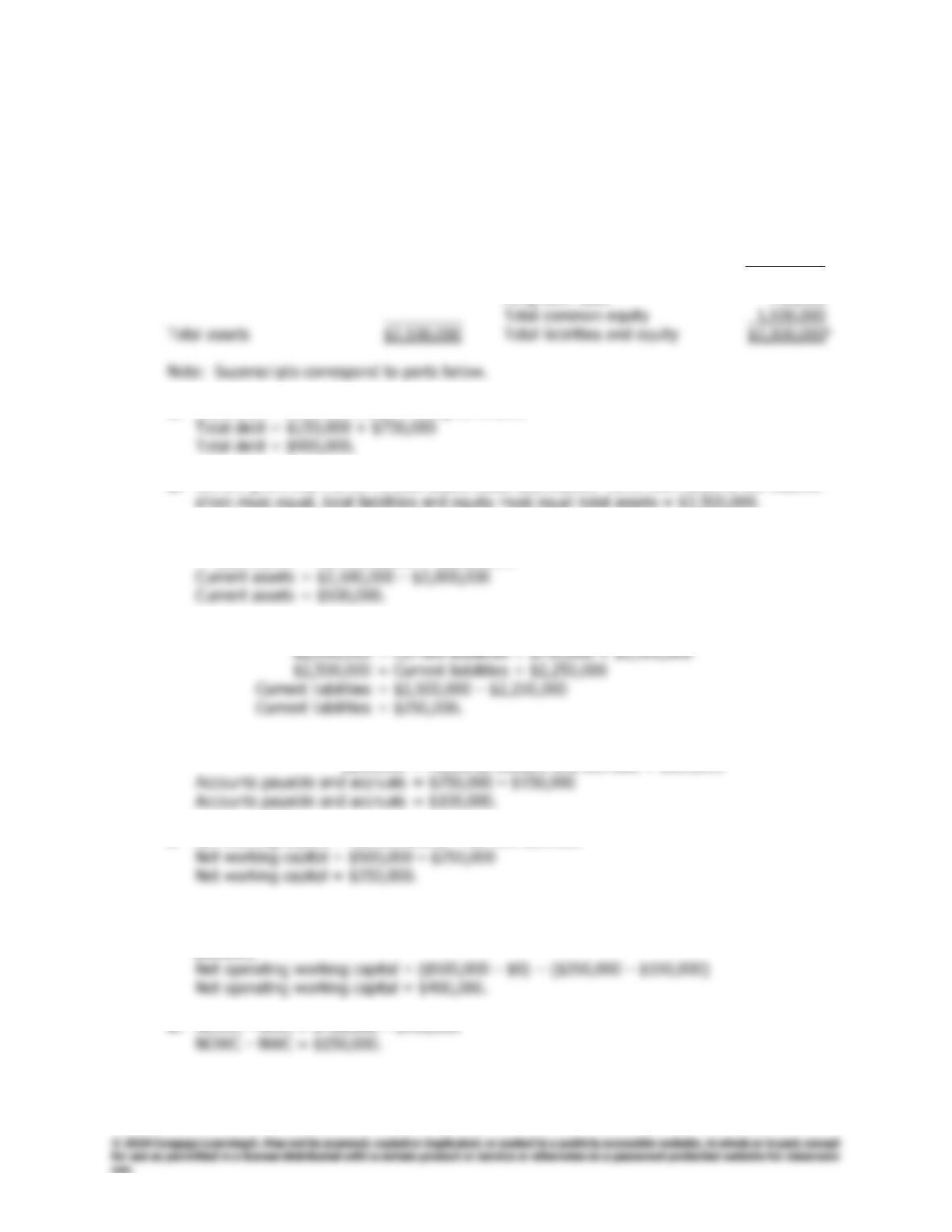
3-1 From the data given in the problem, we know the following:
Current assets $ 500,000c Accounts payable and accruals $ 100,000e
Net plant and equipment 2,000,000 Notes payable 150,000
Current liabilities $ 250,000d
Long-term debt 750,000
a. Total debt = Short-term debt + Long-term debt
b. We are given that the firm’s total assets equal $2,500,000. Since both sides of the balance
sheet must equal, total liabilities and equity must equal total assets = $2,500,000.
c. Total assets = Current assets + Net plant and equipment
$2,500,000 = Current assets + $2,000,000
d. Total liabilities and equity = Current liabilities + Long-term debt + Total common equity
e. Current liabilities = Accounts payable and accruals + Notes payable
$250,000 = Accounts payable and accruals + $150,000
f. Net working capital = Current assets – Current liabilities
g. Net operating working capital = Operating current assets – Operating current liabilities
Net operating working capital = (Current assets – Excess cash) – (Current liabilities – Notes
payable)
28
Answers and Solutions
Chapter 3: Financial Statements, Cash Flow, and Taxes
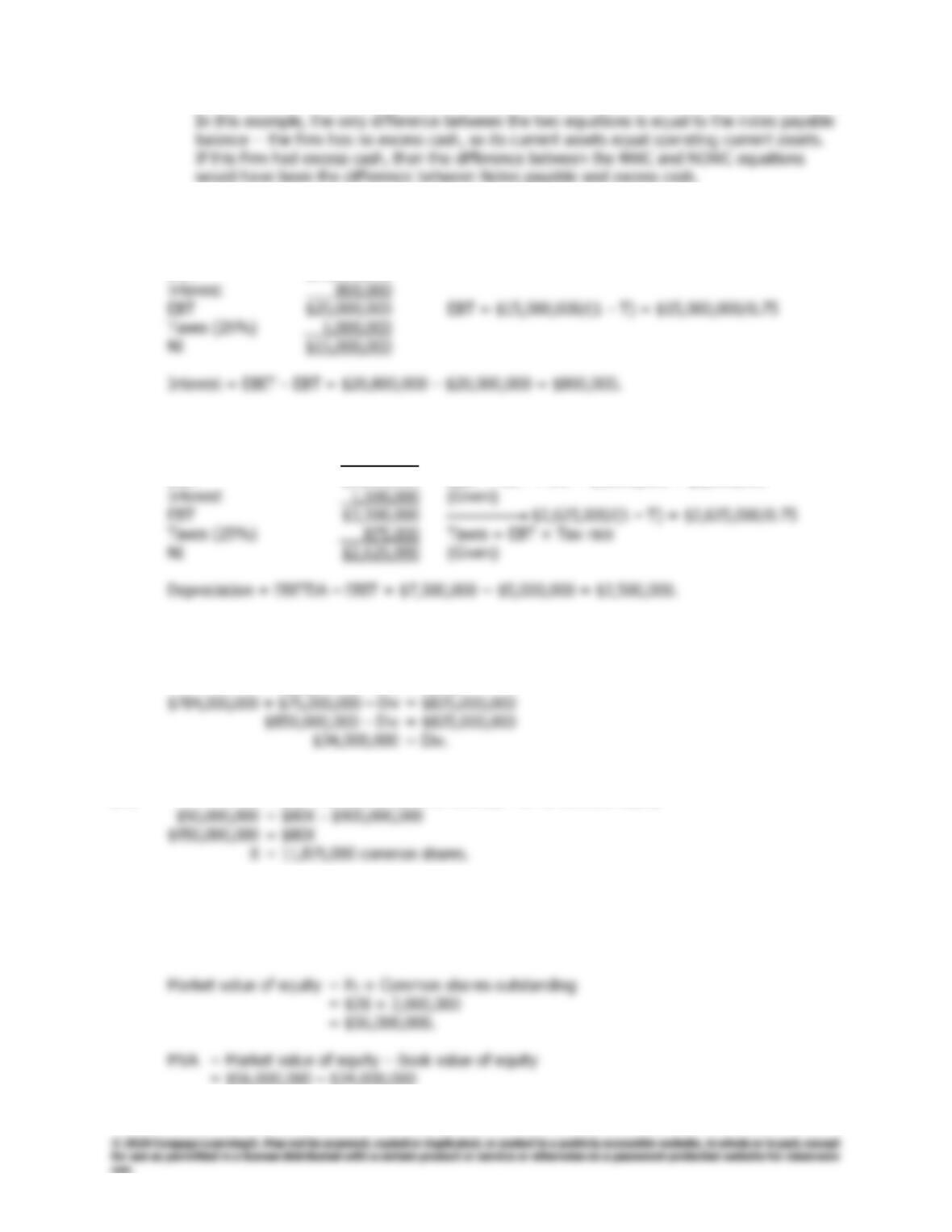
3-2 NI = $15,000,000; EBIT = $20,800,000; T = 25%; Interest = ?
Need to set up an income statement and work from the bottom up.
EBIT $20,800,000
3-3 EBITDA $7,500,000 (Given)
Depreciation 2,500,000 Deprec. = EBITDA – EBIT = $7,500,000 – $5,000,000
EBIT $5,000,000 EBIT = EBT + Int = $3,500,000 + $1,500,000
3-4 NI = $75,000,000; R/EY/E = $825,000,000; R/EB/Y = $784,000,000; Dividends = ?
R/EB/Y + NI – Div = R/EY/E
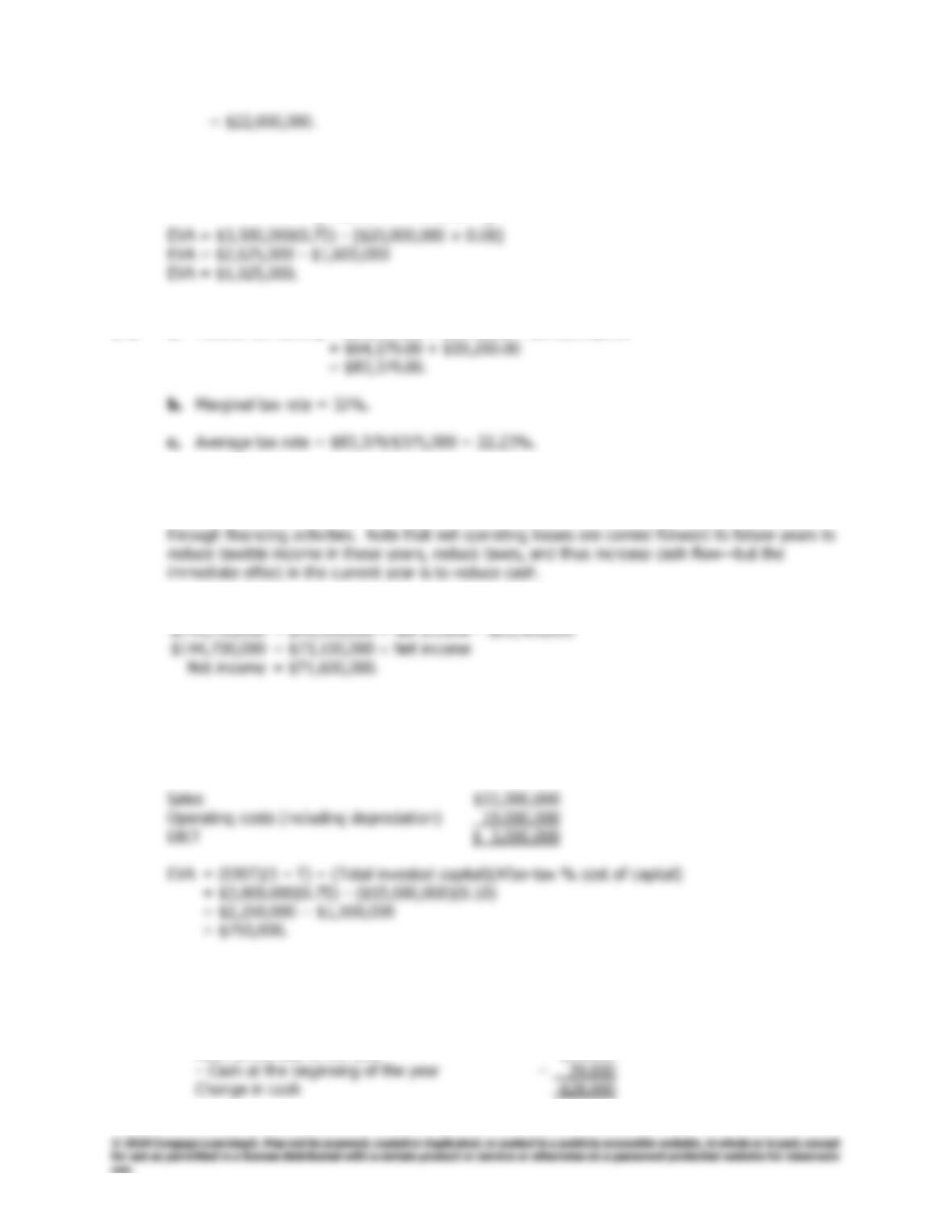
3-5 MVA = (P0 Number of common shares) − BV of common equity
3-6 Book value of equity = $34,000,000.
Price per share (P0) = $28.00.
Common shares outstanding = 2,000,000 shares.
= $56,000,000 – $34,000,000
Chapter 3: Financial Statements, Cash Flow, and Taxes
Answers and Solutions
29
3-7 EVA = EBIT(1 – T) –
capital
ofcost
%tax –After
capital
inv ested
Total
3-8 a. Federal tax liability = $64,179.00 + ($375,000 – $315,000)0.32
3-9 Statements b, c, and d will decrease the amount of cash on a company’s balance sheet.
Statement a will increase cash through the sale of common stock. Selling stock provides cash
3-10 Ending R/E = Beg. R/E + Net income − Dividends
3-11 Tax rate 25%
After-tax % cost of capital 10%
Total invested capital $15,000,000
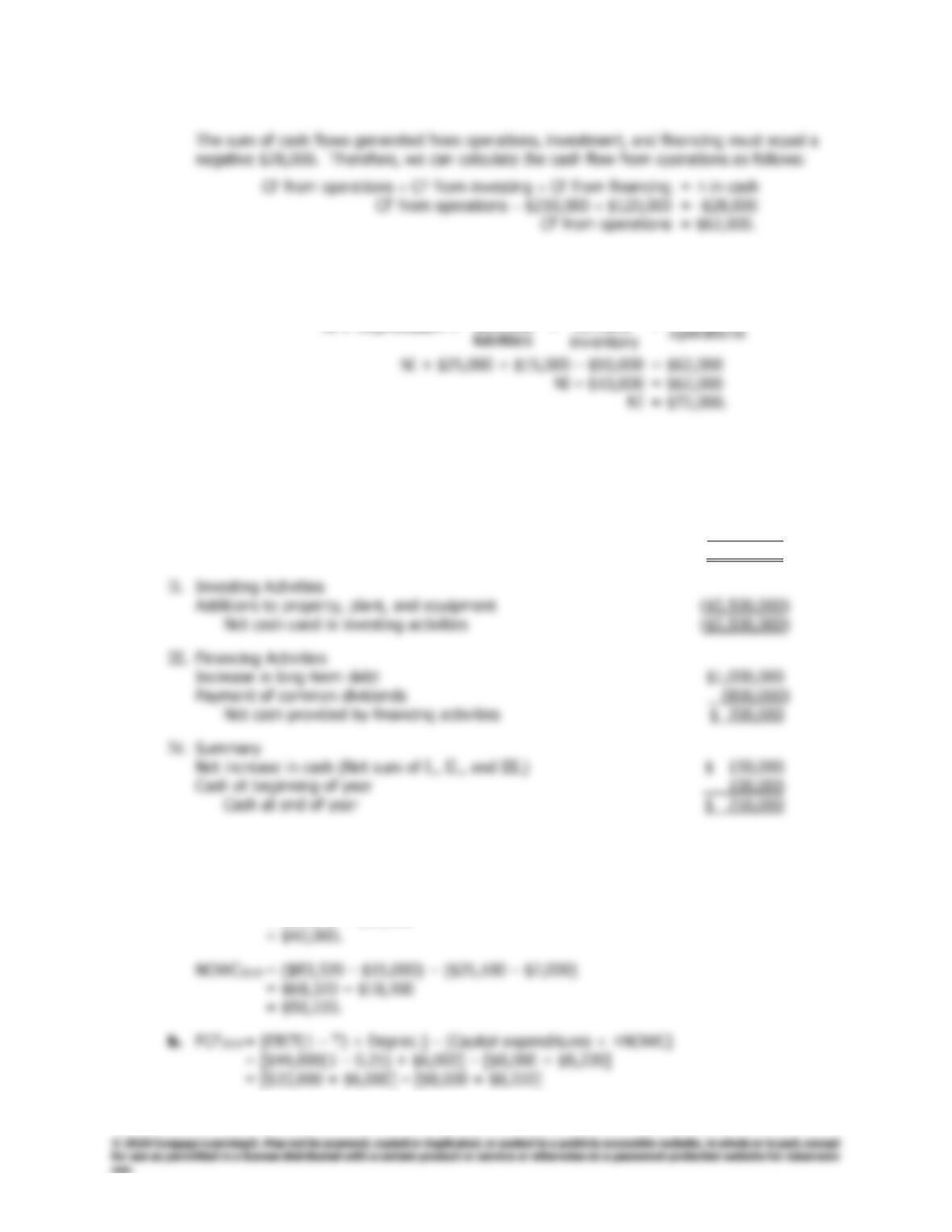
3-12 a. From the statement of cash flows the change in cash must equal cash flow from operating
activities plus investing activities plus financing activities. First, we must identify the change
in cash as follows:
Cash at the end of the year $11,000
30
Answers and Solutions
Chapter 3: Financial Statements, Cash Flow, and Taxes
b. Since we determined that the firm’s cash flow from operations totaled $62,000 in part a of
this problem, we can now calculate the firm’s net income as follows:
NI +
onDepreciati
+
accrued
in Increase
−
and A/R
in Increase
=
from CF
3-13 Statement of Cash Flows
I. Operating Activities
Net income $5,000,000
Depreciation 450,000
NWC 0
Net cash provided by operating activities $5,450,000
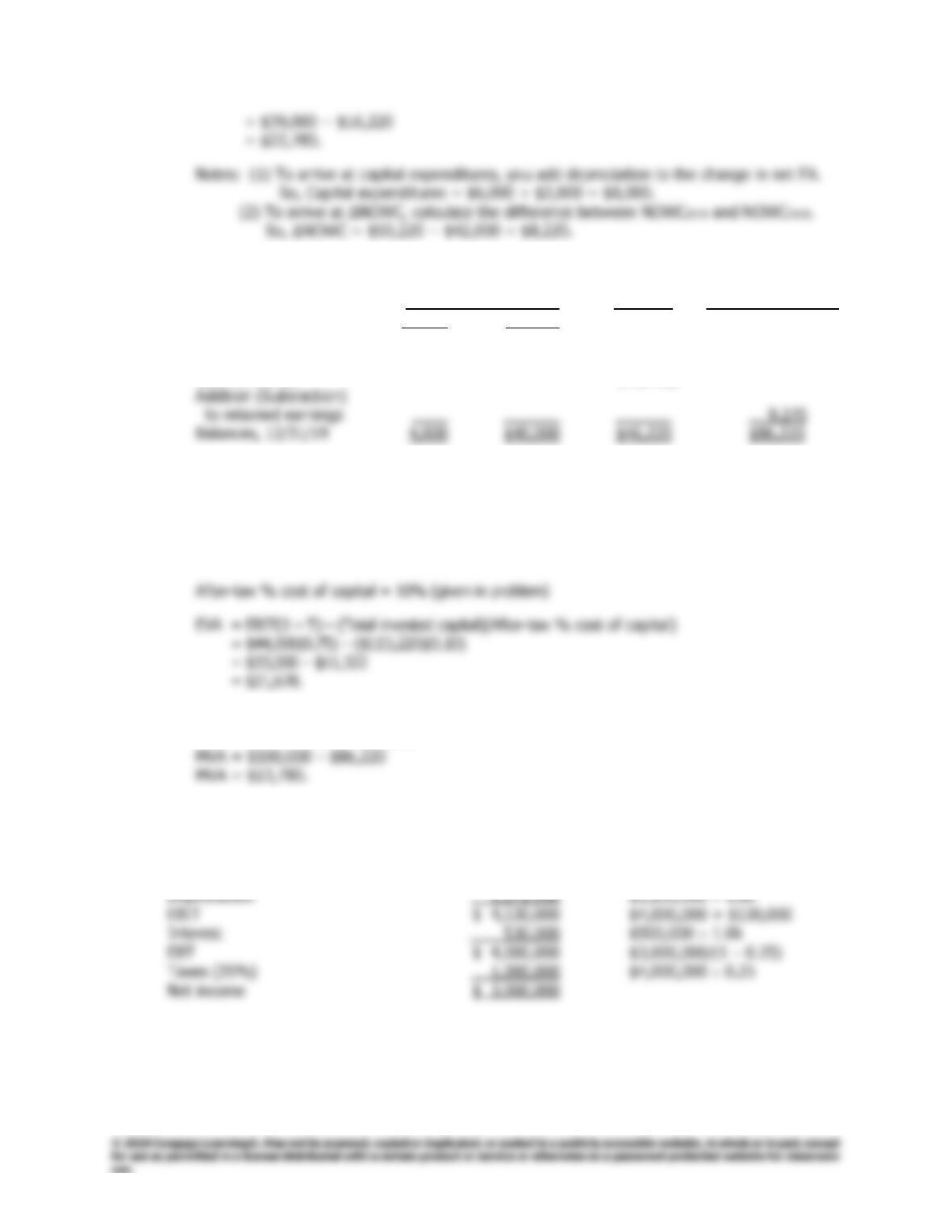
3-14 a. NOWC2018 = Operating current assets – Operating current liabilities
= (Total CA – Excess cash) − (Current liabilities – Notes payable)
= ($71,000 – $14,000) − ($20,050 – $5,050)
= $57,000 − $15,000
Chapter 3: Financial Statements, Cash Flow, and Taxes
Answers and Solutions
31
c. Statement of Stockholders’ Equity, 2019
Retained Total Stockholders’
Common Stock Earnings Equity
Shares Amount
Balances, 12/31/18 4,000 $40,000 $36,950 $76,950
2019 Net income 28,988
Cash dividends (19,718)
d. From Arlington’s 2019 financial statements, you can determine EBIT = $44,000 and Tax rate =
25%.
Total invested capital2019 = Notes payable + Long-term debt + Common equity
= $7,000 + $20,000 + $86,220
= $113,220.
e. MVA = (P0 × Number of shares outstanding) – BV of common equity
MVA = ($25 × 4,000) – $86,220
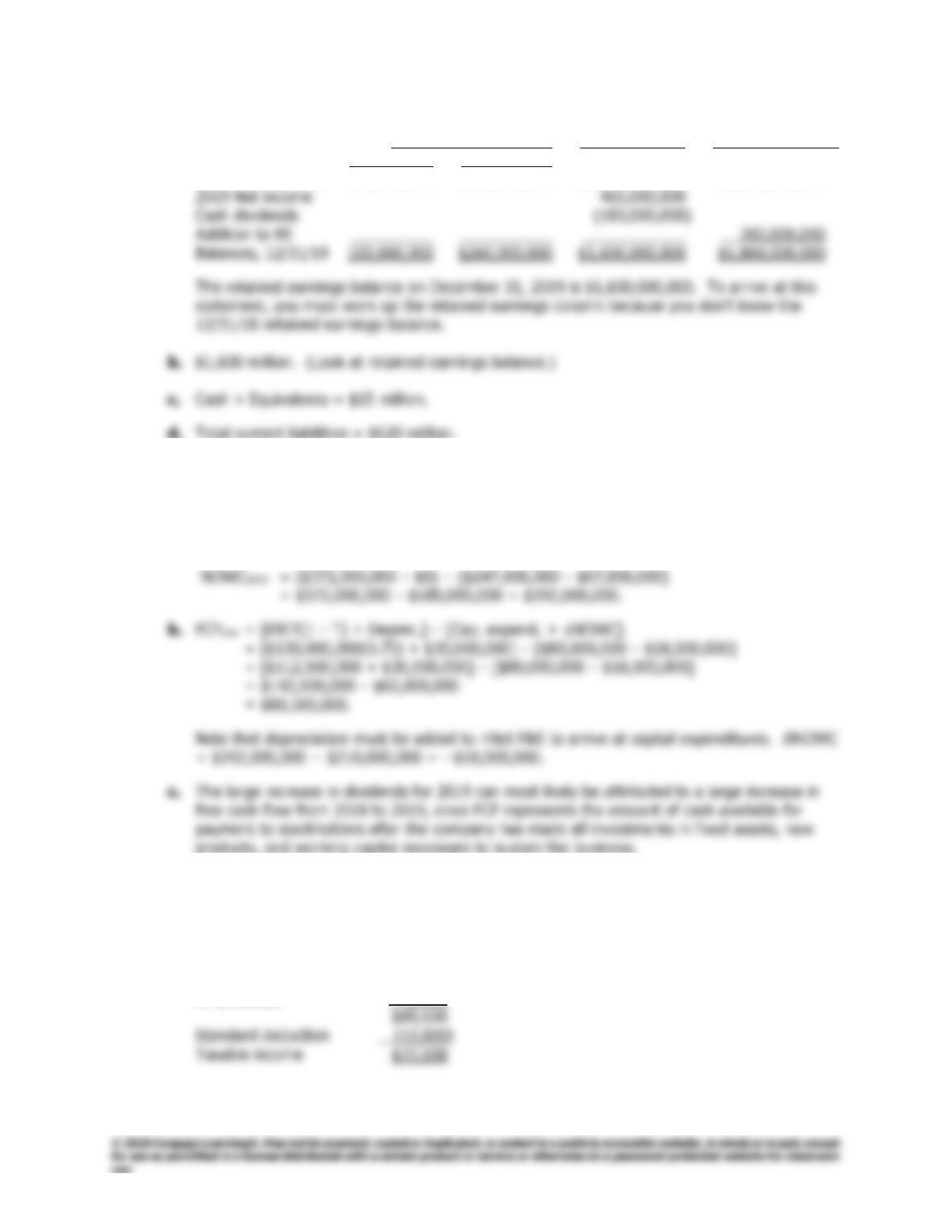
3-15 Working up the income statement you can calculate the new sales level would be $11,782,222.
Sales $12,893,333 S – 0.55S – Deprec. = EBIT
Operating costs (excl. Deprec.) 7,091,333 $12,893,333 0.55
32
Answers and Solutions
Chapter 3: Financial Statements, Cash Flow, and Taxes
3-16 a. Retained Total Stockholders’
Common Stock Earnings Equity
Shares Amount
Balances, 12/31/18 100,000,000 $260,000,000 $1,318,000,000 $1,578,000,000
3-17 a. NOWC2018 = Operating current assets – Operating current liabilities
= (Current assets – Excess cash) − (Current liabilities – Notes payable)
= ($360,000,000 – $0) − ($201,500,000 – $51,500,000)
= $360,000,000 – $150,000,000 = $210,000,000.
3-18 a. First, you need to calculate taxable income. Note, we need to treat the tax on dividend
income and long-term capital gains separately.
Salary $82,000
Interest 5,000
ST proceeds 2,500
Chapter 3: Financial Statements, Cash Flow, and Taxes
Answers and Solutions
33
Be careful to use the Individual Tax Rate Table:
Taxes owed on ordinary taxable income = $4,453.50 + ($77,500 – $38,700)0.22
b. Marginal tax rate = 22%.
c. Average tax rate = Taxes paid/Total taxable income
34
Comprehensive/Spreadsheet Problem
Chapter 3: Financial Statements, Cash Flow, and Taxes
Comprehensive/Spreadsheet Problem
Note to Instructors:
The solution to this problem is not provided to students at the back of their text. Instructors
can access the
Excel
file on the textbook’s website.
3-19
Laiho Industries December 31 Balance Sheets
(in thousands of dollars)
2019 2018
Assets
Cash 102,850$ 89,725$
Accounts receivable 103,365 85,527
Liabilities and equity
Accounts payable 30,761$ 23,110$
Accruals 30,477 22,656
Notes payable 16,717 14,217
Total current liabilities 77,955$ 59,983$
Chapter 3: Financial Statements, Cash Flow, and Taxes
Comprehensive/Spreadsheet Problem
35
a.
The input information required for the problem is outlined in the “Key Input Data” section below. Using
this data and the balance sheet above, we constructed the income statement shown below.
KEY INPUT DATA: Laiho Industries
(in thousands of dollars)
Sales $455,150
EBITDA as a percentage of sales 15%
Laiho Industries Income Statement
(in thousands of dollars)
2019
Sales $455,150
Expenses excluding depreciation and amortization 386,878 Found after finding EBITDA
b.
Statement of Stockholders‘ Equity
(in thousands of dollars)
Common
Stock
Retained
Earnings
Total
Stockholders‘
Equity
Balances, December 31, 2018 $90,000 $38,773 $128,773
Common stock issue 10,000 10,000
Statement of Cash Flows
(in thousands of dollars)
2019
Operating Activities
Net Income $35,700
Depreciation and amortization 12,090
Increase in accounts payable 7,651
Financing Activities
Increase in notes payable $2,500
Increase in long–term debt 12,350
Summary
Net increase/decrease in cash $13,125