Chapter 3: Financial Statements, Cash Flow, and Taxes
Comprehensive/Spreadsheet Problem
37
c.
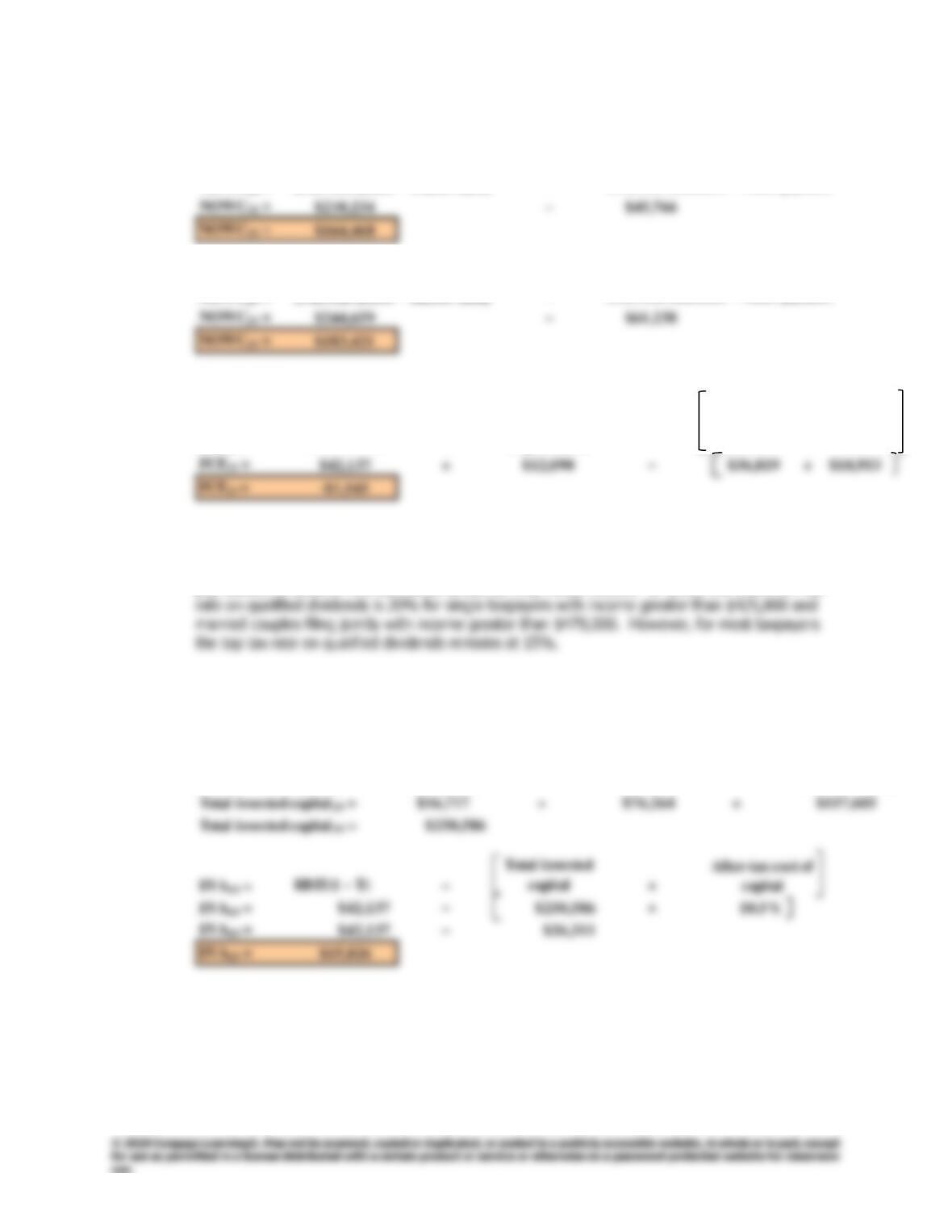
Net Operating Working Capital (must be financed by external sources)
NOWC18 = Operating current assets −Operating current liabilities
NOWC18 = (Current assets − Excess cash) −(Current liabilities − Notes payable)
NOWC19 = Operating current assets −Operating current liabilities
NOWC19 = (Current assets − Excess cash) −(Current liabilities − Notes payable)
Free Cash Flow
FCF19 = EBIT (1 − T) + Depreciation −
Capital
expenditures
+
Increase in
NOWC
d. An increase in the firm’s dividend payout ratio would have no effect on its corporate taxes paid
because dividends are paid with after-tax dollars. However, the company‘s shareholders would
pay additional taxes on the additional dividends they would receive. In 2018, the maximum tax
e.
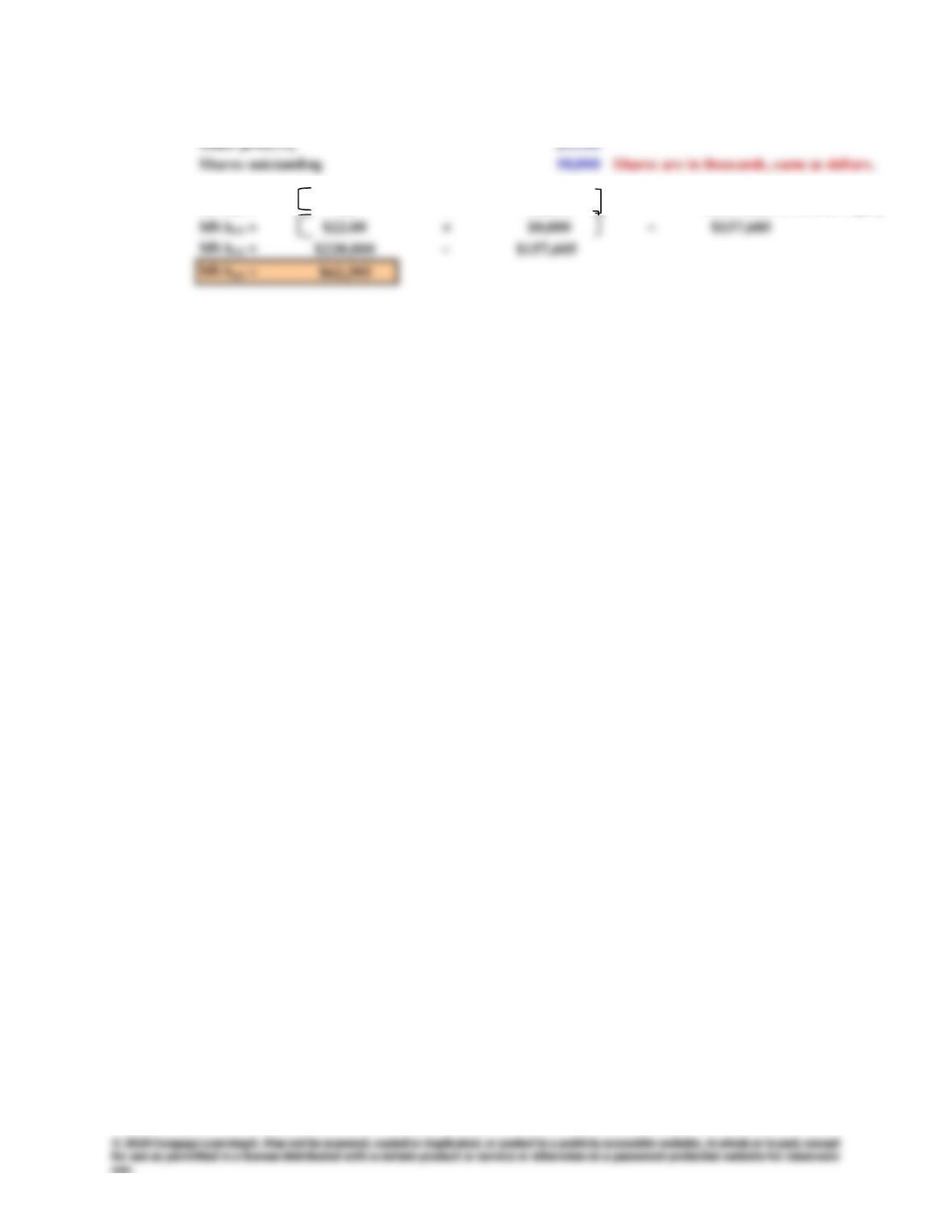
Tax rate 25.0%
After-tax cost of capital 10.5%
Calculate the firm‘s total invested capital first:
Total invested capital19 = Notes payable + LT debt +
Common equity
38
Comprehensive/Spreadsheet Problem
Chapter 3: Financial Statements, Cash Flow, and Taxes
f.
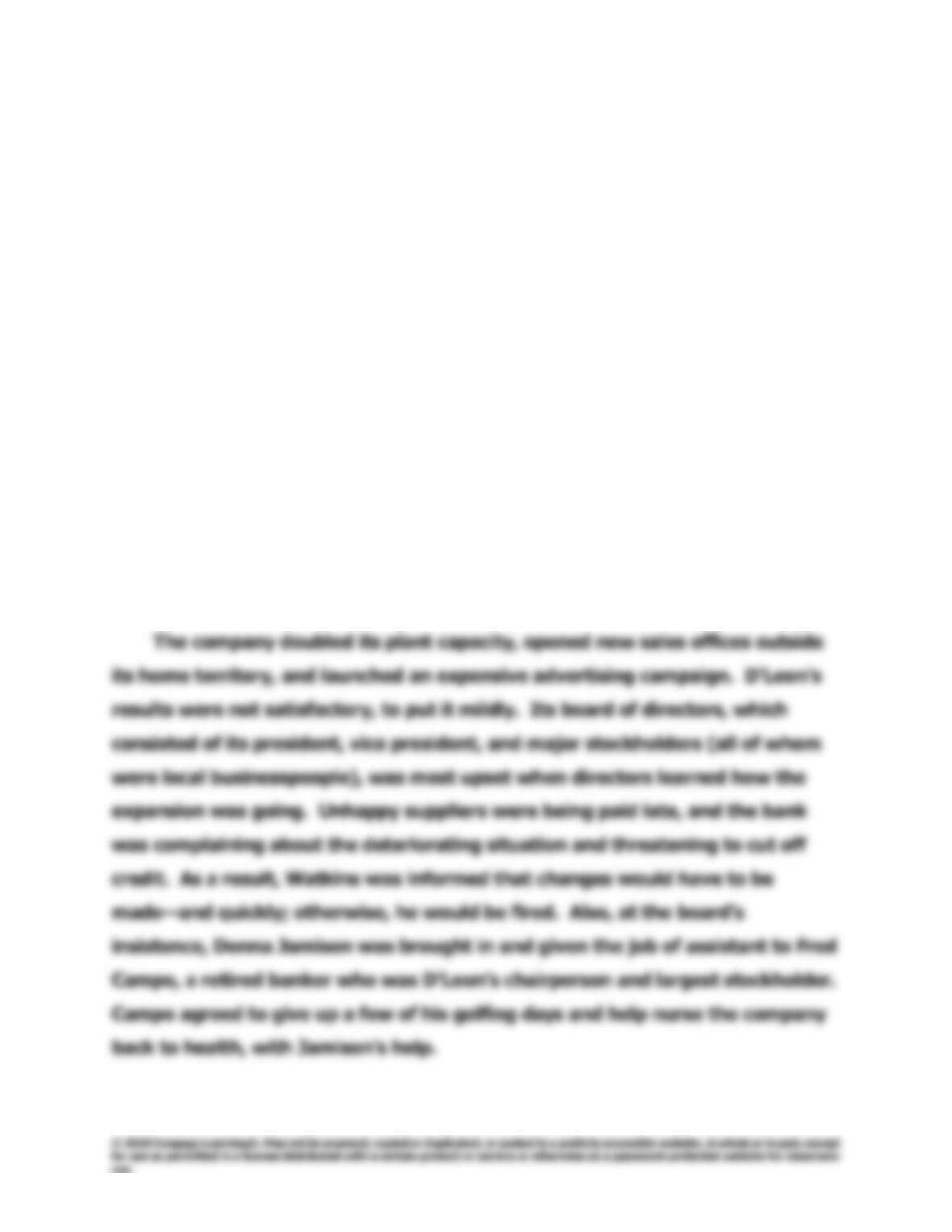
MVA19 = P0×Shares ‒Book value of common equity
MVA19 = $22.00 ×10,000 ‒$157,605
Chapter 3: Financial Statements, Cash Flow, and Taxes
Integrated Case
39
Integrated Case
3-20
D’Leon Inc., Part I
Financial Statements and Taxes
Donna Jamison, a 2014 graduate of the University of Florida, with 4 years of
banking experience, was recently brought in as assistant to the chairperson of
the board of D’Leon Inc., a small food producer that operates in north Florida
and whose specialty is high–quality pecan and other nut products sold in the
snack foods market. D’Leon’s president, Al Watkins, decided in 2018 to
undertake a major expansion and to “go national” in competition with Frito–
Lay, Eagle, and other major snack foods companies. Watkins believed that
D’Leon’s products were of higher quality than the competition’s, that this
quality differential would enable it to charge a premium price, and that the end
result would be greatly increased sales, profits, and stock price.
40
Integrated Case
Chapter 3: Financial Statements, Cash Flow, and Taxes
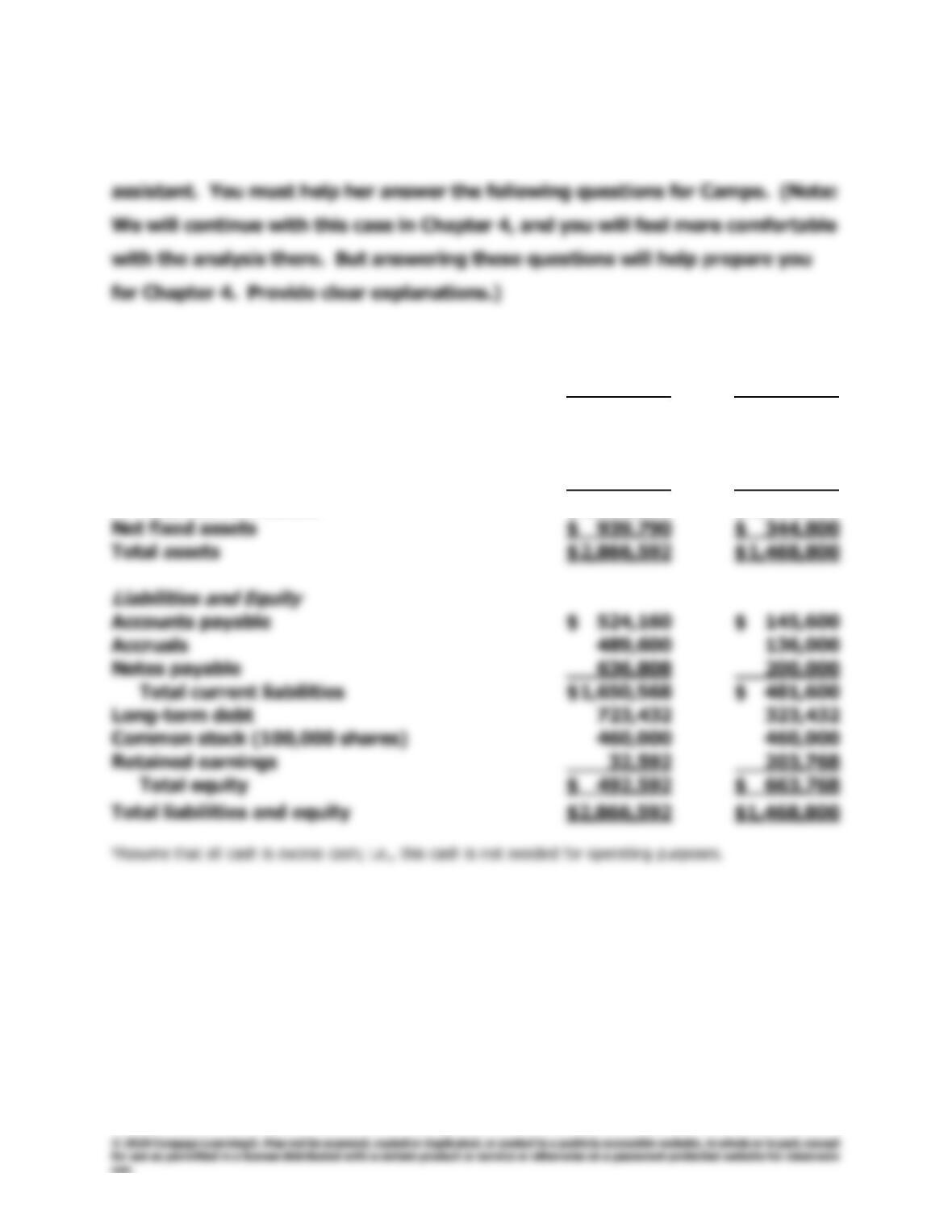
Jamison began by gathering the financial statements and other data given
in Tables IC 3.1, IC 3.2, IC 3.3, and IC 3.4. Assume that you are Jamison’s
Table IC 3.1. Balance Sheets
2019 2018
Assets
Casha $ 7,282 $ 57,600
Accounts receivable 632,160 351,200
Inventories _ 1,287,360 715,200
Total current assets $ 1,926,802 $ 1,124,000
Chapter 3: Financial Statements, Cash Flow, and Taxes
Integrated Case
41
Table IC 3.2. Income Statements
2019 2018
Sales $ 6,126,796 $ 3,432,000
Cost of goods sold 5,528,000 2,864,000
Other expenses 519,988 358,672
Total operating costs excluding
depreciation and amortization $6,047,988 $3,222,672
EPS ($ 1.602) $ 1.100
DPS $ 0.110 $ 0.275
Note:
a The 2019 net operating loss can be carried forward indefinitely to lower taxable income and
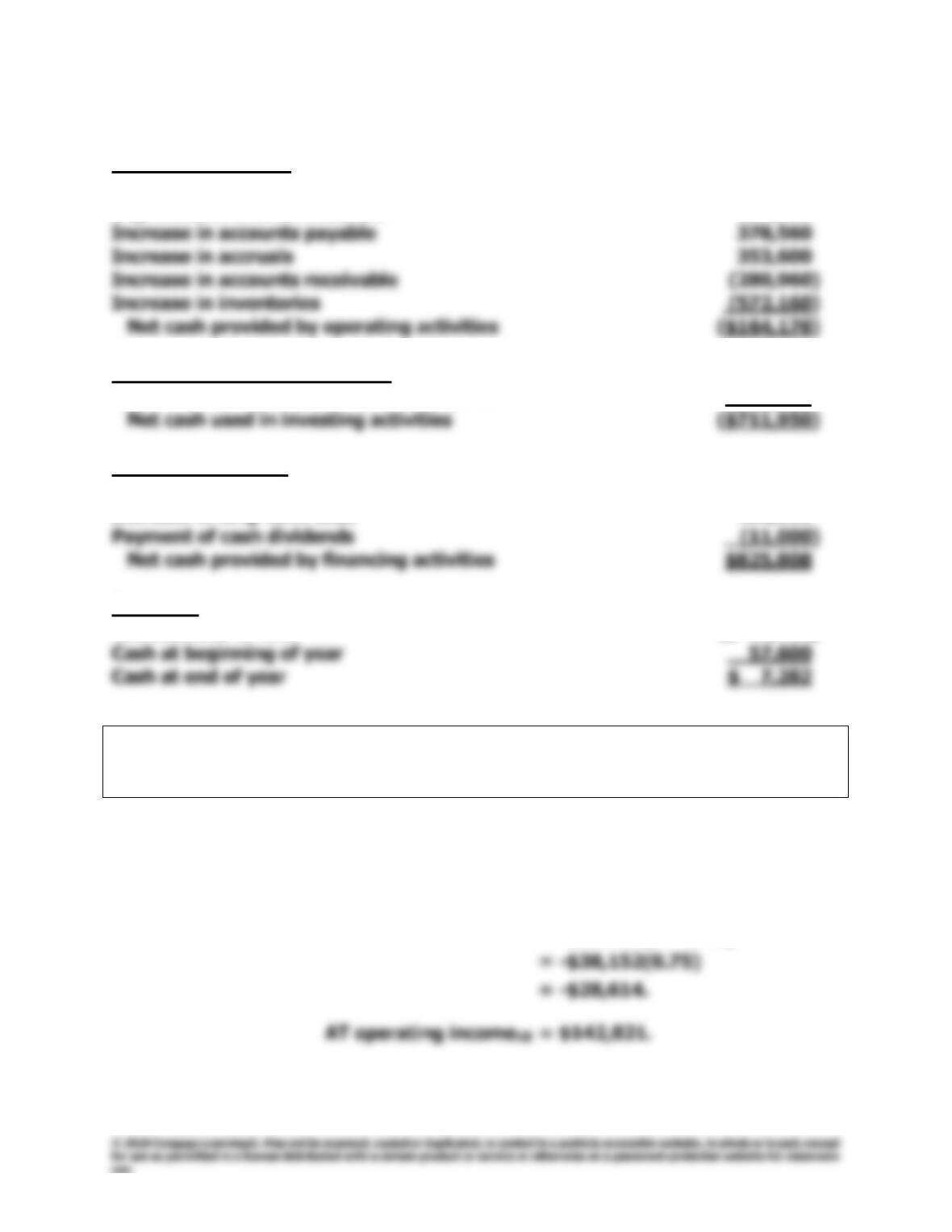
TABLE IC 3.3. Statement of Stockholders’ Equity, 2019
Common Stock
Total
Retained Stockholders’
Shares Amount Earnings Equity
Balances, 12/31/18 100,000 $460,000 $203,768 $663,768
42
Integrated Case
Chapter 3: Financial Statements, Cash Flow, and Taxes
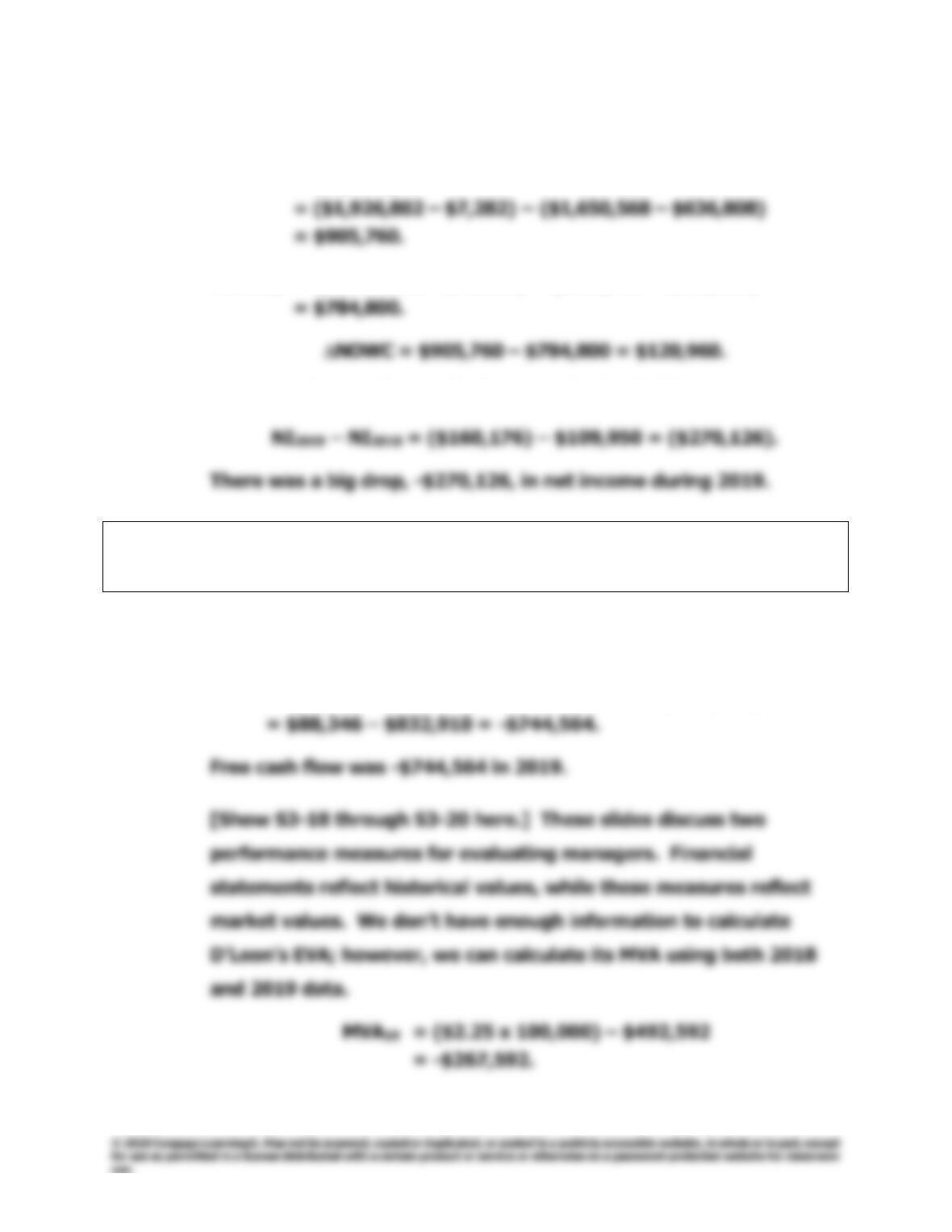
Table IC 3.4. Statement of Cash Flows, 2019
Operating Activities
Net income ($160,176)
Depreciation and amortization 116,960
Long-Term Investing Activities
Additions to property, plant, and equipment ($711,950)
Financing Activities
Increase in notes payable $436,808
Increase in long-term debt 400,000
Summary
Net decrease in cash ($ 50,318)
A. What effect did the expansion have on sales, after-tax operating
income, net operating working capital (NOWC), and net income?
Answer: [S3-1 through S3-11 provide background information. Then show
S3-12 through S3-16 here.] Sales increased by $2,694,796.
AT operating income19 = EBIT(1 – Tax rate)
= -$38,152(1 – 0.25)
Chapter 3: Financial Statements, Cash Flow, and Taxes
Integrated Case
43
NOWC19 = Operating current assets – Operating current liabilities
= (Current assets – Excess cash) − (Current liabilities – Notes
payable)
NOWC18 = ($1,124,000 – $57,600) − ($481,600 – $200,000)
Net operating working capital increased by $120,960.
B. What effect did the company’s expansion have on its free cash
flow?
Answer: [Show S3-17 here.]
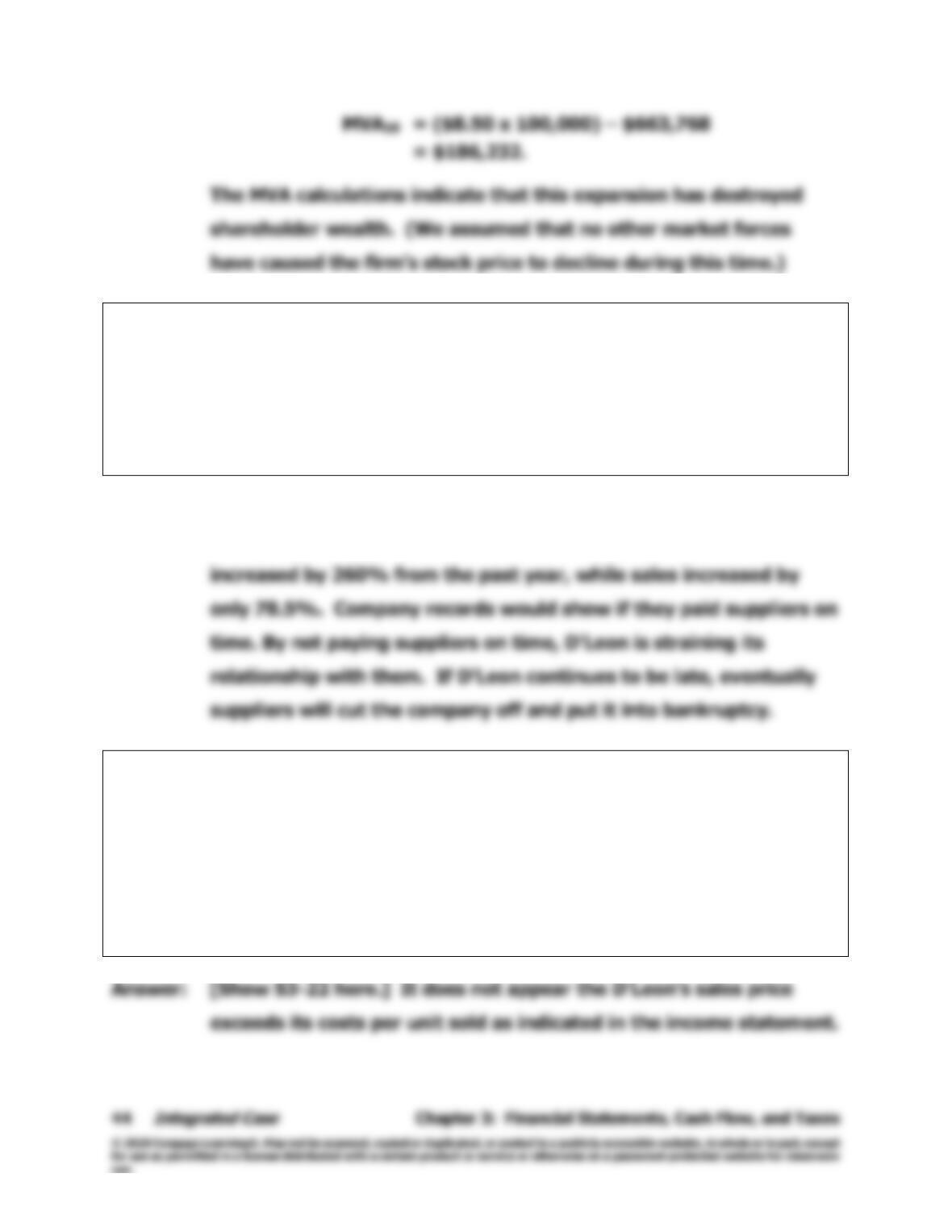
FCF19 = [EBIT(1 – T) + Deprec.] – [Capital expenditures + NOWC]
= [(-$28,614) + $116,960] – ($711,950 + $120,960]
C. D’Leon purchases materials on 30-day terms, meaning that it is
supposed to pay for purchases within 30 days of receipt. Judging
from its 2019 balance sheet, do you think that D’Leon pays
suppliers on time? Explain, including what problems might occur if
suppliers are not paid in a timely manner.
Answer: [Show S3-21 here.] D’Leon probably does not pay its suppliers on
time judging from the fact that its accounts payables balance
D. D’Leon spends money for labor, materials, and fixed assets
(depreciation) to make products—and spends still more money to
sell those products. Then the firm makes sales that result in
receivables, which eventually result in cash inflows. Does it appear
that D’Leon’s sales price exceeds its costs per unit sold? How does
this affect the cash balance?
Chapter 3: Financial Statements, Cash Flow, and Taxes
Integrated Case
45
E. Suppose D’Leon’s sales manager told the sales staff to start offering
60-day credit terms rather than the 30-day terms now being
offered. D’Leon’s competitors react by offering similar terms, so
sales remain constant. What effect would this have on the cash
account? How would the cash account be affected if sales doubled
as a result of the credit policy change?
Answer: [Show S3-23 here.] By extending the sales credit terms, it would
take longer for D’Leon to receive its money—its cash account would
decrease and its accounts receivable would build up. Because
F. Can you imagine a situation in which the sales price exceeds the
cost of producing and selling a unit of output, yet a dramatic
increase in sales volume causes the cash balance to decline?
Explain.
Answer: This situation is likely to occur as suggested in the second part of
G. Did D’Leon finance its expansion program with internally generated
funds (additions to retained earnings plus depreciation) or with

46
Integrated Case
Chapter 3: Financial Statements, Cash Flow, and Taxes
external capital? How does the choice of financing affect the
company’s financial strength?
Answer: [Show S3-24 here.] D’Leon financed its expansion with external
capital rather than internally generated funds. In particular, D’Leon
H. Refer to Tables IC 3.2 and IC 3.4. Suppose D’Leon broke even in
2019 in the sense that sales revenues equaled total operating costs
plus interest charges. Would the asset expansion have caused the
company to experience a cash shortage that required it to raise
external capital? Explain.
Answer: [Show S3-25 here.] Even if D’Leon had broken even in 2019, the
I. The new tax law calls for immediate expensing of certain qualified
business assets rather than depreciating them over a longer time
period. How will that affect (1) a company’s stock of assets, (2) a
firm’s balance sheet account for fixed assets, (3) a company’s
reported net income, and (4) a company’s cash position? In your
response, assume that the same depreciation method is used for
stockholder reporting and for tax calculations and that the
accounting change has no effect on assets’ physical lives.
Answer: [Show S3-26 here.] This would have no effect on the physical stock
of the assets; however, the balance sheet account for net fixed

Chapter 3: Financial Statements, Cash Flow, and Taxes
Integrated Case
47
J. Explain how earnings per share, dividends per share, and book
value per share are calculated and what they mean. Why does the
market price per share not equal the book value per share?
Answer: Net income divided by shares outstanding equals earnings per
share. Dividends divided by shares outstanding equals dividends
per share, while book value per share is calculated as total common
equity divided by shares outstanding.
Market price per share does not equal book value per share.
The market value of a stock reflects future profitability, while book
value per share represents historical cost.
K. Explain briefly the tax treatment of (1) interest and dividends paid,
(2) interest earned and dividends received, (3) capital gains, and
(4) tax loss carry-forwards. How might each of these items affect
D’Leon’s taxes?
Answer: [Show S3-27 through S3-33 here.] For a business, interest paid is
considered an expense and is paid out of pre-tax income.
Therefore, interest paid is tax deductible for businesses. However,
deductible, with the notable exception being limited tax
deductibility on home mortgage interest on up to $750,000 of
principal. Dividends paid by a business are paid out of after-tax
income. Interest earned, whether by a business or individual, is
capital gains remains at 15%. A portion of dividends received by
corporations is tax excludable, to avoid “triple taxation.”
Capital gains are defined as the profits from the sale of an
asset not used in the normal course of business. For individuals,
capital gains on assets are taxed as ordinary income if held for a
Chapter 3: Financial Statements, Cash Flow, and Taxes
Integrated Case
49