Chapter 29
Unions and Labor Market Monopoly Power
◼ Overview
This chapter begins with a very brief history of the U.S. labor movement, stressing how the fortunes of
labor have changed with the amount of governmental protection offered unions. A discussion of what
unions maximize when they have different goals is contained in this chapter. Unions behave differently
◼ Learning Objectives
After studying this chapter, students should be able to:
• 29.1 Outline the essential history of the labor union movement and discuss the current status of labor
unions
◼ Outline
I. Industrialization and Labor Unions: In most countries, labor movements started with local
craft unions, which were groups of workers in individual trades. In the 1790s, some British craft
unions began to try to engage in collective bargaining in which business management engages in
negotiations with union representatives about wages and hours of work. The British Combination
Acts in 1799 and 1800 prohibited unions, but in 1825, unions were allowed to exist and engage in
collective bargaining by Parliament.
A. Unions in the United States: The development of unions in the United States lagged behind
events in Europe. Between the Civil War and the Great Depression, the Knights of Labor was
formed, demanding an eight-hour workday and equal pay for men and women. A dissident
group from the Knights of Labor formed the American Federation of Labor (AFL).
1. The Formation of Industrial Unions: The National Labor Relations Act, or Wagner Act,
2. Congressional Control over Labor Unions
in any establishment.
b. Jurisdictional Disputes, Sympathy Strikes, and Secondary Boycotts: These actions
were made illegal by the Taft-Hartley Act. The most famous aspect of the Taft-Hartley
3. The Rise of Public Sector Unions: The percentage of unionized public sector workers has
1. A Decline in Manufacturing Employment: A major part of the explanation of this
2. Deregulation and Immigration: Deregulation in formerly regulated, unionized industries
3. Changes in the Structure of the U.S. Union Movement: The AFL-CIO dominated the
labor-union movement for 50 years. In 2005, seven unions representing 45 percent of the
II. Union Goals and Strategies: Through collective bargaining, unions establish minimum wages for
union workers. Union representatives and management negotiate collective bargaining contracts.
Once approved by the members, these contracts establish the length of the workday, wage rates,
working conditions, fringe benefits, and other matters, usually for the next two or three years.
A. Strike: The Ultimate Bargaining Tool
B. Union Goals with Direct Wage Setting
1. Effects of a Union Wage above the Market Clearing Wage: One of the major roles of a
C. Three Possible Union Goals
1. Employing All Members in the Union (See Figure 29-3.)
2. Maximizing Member Income (See Figure 29-3.)
3. Maximizing Wage Rates for Certain Workers (See Figure 29-3.)
Chapter 29 Unions and Labor Market Monopoly Power 441
D. Union Strategies to Raise Wages Indirectly
1. Limiting Entry over Time: This involves freezing the number of workers in the union.
(See Figure 29-4.)
2. Altering the Demand for Union Labor
a. Increasing worker productivity
b. Increasing demand for union-made goods
c. Decreasing the demand for non-union-made goods
III. Economic Effects of Labor Unions: Have unions raised wages and affected productivity?
A. Unions and Wages: Unions have been able to increase the wages of members relative to
B. Unions and Labor Productivity: The traditional view of union behavior is that unions
C. Economic Benefits and Costs of Labor Unions: Unions are viewed in two ways. They can be
IV. Monopsony: A Buyer’s Monopoly: A monopsonist is the only buyer of labor services in a market
who faces an upward-sloping supply curve for labor.
A. Marginal Factor Cost: The change in total cost due to a one-unit increase in the variable
B. Derivation of a Marginal Factor Cost Curve: A complete numerical example is shown in
Figure 29-5.
C. Employment and Wages under Monopsony: Because the monopsonist faces an upward-
sloping supply curve, its MFC curve slopes upward and is above the labor supply curve. The
marginal benefits of hiring additional workers are given by the firm’s MRP curve. The firm
finds the optimum number of workers to hire by equating MFC and MRP. (See Figure 29-5.)
1. The Input Price Paid by a Monopsony: Once the profit-maximizing quantity of labor is
2. Effects of Minimum Wage Laws under Monopsony: The supply of labor to the firm
442 Miller • Economics Today, Nineteenth Edition
◼ Points to Emphasize
Have Unions Caused High Wage Rates in the United States?
It is widely believed that unions are responsible for wages being higher in the United States than elsewhere.
Almost from the beginning of U.S. history (1776), wages were relatively higher in the United States than
in most countries, even relative to most European countries. Unions were neither strong nor prevalent,
The Wagner (National Labor Relations) Act
The Wagner Act was passed because most people believed that it was unfair for one employee to bargain
as an individual against a big corporation. Would a single worker be exploited (paid less than marginal
Sympathy Strikes
Sympathy strikes are illegal, but union members probably would not allow their leaders to engage in
sympathy strikes without overwhelming reasons anyway. When a union goes on strike, its members pay
a price in lost wages or in a reduced strike fund. After a prolonged strike of their own (or sympathy strike
for another union), will members be likely to strike in sympathy for another union? Even granting reciprocal
Chapter 29 Unions and Labor Market Monopoly Power 443
Presidential Injunctions
A presidential injunction can be placed on strikes when national health or safety is imperiled. In the early
years, after the Taft-Hartley Act was passed, such injunctions were used in war periods. In recent decades,
this presidential tool has been used in peacetime. Is this good policy? Because substitutes exist for
War—Capital, Labor, and Land
An army draft lowers the relative price of labor to the army, thereby encouraging a greater than optimal
labor-intensive armed service. Relative input prices affect a producer’s input mix by determining the
◼ For Those Who Wish to Stress Theory
Monopsony in College Sports
College and university administrators argue that the NCAA rules are necessary to “keep business out of
higher education.” To achieve this goal, about 600 colleges and universities belong to the NCAA, which
controls more than 20 sports. The NCAA operates as an intercollegiate cartel dominated by universities
that operate big-time athletic programs. It operates as a cartel with monopsony and monopoly power in
four ways:
2. It often fixes the prices that universities can charge for tickets to important intercollegiate events.
4. It enforces its regulations and rules with sanctions and penalties.
The NCAA rules expressly prohibit bidding for college athletes in an overt manner. Rather, the NCAA
requires that all athletes be paid only for tuition, fees, room, board, and books. Moreover, the NCAA
limits the number of scholarships that can be given by a particular university. These rules are ostensibly to
444 Miller • Economics Today, Nineteenth Edition
Craft Unions
The union movement began with craft unions. The reason is related to the elasticity of demand for labor.
One of the determinants of the elasticity of demand for labor discussed in the previous chapter is the
availability of substitutes. By definition, there are no good substitutes for skilled workers who all belong
◼ Further Questions for Class Discussion
1. Newspaper columnists are fond of “analyzing” prolonged strikes in the following manner. They
calculate the wages lost during the strike period, and then determine how many hours of work
(at the eventually agreed-upon new rate) it would take to make up for the “lost” wages. It turns
out, usually, that it would take many years to do so. The implication is that the strike was foolish,
not worthwhile, or irrational. Are these newspaper writers correct? The strike can be viewed as
2. Two longshoremen unions, the International Longshoremen’s Association on the U.S. East Coast
and the International Longshore and Warehouse Union on the West Coast, were able through the
3. Why is it that in any given year the percentage of collective bargaining negotiations that actually
result in strikes is relatively small? Strikes are relatively rare because the cost to workers is a
4. According to the text, the percentage of workers in government employee unions has increased to
40 percent of union workers as the percentages of union workers accounted for by manufacturing
has fallen. In addition, the wages of government workers are significantly higher than the wages
of similar workers in the private sector. What would you predict will happen to employment in
government as this trend continues? The managers of government agencies will begin to
Chapter 29 Unions and Labor Market Monopoly Power 445
5. Manufacturing employment in heavily unionized industries, such as the automobile industry, has
◼ Answers to Questions for Critical Analysis
A Key Structural Change in Collective Bargaining: “Micro–Unit” Representation
(p. 652)
Why do you suppose that some businesses have responded to the NLRB’s micro-unit policy by
eliminating the designations of “divisions” or “departments”?
A Constitutional Interpretation Alters Demands for Nonunion and Union Labor
(p. 656)
Why do you suppose that some observers speculated that a strike by the teachers’ union four days
after the court decision might have reflected a perceived higher demand for union labor?
Should Firms That Can Set Wages Raise Workers’ Pay All at Once or in Stages
(p. 660)
Why would a perfectly competitive firm be unable to take advantage of a dependence of the
marginal product of labor on the level of the wage rate paid by the firm? (Hint: Recall that a firm
in a perfectly competitive labor market cannot influence the market clearing and profit-maximizing
◼ You Are There
Chinese Buyers Act as Monopsony to Push Down Tobacco Prices in Zimbabwe
(p. 662)
1. Why was restraining total Zimbabwean tobacco purchases crucial to ensuring success for the
tobacco buyers’ scheme to act as a singly, collusive purchaser of Zimbabwean tobacco?
2. How might selling tobacco through a single national exchange expose Zimbabwean farmers to
greater susceptibility to monopsonistic collusion on the part of buyers?
◼ Issues and Applications
A Strategy Regarding Minimum Wages Helps to Achieve Union Goals
(pp. 663–664)
1. Why might unions seeking to reduce hiring of nonunion labor desire higher minimum wages
for nonunion workers?
2. Why could unions’ desire to obtain collective bargaining exemptions from minimum wage
laws provide evidence that few employers are monopsonists? (Hint: Recall the effects of a
minimum wage on the employment level of and wage rate paid by a monopsonist.)
◼ Research Project
1. Read the notice regarding Chicago’s minimum wage requirement that must be posted at workplaces
◼ Answers to Problems
29-1. Discuss three aspects of collective bargaining that society might deem desirable.
Individual workers can air grievances to the collective voice who then takes the issue to the
29-2. Give three reasons why a government might seek to limit the power of a union.
29-3. The Writers Guild of America (WGA), which represents TV and film screenwriters, called
for a strike, and most screenwriters stopped working. Nevertheless, writers for certain TV
soap operas, such as The Young and the Restless—which have had shrinking audiences for
years, draw small numbers of viewers for repeat shows, and rarely sell on Blu-ray discs—
opted to drop their WGA memberships and tried to continue working during the strike.
Why do you suppose that the WGA posted on its Web site a phone number for union
members to report “strike-breaking activities and ‘scab writing’” to the union’s 12-person
Strike Rules Compliance Committee? What effect do strikebreakers have on the collective
bargaining power of a union?
29-4. Suppose that the objective of a union is to maximize the total dues paid to the union by its
membership. Explain the union’s strategy, in terms of the wage level and employment level,
under the following two scenarios.
a. Union dues are a percentage of total earnings of the union membership.
b. Union dues are paid as a flat amount per union member employed.
29-5. Explain why, in economic terms, the total income of union membership is maximized when
marginal revenue is zero. (Hint: How much more revenue is forthcoming when marginal
revenue is equal to zero?)
29-6. Explain the impact of each of the following events on the market for union labor.
a. Union-produced TV and radio commercials convince consumers to buy domestically
manufactured clothing instead of imported clothing.
b. The union sponsors periodic training programs that instruct union laborers about the
most efficient use of machinery and tools.
29-7. Why are unions in industries in which inputs such as machines are poor substitutes for
labor more likely to be able to bargain for wages higher than market levels?
29-8. How is it possible for the average annual earnings of nonunionized workers to exceed
those of unionized workers even though unionized workers’ hourly wages are more than
$6 higher?
29-9. In the short run, a tool manufacturer has a fixed amount of capital. Labor is a variable
input. The cost and output structure that the firm faces is depicted in the following table:
Labor Supplied
Total Product
Hourly Wage Rate ($)
10
100
5
11
109
6
12
116
7
13
121
8
14
124
9
15
125
10
Derive the firm’s total wage costs and marginal factor cost at each level of labor supplied.
Quantity of
Labor
Supplied
Total
Physical
Product
Required Hourly
Wage Rate ($ per
unit of labor)
Total Wage
Bill ($)
Marginal
Factor Cost
($ per unit of
labor)
10
100
5
50
—
13
121
8
15
125
29-10. Suppose that for the firm in Problem 29-9, the goods market is perfectly competitive. The
market price of the product the firm produces is $4 at each quantity supplied by the firm. What
is the amount of labor that this profit-maximizing firm will hire, and what wage rate will it pay?
The firm hires labor to the point at which marginal factor cost equals marginal revenue product
29-11. The price and wage structure that a firm faces is depicted in the following table.
Labor Supplied
Total Product
Hourly Wage
Rate ($)
Product Price ($)
10
100
5
3.11
11
109
6
3.00
12
116
7
2.95
13
121
8
2.92
14
124
9
2.90
15
125
10
2.89
Chapter 29 Unions and Labor Market Monopoly Power 449
The firm finds that the price of its product changes with the rate of output. In addition, the
wage it pays its workers varies with the amount of labor it employs. This firm maximizes
profits. How many units of labor will it hire? What wage will it pay?
At 11 units of labor, the marginal revenue product of labor equals $16. This is equal to the
and pay a wage of $6 an hour.
Quantity
of Labor
Supplied
Required
Hourly
Wage Rate
($ per unit
of labor)
Total
Factor
Cost
($)
Marginal
Factor
Cost ($
per unit
of labor)
Total
Physical
Product
Product
Price ($
per unit)
Total
Revenue
($)
Marginal
Revenue
Product
($ per unit
of labor)
10
5
50
—
100
3.11
311.00
—
11
6
66
16.00
109
3.00
327.00
12
7
84
18.00
116
2.95
342.20
13
8
104
20.00
121
2.92
353.32
14
9
126
22.00
124
2.90
359.60
15
150
24.00
125
2.89
361.25
29-12. What is the amount of monopsonistic exploitation that takes place at the firm examined in
Problem 29-11?
29-13. A profit-maximizing clothing producer in a remote area is the only employer of people in
that area. It sells its clothing in a perfectly competitive market. The firm pays each worker
the same weekly wage rate. The last worker hired raised the firm’s total weekly wage
expenses from $105,600 to $106,480. What is the marginal revenue product of the last
worker hired by this firm if it is maximizing profits?
29-14. Why does marginal factor cost increase as a monopsonistic firm utilizes more labor but
remain unchanged as a perfectly competitive firm employs additional labor?
29-15. Why does a monopsonistic firm pay the last unit of labor that it employs a wage that is less
than that unit’s marginal revenue product?
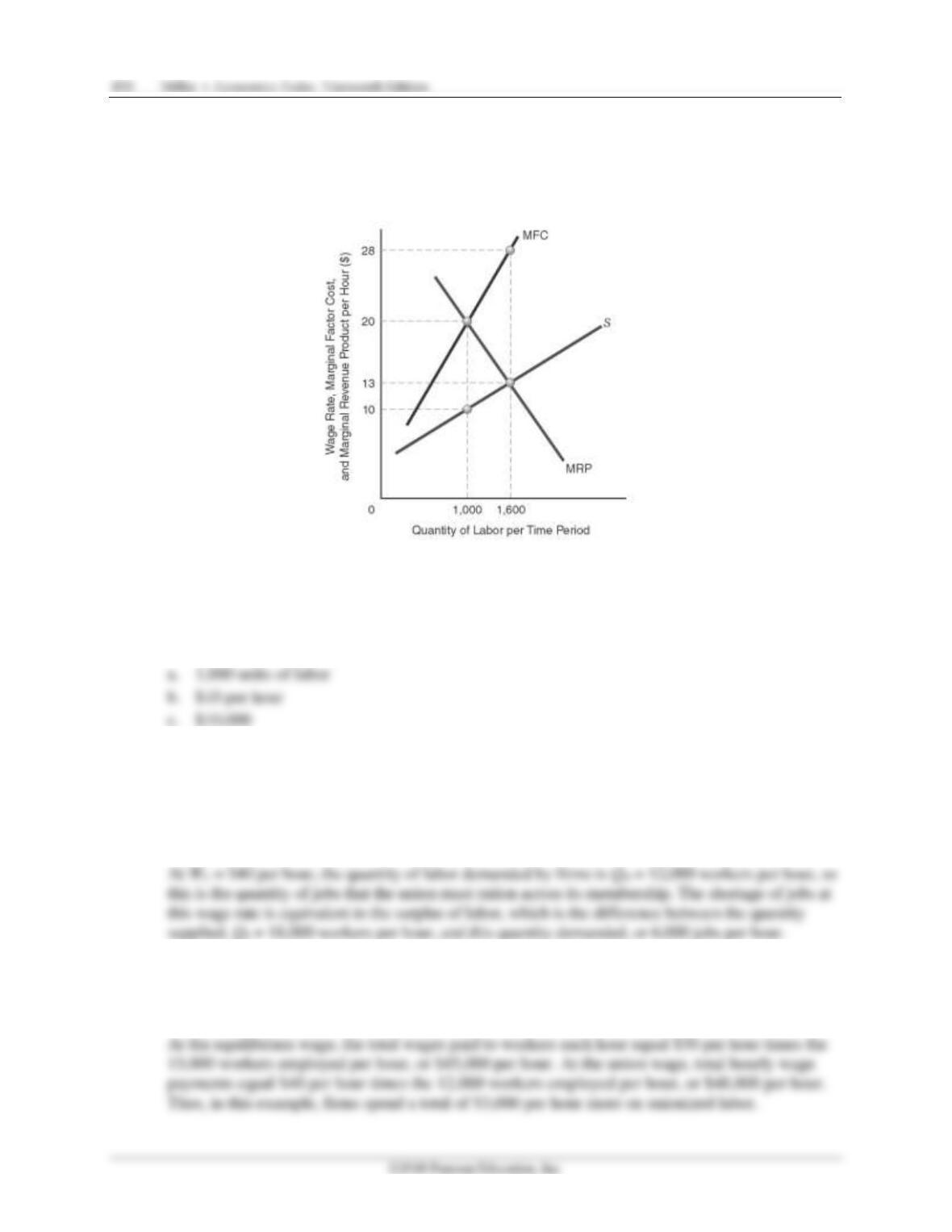
29-16. A single firm is the only employer in a labor market. The marginal revenue product, labor
supply, and marginal factor cost curves that it faces are displayed in the diagram below.
Use this information to answer the following questions.
a. How many units of labor will this firm employ in order to maximize its economic profits?
b. What hourly wage rate will this firm pay its workers?
c. What is the total amount of wage payments that this firm will make to its workers each
hour?
29-17. In Figure 29-2, suppose that We is a wage rate of $30 per hour, and Wu is a wage rate of $40
per hour. In addition, QD is 12,000 workers per hour, Qe is 15,000 workers per hour, and Qs
is 18,000 workers per hour. If each worker hired corresponds to a job available within the
unionized industry, how many jobs must the union ration at the wage rate Wu? What is the
shortage of jobs?
29-18. Given the information in Problem 29-17, how much more for less do the firms in this
industry spend, in total, on the labor employed each hour as a consequence of establishment
of the union wage Wu = $40 per hour above the equilibrium wage We = $30 per hour?
29-19. Take a look at Figure 29-5. Suppose that the monopsonist is contemplating whether it might
consider hiring 7 units of labor per time period. To induce 7 units of labor to be supplied by
workers, the firm would have to pay an hourly wage rate of $24 per hour. What would be
the marginal factor cost of hiring a 7th unit of labor per time period?
29-20. Consider Figure 29-6. Suppose that the vertical distance to point A is $50 per hour, that the
value of Wm is $20 per hour, and that Qm is 1,000 worker-hours. How much more or less
each hour does the monopsonist have to pay each worker as an hourly wage rate to attract
1,000 worker-hours of labor input than the additional cost that the firm incurs in hiring the
1,000th unit of labor?
29-21. Based on the information in and your answer to Problem 29-20, how much more or less
does the monopsonist pay as an hourly wage rate in relation to the additional revenue that
the 1,000th unit of labor generates for the firm?
29-22. Take a look at Figure 29-7. Suppose that Wm = $12 per hour, Wmin = $15 per hour, Qm =
1,000 worker-hours of labor input, and Qmin = 1,400 worker-hours of labor input. By
how much does requiring this monopsonist to pay the minimum wage instead of its profit-
maximizing wage rate increase or reduce its total wage payments to all of its employees?
◼ Selected References
Baird, Charles W., “Labor Law and Management Cooperation: Two Incompatible Views,”
The Cato Journal, Vol. 6, No. 3, Winter 1987, pp. 933–950.
Ehrenberg, Ronald G. and Robert S. Smith, Modern Labor Economics, 2nd ed., Glenview, IL: Scott,
Foresmen, 1985.
452 Miller • Economics Today, Nineteenth Edition
Hammermesh, Daniel S. and Albert Rees, The Economics of Work and Pay, 3rd ed., New York: Harper &
Row, 1984.
Miller, Roger L. and Roger Meiners, Intermediate Microeconomics: Theory, Issues, and Applications,
4th ed., New York: McGraw-Hill, 1987.
Noll, Roger G., ed., Government and the Sports Business, Washington, D.C.: The Brookings
Institution, 1974.