Chapter 29:
1. Indicate whether each of the following represents a credit or debit on the U.S. current account.
2. Indicate whether each of the following represents a credit or debit on the U.S. capital account.
3. How are each of the following events likely to affect the U.S. trade balance?
a. the European price level increases relative to the U.S. price level
b. the dollar appreciates in value relative to the currencies of its trading partners
c. the U.S. government offers subsidies to firms that export goods
Answer: U.S. exports will increase and the trade deficit (surplus) will decrease (increase)
d. the U.S. government imposes tariffs on imported goods
e. Europe experiences a severe recession
4. How are each of the following events likely to affect the value of the dollar relative to the euro?
a. interest rates in the European Union increase relative to the United States
b. the European Union price level rises relative to the U.S. price level
c. the European central bank intervenes by selling dollars on currency markets
Answer: weaken the value of the dollar relative to the euro
d. the price level in the United States falls relative to the price level in Europe
5. If the demand for a domestic currency decreases in a country using a fixed exchange rate system,
what must the central bank do to keep the currency value steady?
Answer: The central bank must purchase the currency using foreign reserve assets to
6. What happens to the supply curve for dollars in the currency market under the following conditions?
a. Americans wish to buy more Japanese consumer electronics
Answer: The supply curve for dollars shifts to the right.
b. the United States wishes to prop up the value of the yen
7. Evaluate -$200 million and the statistical
discrepancy
Answer: The balance of payments must balance so that credits and debits are equal. If
8. Assume that a product sells for $100 in the United States.
a. If the exchange rate between British pounds and U.S. dollars is $2 per pound, what would the price of
the product be in the United Kingdom?
b. If the exchange rate between Mexican pesos and U.S. dollars is 125 pesos per dollar, what would the
price of the product be in Mexico?
Answer: 12,500 pesos
c. In
tastes for foreign products increased?
d. In which direction would the price of the $100 U.S. product change in a foreign country if incomes in
the foreign country fell?
e. In which direction would the price of the $100 U.S. product change in a foreign country if interest rates
in the United States fell relative to interest rates in other countries?
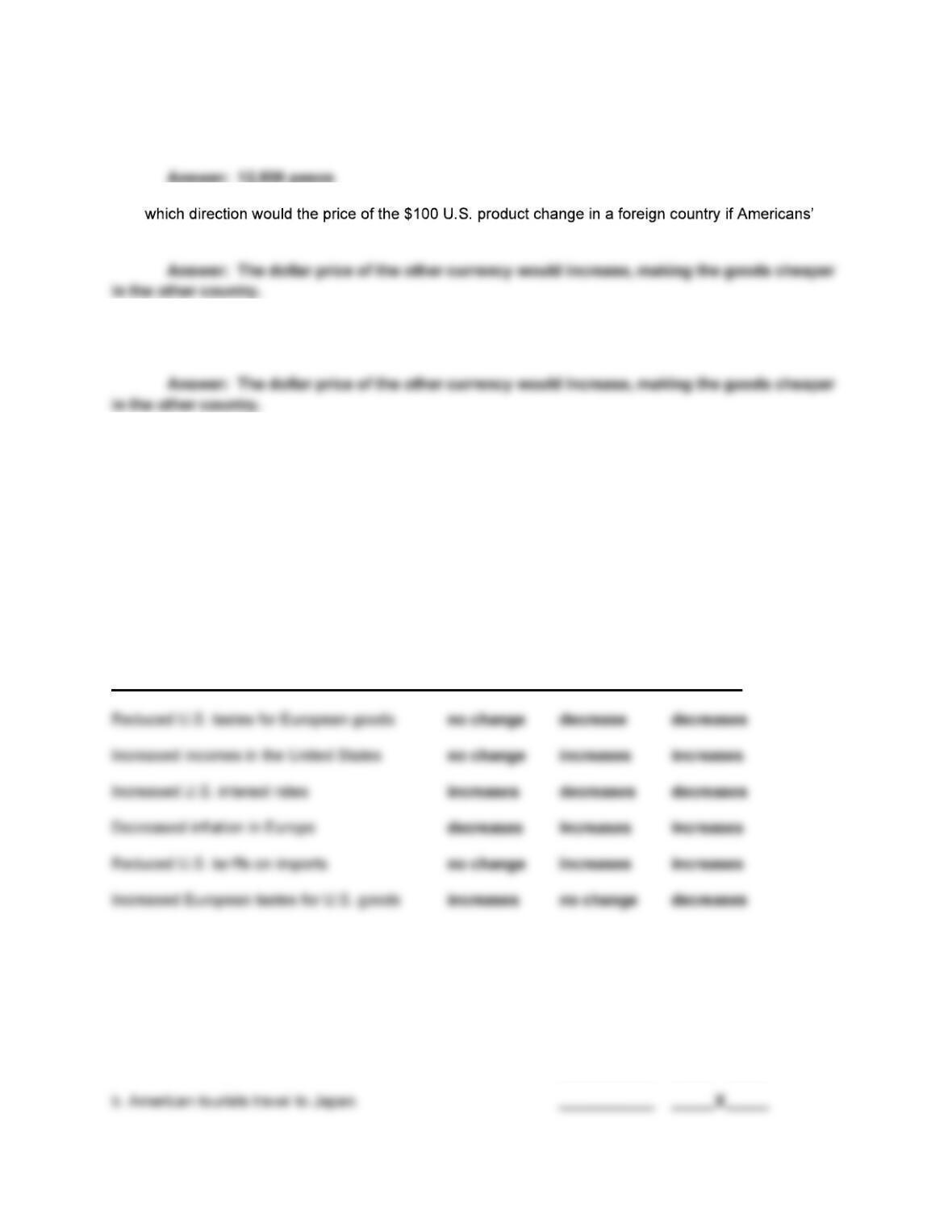
Answer: The dollar price of the other currency would increase, making the goods cheaper
in the other country.
9. How would each of the following affect the supply of euros, the demand for euros, and the dollar price
of euros?
Supply of Demand for Dollar Price
Change Euros Euros of Euros
10. How are each of the following classified, as debits or credits, in the U.S. balance-of-payments
accounts?
Credit Debit
a. Americans buy autos from Japan. ___________ _____X_____
11. What will happen to the supply of dollars, the demand for dollars, and the equilibrium exchange rate
of the dollar in each of the following cases?
Equilibrium
Supply of Dollars Demand for Dollars Exchange Rates
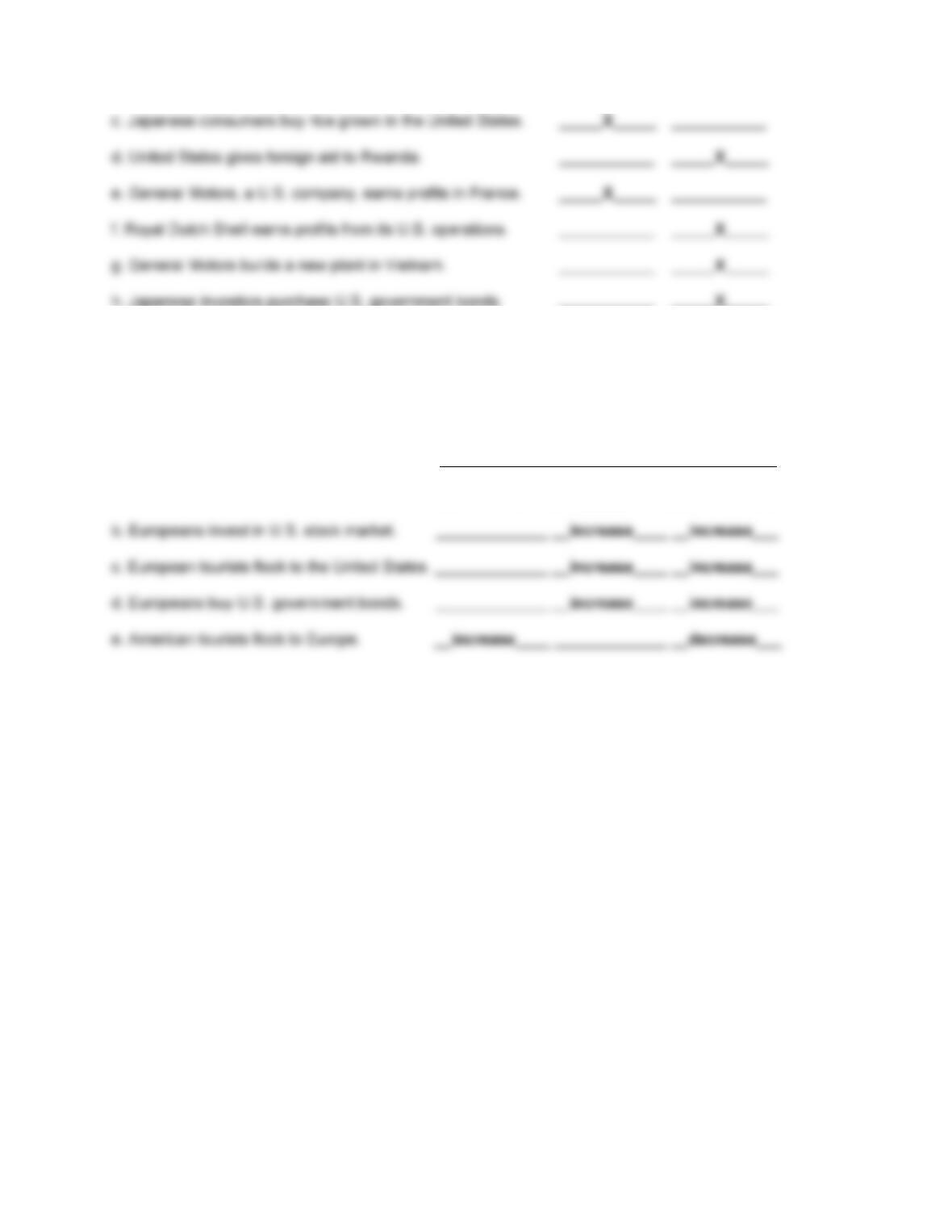
a. Americans buy more European goods. __increase____ _____________ __decrease__