CHAPTER 28
Consumption Theory: Demand
LEARNING OBJECTIVES
Explain the assumptions made about consumers and households used to build utility
theory.
OUTLINE OF CHAPTER
I. The Foundations of Utility Analysis
II. Assumptions of Traditional Consumer Theory
Rationality and Perfect Information
Utility or Joy
III. Progressive Criticism of Neoclassical Consumption Theory
IV. Summary
KEY TERMS
cardinal utility
the idea that the consumer satisfaction (utility or joy) received from a particular good can be
numerically measured in countable
units
of an item are consumed
marginal utility
the change in satisfaction caused by consuming one more unit of a good
negative marginal utility
the decline in marginal utility to the point of its becoming negative, which results as additional
units of a good are consumed; if marginal utility becomes negative, total utility also declines
ordinal utility
the idea that consumers can rank consumption bundles but cannot precisely measure the
ANSWERS TO END OF CHAPTER REVIEW QUESTIONS
Explain the assumptions made about consumers and households used to build utility
theory.
1. List the assumptions that are used to build the traditional model of consumer demand.
1. Consumers are rational.
2. What does it mean if a person is rational and making rational choices?
3. Why is income limited? Does everyone get to make the same choices? Why or why
Define and explain utility, total utility, and diminishing marginal utility.
4. What is the difference between ordinal and cardinal utility?
Cardinal utility means that consumer satisfaction can be numerically measured in
5. Why is it not possible to precisely measure utility or pleasure?
6. What is the difference between total and marginal utility?
7. What is the explanation for diminishing marginal utility? Give an example of
diminishing marginal utility.
8. What happens to total utility even if there is diminishing marginal utility? Even if there
is diminishing marginal utility, why is it assumed that people prefer more rather than
less?
Total utility always increases, because individuals always desire more. Diminishing
Explain how consumers maximize their utility (joy) within the bounds of their income.
9. Is it possible to consume goods until their marginal utility goes to zero? Why or why
not?
10. What is the utility-maximizing condition? What does that mean in words?
Utility maximization occurs when the marginal utility per dollar spent on one good is
Discuss the criticisms of the assumptions of neoclassical consumer theory.
11. Do people always behave in rational ways? Give an example.
12. What is conspicuous consumption? How is this type of decision not rational?
13. What is the difference between demand and effective demand or the ability to buy a good
or service?
Effective demand is demand based on spending of money by consumers and investors.
14. What factors might affect your preferences for different goods or services?
Various answers possible.
15. In general, is there scarcity in a capitalist system? Why or why not?
16. Consumer sovereignty says that households ultimately decide what businesses produce.
How does advertising compromise the notion that households control what businesses do?
Advertising is designed to affect consumer preferences the direction of influence is from
APPENDIX 28.1
Utility Maximization and the Demand Curve
LEARNING OBJECTIVES FOR APPENDIX 28.1
Explain the conditions under which utility is maximized.
OUTLINE OF APPENDIX
I. Maximizing Utility and the Individual Demand Curve
ANSWERS TO APPENDIX 28.1 REVIEW QUESTIONS
Explain the conditions under which utility is maximized.
1. Explain what happens if the marginal utility of the last unit consumed divided by the
price (bang per buck) is not the same. What are you giving up? Why?
Consumer will have reached the maximum utility when purchases cannot be shifted
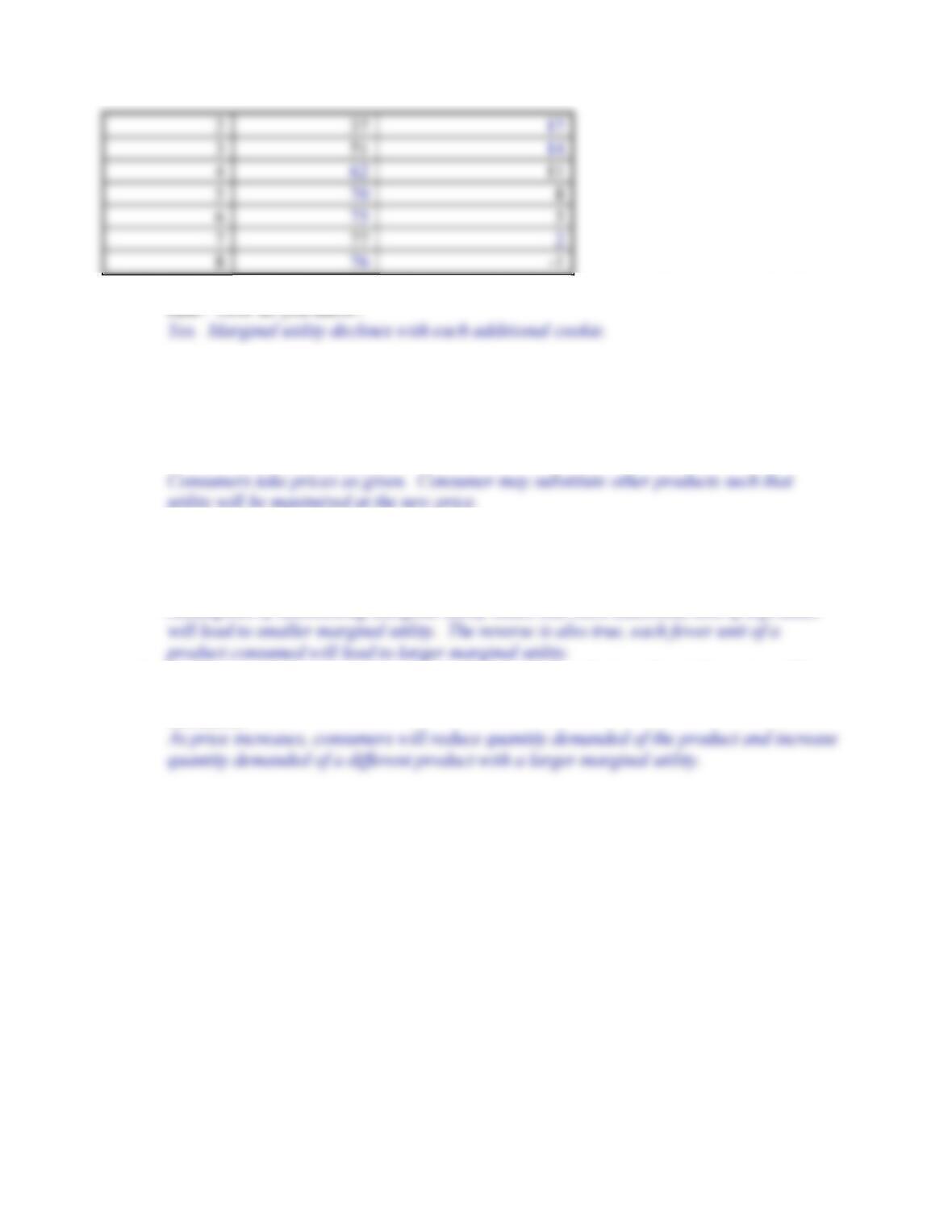
2. Fill in the table above. Is the principle of diminishing marginal utility operative in this
Understand and demonstrate how the demand curve is derived.
3. Can consumers dictate the prices they pay for products at the store? What can consumers
do if the price of a product rises and their income is fixed? What role does the
availability of substitutes play here?
4. If the price of a good goes up and throws the utility-maximizing pattern of consumption
out of whack, what does utility theory predict the consumer will do?
Consumer will substitute more of the relatively cheaper good.
5. Why does the marginal utility increase if the consumer purchases less of a product?
Assumption of diminishing marginal utility states that each additional unit of a product
6. Explain how consumers reacting to changes in prices and attempting to keep at a utility–
maximizing level of consumption leads to the relationship between price and quantity
demanded.