Chapter 28
The Labor Market: Demand, Supply, and Outsourcing
◼ Overview
One important objective of this chapter is to derive the demand for labor for a competitive employer. The
chapter reviews the law of diminishing returns, relates it to diminishing marginal product of labor, and then
relates this concept to a diminishing marginal revenue product of labor (MRP) curve. The profit-maximizing
quantity of labor to hire for competitive firms occurs when the MRP equals the market clearing wage rate
(W). That the demand for labor is a derived demand is discussed. The determinants of an input’s price
elasticity of demand are presented along with the fact that a firm’s elasticity of demand for labor is greater
than is the industry’s. The supply of labor for a firm and an industry are presented. The industry supply
◼ Learning Objectives
After studying this chapter students should be able to:
• 28.1 Understand why a firm’s marginal revenue product curve is its “derived” demand curve
• 28.2 Identify key factors influencing the elasticity of demand for inputs
◼ Outline
I. Labor Demand for a Perfectly Competitive Firm: The analysis begins with the assumption that
both the input and output markets are perfectly competitive.
Chapter 28 The Labor Market: Demand, Supply, and Outsourcing 425
A. Competition in the Product Market: A firm that hires labor under perfectly competitive
B. Marginal Product: The change in output resulting from the addition of one more worker.
C. Marginal Revenue Product: MRP is the marginal physical product (MPP) times marginal
revenue. The MRP represents the incremental worker’s contribution to the firm’s total
revenues. In a competitive product market, MRP is often called the value of marginal product
(VMP) and is equal to product price times MPP. (See Figure 28-1.)
2. General Rule for Hiring: The firm hires workers to the point where marginal factor cost
is equal to the marginal revenue product.
3. The MRP Curve: Demand for Labor: The MRP curve is a factor demand curve for the
D. Derived Demand for Labor: Input factor demand derived from demand for the final product
being produced. (See Figure 28-2.)
2. How a Firm’s Hiring Responds to a Product Price Change
II. Market Labor Demand for and the Elasticity of Demand for Inputs: The market demand curve
for labor will slope downward.
A. Constructing the Market Labor Demand Curve: The market curve for labor is not a simple
horizontal summation of the labor demand curves of all the individual firms. Even if labor
B. Determinants of Demand Elasticity for Inputs
1. Final Product Price Elasticity: The greater is the price elasticity of demand for the final
product, the greater is the elasticity of demand for an input.
2. Ease of Substitution: The easier it is for a particular variable input to be substituted for by
III. Wage Determination in a Perfectly Competitive Labor Market: The industry faces an upward-
sloping supply curve for labor and a downward-sloping demand curve for labor.
1. Reasons for Labor Demand Curve Shifts: The labor demand curve will shift for three
reasons.
a. Changes in demand for the final product: A change in the demand for the final
product that labor is producing will shift the demand curve for labor in the same
direction.
complementary input will cause the demand for labor to change in the opposite direction.
2. Determinants of the Supply of Labor: If wage rates for factory workers in one industry
remain constant while wages for factory workers in another industry go up, the supply
IV. Labor Outsourcing, Wages, and Employment: A firm that employs labor outside the country in
which it is located engages in labor outsourcing.
A. Wage and Employment Effects of Outsourcing: The immediate economic effects of
outsourcing are clear. When a home industry’s firms can employ foreign labor services that are
a close substitute for home labor services, the demand for foreign labor services will increase,
and the demand for home labor services will decrease.
1. U.S. Labor Market Effects of Outsourcing by U.S. Firms: In the United States, the
3. Wage and Employments of Outsourcing: In a foreign country such as India, the demand
4. U.S. Labor Market Effects of Outsourcing by Foreign Firms: In the United States,
B. Gauging the Net Effects of Outsourcing on the U.S. Economy: Labor outsourcing by U.S.
firms tends to reduce U.S. wages and employment. When foreign firms engage in labor
outsourcing in the United States, U.S. wages and employment tend to increase.
1. Summing Up the Economic Implications of Outsourcing: Outsourcing provides another
way for nations to trade with one another, which allows nations’ residents to specialize in
Chapter 28 The Labor Market: Demand, Supply, and Outsourcing 427
V. Labor Demand of a Monopolist and Overall Input Utilization
A. Constructing the Monopolist’s Input Demand Curve: In constructing the demand schedule
1. Marginal Revenue Product for a Perfectly Competitive Firm: Marginal revenue for the
2. Marginal Revenue Product for a Monopoly Firm: Marginal revenue of a monopolist is
less than price because the monopolist has to sell additional units at a lower price.
4. The Monopolist’s Marginal Revenue Product: The elasticity of the monopolist’s MRP
curve around a given wage rate is lower than the elasticity of the labor demand curve for a
perfectly competitive industry. (See Figure 28-7.)
5. The Monopolist’s Demand for Labor: A profit-maximizing monopolist will continue to
B. Why the Monopolist Hires Fewer Workers: If an industry in which there is perfect competition
in the output market could be changed to one in which there is a monopoly in the output
C. The Utilization of Other Factors of Production: How much of each variable factor of
production should the firm utilize when all the variable factors are combined to produce the
product?
1. Cost Minimization and Factor Utilization: To minimize total costs for a particular rate
of production, the firm will hire factors of production up to the point where the marginal
2. Profit Maximization Revisited: The profit-maximizing combination of resources for
◼ Points to Emphasize
The Optimum Employment of Labor
The concept of rational or maximizing behavior can be applied to situations in which marginal benefit
(MB) decreases and marginal cost (MC) remains constant, when MB and MC can be identified and
428 Miller • Economics Today, Nineteenth Edition
The optimal rate of employment for a competitive firm in the product and labor markets is where MB = MC,
Labor Market Equilibrium
Consider the industry supply and demand for labor on a given coordinate system. The equilibrium wage
rate and labor quantity will be determined at the intersection of these two curves. At any given wage rate
above the equilibrium wage rate, a surplus of labor exists. Buyers of labor are maximizing, but sellers
Cost Minimization
When several inputs are variable, the minimum cost of producing a given quantity of output occurs when
the marginal product per last dollar spent on each input is equated. The rule for cost minimization is that
◼ For Those Who Wish to Stress Theory
Nonequalizing Wages
Using graphs, the point can be illustrated that given competitive markets, two firms using the same labor
skill will eventually be forced to pay the same wage rate. Given the demand for labor, workers will move
Chapter 28 The Labor Market: Demand, Supply, and Outsourcing 429
The Long-Term Effects of Outsourcing
Outsourcing is viewed in the media as a zero-sum game. When U.S. firms engage in outsourcing,
the demand for labor and employment in the United States decreases, and the demand for labor and
employment in foreign countries increases in the short run. The underlying reason for this result is
◼ Further Questions for Class Discussion
1. Is a superstar such as Angelina Jolie, who reportedly is paid $15 million per movie, overpaid?
2. You can often get a good discussion going by asking your class what a person is worth. This
is a real problem for the legal system where such matters must be resolved in cases of personal
3. Assume that Indian and U.S. computer programmers were equally skilled (equal marginal
physical products). Suppose, however, that Indian workers earned lower wages than their
American counterparts. If outsourcing of computer programming by U.S. firms occurs, what would
be likely to happen to Indian and U.S. programmers’ wages in both countries? Over time, their
430 Miller • Economics Today, Nineteenth Edition
4. There is evidence of a probability that a young person graduating from high school today is less
educated than that of his or her parents according to a 2008 report by The Education Trust Counting
on Education. If this report is correct, what do you predict will happen to the average wage rate in
the United States, other things held constant? A decrease in graduation rates implies a decrease in
5. How could U.S. workers possibly compete with foreign workers who are making wages that are
only one-fifth of the wages of U.S. workers? If U.S. workers’ productivity is more than five times
6. An important trend in the automobile industry assembly lines has been an increased use of robots.
As autoworkers’ wages increased, the use of robots increased. Does the rule of cost minimization
condition in the text provide a likely explanation for this trend? Yes. The cost minimization
condition for the use of labor and robots is
◼ Answers to Questions for Critical Analysis
Oil Prices Drop, and the Derived Demand for Oil Workers Declines (p. 629)
Did the decline in the global price of oil reduce marginal revenue product by reducing marginal
revenue from the sale of oil or the marginal product of labor provided by oil workers? Explain.

Chapter 28 The Labor Market: Demand, Supply, and Outsourcing 431
A Rise in the Demand for Restaurants’ Food Services Shifts the Labor Demand
Curve (pp. 632–633)
Why might an employer choose not to hire some job candidates offering relatively high levels of
marginal product if the price of the product the employer sells decreases considerably?
Can Behavioral Nudges Induce Workers to Keep Labor Supply Promises? (p. 634)
If more firms were to find ways to induce larger numbers of workers to hold true to labor supply
commitments, would the market labor supply curve tend to shift to the left or the right? Explain
your reasoning?
“Mental Productivity” and the Hiring of Younger versus Older Workers” (p. 641)
Other things being equal, how would a firm adjust if the market clearing wage rate for older
workers decreases relative to the market clearing wage rate for younger workers? Explain briefly.
◼ You Are There
Robot Tailors Threaten Human Sewing Workers (p. 642)
1. Why would increased use of robotic sewing machines on the part of a clothing manufacturer
cause the marginal product derived from utilization of these machines to decline?
2. If clothing manufacturers were to substitute robotic sewing machines for human labor,
would you anticipate that the prices of these two resources would remain unchanged?
Explain your reasoning.
◼ Issues and Applications
Effects of Minimum Wage Laws with Substitution of Capital for Labor (p. 642–643)
1. Would a higher minimum wage rate cause a shift of a firm’s labor demand curve or a
movement along that curve? Explain.

2. Why do you suppose that a growing number of fast-food restaurant companies are
experimenting with automatic cooking equipment?
◼ Research Project
1. Take a look at various forms of order-taking equipment available to restaurants in the Web Links in
MyEconLab.
◼ Answers to Problems
28-1. The following table depicts the output of a firm that manufactures computer printers. The
printers sell for $100 each.
Labor Input (workers per week)
Total Output (printers per week)
10
200
11
218
12
234
13
248
14
260
15
270
16
278
Calculate the marginal product and marginal revenue product at each input level above
10 units.
Labor Input
(workers per
week)
Total Physical
Output (printers
per day)
Marginal Physical
Product
Marginal Revenue
Product ($)
10
200
—
—
11
218
18
1,800
13
248
14
1,400
15
270
10
1,000
16
278
28-2. Refer back to your answers to Problem 28-1 in answering the following questions.
a. What is the maximum wage the firm will be willing to pay if it hires 15 workers?
b. The weekly wage paid by computer printer manufacturers in a perfectly competitive
market is $1,200. How many workers will the profit- maximizing employer hire?
Chapter 28 The Labor Market: Demand, Supply, and Outsourcing 433
c. Suppose that there is an increase in the demand for printed digital photos. Explain the
likely effects on marginal revenue product, marginal factor cost, and the number of
workers hired by the firm.
28-3. Explain what happens to the elasticity of demand for labor in a given industry after each of
the following events.
a. A new manufacturing technique makes capital easier to substitute for labor.
b. There is an increase in the number of substitutes for the final product that labor
produces.
c. After a drop in the prices of capital inputs, labor accounts for a larger portion of a
firm’s factor costs.
28-4. Explain how the following events would affect the demand for labor.
a. A new education program administered by the company increases labor’s marginal
product.
b. The firm completes a new plant with a larger workspace and new machinery that
workers can utilize and that does not substitute for the functions provided by workers’
labor.
28-5. The following table depicts the product market and labor market a digital device
manufacturer faces.
Labor Input
(workers per day)
Total Product
Product Price ($)
10
100
50
11
109
49
12
116
48
13
121
47
14
124
46
15
125
45
434 Miller • Economics Today, Nineteenth Edition
a. Calculate the firm’s marginal product, total revenue, and marginal revenue product at
each input level above 10 units.
b. The firm competes in a perfectly competitive labor market, and the market wage it faces
is $100 per worker per day. How many workers will the profit-maximizing employer
hire?
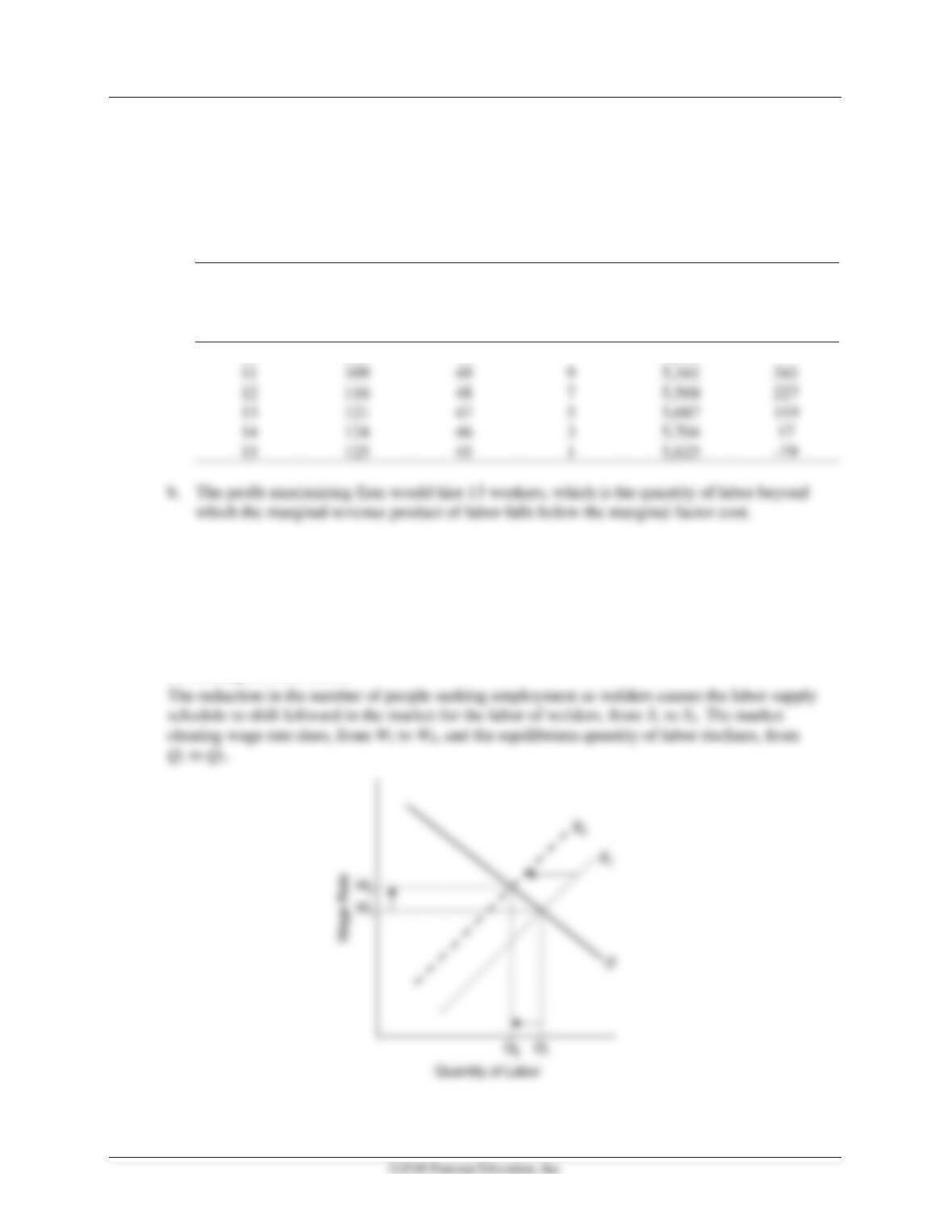
a.
Labor
Input
(workers
per week)
Total
Physical
Product
Product
Price
($ per unit)
Marginal
Physical
Product
Total
Revenue ($)
Marginal
Revenue
Product ($)
10
100
50
—
5,000
—
12
116
48
5,568
227
14
124
46
5,704
17
28-6. Recently, there has been an increase in the market demand for products of firms in
manufacturing industries. The production of many of these products requires the skills of
welders. Because welding is a dirty and dangerous job compared with other occupations, in
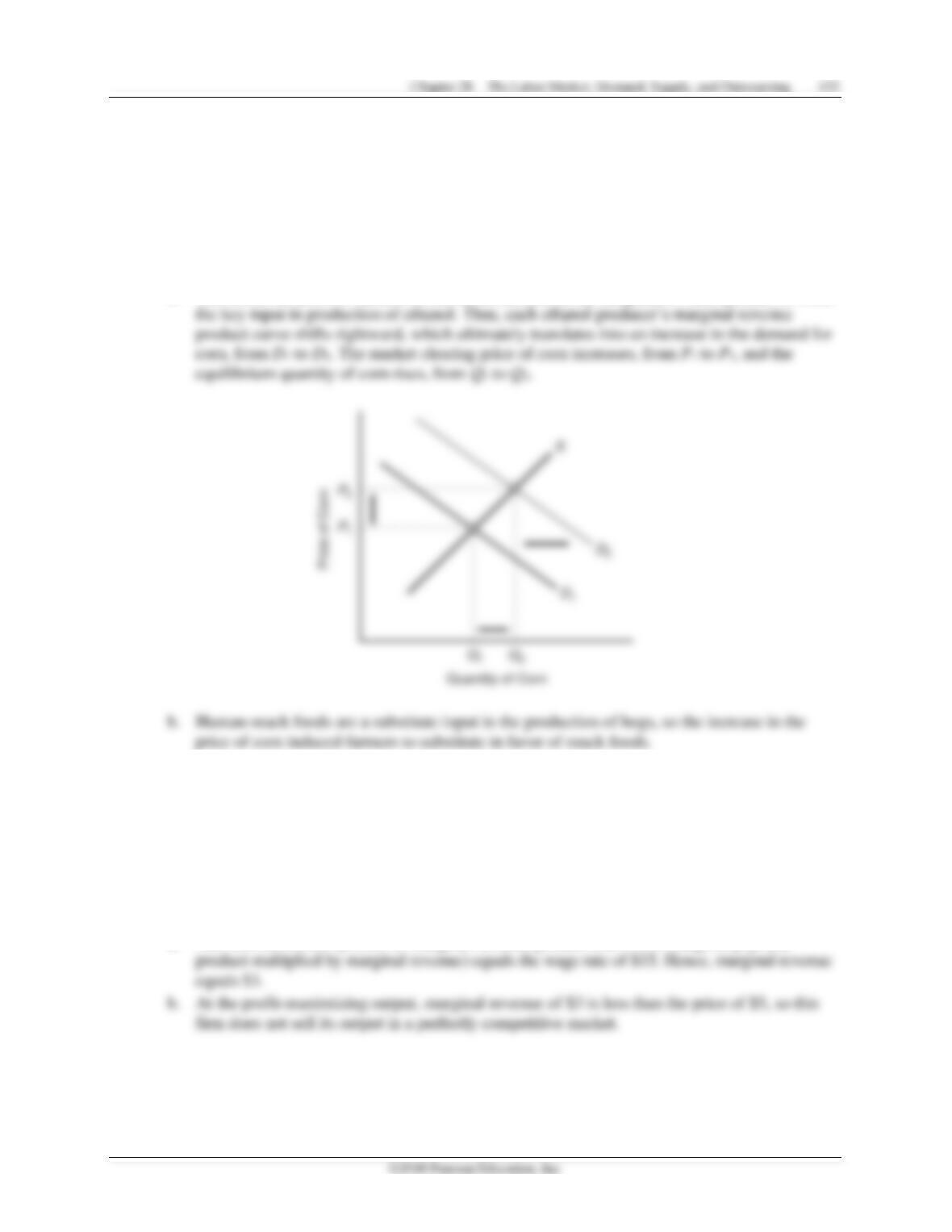
recent years fewer people have sought employment as welders. Draw a diagram of the
market for the labor of welders. Use this diagram to explain the likely implications of these
recent trends for the market clearing wage earned by welders and the equilibrium quantity
of welding services hired.
28-7. Since the beginning of this century, there has been a significant increase in the price of
corn-based ethanol.
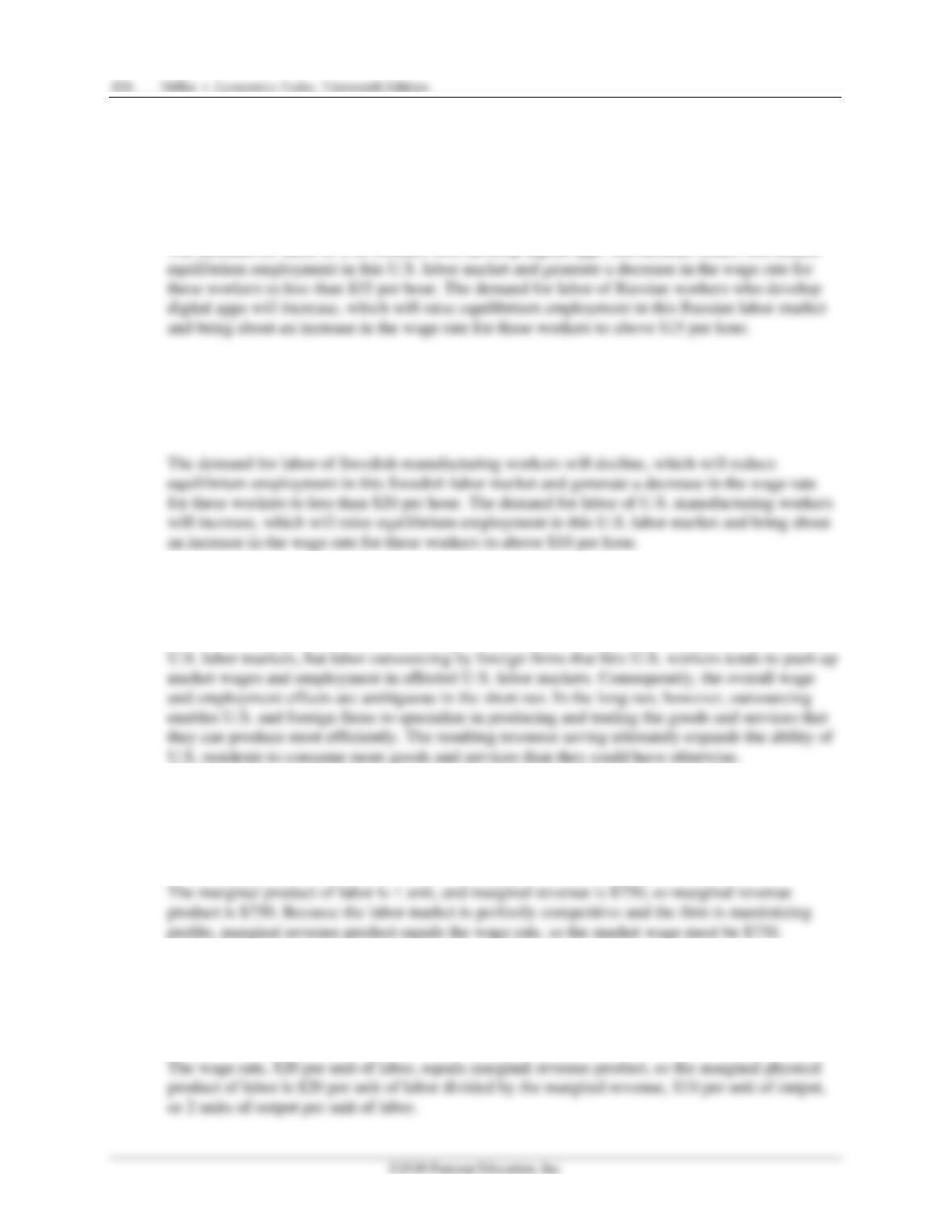
a. A key input in the production of corn-based ethanol is corn. Use an appropriate
diagram to explain what has likely occurred in the market for corn.
b. In light of your answer to part (a), explain why many hog farmers, who in the past used
corn as the main feed input in hog production, have switched to cookies, licorice, cheese
curls, candy bars, and other human snack foods instead of corn as food for their hogs.
a. The rise in the price of ethanol results in an increase in the marginal revenue product of corn,
28-8. A firm hires labor in a perfectly competitive labor market. Its current profit-maximizing
hourly output is 100 units, which the firm sells at a price of $5 per unit. The marginal
product of the last unit of labor employed is 5 units per hour. The firm pays each worker an
hourly wage of $15.
a. What marginal revenue does the firm earn from sale of the output produced by the last
worker employed?
b. Does this firm sell its output in a perfectly competitive market?
a. The firm maximizes profits, so marginal revenue product (the 5-unit marginal physical
28-9. Suppose that until recently, U.S. firms that produce digital apps had been utilizing only the
labor of qualified U.S. workers at a wage rate of $35 per hour. Now, however, these firms
have begun engaging in labor outsourcing to Russia, where qualified workers are available
at a dollar wage rate of $15 per hour. Evaluate the effects of this new U.S. app-labor
outsourcing initiative on U.S. and Russian employment levels and wages.
The demand for labor of U.S. workers who develop digital apps will decline, which will reduce
28-10. Recently, Swedish companies have outsourced manufacturing labor previously performed
by Swedish workers at $20 per hour to U.S. workers who receive a wage rate of $10 per
hour. Evaluate the effects of Swedish manufacturing-labor outsourcing on Swedish and U.S.
employment levels and wages.
28-11. Explain why the short-term effects of outsourcing on U.S. wages and employment tend to be
more ambiguous than the long-term effects.
Labor outsourcing by U.S. firms tends to push down market wages and employment in affected
28-12. A profit-maximizing monopolist hires workers in a perfectly competitive labor market.
Employing the last worker increased the firm’s total weekly output from 110 units to
111 units and caused the firm’s weekly revenues to rise from $25,000 to $25,750. What is
the current prevailing weekly wage rate in the labor market?
28-13. A monopoly firm hires workers in a perfectly competitive labor market in which the market
wage rate is $20 per day. If the firm maximizes profit, and if the marginal revenue from the
last unit of output produced by the last worker hired equals $10, what is the marginal
product of that worker?
28-14. The current market wage rate is $10, the rental rate of land is $1,000 per unit, and the
rental rate of capital is $500. Production managers at a firm find that under their current
allocation of factors of production, the marginal product of labor is 100, the marginal
product of land is 10,000, and the marginal product of capital is 4,000. Is the firm
minimizing costs? Why or why not?
28-15. The current wage rate is $10, and the rental rate of capital is $500. A firm’s marginal
product of labor is 200, and its marginal product of capital is 20,000. Is the firm maximizing
profits for the given cost outlay? Why or why not?
28-16. Consider Figure 28-1, and suppose that the firm is contemplating 14 units of labor, and it
knows that doing so would cause its total, product to increase to 4,075 units. What would be
the resulting marginal product of the 14th unit of labor employed?
28-17. Based on the information in Problem 28-16, if the firm considered in Figure 28-1 were to
employ 14 units of labor, what would be the resulting marginal revenue product of the
14th unit of labor hired?
28-18. Suppose that the MRP0 curve in Figure 28-2 is drawn under the assumption the product
price is $5 per unit. Which alternative MRP curve-MRP1 or MRP2-applies if the market
clearing product price drops to $3 per unit? Why?
28-19. Suppose that we were to observe unemployment in the labor market depicted in Figure 28-4.
Would this imply that the current wage rate is above or below the $1,000 equilibrium
weekly wage rate in the figure? Explain briefly?
28-20. Take a look at the two panels of Figure 28-5. Explain why at the points labeled E1, U.S.
firms might have an incentive to outsource labor services abroad. In addition, explain why
28-21. Consider Figure 28-7. Suppose that the monopolist is contemplating hiring 14 units of labor,
which it knows would cause the marginal product to decline to 150 units of output per unit
of labor. As a result, the product price would decrease to $4.50 per unit, and the firm’s
marginal revenue would decline to $3.20n per unit. What would be the firm’s marginal
revenue product if it hires a 14th unit of labor?
◼ Selected References
Ehrenberg, Ronald G. and Robert S. Smith, Modern Labor Economics: Theory and Public Policy, 2nd
ed., Glenview, IL: Scott, Foresman, 1985.
Hammermesh, Daniel S. and Albert Rees, The Economics of Work and Pay, 3rd ed., New York: Harper &
Row, 1984.
Hicks, J. R., The Theory of Wages, 2nd ed., London: Macmillan, 1963.
Lloyd, C. B. and B. T. Niemi, The Economics of Sex Differentials, New York: Columbia University
Press, 1980.