Chapter 27:
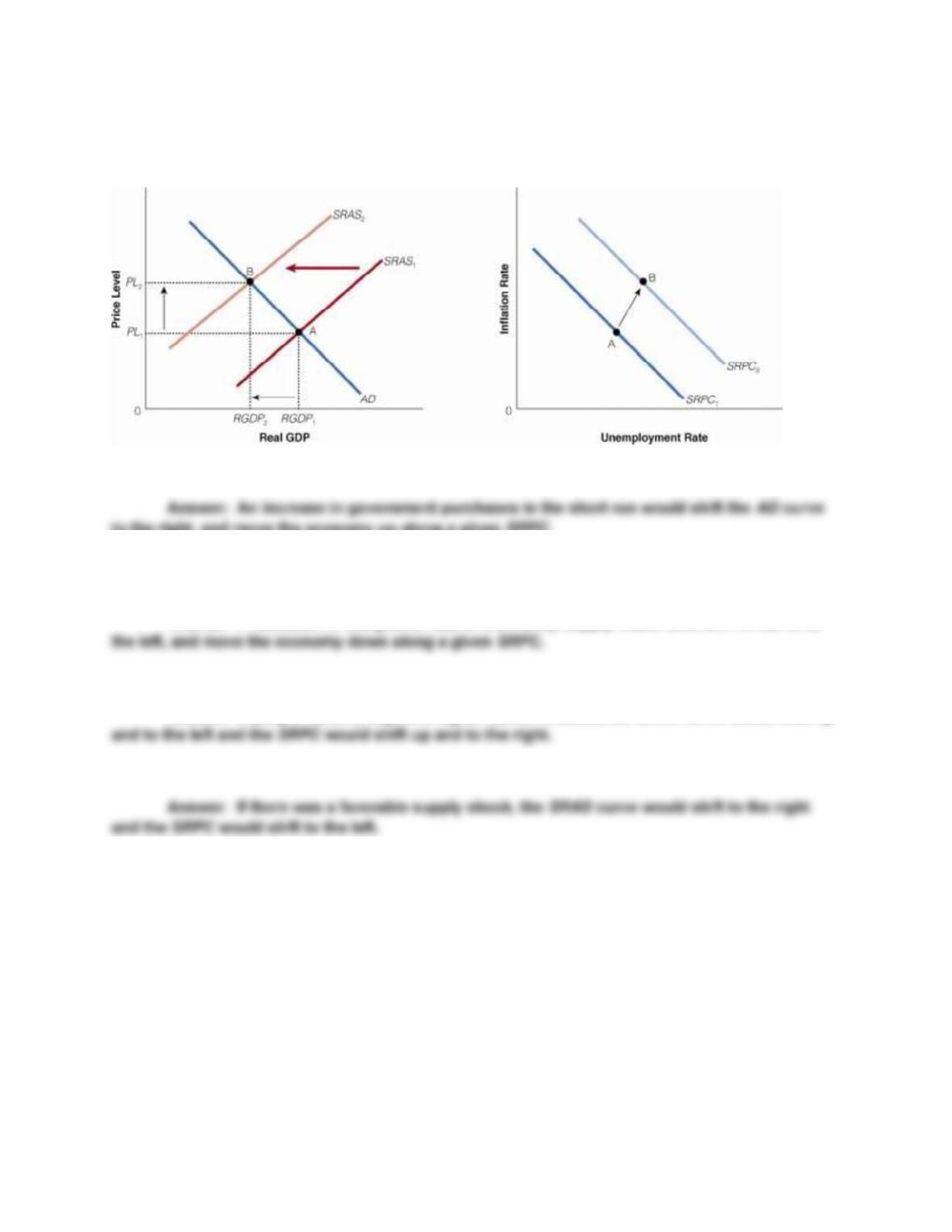
1. Use the following diagrams and
a. show what would happen in both diagrams if government purchases increase in the short run.
to the right, and move the economy up along a given SRPC.
b. show what would happen in both diagrams if the growth rate of the money supply was reduced in the
short run.
Answer: A reduction in the growth rate of the money supply would shift the AD curve to
c. show what would happen in both diagrams if people came to expect a higher rate of inflation.
Answer: If people came to expect a higher rate of inflation, the SRAS curve would shift up
d. show what would happen in both diagrams if a favorable supply shock occurred.
2. Use the diagram to answer the following questions:
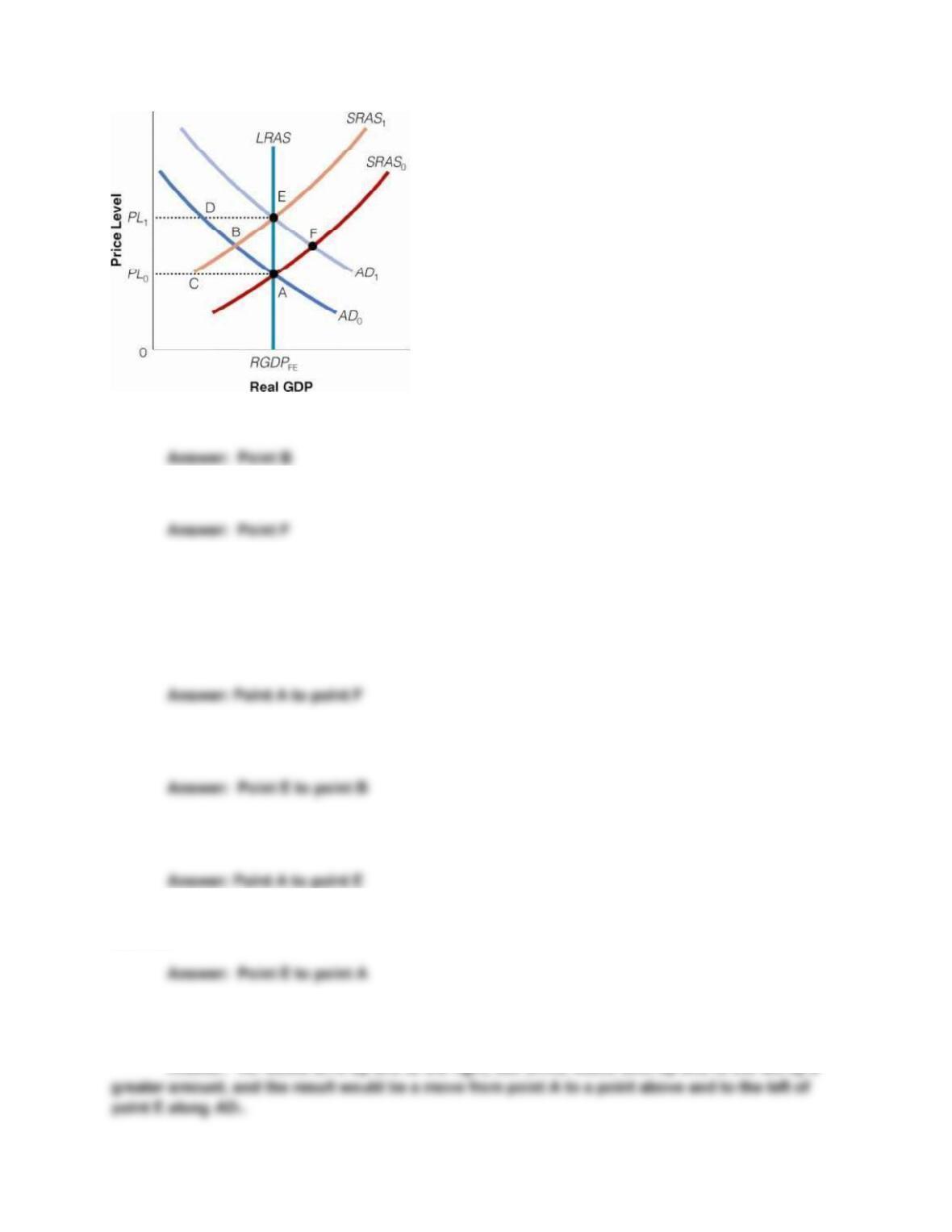
a. At which point might expansionary government policy help stabilize the economy?
b. At which point might contractionary government policy help stabilize the economy?
3. Use the diagram from problem 2 and indicate:
a. which movement would correspond to an unanticipated expansionary government policy in the short
run.
b. which movement would correspond to an unanticipated contractionary government policy in the short
run.
c. which movement would correspond to a completely anticipated expansionary government policy, under
rational expectations.
d. which movement would correspond to a completely anticipated contractionary government policy in the
short run.
e. what would happen if an expansionary government policy occurred, but its inflationary effects were
smaller than they were expected to be.
Answer: AD would shift up and to the right, but SRAS would shift up and to the left by a
4. Abraham ll
of the time,
happens if people begin to anticipate future monetary policy correctly based upon past experience?
Answer: A central bank can fool people by conducting monetary policy that is
inflationary, for example, when people are expecting no inflation. Employees may sign wage
5. Predict the impact an unexpected decrease in the money supply would have on the following variables
in the short run and in the long run.
6. Predict whether unemployment will increase or decrease as a result of each of the following monetary
policies. If it is unanticipated? What if it is anticipated?
7. If money wages are rising faster than output prices,
a. what is happening to real wages?
b. what would happen to unemployment as a result?
c. what would happen to SRAS as a result?
Answer: The short run aggregate supply curve would shift up and to the left (and it would
8. Answer the following questions.
a. Why does an upward shift in the Phillips curve correspond to an upward shift in the short–run aggregate
supply curve?
Answer: The short run Phillips Curve shifts up when expected inflation increases; the
b. Why does a movement up and to the left along a Phillips curve correspond to a movement up and to
the right along a short-run aggregate supply curve?
9. Why is the credibility of the monetary authorities so crucial to quickly overcoming expected inflation?
Answer: Given that a move to reduce inflation could easily be undone with renewed
10. Suppose the following data represent points along a short-run Phillips curve. Are the data consistent
with what you would expect? Why or why not?
Inflation Rate Unemployment Rate
A 0% 5%
B 1% 4.5%
C 2% 3.75%
D 3% 2.75%
E 4% 1.5%
Answer: Although the data does exhibit an inverse relationship between the inflation rate
and the unemployment rate, the relationship is not quite as expected. At higher rates of inflation,
11. How are the long-run Phillips curve and the long-run aggregate supply curve related?
Answer: The long-run Phillips curve is vertical at the natural rate of unemployment. The
12. How would each of the following likely affect long-run and/or short-run aggregate supply and
employment in the macroeconomy?
13. Why do economists who believe people form rational expectations have little faith that announced
changes in monetary policy will have substantial effects on real output?
Answer: Rational expectations theorists believe that when policy targets become public,
14. Does stagflation contradict the theory of the Phillips curve?
Answer: Stagflation does not contradict the theory of the Phillips curve, but reflects a