Chapter 26
Oligopoly and Strategic Behavior
◼ Overview
In this chapter, the oligopoly model is presented and its major characteristics are discussed. The reason
why oligopoly occurs is discussed, and the concept of industry concentration is introduced. Strategic
◼ Learning Objectives
After studying this chapter, students should be able to:
• 26.1 Outline the fundamental characteristics of oligopoly
◼ Outline
I. Oligopoly: An oligopoly is a market structure in which there are very few sellers. Each seller
knows the other sellers will react to its changes in prices and quantities. An oligopoly market
structure can exist for either a homogeneous or a differentiated product.
A. Characteristics of Oligopoly
1. Small Number of Firms: An oligopoly exists when the few top firms account for an
2. Interdependence: This is also called strategic dependence, which is a situation in which
B. Why Oligopoly Occurs
1. Economies of Scale: The strongest reason that has been offered for the existence of oligopoly
is economies of scale. Economies of scale are defined as a production situation in which a
2. Barriers to Entry: These barriers include legal barriers, such as patents, and control and
3. Oligopoly by Merger: A merger is the joining of two of more firms under a single ownership
II. Measuring Industry Concentration
A. Concentration Ratio: The percentage of all sales contributed by the leading four or leading
B. The Herfindahl-Hirschman Index:
2. Defining and Computing the Herfindahl-Hirschman Index: The sum of the squared
percentage sales shares of all firms in an industry. (See Table 26-3.)
III. Strategic Behavior and Game Theory: When there are relatively few firms in an industry,
each reacts to the price, quantity, quality, and new product innovations that the others undertake.
A. Some Basic Notions about Game Theory: Games can be cooperative or noncooperative.
They are classified by whether the payoffs are negative, zero, or positive. A cooperative
1. Strategies in Noncooperative Games: A strategy is any rule that is used to make a choice,
B. The Prisoner’s Dilemma: An example of game theory in which two people involved in a bank
robbery are caught.
1. The Structure of the Prisoner’s Dilemma: The payoff matrix shows two possibilities for
2. The Predicted Prisoner’s Dilemma Outcomes: To confess is a dominant strategy for
Chapter 26 Oligopoly and Strategic Behavior 395
C. Applying Game Theory to Pricing Strategies: An example of the use of game theory is
presented. (See Figure 26-2.)
D. Opportunistic Behavior: Actions that ignore possible long-run benefits of cooperation and
IV. The Cooperative Game: A Collusive Cartel: This section looks at why firms collude to increase
prices, how they work to do so, and what they have to do to be successful.
A. Collusive Production and Pricing and the Seeds of a Cartel’s Undoing: Firms in an industry
must collude if they decide to form a cartel so that they can achieve the same outcome as a
monopoly and increase their profits above a competitive level.
1. Collusive Price and Output Determination by Firms in a Cartel: To operate a
profit-maximizing cartel, member firms must be willing and able to set up and maintain an
arrangement for coordinating overall cartel production at a common price. Then they can
share the maximized profits. (See Figure 26-3.)
a. The Pre-Cartel, Noncoordinated Market: In the absence of collusion among firms, the
b. Boosting Economic Profits via a Collusive Cartel Price: If firms in the market form
c. Profit-Maximizing Collusion Requires Reducing Total Production: The cartel
2. The Temptation to Cheat on a Cartel Agreement: Any one member of the cartel can
B. Enforcing a Cartel Agreement: There are four conditions that make it more likely that firms
will be able to coordinate their efforts to restrain output successfully and deter cheating.
industry, the easier it is to prevent cheating.
2. Relatively Undifferentiated Products: If the cartel members sell a homogeneous or
3. Easily Observable Prices: If the terms of industry transactions are publically available,
C. Why Cartel Agreements Usually Break Down: Most cartels usually do not last for more than
396 Miller • Economics Today, Nineteenth Edition
V. Network Effects and Two-Sided Markets: A network effect is a situation in which a consumer’s
willingness to purchase a good or service is influenced by how many others also buy or have
bought the item.
A. Network Effects and Market Feedback: Industries in which network effects are important
can experience sudden surges in growth as well as significant and sudden reversals.
2. Negative Market Feedback: A tendency for a good or service to fall out of favor with
B. Network Effects and Industry Concentration: In an industry that produces and sells products
C. Two-Sided Markets, Network Effects, and Oligopoly: A two-sided market is a market in
which an intermediary firm provides services that link groups of producers and consumers.
1. Types of Two-Sided Markets: In a two-sided market, the intermediary firm is a platform
and the groups of producers and consumers are end users. (See Figure 26-4.)
a. Audience Seeking Markets: Media platforms link advertisers to audiences.
platform.
2. Network Effects in Two-Sided Markets: Network effects are a common feature of two-
3. Two-Sided Oligopolistic Pricing: Oligopoly is the most common industry structure in
two-sided markets with network effects. In these markets, a few firms are often able to
◼ Points to Emphasize
Economies of Scale
If economies of scale are great relative to market size, an oligopoly will emerge. It appears that worldwide,
wherever automobiles, steel, televisions, cigarettes, and certain other goods are produced, they are produced
Chapter 26 Oligopoly and Strategic Behavior 397
The Oligopoly Model
Because the demand curve for an oligopolist is downward sloping and because there are barriers to entry,
the oligopolistic market structure is economically inefficient because P MC and long-run economic
profits may be positive. If economies of scale are truly prevalent and the oligopoly is a direct result of
Concentration Ratios
Concentration ratios are widely believed to measure the degree of monopoly or oligopoly market power
in an industry. Because concentration ratios indicate high concentrations in many U.S. industries, often
Cartels
It is important to emphasize the purpose of a cartel and the conditions necessary for its likely success.
The obvious reason for the formation of a cartel is to create a monopoly and raise member profits by
raising price. The likelihood of success is enhanced by having a small number of firms in the industry to
Network Effects
These effects are becoming increasingly common in the consumer electronics market. For example,
Apple made its iPhone incompatible with other producers’ products and even with applications so that if
398 Miller • Economics Today, Nineteenth Edition
◼ For Those Who Wish to Stress Theory
Price and Output under Oligopoly Conditions
The existence of mutual interdependence makes it impossible to find “a” price and output that will, in
Why Cartels Usually Break Down
Students should understand why the incentives facing individual cartel members result in cartels seldom
succeeding in the long run. The answer is related to price elasticity conditions faced by cartel members as
a group and as individual firms. The incentive system of a cartel is likely to make it unstable. Basically,
◼ Further Questions for Class Discussion
1. A cartel is a cooperative, positive sum game. By cooperating, the total profits of the cartel are
maximized, and each firm’s profits are higher than they would be in the absence of the cartel.
2. Can students explain why nonprice competition is more likely under oligopoly conditions
than is price competition? The explanation is tied to strategic dependence. The text points
3. eBay, the Internet auctioneer, earns revenues by assessing commissions based on sales prices.
Its popularity is the key to its success because when sellers list items for auction, they want to be
certain that there will be many potential buyers. In addition, eBay continues to provide a wider
range of auctioneering services than do other services. Yahoo! decided to compete with eBay
and entered the online auction business by offering free online auction services. In spite of
Yahoo!’s action and competition from other Internet sellers such as Onsale.com and
Amazon.com, eBay remains the most popular auction site on the Internet.
4. Why are social networking firms dominated by a few large firms such as YouTube and
◼ John Kenneth Galbraith (1908–2006): American Economist
John Kenneth Galbraith was perhaps the most popular American advocate of democratic socialism and
state economic planning. In his career as a professor of economics, journalist, public servant, and through
his books—which include the best-selling The Affluent Society (1958), The New Industrial State (1967),
and The Age of Uncertainty (1977)—the witty and urbane Galbraith attempted to demonstrate how the
growth of monopoly and the power of advertising have irrevocably transformed the nature of economics.
Galbraith taught at the University of California, Harvard, and Princeton before moving in 1941 to the Office
of Price Administration. There, he was criticized for overzealously applying price controls to the largest
400 Miller • Economics Today, Nineteenth Edition
◼ Answers to Questions for Critical Analysis
The Four-Firm Concentration Ratio in the U.S. Broadband Industry (p. 581)
What was the five-firm concentration ratio in the broadband industry?
The HHI for the Global Tablet-Device Industry (p. 583)
What would be the revised HHI value if the top dozen firms decided to conduct a horizontal merger
and offer a single “Top 12 Tablet” product?
Why There Is a 50-50 Chance That Cheating on One’s Mate Is a Dominant Strategy
(p. 584)
How might the fact that men continue to earn slightly higher incomes than women help to explain
the observation that males are more likely to cheat on their males than females? (Hint: People with
higher incomes have more funds available to pay for more “date” with others besides their males.)
New Online-Dating Platform Firms Specialize in Limiting the Number of Matches
(p. 592)
Why do you suppose that people with college degrees who earn high hourly incomes have been
among the customers of online-dating firms that provide fewer high-quality matches?
◼ You Are There
Free-Game Platform Firms Find Positive Market Feedback Harder To Find
(p. 593–594)
1. In what type of two-sided market does Animoca complete?
2. Why do you suppose that a handful of large firms have become predominant in the market
for multiplayer electronic games in which network effects are particularly important?
Chapter 26 Oligopoly and Strategic Behavior 401
◼ Issues and Applications
The Ticket- Resale Industry—An Oligopoly with Many Firms (p. 594–595)
1. In what sense is there oligopolistic interdependence in the basic dominant-firm model, in
which there truly is just one single dominant firm? Explain your reasoning.
2. If a dominant firm cannot maintain a cost advantage over other fringe firms in the
industry, why might we anticipate that eventually its “dominance” might disappear? (Hint:
What would happen to the number of fringe producers if the dominant firm were to earn
economic profits-and then what would happen over time to the dominant firm’s profit?)
◼ Research Project
◼ Answers to Problems
26-1. Suppose that the distribution of sales within an industry is as shown in the table.
Firm
Share of Total Market Sales
A
15%
B
14
C
12
D
11
E
10
F
10
G
8
H
7
All others
13
Total
100%
a. What is the four-firm concentration ratio for this industry?
b. What is the eight-firm concentration ratio for this industry?
26-2. The table below shows recent worldwide market shares of producers of inkjet printers.
Firm
Share of Worldwide Market Sales
Brother
3%
Canon
17
Dell
6
Epson
18
Hewlett-Packard
41
Lexmark
13
Samsung
1
Other
1
a. In this year, what was the four-firm concentration ratio in the inkjet-printer industry?
b. In this year, what was the seven-firm concentration ratio in the inkjet-printer industry?
26-3. If there are 13 “All others” in the industry in Problem 26-1, each of which has a share of
sales equal to 1 percent, what is the value of the Herfindahl- Hirschman Index for this
industry?
26-4. What is the value of the Herfindahl-Hirschman Index for the industry in Problem 26-2?
26-5. Characterize each of the following as a positive-sum game, a zero-sum game, or a
negative-sum game.
a. Office workers contribute $10 each to a pool of funds, and whoever best predicts the
winners in a professional sports playoff wins the entire sum.
b. After three years of fighting with large losses of human lives and materiel, neither
nation involved in a war is any closer to its objective than it was before the war began.
c. Two collectors who previously owned incomplete and nearly worthless sets of trading
cards exchange several cards, and as a result both end up with completed sets with
significant market value.
26-6. Characterize each of the following as a positive-sum game, a zero-sum game, or a negative-
sum game.
a. You play a card game in your dorm room with three other students. Each player brings
$5 to the game to bet on the outcome, winner take all.
Chapter 26 Oligopoly and Strategic Behavior 403
b. Two nations exchange goods in a mutually beneficial transaction.
c. A thousand people buy $1 lottery tickets with a single payoff of $800.
26-7. Last weekend, Bob attended the university football game. At the opening kickoff, the
crowd stood up. Bob therefore realized that he would have to stand up as well to see the
game. For the crowd (not the football team), explain the outcomes of a cooperative game
and a noncooperative game. Explain what Bob’s “tit-for-tat strategic behavior” would be
if he wished to see the game.
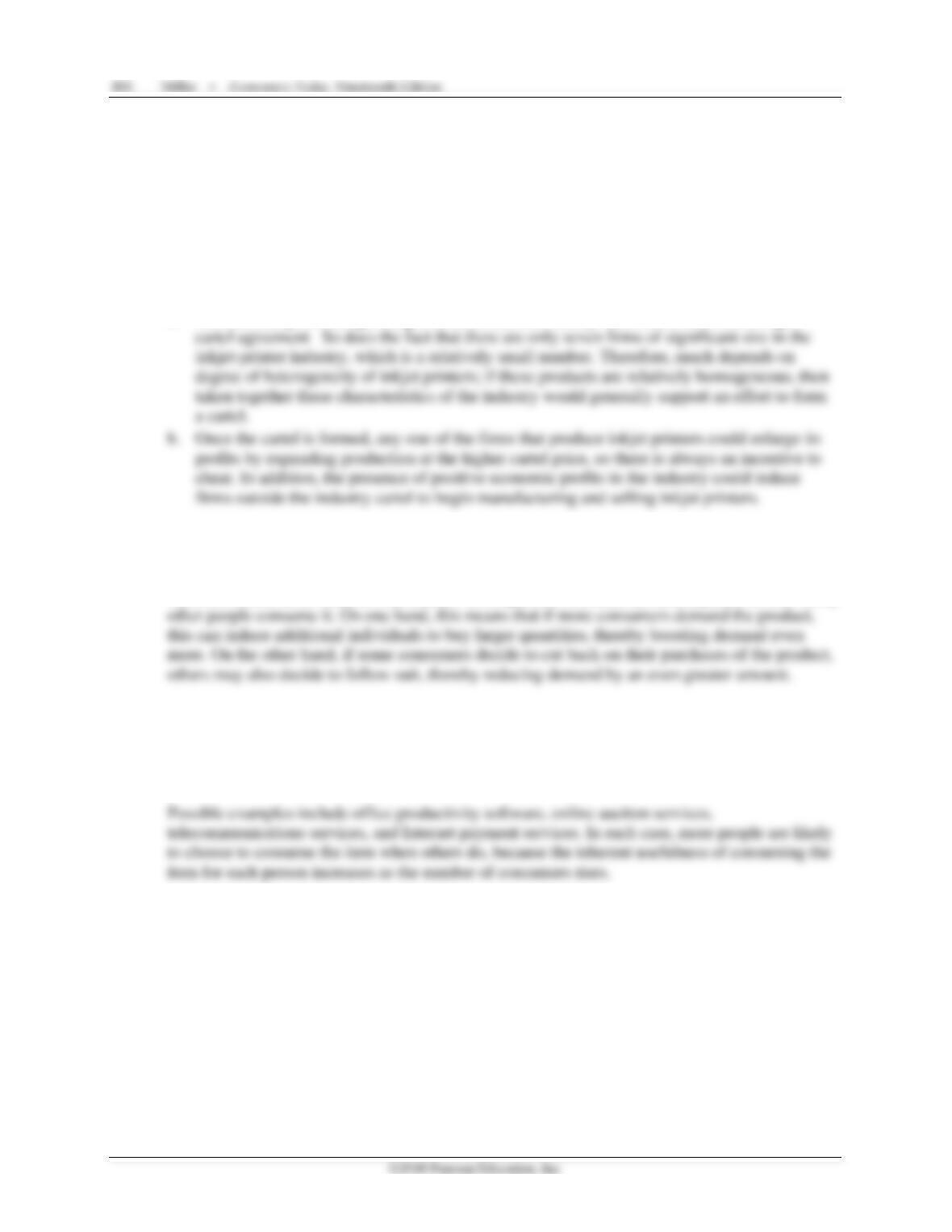
26-8. Consider two strategically dependent firms in an oligopolistic industry, Firm A and Firm B.
Firm A knows that if it offers extended warranties on its products but Firm B does not, it
will earn $6 million in profits, and Firm B will earn $2 million. Likewise, Firm B knows
that if it offers extended warranties but Firm A does not, it will earn $6 million in profits,
and Firm A will earn $2 million. The two firms know that if they both offer extended
warranties on their products, each will earn $3 million in profits. Finally, the two firms
know that if neither offers extended warranties, each will earn $5 million in profits.
a. Set up a payoff matrix that fits the situation faced by these two firms.
b. What is the dominant strategy for each firm in this situation? Explain.
The payoff matrix is displayed below. If Firm B does not offer an extended warranty, Firm A
earns higher profits ($6 million instead of $5 million) by providing an extended warranty. If Firm
26-9. Take a look back at the data regarding the inkjet-printer industry in Problem 26-2, and
answer the following questions.
a. Suppose that consumer demands for inkjet printers, the prices of which are readily
observable in office supply outlets and at Internet sites, are growing at a stable pace.
Discuss whether circumstances are favorable to an effort by firms in this industry to
form a cartel.
b. If the firms successfully establish a cartel, why will there naturally be pressures for the
cartel to break down, either from within or from outside?
a. The fact that prices are growing at a stable rate and readily observable favor enforcing a
26-10. Explain why network effects can cause the demand for a product either to expand or to
contract relative to what it would be if there were no network effects.
Network effects arise when an individual’s willingness to consume an item depends on how many
26-11. List three products that you think are subject to network effects. For each product, indicate
whether, in your view, all or just a few firms within the industry that produces each
product experience market feedback effects. In your view, are any market feedback effects
in these industries currently positive or negative?
26-12. Consider the following list, and classify each item according to the appropriate type of two-
sided market—audience-making, matchmaking, shared-input, or transaction-based—and
write a one-sentence answer justifying your classification. (Hint: You may wish to check out
the firms’ Web sites to assist in answering this question.)
a. Realtor.com
b. NYTimes.com
c. Linux.com
d. Paypal.com
Chapter 26 Oligopoly and Strategic Behavior 405
26-13. Consider the following list, and classify each item according to the appropriate type of two-
sided market—audience-making, matchmaking, shared- input, or transaction-based—and
write a one-sentence answer justifying your classification. (Hint: You may wish to check out
the firms’ Web sites to assist in answering this question.)
a. Mastercard.com
b. FreeBSD.com
c. Plentyofish.com
d. WSJ.com
a. Mastercard.com is a platform for linking people making payments with credit cards to banks
26-14. Suppose that a company based in Dallas, Texas, confronts only four other rival firms. Its
own market share is 35 percent, which ties it with the other largest producer and seller in
the industry. The other three firms each have a 10 percent market share. What is the four-
firm concentration ratio for this industry?
26-15. In Problem 26-14, what is the value of the Herfindahl-Hirschman index?
26-16. Suppose that a firm located in Cleveland, Ohio, has entered the same industry as the Dallas
company discussed in Problem 26-14. The new firm captures a 5 percent market share, and
the market share of one of the smallest three original incumbents declines to 5 percent as
well. After the Cleveland firm’s entry into the industry, what are the values of the four-firm
concentration ratio and of the Herfindahl-Hirschman index?
26-17. Consider Figure 26-2. Suppose conditions in the industry change in such a way that the
amount that each firm makes if it charges a high price when the other firm charges a low
price increases from $2 million to $3 million. Is the firm’s pricing decision altered by this
change and, if so, in what way? Explain briefly?
406 Miller • Economics Today, Nineteenth Edition
26-18. Take a look at Figure 26-3. What is the total dollar amount of the typical perfectly
competitive firm’s economic incentive to join the proposed cartel, assuming that after the
fact no firms cheat on the specified cartel agreement? Explain your reasoning?
26-19. Consider Figure 26-3, and suppose that this typical firm has agreed to participate in the
proposed cartel. What is the total dollar amount of the firm’s economic incentive to cheat
on the cartel agreement, assuming that all other firms continue to abide by the agreement?
Explain your reasoning?
◼ Selected References
Bain, Joe S., “Relation or Profit-Rate to Industry Concentration: American Manufacturing, 1936–1940,”
Quarterly Journal of Economics, August 1951, pp. 293–324.
Fellner, William, Competition Among the Few, New York: Knopf, 1950.
Kilpatrick, R. W., “Stigler on the Relationship between Industry Profit Rates and Market Concentration,”
Journal of Political Economy, May–June 1968, pp. 479–488.