Chapter 25
Monopolistic Competition
◼ Overview
In this chapter, the model of monopolistic competition is discussed. Its key characteristics are defined,
and the profit-maximizing rate of output and long-run implications for efficiency with the perfect
competition model are analyzed. The purpose and effect of advertising, an important characteristic
of monopolistic competition, is also discussed. The nature and purpose of product differentiation is
analyzed, with special attention to the use of brand names and advertising. Finally, information
products and monopolistic competition are presented.
◼ Learning Objectives
After studying this chapter, students should be able to:
• 25.1 Discuss the key characteristics of a monopolistically competitive industry
◼ Outline
I. Monopolistic Competition: A market structure where a large number of firms produce similar but
not identical products, which they advertise and promote. Entry into the industry is relatively easy.
A. Number of Firms: Monopolistic competition has a large number of firms but not as many as in
perfect competition. This fact has several implications for a monopolistically competitive
industry.
1. Small share of market: When many firms exist in an industry, each firm has a relatively
378 Miller • Economics Today, Nineteenth Edition
B. Product Differentiation: Product differentiation is the distinguishing of products by brand
name, color, minor attributes, and the like. Product differentiation occurs in other than
C. Sales Promotion and Advertising: No individual firm in a perfectly competitive market will
the marginal cost of advertising.
D. Ease of Entry: For a monopolistic competitor, potential competition is always a threat. The
II. Price and Output for the Monopolistic Competitor (See Figure 25-1.)
A. The Individual Firm’s Demand and Cost Curves: Because the individual firm is not a
perfect competitor, its demand curve slopes downward. It faces a marginal revenue curve
C. The Long Run: Zero Economic Profits: In the long run, because so many competitors
D. Comparing Perfect Competition with Monopolistic Competition: Both the monopolistic
competitor and the perfect competitor make zero economic profits in the long run. The perfect
III. Brand Names and Advertising: Because “differentness” has value to consumers, monopolistically
competitive firms view their brand names as valuable. Firms advertise their brand to maintain
differentiation of their products from those of other firms.
A. Brand Names and Trademarks: A firm’s value in the marketplace depends largely on its
current profitability and perceptions of its future profitability. (See Table 25-1.)
B. Advertising: To help ensure that consumers differentiate their products from those of other
firms, monopolistically competitive firms engage in advertising.
1. Methods of Advertising: Advertising can be in the form of direct marketing, mass
Chapter 25 Monopolistic Competition 379
3. Informational versus Persuasive Advertising: Informational advertising transmits
knowledge about features of a product and is more likely to be used with a search good.
4. Advertising as Signaling Behavior: Signals are compact gestures or actions that convey
IV. Information Products and Monopolistic Competition: A product produced using information-
intensive inputs at a relatively high fixed cost but distributed for sale at a relatively low marginal
cost is an information product.
A. Special Cost Characteristics of Information Products: Creating the first unit of an
information product, such as a computer program, entails a high initial up-front cost.
Additional units are very inexpensive to produce.
2. Cost Curves for an Information Product: The larger the number of units of an information
product that is sold, the lower the average fixed cost. Thus, the average fixed cost curve
B. Monopolistic Competition and Information Products (See Figure 25-5.)
1. Marginal Cost Pricing and Information Products: Short-run economies of operation
2. The Case in Which Price Equals Average Total Cost: In the long run, after all entry and
3. Long-Run Equilibrium for an Information Product Industry: When the price of an
380 Miller • Economics Today, Nineteenth Edition
◼ Points to Emphasize
Why the Monopolistically Competitive Firm Does Not Attain Maximum
Efficiency in the Long Run
The demand curve facing a monopolistic competitor is downward sloping, its average total cost curve is
U-shaped, and in the long run, free entry and exit imply zero economic profits. Given these
considerations, the implications of the monopolistic competition model are clear. Because the demand
The Efficiency Implications of Monopolistic Competition
Because ATC is not minimized and P MC in the monopolistic competition model, “inefficiency”
results. Yet, some excess capacity resulting from “too many” monopolistic competitors, each not producing
Information Products
Information products are becoming fairly common and have some interesting implications. They are very
expensive to develop, that is, to produce the first unit. After that, additional units can be produced at a
very low marginal and average variable cost. This means that they are especially appealing to piracy, that
◼ For Those Who Wish to Stress Theory
Advertising
Some believe that consumer sovereignty does not exist in the United States. They allege that consumer
sovereignty has been replaced by producer sovereignty. Producers decide what they want to produce, or
they produce what is most profitable and sell it to unwitting buyers. The belief is that buyers can be induced
Chapter 25 Monopolistic Competition 381
to buy whatever the producers want to sell by advertising campaigns. Will anyone admit to being deceived?
It is always the “masses” who are manipulated. Proof that this idea may not be valid can be illustrated in
the following way. Rulers in the ex-USSR did not shy away from behavior manipulation. The Soviets
had a great propaganda machine. Yet, shortages and surpluses abounded in the ex-USSR. Why didn’t
the Soviets just advertise and convince their people to want fewer goods that were in short supply and
more of the goods that were in surplus?
A very revealing book on advertising written by successful New York ad-man Jerry Della Femina is entitled
From Those Wonderful People Who Gave You Pearl Harbor. In his book, Della Femina makes three
interesting observations. The first is that some products are easier to advertise than others. One must
wonder how this could be if the state of psychology is so advanced as to convince people to buy goods
◼ Joan Robinson (1903–1983): English Economist
Joan Robinson taught at Cambridge University, England, for more than 40 years. She wrote and lectured
widely on economic theory and made original contributions to the theories of imperfect competition and
the accumulation of capital. She called herself a “left–wing Keynesian,” but she was versed in
neoclassical economic theory as well as in Marxist thought. Eclectic in approach, but rigorous in analysis—
“I don’t know math,” she once remarked, “so I am obliged to think”—she drew on the insights of history’s
greatest economists to develop critiques of modern capitalism and the current orthodox schools of
economic thought.
382 Miller • Economics Today, Nineteenth Edition
◼ Further Questions for Class Discussion
1. Is mobile phone advertising persuasive or informative? It depends on who is doing the
2. Some economists argue that in long-run equilibrium under conditions of monopolistic
competition there is economic waste because price is greater than marginal cost and average total
cost is not at a minimum. How would it be possible to “eliminate” this waste? What would we
3. According to a study by Tufts University, the cost of developing a new prescription drug was
$802 million in 2001. According to the study, for every 5,000 chemical compounds that are tested
on animals as medications, only five are tested on humans, and of those tested on humans, only
one is approved for sale. Also, it typically takes 12 years on average for a new drug to reach the
market. In addition, increases in the costs of human clinical trials have been increasing at 12
percent per year.
What is the average cost of the first dose of a new drug? What about the marginal cost of
4. Many service industries have raised entry costs by getting legislation passed that requires
extensive training and licensing before someone can enter the industry. In California, a license
to style hair requires the expenditure of more than $6,000 for 1,600 hours of cosmetology classes.
Hair braiders, who are hairstylists for the African-American community, did not need a license to
style hair until the California Barbering and Cosmetology Board ruled otherwise. The hair
braiders are suing to get an exemption from California’s and other states’ licensing laws. Suppose
that the hair braiders win their case and do not need to meet cosmetology licensing requirements.
What will be the long-run effect on the economic profits from braiding hair of licensed
cosmetologists in California? (Hint: What type of long-run adjustment process will occur?)
5. What would the short-run shutdown price be for a producer of an information product? What
would output be at the shutdown price? Look at Figure 25-4. Price would have to be equal to
6. When trying to decide which university to attend, prospective students has been concerned
with information such as faculty degrees, graduation rates, and SAT and ACT scores of entering
students. These types of information do not tell students what a graduate will learn, know, and
be able to do as a result of getting a degree at that university. In recent years, the accrediting
◼ Answers to Questions for Critical Analysis
When a Drink’s Taste Is Not Sufficiently Distinguishable, Try a Flavored Edible
Straw (p. 561)
Why might serving drinks with uniquely flavored edible straws assist a restaurant in distinguishing
its products from competitors’ products with similar tastes and textures?
Want to Start a Kids” TV Network? Bring Back Old Cartoon Characters? (p. 562)
Why do you suppose that companies such as Amazon and Netflix have also entered the children’s
TV programming industry by streaming kids’ shows online?
Do Business Schools’ Uses of Their Rankings Inform or Persuade? (p. 568)
Why do you suppose that business schools with weaker programs typically display their category
ratings on billboards, whereas those with stronger programs usually do not place ads on billboards
at all?
Business schools with weaker programs are not as well-known as their counterparts with stronger
384 Miller • Economics Today, Nineteenth Edition
◼ You Are There
A Soft Drink Company Faces Another Entity into an Already Crowded Industry
(p. 572)
1. Other things being equal, how did the entry of Keurig into this industry likely initially
affect the demand for items produced and sold by SodaStream?
2. How were SodaStream’s responses discussed above likely intended to affect the demand for
its products following Keurig’s entry into the industry?
◼ Issues and Applications
Professional Service Firms Confront Easier Entry by New Competitors
(pp. 572–573)
1. If efforts by traditional financial-planning firms to promote their financial therapy services
prove successful, what will happen to the positions of and shapes of the demand curves that
they face? Explain.
2. How has the entry of the legal divisions of commercial accounting firms into the market for
legal services likely affected the positions and shapes of the demand curves faced by
incumbent commercial law firms?
◼ Research Project
1. Learn more about the financial therapy approach to the provision of personal financial-planning
services in the Web Links in MyEconLab.
Chapter 25 Monopolistic Competition 385
◼ Answers to Problems
25-1. Explain why the following are examples of monopolistic competition.
a. There are a number of fast-food restaurants in town, and they compete fiercely. Some
restaurants cook their hamburgers over open flames. Others fry their hamburgers. In
addition, some serve broiled fish sandwiches, while others serve fried fish sandwiches.
A few serve ice cream cones for dessert, while others offer frozen ice cream pies.
b. There are a vast number of colleges and universities across the country. Each competes
for top students. All offer similar courses and programs, but some have better programs
in business, while others have stronger programs in the arts and humanities. Still others
are academically stronger in the sciences.
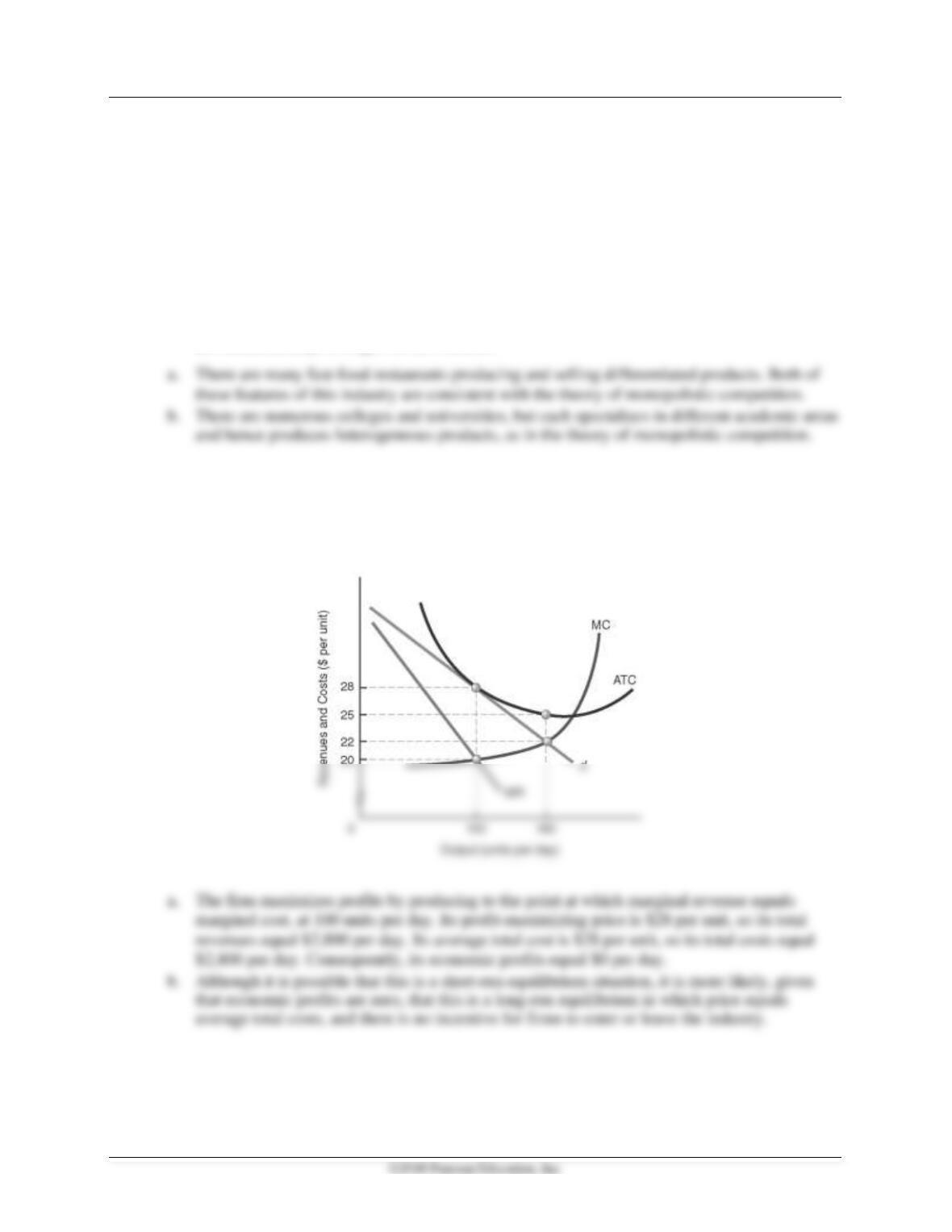
25-2. Consider the diagram below depicting the demand and cost conditions faced by a
monopolistically competitive firm.
a. What are the total revenues, total costs, and economic profits experienced by this firm?
b. Is this firm more likely in short- or long-run equilibrium? Explain.
25-3. In a perfectly competitive market, price equals marginal cost, but this condition is not
satisfied for the firm with the revenue and cost conditions depicted in Problem 25-2. In the
long run, what would happen if the government decided to require the firm in Problem 25-2
to charge a price equal to marginal cost at the firm’s long-run output rate?
386 Miller • Economics Today, Nineteenth Edition
25-4. Based on your answer to Problem 25-3, is the firm with the revenue and cost conditions
depicted in Problem 25-2 behaving “anticompetitively” in the sense of intentionally “taking
advantage” of consumers by charging them a price greater than marginal cost? Explain
your reasoning.
There is no definite “right” or “wrong” answer to this question, which has long bedeviled
economists. On one hand, the fact that price exceeds marginal cost can be interpreted as meaning
25-5. The table below depicts the prices and total costs a local used-book store faces. The
bookstore competes with a number of similar stores, but it capitalizes on its location and the
word-of-mouth reputation of the coffee it serves to its customers. Calculate the store’s total
revenue, total profit, marginal revenue, and marginal cost at each level of output, beginning
with the first unit. Based on marginal analysis, what is the approximate profit-maximizing
level of output for this business?
Output
Price per
Book ($)
Total Costs ($)
0
6.00
2.00
1
5.75
5.25
2
5.50
7.50
3
5.25
9.60
4
5.00
12.10
5
4.75
15.80
6
4.50
20.00
7
4.00
24.75
Output
Price ($ per
Unit)
Total
Costs ($)
Total
Revenue
($)
Marginal
Cost ($ per
unit)
Marginal
Revenue
($ per unit)
Total
Profit ($)
0
6.00
2.00
0.00
—
—
−2.00
2
5.50
7.50
2.25
4
5.00
2.50
7
4.00
4.75
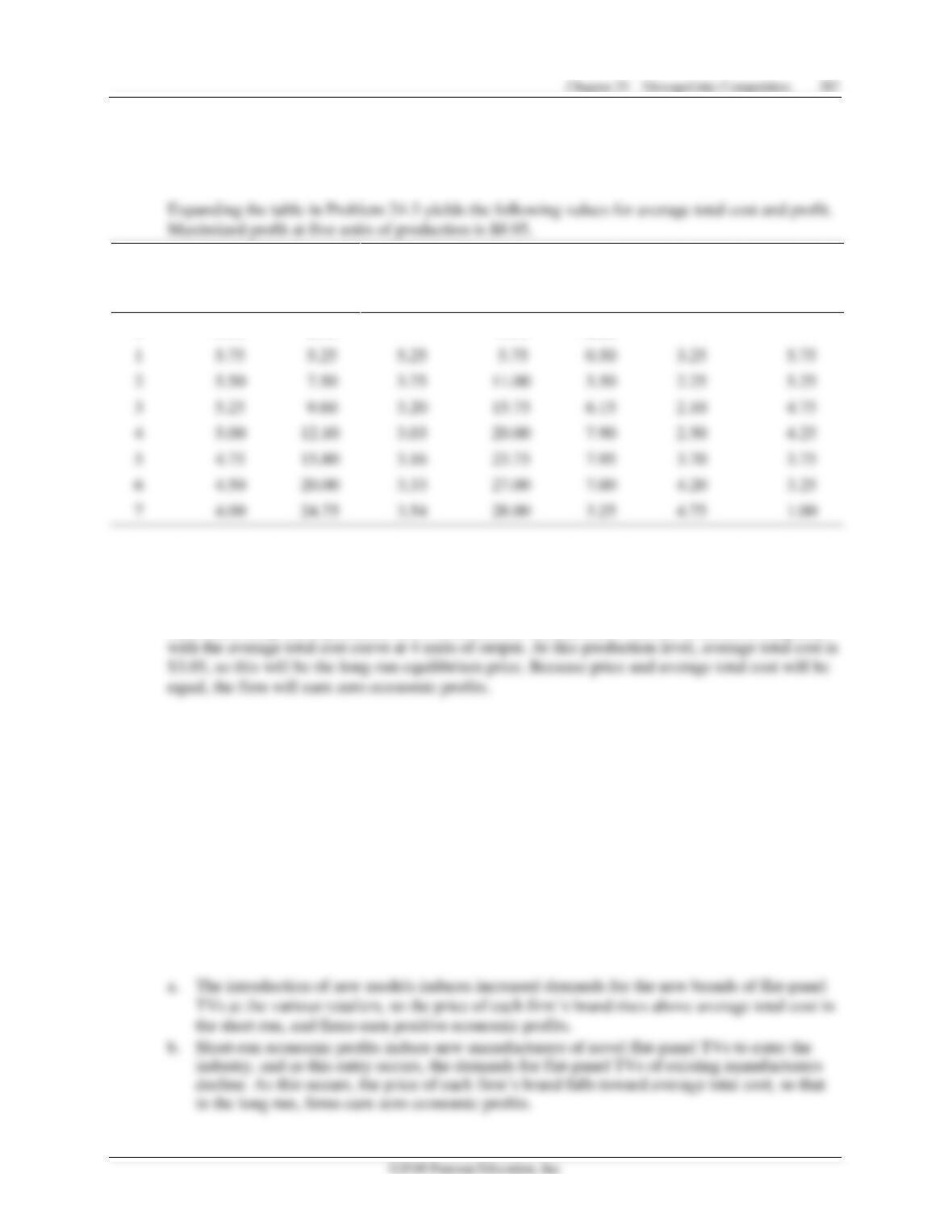
25-6. Calculate total average costs for the bookstore in Problem 25-5. Illustrate the store’s short–
run equilibrium by plotting demand, marginal revenue, average total costs, and marginal
costs. What is its total profit?
Output
Price
($ per
Unit)
Total
Costs ($)
Average
Total Costs
($ per unit)
Total
Revenue
($)
Total
Profit
($)
Marginal
Cost
($ per unit)
Marginal
Revenue
($ per unit)
0
6.00
2.00
—
0.00
−2.00
—
—
25-7. Suppose that after long-run adjustments take place in the used-book market, the business in
Problem 25-5 ends up producing 4 units of output. What are the market price and economic
profits of this monopolistic competitor in the long run?
After these long-run adjustments have occurred, the demand curve will have shifted to tangency
25-8. It is a typical Christmas electronics shopping season, and makers of flat-panel TVs are
marketing the latest available models through their own Web sites as well as via retailers
such as Best Buy and Wal-Mart. Each manufacturer offers its own unique versions of flat-
panel TVs in differing arrays of shapes and sizes. As usual, each is hoping to maintain a
stream of economic profits earned since it first introduced these most recent models late last
year or perhaps just a few months before Christmas. Nevertheless, as sales figures arrive at
the headquarters of companies such as Dell, Samsung, Sharp, and Sony, it is clear that most
of the companies will end up earning only a normal rate of return this year.
a. How can makers of flat-panel TVs earn economic profits during the first few months
after the introduction of new models?
b. What economic forces result in the dissipation of economic profits earned by
manufacturers of flat-panel TVs?
25-9. Classify each of the following as an example of direct, interactive, and/or mass marketing.
a. The sales force of a pharmaceutical company visits physicians’ offices to promote new
medications and to answer physicians’ questions about treatment options and possible
side effects.
b. A mortgage company targets a list of specific low-risk borrowers for a barrage of e-mail
messages touting its low interest rates and fees.
c. An online bookseller pays fees to an Internet search engine to post banner ads relating
to each search topic chosen by someone conducting a search. In part, this helps promote
the bookseller’s brand, but clicking on the banner ad also directs the person to a Web
page displaying books on the topic that are available for purchase.
d. A national rental car chain runs advertisements on all of the nation’s major television
networks.
25-10. Classify each of the following as an example of direct, interactive, and/or mass marketing.
a. A cosmetics firm pays for full-page display ads in a number of top women’s magazines.
b. A magazine distributor mails a fold-out flyer advertising its products to the addresses of
all individuals it has identified as possibly interested in magazine subscriptions.
c. An online gambling operation arranges for popup ads to appear on a digital device’s
screen every time a person uses a media player to listen to digital music or play video
files, and clicking on the ads directs an individual to its Web gambling site.
d. A car dealership places advertisements in newspapers throughout the region where
potential customers reside.
25-11. Categorize each of the following as an experience good, a search good, or a credence good or
service, and justify your answer.
a. A heavy-duty filing cabinet
b. A restaurant meal
c. A wool overcoat
d. Psychotherapy
a. Search good. Given the knowledge that it is a heavy-duty filing cabinet, a photo and description
25-12. Categorize each of the following as an experience good, a search good, or a credence good or
service, and justify your answer.
a. Services of a carpet cleaning company
b. A new cancer treatment
c. Athletic socks
d. A silk necktie
a. Experience good. How well the company’s employees clean a carpet can be assessed only by
25-13. In what ways do credence goods share certain characteristics of both experience goods and
search goods? How do credence goods differ from both experience goods and search goods?
Why does advertising of credence goods commonly contain both informational and
persuasive elements? Explain your answers.
Consumers may be able to assess certain features of a credence good in advance of purchase, so
in this sense a credence good is similar to a search good. Consumers lack expertise to evaluate the
ads for credence goods also commonly include persuasive elements.
25-14. Is each of the following items more likely to be the subject of an informational or a
persuasive advertisement? Why?
a. An office copying machine
b. An automobile loan
c. A deodorant
d. A soft drink
a. Informational advertising. A copying machine is a search good that provides basic functions,
25-15. Discuss the special characteristics of an information product, and explain the implications for
a producer’s short-run average and marginal cost curves. In addition, explain why having a
price equal to marginal cost is not feasible for the producer of an information product.
Typically, the fixed costs of producing an information product are relatively high, while average
25-16. A firm that sells e-books—books in digital form downloadable from the Internet—sells all
e-books relating to do-it-yourself topics (home plumbing, gardening, and the like) at the
same price. At present, the company can earn a maximum annual profit of $25,000 when it
sells 10,000 copies within a year’s time. The firm incurs a 50-cent expense each time a
consumer downloads a copy, but the company must spend $100,000 per year developing
new editions of the e-books. The company has determined that it would earn zero economic
profits if price were equal to average total cost, and in this case it could sell 20,000 copies.
Under marginal cost pricing, it could sell 100,000 copies.
a. In the short run, what is the profit-maximizing price of e-books relating to do-it–
yourself topics?
b. At the profit-maximizing quantity, what is the average total cost of producing e-books?
a. The firm’s total costs equal total fixed costs of $100,000 plus total variable costs, or $0.50 per
25-17. Take a look at panel (a) of Figure 25-1, and assume that it initially applies to a typical firm
in a monopolistically competitive industry. Explain how it might be possible for this firm
temporarily to find itself in a situation such as that depicted in panel (b) during the process
of adjustment from panel (a) to a final long-run equilibrium as shown in panel (c).
In panel (a), the typical firm experiences positive economic profits. Substantial entry by new
25-18. Take a look at panel (b) of Figure 25-1, and assume that it initially applies to a typical firm
in a monopolistically competitive industry. Explain how it might be possible for this firm
temporarily to find itself in a situation such as that depicted in panel (a) during the process
of adjustment form panel (b) to a final long-run equilibrium as shown in panel (c).
25-19. In what fundamental ways does the monopolistic competitor in panel (b) of Figure 25-2
behave similarly to the perfectly competitive firm in panel (a) in a long-run equilibrium?
In what fundamental ways does the monopolistically competitive firm behave differently?
25-20. At every point along the AFC curve in Figure 25-4, what is true of the explicit dollar
amount of this firm’s total fixed costs at any given point that one might select, such as the
three points displayed along the AFC curve in the figure?
25-21. Take a look at panel (a) of Figure 25-5. Suppose that during the relevant time period, the
firm’s marginal and average variable costs remain unchanged. The firm’s total fixed costs,
however, rise from $250,000 to $300,000. If the firm had to set the price of its information
product equal to marginal cost, what would be the amount of its economic profit, or loss
following the increase in its total fixed costs?
25-22. Consider panel (b) of Figure 25-5, in which the ATC curve and associated data are the
same-drawn at a slightly different scale, however-as in Figure 25-4. Suppose that the shape
of the demand curve faced by the firm in panel (b) changes in such a way that it becomes
tangent to the ATC curve at a price of $5 per unit. What will happen to this firm’s long-run
output rate and economic profits as a result?
◼ Selected References
Bain, Joe S., “Relation or Profit-Rate to Industry Concentration: American Manufacturing, 1936–1940,”
392 Miller • Economics Today, Nineteenth Edition
Fellner, William, Competition Among the Few, New York: Knopf, 1950.
Kilpatrick, R. W., “Stigler on the Relationship between Industry Profit Rates and Market Concentration,”
Journal of Political Economy, May–June 1968, pp. 479–488.
MacAvoy, Paul W., et al., “High and Stable Concentration Levels, Profitability and Public Policy:
A Response,” Journal of Law and Economics, October 1971, pp. 493–500.