Chapter 24
Monopoly
◼ Overview
In this chapter, monopoly is defined, and its causes and implications are discussed. Various possible barriers
to entry are identified and examined in this process. Another objective is to differentiate between the
monopolist’s demand curve and that of the perfect competitor’s. Because the monopolist’s demand curve
◼ Learning Objectives
After studying this chapter, students should be able to:
• 24.1 Identify situations that can give rise to monopoly
• 24.2 Describe the demand and marginal revenue conditions a monopolist faces
• 24.3 Discuss how a monopolist determines how much output to produce, what price to charge, and the
amount of its profits
• 24.4 Understand price discrimination
• 24.5 Explain the social cost of monopolies
◼ Outline
I. Defining and Explaining the Existence of Monopoly: A monopolist is a single supplier that
comprises its entire industry for a good or service for which there is no close substitute.
A. The Monopolist as the Industry: In a monopoly, the firm (the monopolist) and the industry
are one and the same.
B. Barriers to Entry: For any amount of monopoly power to continue to exist in the long run,
the market must be closed to entry in some way. Either legal means or certain aspects of the
industry’s technical or cost structure may prevent entry.
2. Economies of Scale: When economies of scale exist, firms with larger output have lower
a. The Phenomenon of Economies of Scale: A situation in which demand is insufficient
to allow for more than one producer in a market because of economies of scale.
b. Natural Monopoly: A natural monopoly arises when there are large economies of
3. Legal or Governmental Restrictions
a. Licenses, Franchises, and Certificates of Convenience: It is illegal to enter many
b. Patents: A patent is issued to an inventor to provide protection from having the
invention copied or stolen for a period of 20 years. The patent holder has a monopoly.
c. Regulations: Government regulation has increased in the interest of safety and quality.
Large expenditures have been necessary by certain industries to comply. Large fixed
d. Tariffs: Tariffs are special taxes imposed on certain imported goods. If tariffs are high
enough, imports become overpriced and domestic producers gain a monopoly
advantage as the only suppliers.
II. The Demand Curve a Monopolist Faces: The monopolist faces the market demand curve because
the monopolist is the industry.
A. Profit to Be Made from Increasing Production: Firms may benefit by changing production
rates.
1. Marginal Revenue for the Perfect Competitor: Marginal revenue is the change in total
2. Marginal Revenue for the Monopolist: Because a monopolist is the entire industry, the
3. Perfect Competition versus Monopoly: The perfectly competitive firm faces a perfectly
B. The Monopolist’s Marginal Revenue: Less Than Price: A monopolist’s marginal revenue is
C. Elasticity and Monopoly: The price elasticity of demand for the monopolist depends on the
number and similarity of imperfect substitutes for its product. The more numerous and more
364 Miller • Economics Today, Nineteenth Edition
III. Costs and Monopoly Profit Maximization: The pure monopolist, and the perfect competitor, both
seek a profit-maximizing price and output combination.
A. Price Searching to Maximize Monopoly Profits: The monopolist is a price searcher, that is, a
firm that, because it faces a downward-sloping demand curve, must determine the price–
output combination that maximizes profit. The profit-maximizing price–output combination
can be determined by looking at total revenues and total costs or by looking at marginal
revenues and marginal costs. (See Figures 24-4 and 24-5.)
1. The Total Revenues–Total Costs Approach: Profit maximization involves maximizing
2. The Marginal Revenue–Marginal Cost Approach: Profit maximization occurs where
a. Equalizing Marginal Revenue and Marginal Cost
b. Why Produce Where Marginal Revenue Equals Marginal Cost? If the monopolist
B. What Price to Charge for Output? The monopolist sets quantity where marginal cost equals
marginal revenue and then finds out the highest price the market will bear at that quantity.
1. The Monopoly Price: The way of finding the profit-maximizing short-run price-quantity
2. Real-World Informational Limitations: In the real world, the demand curve can only be
C. Calculating Monopoly Profit
1. The Graphical Depiction of Monopoly Profits: The monopolist is maximizing profits by
producing an output (Q) where marginal cost equals marginal revenue and setting price at
2. No Guarantee of Profits: The mere existence of a monopoly does not guarantee high
IV. On Making Higher Profits: Price Discrimination: Price discrimination is selling a given product
at more than one price, with the price difference being unrelated to differences in marginal cost.
Price discrimination is different from price differentiation in which price differences reflect
differences in the marginal cost of providing a good to different groups of buyers.
A. Necessary Conditions for Price Discrimination
1. The firm must face a downward-sloping demand curve.
V. The Social Cost of Monopolies
A. Comparing Monopoly with Perfect Competition (See Figure 24-8.)
1. The Monopolist’s Price and Quantity: The monopolist looks at the marginal revenue
B. Implications of Higher Monopoly Prices: P MC for the monopolist compared to P = MC
for a competitive industry. Marginal cost (MC) represents what society had to give up in order
to have the last unit produced. Price (P) represents society’s valuation of the last unit produced.
When P MC, the value of the last unit of the good is greater than its cost and not enough of
the good is being produced.
1. Underproduction at a Higher Price: The differences between monopoly and perfect
2. A Key Assumption: The monopolization of the perfectly competitive industry does not
◼ Points to Emphasize
Profit Maximization
The general model of economic rationality can be used in this chapter. Even though marginal revenue is
less than price, it is often viewed as the marginal benefit of selling one more unit. It can be helpful to
Monopolies and the Government
A significant minority of economists believes that government is the source of monopoly and only special
privilege granted and enforced by government can prolong monopoly power in the long run. Monopoly
power in unregulated markets erodes over time because of the forces of competition, domestic and
international. One of the most important examples of an unregulated monopoly in the United States was
366 Miller • Economics Today, Nineteenth Edition
these were government created and enforced cartels. When the Civil Aeronautics Board deregulated the
airlines during October 1977 to July 1978, average air fares fell by 10 percent, while the average price
Misconceptions about Monopoly
1. It is commonly believed that monopolists charge the “highest price possible.” A monopolist does
not try to maximize price. It attempts to maximize profits. Profit maximization requires that the
2. Another misconception is that a monopolist always earns economic profits. Even a
governmentally granted and enforced monopoly may not be able to earn economic profits. If the
3. Finally, it should be realized that the rational monopolist does not maximize total revenues. Total
profit maximization is the goal. Suppose that at current prices the monopolist is operating in an
Price Discrimination
Examples of price discrimination abound. Profit-maximizing physicians could charge one price to lower-
income patients and higher prices to higher-income patients. Such price discrimination is possible because
it is not possible for patients to resell their surgical operations or other medical treatments.
Movie theaters, amusement parks, and many other places tend to give discount prices for children.
Presumably, adults with children have more highly price-elastic demand than do adults with no children.
Airlines engage in price discrimination based on how far in advance a buyer is willing to purchase a ticket
or on whether the buyer wants a confirmed seat or is willing to fly standby. Tickets cannot be resold.
Chapter 24 Monopoly 367
◼ For Those Who Wish to Stress Theory
A Monopoly Market and the Supply Curve
A monopoly market (or any market in which firms have market power) has no supply curve. To demonstrate
Long-Run Monopoly Profits
Some economists doubt that monopoly profits exist in the long run because they simply become capitalized.
◼ Further Questions for Class Discussion
1. Firms have coupons printed in newspapers, which can provide a discount on one of their products
if the consumer buys the product, to induce consumers to buy (or try) their product. This is
considered a form of price discrimination. Why? To cut out, collect, and redeem coupons for
2. Why will a profit-maximizing monopolist only operate in the elastic portion of its demand curve?
3. A cartel is an association of producers of the same product, which has the goal of increasing
profits. Why is it necessary for cartels to reduce output in an attempt to achieve this goal? The
4. For years, many cities, such as New York, Las Vegas, and Denver, limited the number of cabs
5. Chimney sweeps in Germany must be licensed by the central government. Each chimney sweep
can only clean chimneys in a given town, part of a city, or given rural area. In addition, the
government requires every home with a chimney to be cleaned at regular intervals, and the home
6. Pharmaceutical companies have begun the practice of charging customers who cannot afford
some of their highest priced products, such as prescription cancer drugs, less than what they
charge those with insurance to cover the drugs or those who have enough money to pay for them.
◼ Answers to Questions for Critical Analysis
A Tombstone law Is a Grave Barrier to Entry in New Jersey (p. 538)
Who gained from passage of the New Jersey law? Explain briefly.
Want to Raise Prices of Heart Drugs? Create a Monopoly Seller (p. 545)
What do you suppose happened to the profit-maximizing quantities of heart drugs produced and
sold by the new pharmaceutical monopoly?
Can Firms Use “Big Data” and Complicated Pricing to “Gouge” Consumers?
(p.548)
What essential economic conditions must be satisfied for firms to succeed in utilizing big data
techniques to engage in price discrimination that increases their profits?
Chapter 24 Monopoly 369
◼ You Are There
A Legal Barrier to Entry Prevents Lemonade Sales by Two Young Sisters
(pp. 550–551)
1. How does the act of forbidding competitors such as Andria and Zoey from selling cold
drinks on the street affect the prices that legally licensed sellers can obtain for their cold
drinks?
2. What is the effect of Overton’s barrier to entry on the total quantity of cold drinks sold by
the city’s food-and-beverage retailing industry?
◼ Issues and Applications
Why a French Dealer of Illegal Drugs Provides Loyalty Discount Cards
(pp. 550–551)
1. Why do you suppose that the Marseilles drug dealer also seeks to prevent customers from
reselling drugs to other buyers?
2. Is there any economic difference between a customer-loyalty-card program offered by a
legitimate drugstore and the program established by the Marseilles drug dealer?
◼ Research Project
1. For contemplate various reasons, including price discrimination, that businesses sometimes offer
370 Miller • Economics Today, Nineteenth Edition
◼ Appendix G—Consumer Surplus and the Deadweight Loss
Resulting from Monopoly
I. Consumer Surplus in a Perfectly Competitive Market (See Figure G-1.)
II. How Society Loses from Monopoly
A. Implications of Monopoly for Consumer Surplus: The monopolist transfers a portion of the
◼ Answers to Problems
24-1. The following table depicts the daily output, price, and costs of a monopoly dry cleaner
located near the campus of a remote college town.
Output
(suits cleaned)
Price per Suit
($)
Total Costs
($)
0
8.00
3.00
1
7.50
6.00
2
7.00
8.50
3
6.50
10.50
4
6.00
11.50
5
5.50
13.50
6
5.00
16.00
7
4.50
19.00
8
4.00
24.00
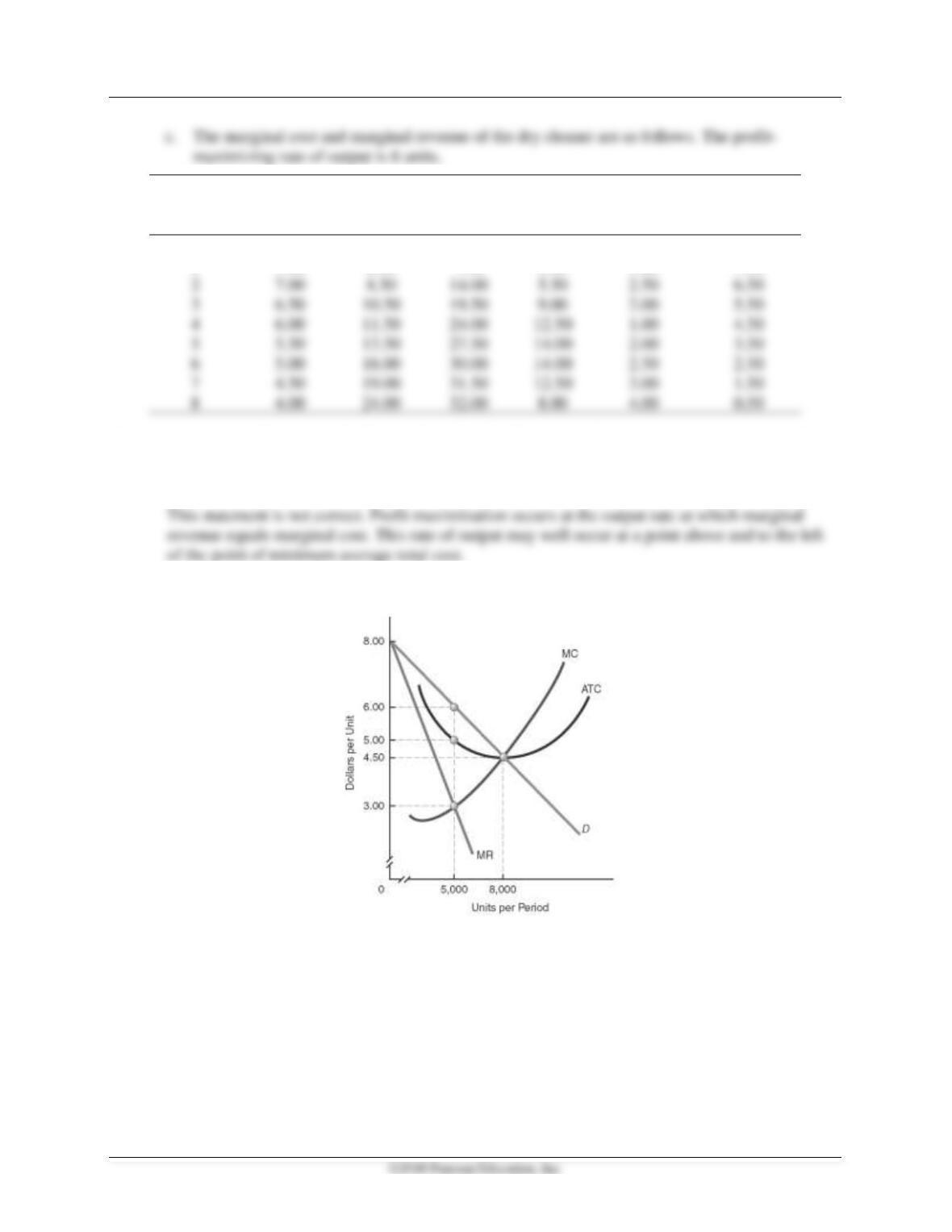
a. Compute revenues and profits at each output rate.
b. What is the profit-maximizing rate of output?
c. Calculate the dry cleaner’s marginal revenue and marginal cost at each output level.
What is the profit-maximizing level of output?
Output
(suits cleaned)
Price per Suit
($)
Total Costs
($)
Total
Revenue ($)
Total Profit
($)
0
8.00
3.00
0
–3.00
Chapter 24 Monopoly 371
Output
(suits
cleaned)
Price per
Suit
($)
Total
Costs ($)
Total
Revenue
($)
Total
Profit
($)
Marginal
Cost
($ per unit)
Marginal
Revenue ($
per unit)
0
8.00
3.00
0
–3.00
—
—
1
7.50
6.00
7.50
1.50
3.00
7.50
2
7.00
8.50
3
6.50
10.50
9.00
2.00
5.50
4
6.00
11.50
1.00
4.50
5
5.50
6
5.00
16.00
2.50
2.50
8
4.00
24.00
8.00
4.00
0.50
24-2. A manager of a monopoly firm notices that the firm is producing output at a rate at which
average total cost is falling but is not at its minimum feasible point. The manager argues
that surely the firm must not be maximizing its economic profits. Is this argument correct?
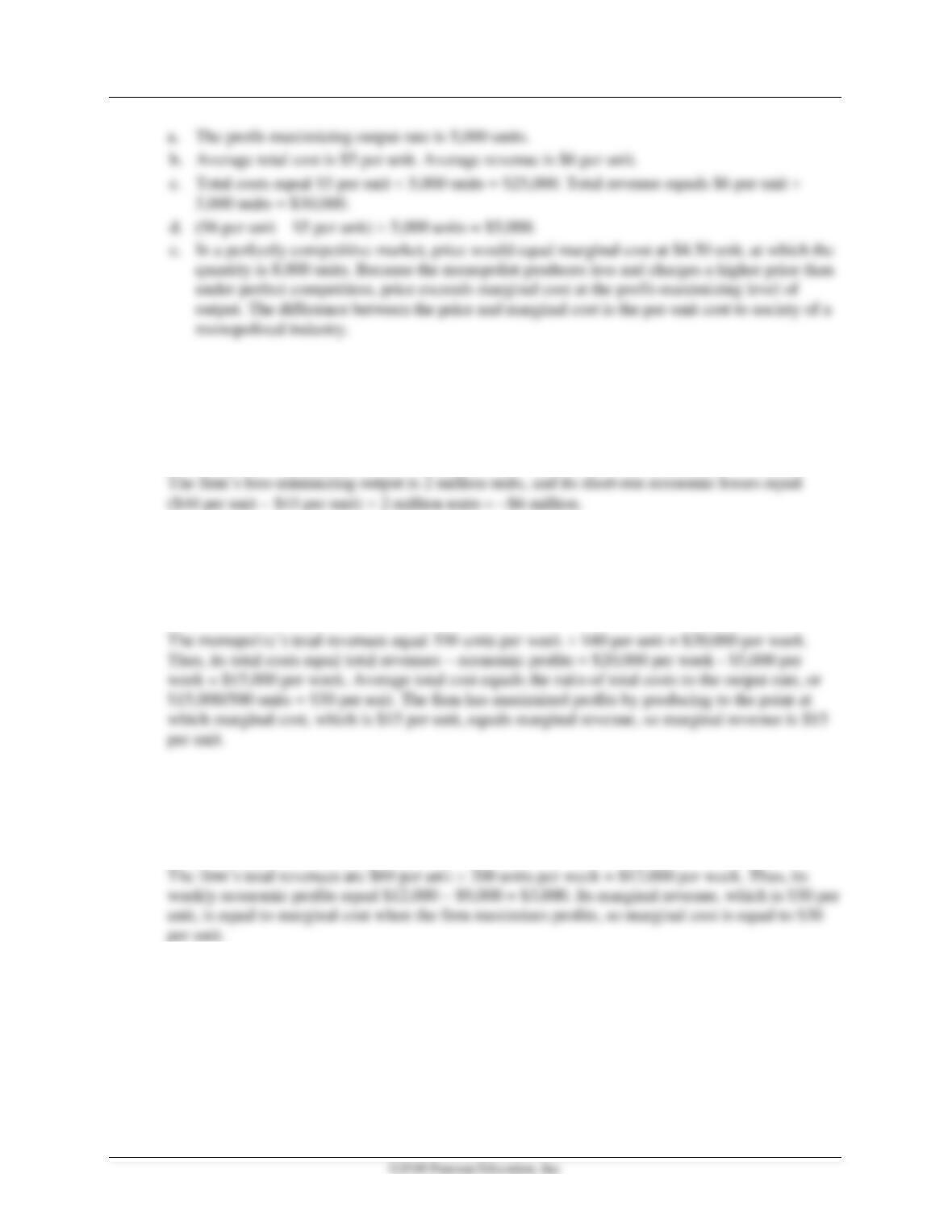
24-3. Use the following graph to answer the questions that follow.
a. What is the monopolist’s profit-maximizing output?
b. At the profit-maximizing output rate, what are average total cost and average revenue?
c. At the profit-maximizing output rate, what are the monopolist’s total cost and total
revenue?
d. What is the maximum profit?
e. Suppose that the marginal cost and average total cost curves in the diagram also illustrate
the horizontal summation of the firms in a perfectly competitive industry in the long run.
What would the equilibrium price and output be if the market were perfectly competitive?
Explain the economic cost to society of allowing a monopoly to exist.
372 Miller • Economics Today, Nineteenth Edition
24-4. The marginal revenue curve of a monopoly crosses its marginal cost curve at $30 per unit
and an output of 2 million units. The price that consumers are willing to pay for this output
is $40 per unit. If it produces this output, the firm’s average total cost is $43 per unit, and
its average fixed cost is $8 per unit. What is the profit-maximizing (loss- minimizing)
output? What are the firm’s economic profits (or economic losses)?
24-5. A monopolist’s maximized rate of economic profits is $5,000 per week. Its weekly output is
500 units, and at this output rate, the firm’s marginal cost is $15 per unit. The price at
which it sells each unit is $40 per unit. At these profit and output rates, what are the firm’s
average total cost and marginal revenue?
24-6. Currently, a monopolist’s profit-maximizing output is 200 units per week. It sells its output
at a price of $60 per unit and collects $30 per unit in revenues from the sale of the last unit
produced each week. The firm’s total costs each week are $9,000. Given this information,
what are the firm’s maximized weekly economic profits and its marginal cost?
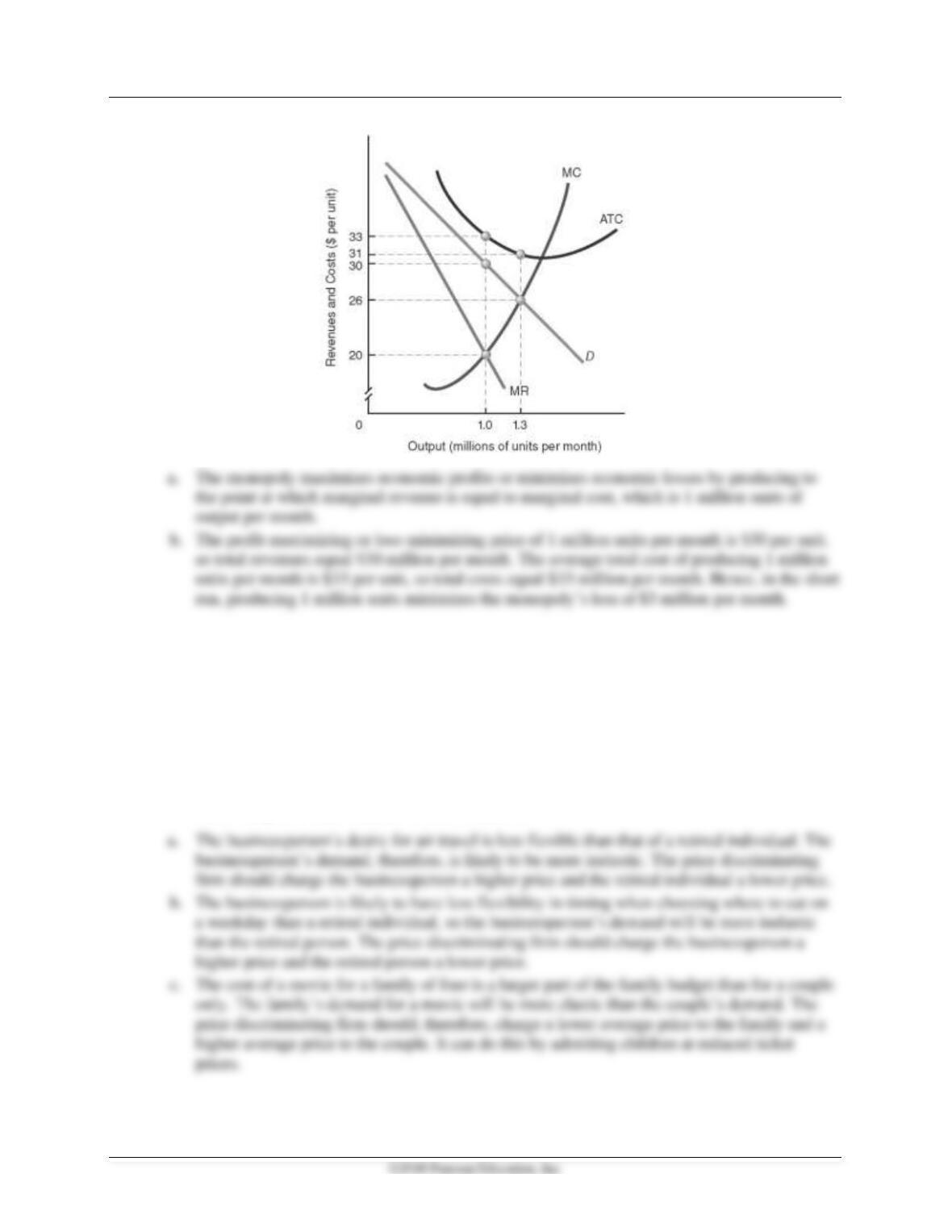
24-7. Consider the revenue and cost conditions for a monopolist that are depicted in the figure at
the top of the next page.
a. If price exceeds AVC, what is this producer’s profit-maximizing (or loss-minimizing)
output?
b. What are the firm’s economic profits (or losses)?
Chapter 24 Monopoly 373
24-8. For each of the following examples, explain how and why a monopoly would try to price
discriminate.
a. Air transport for businesspeople and tourists
b. Serving food on weekdays to businesspeople and retired people. (Hint: Which group has
more flexibility during a weekday to adjust to a price change and, hence, a higher price
elasticity of demand?)
c. A theater that shows the same movie to large families and to individuals and couples.
(Hint: For which set of people will the overall expense of a movie be a larger part of
their budget, so that demand is more elastic?)
24-9. A monopolist’s revenues vary directly with price. Is it maximizing its economic profits?
Why or why not? (Hint: Recall that the relationship between revenues and price depends on
price elasticity of demand.)
24-10. A new competitor enters the industry and competes with a second firm, which had been a
monopolist. The second firm finds that although demand is not perfectly elastic, it is now
more elastic. What will happen to the second firm’s marginal revenue curve and to its
profit-maximizing price?
24-11. A monopolist’s marginal cost curve has shifted upward. What is likely to happen to the
monopolist’s price, output rate, and economic profits?
24-12. Demand has fallen. What is likely to happen to the monopolist’s price, output rate, and
economic profits?
24-13. Suppose that in Figure 24-4, the monopolist knows that if it were to reduce the price of its
product to $5.40 per unit, the quantity demanded-and hence its output-would rise to 13
units per week. What would be the marginal revenue that the monopolist would derive from
producing and selling a 13th unit?
24-14. Consider the information from Problem 24-13. If the total costs of producing 13 units were
equal to $72.70 per week, would the marginal revenue of producing the 13th unit (your answer
to Problem 24-13) be greater or less than the marginal cost of producing that unit? How
would the firm’s weekly economic profits be affected if the firm were to produce the 13th unit?
24-15. Take a look a Figure 24-5. Suppose that Q1 is equal to 25 units of output per time period. If
the vertical distance to point A is $10 per unit and the vertical distance to point B is $4 per
unit, then by how much does producing the 25th unit of output affect the firm’s economic
profits?
24-16. Take a look a Figure 24-5. Suppose that Q2 is equal to 35 units of output per time period. If
the vertical distance to point C is $6 per unit and the vertical distance to point B is $3 per
unit, then by how much does producing the 35th unit of output affect the firm’s economic
profit?
24-17. Take a look a Figure 24-6. Suppose that Qm is 9.5 units per week, that Pm is $6.10 per unit
and that the average total cost of producing the 9.5 units is $4.26 per unit. What is the
dollar amount of maximized monopoly profits displayed by the green area?
24-18. Suppose that initially the data in Problem 24-17 apply, but then an increase in fixed costs
occurs. As a result, the ATC curve in Figure 24-6 shifts upward, As a result, the average
total cost of producing 9.5 units of output rises to $5 per unit. Does the monopolist’s profit-
maximizing weekly output rise, fall, or remain the same? What is the new amount of
maximized weekly economic profits?
◼ Selected References
Brozen, Yale, “Is Government the Source of Monopoly?” The Intercollegiate Review, Winter 1968–69.
The Competitive Economy, Morristown, NJ: General Learning Press, 1975.
376 Miller • Economics Today, Nineteenth Edition
Liebeler, Wesley J., “Market Power and Competitive Superiority in Concentrated Industries,” UCLA Law
Review 25, 1978.
Mansfield, Edwin, Monopoly Power and Economic Performance, 3rd ed., New York: Norton, 1974.
Miller, Roger LeRoy and Roger Meiners, Intermediate Microeconomics: Theory, Issues, and
Applications, 4th ed., New York: McGraw-Hill, 1987.