Chapter 23
Perfect Competition
◼ Overview
The main objective of this chapter is to present the model of perfect competition. Its characteristics,
why the perfectly competitive firm faces a horizontal demand curve, and its profit-maximizing rate of
output are discussed. The firm’s break-even and shutdown points are analyzed. An important objective
◼ Learning Objectives
After studying this chapter, students should be able to:
• 23.1 Identify the characteristics of a perfectly competitive market structure
• 23.2 Discuss the process by which a perfectly competitive firm decides how much output to produce
◼ Outline
I. Characteristics of a Perfectly Competitive Market Structure: Perfect competition is a market
A. What It Means for a Firm to Be a Price Taker: Each firm is so small that it cannot
B. Characteristics of Perfect Competition
2. The product sold by the firms in the industry is homogeneous.
4. Any firm can enter or leave the industry without serious impediments.
Chapter 23 Perfect Competition 347
II. Profit-Maximizing Choices of a Perfectly Competitive Firm: Because the perfectly competitive
firm produces a homogeneous commodity, the individual firm will lose all of its business if it raises
A. How Much Should the Perfect Competitor Produce? The firm has only one decision: how
much should it produce?
1. Total Revenues: Total revenue is the price per unit times the total quantity sold. Market
price and average revenue are the same:
2. Comparing Total Costs with Total Revenues: The firm will maximize profits where the
B. Using Marginal Analysis to Determine the Profit-Maximizing Rate of Production: The use
1. Marginal Revenue: The change in total revenues resulting from a change in output of one
unit of the product in question. It is the change in total revenue divided by the change in
output. (See Figure 23-2.)
2. When Are Profits Maximized? The marginal cost curve initially falls and then starts to
rise. Marginal revenue is constant and equals price.
a. Equalizing Marginal Revenue and Marginal Cost: The firm has an incentive to
III. Short-Run Supply under Perfect Competition
A. Short-Run Profits: Total profits or losses can be computed as TR − TC or as (P − ATC) Q at
the profit-maximizing rate of output. (See Figures 23-2 and 23-3.)
1. A Graphical Depiction of Maximum Profits: The example shows economic profits where
B. The Short-Run Break-Even Price and the Short-Run Shutdown Price: In the short run, the
firm will not shut down as long as the loss from staying in business is less than the loss from
fixed costs. (See Figure 23-5.)
1. Calculating the Short-Run Break-Even Price: The prices at which a firm’s total
2. Calculating the Short-Run Shutdown Price: The price that just covers average variable
costs.
3. The Meaning of Zero Economic Profits: The average total cost curve includes the full
a. Accounting Profits versus Economic Profits: Accounting profits at the break-even
D. The Short-Run Industry Supply Curve (See Figure 23-7.)
2. Constructing the Industry Supply Curve: The short-run industry supply curve is the
E. Factors That Influence the Industry Supply Curve: Anything that affects the marginal cost
curves of the firms will influence the industry supply curve. These are factors that cause the
IV. Price Determination under Perfect Competition
A. The Market Clearing Price: The industry demand curve is a representation of the demand
curve for all potential consumers. The short-run industry supply curve is the horizontal
curves determines the equilibrium or market price. (See Figure 23-8.)
B. Market Equilibrium and the Individual Firm: The individual firm demand curve is set at the
V. The Long-Run Industry Situation: Exit and Entry
A. Exit and Entry of Firms: If firms in an industry are making economic profits, this will signal
owners of capital elsewhere in the economy that they should enter this industry. If firms in an
1. Allocation of Capital and Market Signals: Signals are compact ways of conveying to
economic decision makers information needed to make decisions. An effective decision,
2. Tendency Toward Equilibrium: There is only a tendency for markets to move to competitive
B. Long-Run Industry Supply Curves: A market supply curve that shows the relationship between
prices and quantities after firms have been allowed the time to enter into or exit from an industry,
depending on whether there have been positive or negative economic profits. (See Figure 23-9.)
1. Constant-Cost Industries: Industries whose total output can be increased without an
C. Long-Run Equilibrium: In the long run, the firm can change the scale of its plant, adjusting its
plant size in such a way that it has no further incentive to change.
1. The Firm’s Long-Run Situation: Given a price of P and a marginal cost curve MC, the
firm produces output at which economic profits must be zero in the long run. The firm’s
2. Perfect Competition and Minimum Average Total Cost: Under conditions of perfect
D. Competitive Pricing: Marginal Cost Pricing: Competitive pricing is a system of pricing in
which the price charged for the last unit produced is equal to the opportunity cost to society of
1. Marginal Cost Pricing: A system of pricing in which the price charged is equal to the
a. Matching the Consumer’s Marginal Benefit: The marginal benefit to consumers
b. The Efficiency of Marginal Cost Pricing: When the consumer pays a price equal to
2. Market Failure: A situation in which an unrestrained market operation leads to either too
350 Miller • Economics Today, Nineteenth Edition
◼ Points to Emphasize
The Law of Diminishing Returns and Short-Run Supply
Marginal Cost and Supply
Having demonstrated the firm’s upward-sloping short-run marginal cost curve, the short-run supply
schedule for the competitive firm can be derived. A successful classroom technique is to graph and
Niels Bohr and the Perfectly Competitive Stock Market
In a 1964 biography of Nobel Prize-winning physicist Niels Bohr, it was reported that he had made some
very insightful remarks about the stock market. Consider a model consisting of three groups of stock
Profits and Resource Allocation
The crucial role of profits in allocating resources should be stressed. Profits are so often thought of by many
students as somehow being a bad thing. Often, students can be shown that their choice of a major can be
Chapter 23 Perfect Competition 351
Asymmetry of Information
A perfectly competitive market requires that both buyers and sellers have equal access to information.
Information is costly, however, and companies do not have an incentive to tell consumers voluntarily
about potential problems with their products. A few years ago, Ford knew that its Pinto had a gasoline
◼ For Those Who Wish to Stress Theory
The Rational Behavior Model
The analysis can be carried on in terms of any activity. An activity will be increased when marginal
benefit (MB) marginal cost (MC). An activity will be decreased or not be carried out if MC MB. The
model can be applied successfully if MB and MC are in the same units and MC increases relative to MB.
Plot total net benefit on the y–axis and the quantity of some activity per unit of time on the x-axis.
Initially, total net benefit will rise (where MB MC), then it falls when MC MB. The maximization
The Concept of Pareto Optimality
A Pareto optimum exists when it is no longer possible for anyone to gain from voluntary exchange. The
basic idea is that it is not possible to make one person better off without making someone else worse off
given the existing distribution of income. Perfect competition will, in the absence of market failure, lead to a
352 Miller • Economics Today, Nineteenth Edition
◼ Further Questions for Class Discussion
1. During the energy crisis in the United States in the 1970s, a vigorous public campaign was
launched to encourage consumers to conserve on their electricity use. People did reduce their
2. In Chapter 3 on supply and demand, the text notes that a per-unit tax has the effect of decreasing
3. Do firms really calculate marginal cost and marginal revenue to find the profit-maximizing output?
If you examine the accounting records of most small businesses, you will be hard-pressed to find
explicit calculations of marginal cost and marginal revenue. So, why do economists develop rather
elaborate, formal models of profit maximization when no one seems to do what we say they do?
4. According to the model of perfect competition, all sellers charge the market price. But if sellers
conspire to fix prices, they also charge the same price. How might one tell if sellers are charging
5. Since the early twentieth century, the number of farms in the United States has decreased. In most
of those years, farmers earned revenues that were greater than their explicit costs, so that an
6. In the 2000s, the federal government decided to require the use of ethanol in gasoline to reduce the
emissions of greenhouse gases. To encourage production the government provided a per bushel
subsidy to corn farming to increase the amount of corn that could be used to make ethanol. What
was the effect of the subsidy on the marginal cost curve of individual corn farmers and the market
Chapter 23 Perfect Competition 353
◼ Answers to Questions for Critical Analysis
Characteristics of Perfect Competition in the Propane-Distribution Market (p. 512)
If the government were to decide to limit the number of propane distributors to a handful of firms,
would the propane-distribution industry still satisfy the characteristics of perfect competition?
Explain.
Do competition and Bad Behavior necessarily Go Together? (p. 515)
Why might firms that hire mostly untrustworthy people struggle to provide as much output in a
competitive market as firms that attract and retain mostly honest individuals?
Long-Run Supply Curve for “Rare Earths” Turn Out Not to Slope Upward After All
(p. 526)
If the price of a particular rare earth were actually to drop below its original level following entry
of new firms even as market demand continued to increase, what type of industry would exist?
◼ You Are There
Lower Recycled-Plastics Prices Cause Short-Run Shutdowns-And Exits from That
Industry (p. 528)
1. Why would a number of plastic-recycling firms continue to operate even though the market
clearing price of recycled plastic is lower than their break-even price?
2. Why might daily variations in the market clearing price of recycled plastic induce some
firms to call in their workers and pay them wages for their labor services on some days but
tell them to stay home on others?
354 Miller • Economics Today, Nineteenth Edition
◼ Issues and Applications
Just how Commonplace Are Entrances and Exits of U.S. Firms? (pp. 529–530)
1. Why do economists seeking to study industry entry and exit measure the number of firms
instead of the number of establishments? (Hint: At which level are fundamentally
independent economic decisions made by a business: the firm as a whole or an individual
sales outlet of the firm?)
2. Why are we unable to conclude that large numbers of entries into and exits from all U.S.
industries imply that all the industries are perfectly competitive? (Hint: What are the other
characteristics of perfect competition?)
◼ Research Project
2. To examine an index measure of startups of new U.S. firms, see the Web Links in MyEconLab.
◼ Answers to Problems
23-1. Explain why each of the following examples is not a perfectly competitive industry.
a. One firm produces a large portion of the industry’s total output, but there are many
firms in the industry, and their products are indistinguishable. Firms can easily exit and
enter the industry.
b. There are many buyers and sellers in the industry. Consumers have equal information
about the prices of firms’ products, which differ moderately in quality from firm to
firm.
c. Many taxicabs compete in a city. The city’s government requires all taxicabs to provide
identical service. Taxicabs are nearly identical, and all drivers must wear a designated
uniform. The government also enforces a binding limit on the number of taxicab
companies that can operate within the city’s boundaries.
23-2. Consider a market for online movie rentals. The market supply curve slopes upward, the
market demand curve slopes downward, and the equilibrium rental price equals $3.50.
Consider each of the following events, and discuss the effects they will have on the market
clearing price and on the demand curve faced by the individual online rental firm.
a. People’s tastes change in favor of going to see more movies at cinemas with their friends
and family members.
b. More online movie-rental firms enter the market.
c. There is a significant increase in the price to consumers of purchasing movies online.
a. The market demand for online rentals decreases, so the market demand curve shifts inward.
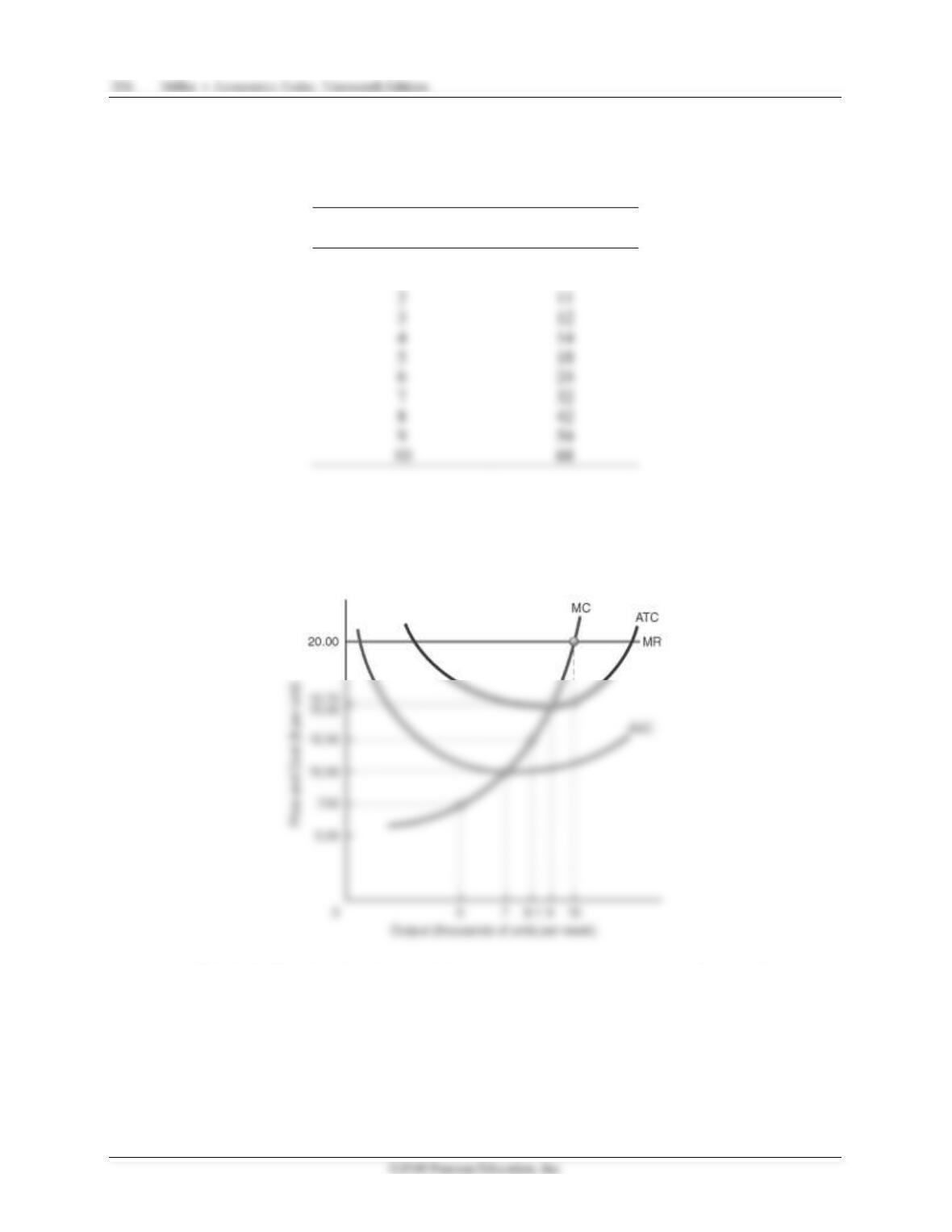
23-3. Consider the diagram in the next column, which applies to a perfectly competitive firm,
which at present faces a market clearing price of $20 per unit and produces 10,000 units of
output per week.
a. What is the firm’s current average revenue per unit?
b. What are the present economic profits of this firm? Is the firm maximizing economic
profits? Explain.
c. If the market clearing price drops to $12.50 per unit, should this firm continue to
produce in the short run if it wishes to maximize its economic profits (or minimize its
economic losses)? Explain.
d. If the market clearing price drops to $7.50 per unit, should this firm continue to
produce in the short run if it wishes to maximize its economic profits (or minimize its
economic losses)? Explain.
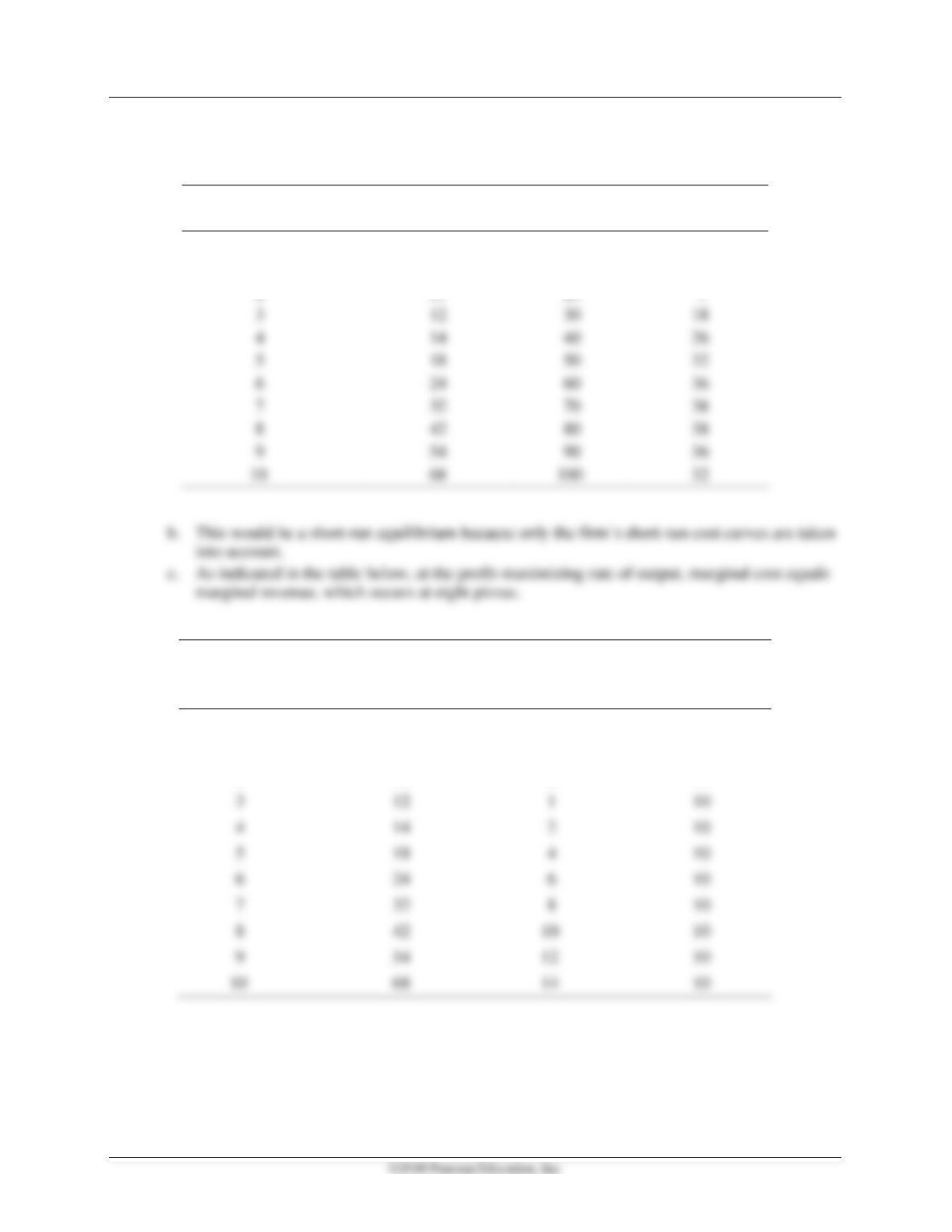
23-4. The table below represents the hourly output and cost structure for a local pizza shop. The
market is perfectly competitive, and the market price of a pizza in the area is $10. Total
costs include all opportunity costs.
Total Hourly Output
and Sales of Pizzas
Total Hourly
Cost ($)
0
5
1
9
2
3
4
5
6
7
8
9
a. Calculate the total revenue and total economic profit for this pizza shop at each rate of
output.
b. Assuming that the pizza shop always produces and sells at least one pizza per hour, does
this appear to be a situation of short-run or long-run equilibrium?
c. Calculate the pizza shop’s marginal cost and marginal revenue at each rate of output.
Based on marginal analysis, what is the profit- maximizing rate of output for the pizza
shop?
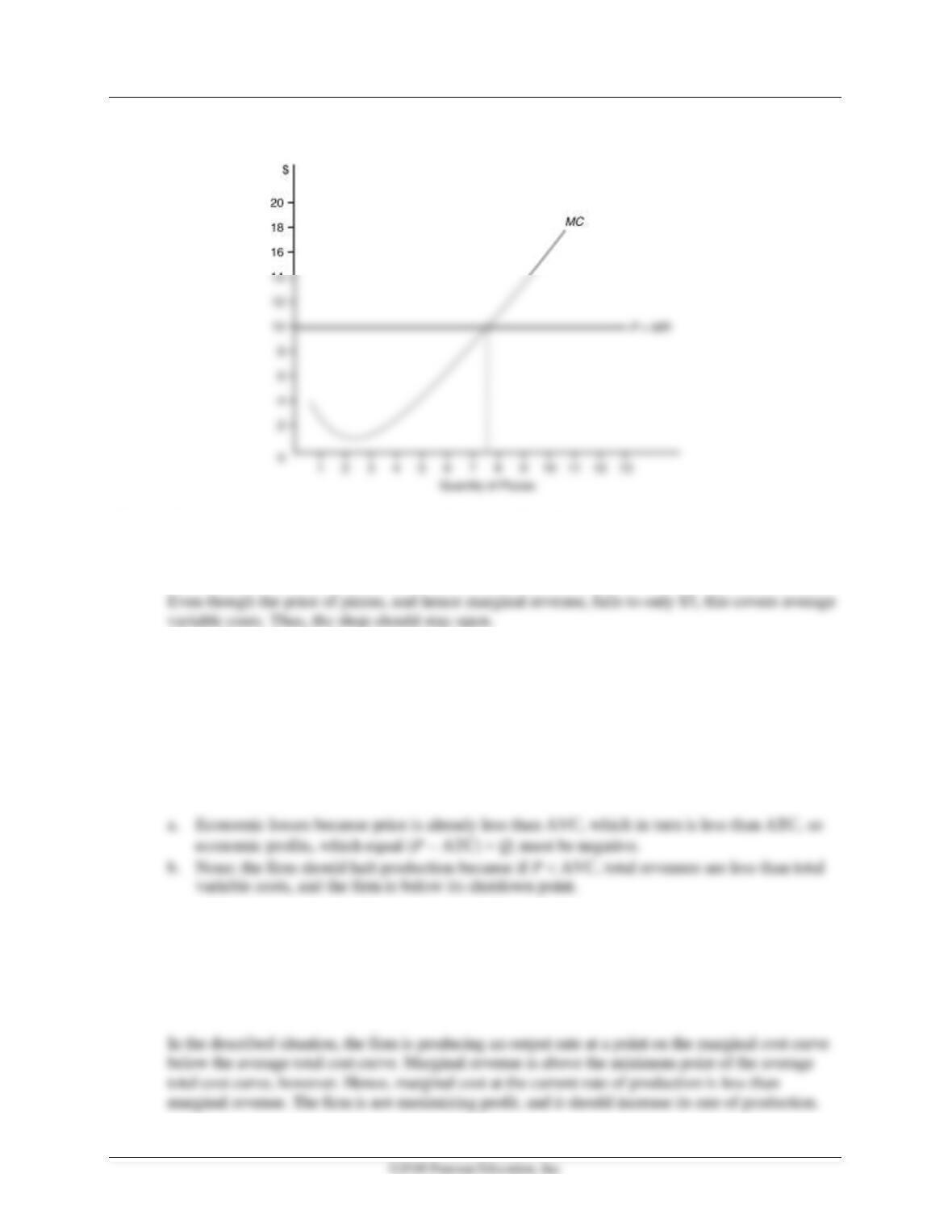
d. Draw a diagram depicting the short-run marginal revenue and marginal cost curves for
this pizza shop, and illustrate the determination of its profit-maximizing output rate.
Chapter 23 Perfect Competition 357
a. Total revenues and total costs and economic profits appear below.
Total Output and
Sales of Pizzas
Total Costs ($)
Total
Revenues ($)
Total Economic
Profits ($)
0
5
0
−5
1
9
10
1
2
11
20
9
3
12
30
4
14
40
7
32
70
8
42
80
9
54
90
10
68
Total Output
and Sales of
Pizzas
Total Costs ($)
Marginal Cost
($ per unit)
Marginal Revenue
($ per unit)
0
5
—
10
1
9
4
10
2
11
2
10
3
12
1
10
4
14
2
10
5
4
10
6
24
6
10
8
42
10
10
9
10
358 Miller • Economics Today, Nineteenth Edition
d.
23-5. Consider the information provided in Problem 23-4. Suppose the market price drops to
only $5 per pizza. In the short run, should this pizza shop continue to make pizzas, or will
it maximize its economic profits (that is, minimize its economic loss) by shutting down?
23-6. Yesterday, a perfectly competitive producer of construction bricks manufactured and sold
10,000 bricks per week at a market price that was just equal to the minimum average
variable cost of producing each brick. Today, all the firm’s costs are the same, but the
market price of bricks has declined.
a. Assuming that this firm has positive fixed costs, did the firm earn economic profits,
economic losses, or zero economic profits yesterday?
b. To maximize economic profits today, how many bricks should this firm produce today?
23-7. Suppose that a firm in a perfectly competitive industry finds that at its current output rate,
marginal revenue exceeds the minimum average total cost of producing any feasible rate of
output. Furthermore, the firm is producing an output rate at which marginal cost is less
than the average total cost at that rate of output. Is the firm maximizing its economic
profits? Why or why not?
23-8. A perfectly competitive industry is initially in a short-run equilibrium in which all firms
are earning zero economic profits but in which firms are operating below their minimum
efficient scale. Explain the long-run adjustments that will take place for the industry to
attain long-run equilibrium with firms operating at their minimum efficient scale.
As firms expand the scale of their operations to reduce their average total costs, their short-run
23-9. Two years ago, a large number of firms entered a market in which existing firms had been
earning positive economic profits. By the end of last year, the typical firm in this industry
had begun earning negative economic profits. No other events occurred in this market
during the past two years.
a. Explain the adjustment process that occurred last year.
b. Predict what adjustments will take place in this market beginning this year, other things
being equal.
23-10. The minimum feasible long-run average cost for firms in a perfectly competitive industry is
$40 per unit. If every firm in the industry currently is producing an output consistent with a
long-run equilibrium, what is the marginal cost incurred by each firm? What is the market
price?
23-11. In several markets for digital devices that can be viewed as perfectly competitive, steady
increases in demand for the required minerals ultimately have generated long–run reductions
in the market prices of these devices. Describe in words the types of adjustments that must
have occurred in these markets to have brought about this outcome, and evaluate whether
such digital-device industries are increasing-, constant-, or decreasing-cost industries.
23-12. In several perfectly competitive markets for minerals used as inputs in digital devices,
persistent increases in demand eventually have generated long-run increases in the market
prices of these devices. Describe in words the types of adjustments that must have occurred
in these markets to have brought about this outcome, and evaluate whether such mineral-
extraction industries are increasing-, constant-, or decreasing-cost industries.
360 Miller • Economics Today, Nineteenth Edition
23-13. Suppose that the firm with the costs and revenues tabulated in Figure 23-2 is contemplating
whether to produce 12 units of output. If it were to produce this many units, what (if
anything) would happen to the market price? What would be the firm’s marginal revenue
for the 12th unit produced? What would be the firm’s total revenues per hours?
23-14. Consider the firm discussed in Problem 23-13. If the firm were to produce the 12th unit and
thereby incur hourly total costs of $65, what would be its marginal cost? Based on this
answer and your answers to Problem 23-13, would producing 12 units maximize the firm’s
profits? What would be its hourly economic profits?
23-15. Take a look at Figure 23-3. This figure uses the data in the table from Figure 23-2, which
indicates that the area of the blue rectangle displaying hourly economic profits is $5 per
period. What prevents this firm from continuing to produce the same number of units per
hour but raising the price that it charges for each unit in order to enlarge the area of the
profit rectangle?
23-16. Consider Figure 23-5, and suppose that the price per unit corresponding to the position of
d1 is at $4.50 per unit and that the quantity at point E1 is exactly 7 units per hour. Calculate
total revenues, total costs, and economic profits at point E1, and explain why it is called the
short-run break-even point.
23-17. Take a look at Figure 23-5, and suppose that the price per unit corresponding to the
position of d2 is at $2.50 per unit and that the quantity at point E2 is exactly 5 units per
hour. Calculate total revenues and total variable costs at point E2 and explain why it is
called the short-run shutdown point.
23-18. Consider Figure 23-8. Why does the output rate in panel (b) remain at qe units per hour
even if the position of the AC curve shifts from AC1 to AC3 following an increase in fixed
costs, and how do we know that economic profits then become negative?
◼ Selected References
Knight, Frank H., Risk, Uncertainty, and Profit, New York: Harper & Row, 1965.
Machlup, Fritz, Economics of Sellers’ Competition, Baltimore, MD: Johns Hopkins Press, 1952.