Chapter 22
Modern Business Cycle Theory
◼ Chapter Outline, Overview, and Teaching Tips
Chapter Outline
Real Business Cycle Model
Productivity Shocks and Business Cycle Fluctuations
Objections to the Real Business Cycle Model
New Keynesian Model
Building Blocks of the New Keynesian Model
A Comparison of Business Cycle Models
How Do the Models Differ?
Chapter 22 Web Appendix: The New Classical Model
Chapter Overview and Teaching Tips
Chapter 22 describes the two competing business cycle theories that emerged from the focus on
microeconomic foundations of macroeconomics and the rational expectations revolution described in the
previous chapter: real business cycle and new Keynesian models. Here is where the dynamic AD/AS
252 Mishkin • Macroeconomics: Policy and Practice, Second Edition
The new Keynesian model has some key elements of the real business cycle model—rational expectations
and the view that supply shocks can be important to output fluctuations—but it allows for wage and price
stickiness and thus has an upward-sloped short-run aggregate supply curve that differs from the long-run
Because the real business cycle, new Keynesian, and more traditional Keynesian models can all be
couched in the AD/AS framework, it is easy to compare them, as is done in the chapter. First, Figure 22.5
shows that the difference in the real business cycle and new Keynesian models is one of degree. As wages
and prices become more flexible the short-run aggregate supply curve has a steeper slope and rotates
counterclockwise, and with complete wage and price flexibility, it becomes the same thing as the long-run
aggregate supply curve. Thus the new Keynesian model becomes more like the real business cycle model
as wage and price flexibility increases, and the real debate between them is how much of business cycle
◼ Answers to End of Chapter Review Questions and Problems
Answers to Review Questions
Real Business Cycle Model
1. The real business cycle (RBC) model assumes that all wages and prices are completely flexible. This
means that the short-run aggregate supply curve is identical to the long-run aggregate supply curve.
2. The RBC model explains fluctuations in employment and unemployment through intertemporal
substitution. When productivity rises, thereby increasing output, workers earn higher wages today,
3. First, labor hoarding, in which firms maintain their workforce despite slowdowns in production,
distorts the measurement of total factor productivity, so it does not actually decline during recessions
as the real business cycle (RBC) model asserts. Second, critics doubt whether negative productivity
Modern Business Cycle Theory 253
New Keynesian Model
4. In the new Keynesian model, firms change their prices infrequently, so prices are sticky, and
individual firms do not all change their prices at the same time, so price changes are staggered. This
5. The new Keynesian model incorporates forward-looking behavior by consumers and firms so that
consumption and investment spending depend on current and future output along with the real
6. Like the real business cycle model, the new Keynesian model recognizes that shocks to long-run
aggregate supply can be an important cause of business cycle fluctuations. However, unlike the real
business cycle model, the new Keynesian model also emphasizes the importance of demand shocks
Comparison of Business Cycle Models
7. In the traditional Keynesian model expectations are adaptive and backward-looking; the other two
models assume rational expectations. The real business cycle model assumes that prices are
8. In all three models, expansionary policy shifts the aggregate demand curve to the right. In the traditional
Keynesian model, the short-run aggregate supply curve does not shift, so the expansionary policy
causes both output and inflation to rise. In the new Keynesian model, if the expansionary policy is
9. In all three models, anti-inflation policy shifts the aggregate demand curve to the left. In the traditional
Keynesian model, the short-run aggregate supply curve does not shift, so the anti-inflation policy
254 Mishkin • Macroeconomics: Policy and Practice, Second Edition
10. The real business cycle model does not see any benefit from discretionary policy and only costs
because it will not affect output fluctuations but will create volatility in inflation. The traditional
Answers to Problems
Real Business Cycle Model
1. a
Variable
Period 1
Period 2
Period 3
Period 4
Period 5
Period 6
Capital (K)
1
1
1.1
1
0.95
1
Labor (L)
32
33
32
32
323
2
Output (Y)
Variable
Output (Y)
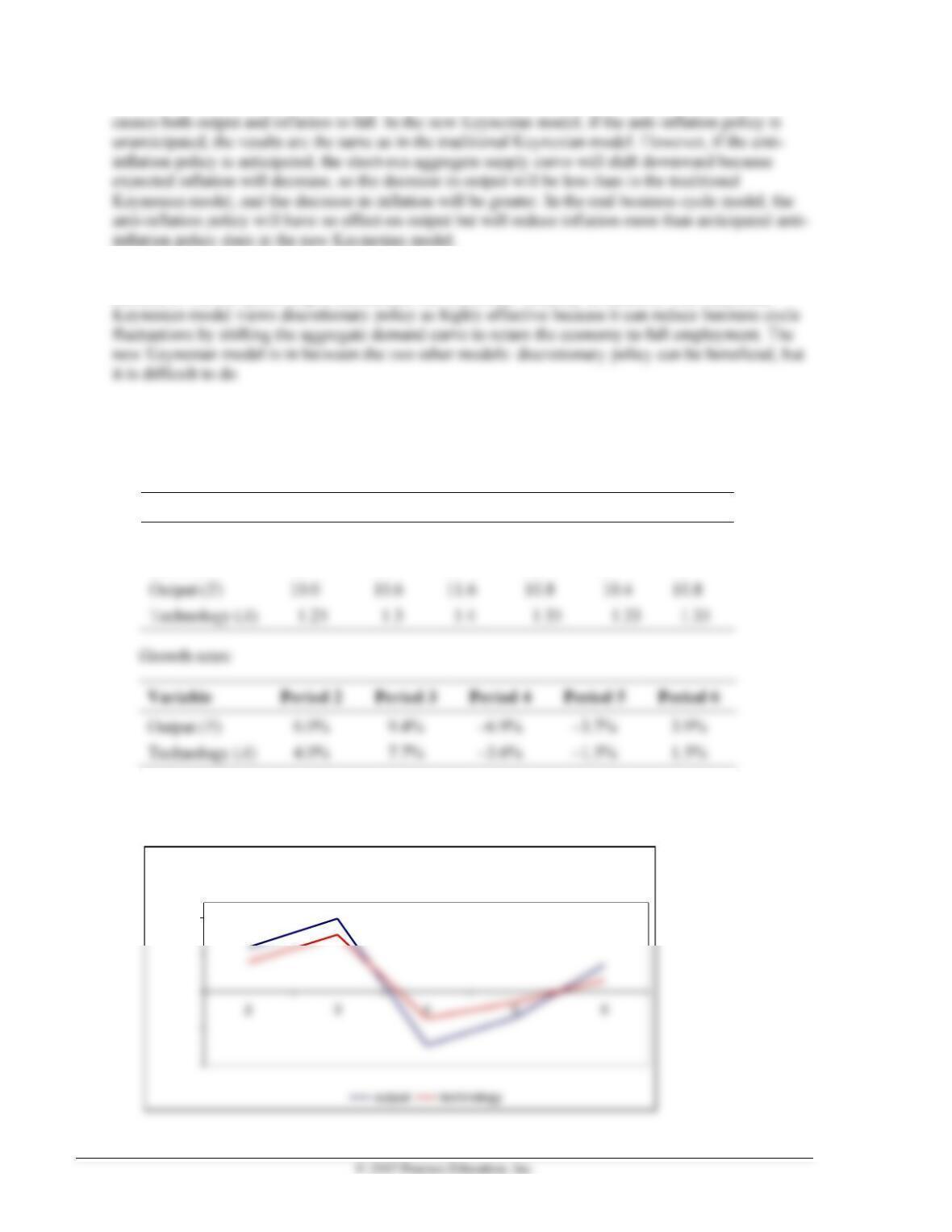
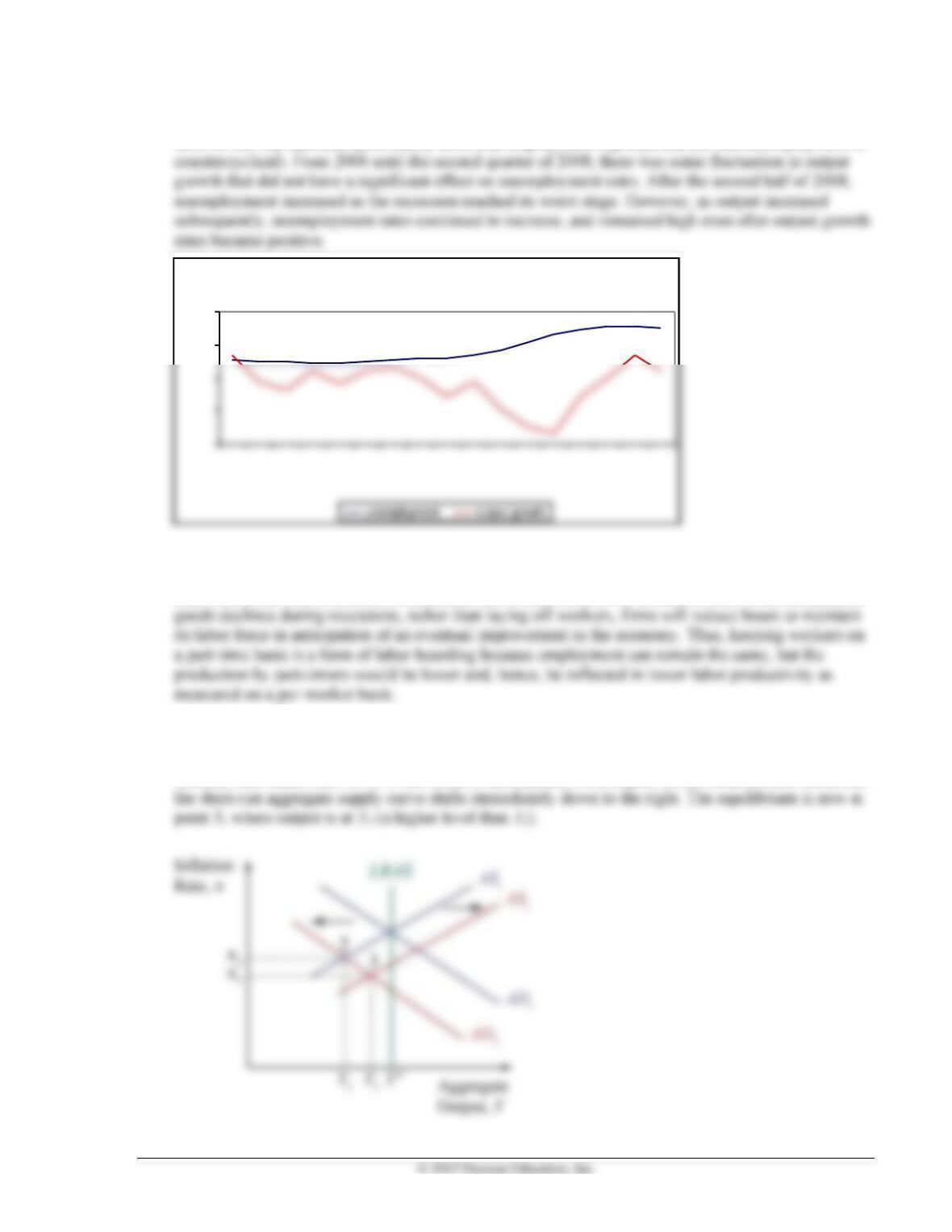
b. According to the data presented in the table, there seems to be evidence supporting real business
cycle theory. Solow’s residual and output growth rates follow each other quite closely. As observed
in the table and in the graph, they are both positive and negative at the same point in time.
Output and Technology Growth Rates
10.0%
Modern Business Cycle Theory 255
2. According to data on unemployment and output growth, there does not seem to be much evidence in
favor of the real business cycle theory tenet that employment is procyclical (or that unemployment is
Output growth and Unemployment (US data 2006-2010)
7.0
12.0
3. No, this is not consistent with the real business cycle model, in which all unemployment is voluntary.
If workers are employed part-time for economic reasons, they are involuntarily working less than
they would like due to economic conditions out of their control. As a result of this, when demand for
New Keynesian Model
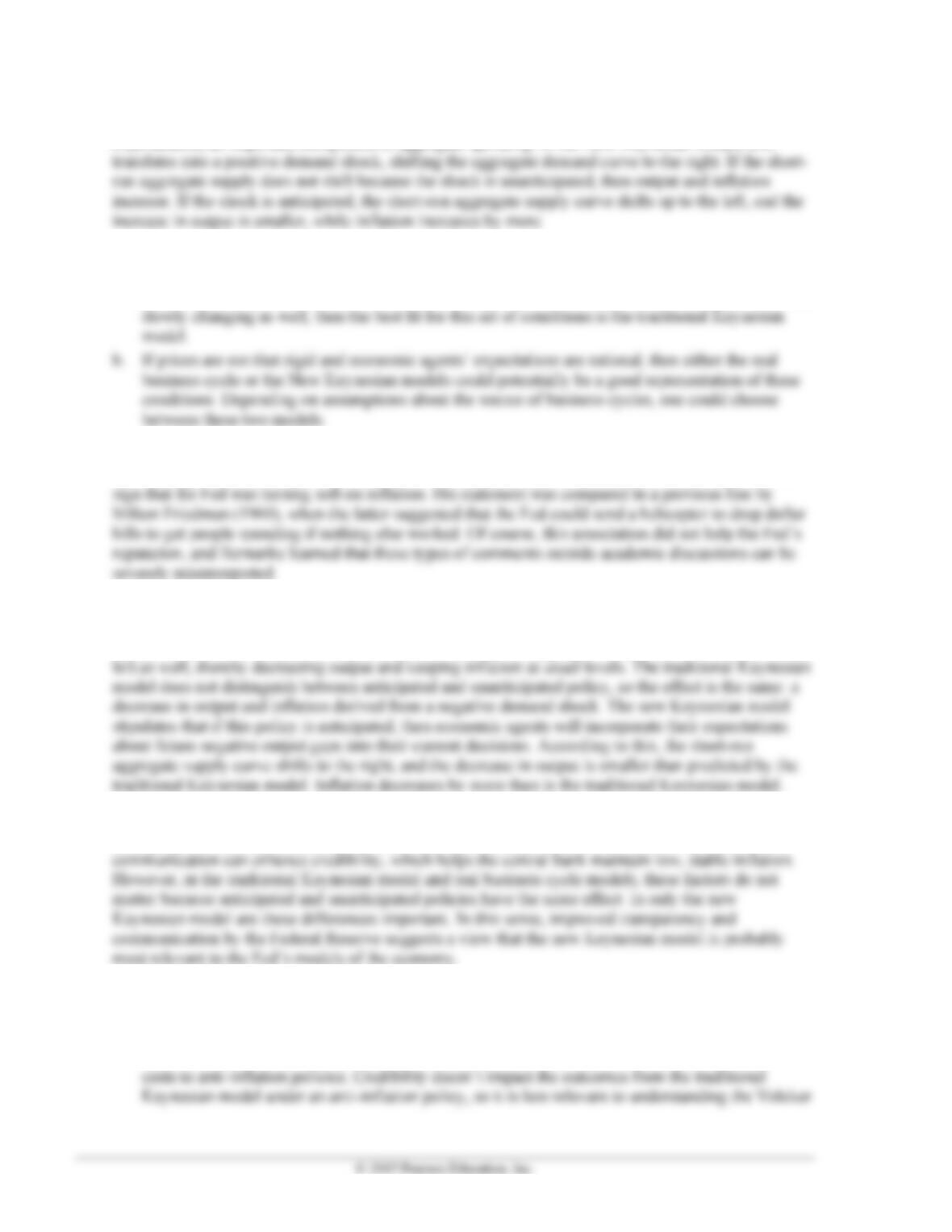
4. If the negative demand shock is unanticipated, the short-run aggregate supply curve does not shift
initially, and output falls to Y2. If the shock is anticipated, firms expect lower inflation, and therefore,
256 Mishkin • Macroeconomics: Policy and Practice, Second Edition
5. An increase in consumer confidence about the future results in an increase in consumption
expenditures, an important component of aggregate spending. In the New Keynesian model, this
Comparison of Business Cycle Models
6. a. The fact that most wages are the result of collective bargaining imposes significant rigidity in
prices, especially in the downward direction. If expectations are adaptive (based on past data) and
7. Bernanke’s speech had unintended consequences for the Fed’s reputation. Hours after he suggested
the Fed might take all of these measures to avoid deflation, bond traders interpreted his speech as a
8. According to the real business cycle model, the negative demand shock created by the increase in
taxes will have no effect on output but would reduce inflation. Depending on the size and amount of
distortion caused by taxation, it is plausible that the long-run aggregate supply curve could shift to the
9. Greater transparency and communication has the potential to guide expectations by price and wage
setting agents, which can beneficially speed the adjustment process. Moreover, transparency and
10. a. Output changed by –2.15 percent over that period, while inflation changed by –4.8 percentage
points. Thus, the sacrifice ratio was 0.45.
b. Because there were significant costs to the Volcker disinflation and a relatively high sacrifice
ratio, this rules out the real business cycle model as a relevant framework because it predicts no
Modern Business Cycle Theory 257
◼ Answers to Data Analysis Problems
1. a. For 2013:Q2, real GDP growth was 1.7 percent, and the Solow residual growth was 0.7 percent.
b. The last time the Solow residual growth was negative was 2012:Q4 at –1.4 percent; real GDP
2. a. From June 2012 to June 2013, employment growth was 1.1 percent, and inflation over that time
was 1.3 percent.
b. The end of the last recession occurred June 2009, when employment growth was –3.9 percent
3. a. Inflation recently was at its lowest point in 2009:Q3, when it was 0.2 percent. Prior to this, the
highest recent inflation rate was 3.4 percent in 2006:Q2. Thus, inflation declined by a total of 3.2
percentage points over that time.
b. From 2006:Q2 to 2009:Q3, real GDP decreased from $14,591.6 billion to $14,402.5 billion,
◼ Answers to Review Questions and Problems in Web Appendix,
“The New Classical Model”
1. According to the new classical short-run aggregate supply curve, aggregate output deviates from
potential output when the actual inflation rate differs from the expected inflation rate. For example, if
actual inflation exceeds expected inflation, then aggregate output will be greater than potential
258 Mishkin • Macroeconomics: Policy and Practice, Second Edition
2. If a policy change is unanticipated, then expected inflation does not change. Thus, when the policy
change shifts the aggregate demand curve, the short-run aggregate supply curve does not shift.
Aggregate output and inflation both either rise (if expansionary policy shifts AD to the right) or fall
3. The policy ineffectiveness proposition emphasizes that policy changes have different effects
depending on whether or not they are anticipated, which implies that policy makers cannot predict the
impact their policies will have unless they know the public’s expectations. For example, suppose
4. The chief objection to the new classical model is that it cannot explain the persistence of business
cycle fluctuations. Additional objections are that firms would not be fooled as misperceptions theory
describes and that there is little empirical support for the policy ineffectiveness proposition.