
Chapter 22 – Immigration
22-1
Chapter 22 Immigration
QUESTIONS
1. Which of the following statements are true? Which are false? Explain why the false statements
are untrue. LO1
a. More immigrants arrive to the United States each year illegally than legally.
b. The majority of legal immigrants are men.
c. Over half the new legal immigrants to the United States each year are from Mexico.
d. Most legal immigrants to the United States gain their legal status through employment-based
preferences.
Answer: (a) False. The number of legal immigrants between 2000 and 2009 was
2. In what respect is the economic decision to move across international borders an investment
decision? Why do economic migrants move to some countries, but not to others? Cite an example
of an explicit cost of moving; an implicit cost of moving. How do distance and age affect the
migration decision? How does the presence of a large number of previous movers to a country
affect the projected costs and benefits of subsequent movers? LO2
Answer: The decision to migrate is an investment decision because the individual is
expecting to earn a wage rate that will payoff over time sufficient to cover the explicit
3. Suppose that the projected lifetime earnings gains from migration exceed the costs of moving.
Explain how the decision to move might be reversed when a person considers present value. LO2
Answer: If this person were adding up earnings per year without taking into account
discounting, they would be overestimating the benefit of moving. Recall $10,000 a year
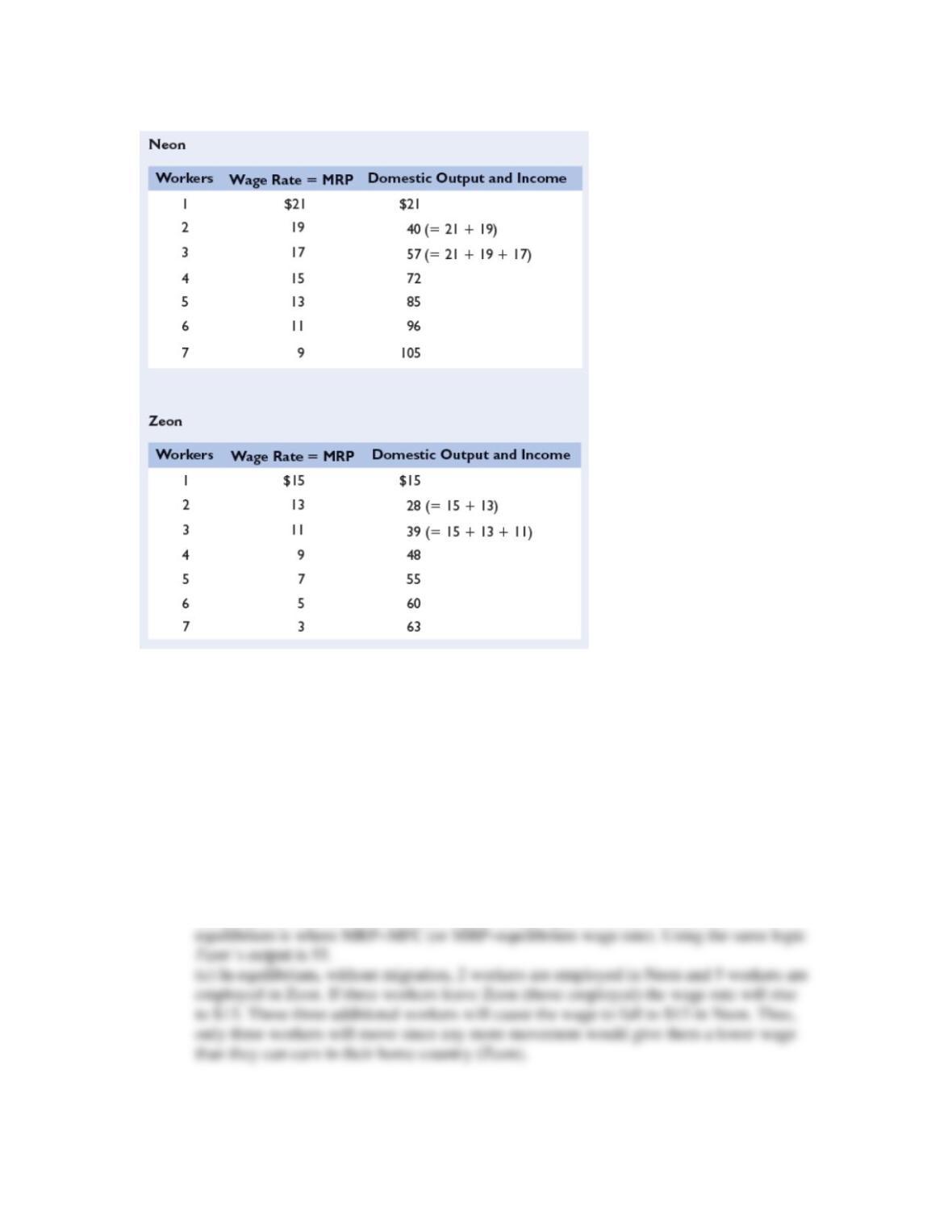
4. Use the accompanying tables for Neon and Zeon to answer the questions that follow. Assume
that the wage rate shown equals hourly output and income, and that the accumulated output and
income are the sum of the marginal revenue products (MRPs) of each worker. LO3
Chapter 22 – Immigration
22-2
a. Which country has the greater stock of capital and technological prowess? How can you tell?
b. Suppose the equilibrium wage rate is $19 in Neon and $7 in Zeon. What is the domestic output
(= domestic income) in the two countries?
c. Assuming zero migration costs and initial wage rates of $19 in Neon and $7 in Zeon, how
many workers will move to Neon? Why will not more than that number of workers move to
Neon?
d. After the move of workers, what will the equilibrium wage rate be in each country? What will
the domestic output be after the migration? What is the amount of the combined gain in domestic
output produced by the migration? Which country will gain output; which will lose output? How
will the income of native-born workers be affected in each country?
Answer: (a) Neon. Neon produces more per worker.
(b) Output in Neon is 40 because the equilibrium wage rate is $19. Recall that

Chapter 22 – Immigration
22-3
5. How might the output and income gains from immigration shown by the simple immigration
model be affected by (a) unemployment in the originating nation, (b) remittances by immigrants
to the home country, and (c) backflows of migrants to the home country? LO3
Answer: (a) If there is unemployment in the originating nation output may not fall after
6. Suppose initially that immigrant labor and native-born labor are complementary resources.
Explain how a substantial immigration might change the demand for native-born workers,
altering their wages. (Review the relevant portion of Chapter 12 if necessary to help answer this
question.) Next, suppose that new immigrant labor and previous immigrant labor (not native-
born) are substitute resources. Explain how a substantial immigration of new workers might
affect the demand for previous immigrants, altering their wages. LO3
Answer: If immigrant labor and native-born labor are complementary resources then we
would expect to see an increase in demand for native-born labor with an increase in
7. What is a “brain drain” as it relates to international migration? If emigrants are highly educated
and received greatly subsidized education in the home country, is there any justification for that
country to levy a “brain drain” tax on them? Do you see any problems with this idea? LO3
Answer: The ‘brain drain’ is when well educated (or the best educated) in poor countries
migrate to the U.S. and Europe to increase their return on their human capital investment.

Chapter 22 – Immigration
22-4
8. In July 2007 The Wall Street Journal (WSJ) reported that a growing shortage of skilled labor in
Eastern European countries such as Slovakia was driving up wages in key industries and reducing
business income. The reason for the shortages was a large migration of skilled Eastern European
workers to Western European countries. Use the simple immigration model to demonstrate the
key elements of the WSJ story as just described. LO3
Answer: Initially there are higher wages in the Western European countries for skilled
labor (this was likely due to better technology and more capital). Educated, or skilled,
9. Why is each of these statements somewhat misleading? (a) “Illegal immigrants take only jobs
that no American wants.” (b) “Deporting 100,000 illegal immigrants would create 100,000 job
openings for Americans.” LO4
Answer: Both of these statements are misleading. (a) Illegal immigrants probably do
10. Why are so many state and local governments greatly concerned about the Federal
government’s allegedly lax enforcement of the immigration laws and Congressional proposals to
grant legal status (amnesty) to the 11 million illegal immigrants in the United States? How might
an amnesty program affect the flow of future border crossings? LO5
Answer: The Fiscal Impact on Local and State Governments on average (government
11. If someone favors the free movement of labor within the United States, is it inconsistent for
that person to also favor restrictions on the international movement of labor? Why or why not?
LO5
Answer: If one is just as concerned with the economic well-being of citizens of foreign
countries as one is with the welfare of one’s national compatriots, then to argue for free

Chapter 22 – Immigration
22-5
12. LAST WORD What were the five main features of the proposed immigration reform of
2007? Which of these features, as general principles, do you support? Which do you oppose?
Explain your reasoning.
Answer: (1) Boost funding for fencing, monitoring, and policing the U.S. Mexican
PROBLEMS
1. Mexico has daily (rather than hourly) minimum wage laws. In 2010, the daily minimum wage
in Mexico was about 60 pesos per day, and the exchange rate between Mexican pesos and U.S.
dollars was about 12 pesos per dollar. LO3
a. In 2010, what was the Mexican minimum daily wage in terms of dollars?
b. Given that Mexican employees typically work 8-hour days, about how much per hour is the
Mexican minimum wage in terms of dollars?
c. In 2010, the Federal minimum wage in the United States was $7.25 per hour. How many times
larger was the hourly U.S. Federal minimum wage than the hourly Mexican minimum wage?
d. If unskilled workers have a tendency to migrate to where they can obtain the highest
compensation for their labor, which country is more likely to be receiving low-skilled
immigrants?
minimum wage laws. In 2010, the daily minimum wage in Mexico was about 60 pesos
per day, and the exchange rate between Mexican pesos and U.S. dollars was about 12
pesos per dollar.
Part a:
In 2010, what was the Mexican minimum daily wage in terms of dollars?
To convert the 60 pesos per day to U.S. dollars we need to multiply this value by the
The answer is 60 pesos is equivalent to $5 (= (1/12) x 60) a day.

Chapter 22 – Immigration
22-6
A quick rule-of-thumb to determine the appropriate exchange rate to use in the
Part b:
Given that Mexican employees typically work 8-hour days, about how much per hour is
the Mexican minimum wage in terms of dollars?
To convert the $5 a day minimum wage to an hourly rate divide by the number of hours
Part c:
In 2010, the Federal minimum wage in the United States was $7.25 per hour. How many
times larger was the hourly U.S. Federal minimum wage than the hourly Mexican
minimum wage?
The U.S. Federal minimum wage is 11.6 (= $7.25/$0.625) times larger than the hourly
Part d:
If unskilled workers have a tendency to migrate to where they can obtain the highest
compensation for their labor, which country is more likely to be receiving low-skilled
immigrants?
2. Differences in productivity are usually the major force behind differences in wages and unit
labor costs. Suppose that a single unskilled worker at a pottery factory in Mexico can produce 1
mug per hour. By comparison, suppose that a single unskilled worker at a pottery factory in the
United States can produce 14 mugs per hour because more and better machinery generates higher
labor productivity. The Mexican mugs and the American mugs are identical in quality and
durability and sell for the same price. LO3
a. If unskilled pottery workers are paid the local minimum wage in both countries, how much is
the labor cost per mug for mugs produced in Mexico? For mugs produced in the United States?
(Use the minimum wages from Problem 1 and make all calculations in dollars.)
b. With regard to mug production, how much higher are labor costs per hour in the United States?
c. With regard to mug production, how much higher are labor costs per unit in Mexico?
d. Do higher labor costs per hour always imply higher labor costs per unit?
e. If firms with lower labor costs per unit expand while those with higher labor costs per unit
contract, in which country will mug-making firms be increasing in size and hiring more
employees? If unskilled pottery workers relocate to where they can find jobs, to which country
will they be moving?

Chapter 22 – Immigration
22-7
Feedback: Consider the following example. Differences in productivity are usually the
major force behind differences in wages and unit labor costs. Suppose that a single
unskilled worker at a pottery factory in Mexico can produce 1 mug per hour. By
comparison, suppose that a single unskilled worker at a pottery factory in the United
States can produce 14 mugs per hour because more and better machinery generates
higher labor productivity. The Mexican mugs and the American mugs are identical in
quality and durability and sell for the same price.
Part a:
If unskilled pottery workers are paid the local minimum wage in both countries, how
much is the labor cost per mug for mugs produced in Mexico? For mugs produced in the
United States? (Use the minimum wages from Problem 1 and make all calculations in
dollars.)
Using the minimum wages from problem 1, we have an hourly minimum wage in the
Part b:
With regard to mug production, how much higher are labor costs per hour in the United
States?
Part c:
With regard to mug production, how much higher are labor costs per unit in Mexico?
Part d:
Do higher labor costs per hour always imply higher labor costs per unit?
Part e:
If firms with lower labor costs per unit tend to expand while those with higher labor costs
per unit tend to contract, in which country will mug-making firms be increasing in size
and hiring more employees? If unskilled pottery workers tend to relocate to where they
can find jobs, to which country will they tend to be moving?

Chapter 22 – Immigration
22-8
3. There is evidence that, other things equal, a 10 percent increase in the number of workers
having a particular skill level leads to about a 4 percent decline in wages for workers with that
skill level. In addition, this 10-to-4 ratio appears to hold true whether the increase in labor supply
is caused by domestic changes in labor supply or by an influx of foreign immigrants. LO3
a. Suppose 42,000 computer programmers work in Silicon Valley. If the number of computer
programmers in Silicon Valley increases by 1260 because of a change in U.S. immigration laws,
by how many percentage points would you expect the wage of computer programmers to fall in
Silicon Valley?
b. Suppose that 8,000 full-time cooks work in restaurants in the Denver area. If Denver becomes
popular both with U.S. citizens and with foreigners such that 400 full-time cooks move to Denver
from other parts of the United States while 480 full-time cooks move to Denver from other
Feedback: Consider the following example. There is evidence that, other things equal, a
10 percent increase in the number of workers having a particular skill level leads to about
a 4 percent decline in wages for workers with that skill level. In addition, this 10–to-4
ratio appears to hold true whether the increase in labor supply is caused by domestic
changes in labor supply or by an influx of foreign immigrants.
Part a:
Suppose that there are 42,000 computer programmers living in Silicon Valley. If the
number of computer programmers in Silicon Valley increases by 1260 due to a change in
U.S. immigration laws, by how many percentage points would you expect the wage of
computer programmers to fall in Silicon Valley?
Part b:
Suppose that there are 8,000 full-time cooks in restaurants in the Denver area. If Denver
becomes popular both with U.S. citizens and with foreigners such that 400 full-time
cooks move to Denver from other parts of the United States while 480 full-time cooks
move to Denver from other countries, by how much would you expect the wages of full-
time cooks to fall in Denver?
4. In 2008, an estimated 7.8 million Mexican-born immigrants were employed in the United
States. LO3

Chapter 22 – Immigration
22-9
a. If 60 percent of the Mexican-born immigrants remitted money to family members in Mexico in
2008, and if they each sent $100 per month, how much money did they remit in total for the year?
b. If, instead, 100 percent of the Mexican-born immigrants remitted money to family members in
Mexico in 2008, and if they each sent $250 per month, how much money did they remit in total
for the year?
c. The actual amount remitted to Mexico in 2008 by Mexican-born immigrants living in the
United States was about $22 billion. If we assume that 75 percent of the Mexican-born
immigrants remitted money to Mexico that year and if we further assume that each of those
immigrants remitted an equal amount each month, how much per month did each of those
immigrants have to remit to total $22 billion for the year?
Feedback: Consider the following example. In 2008, it was estimated that there were
about 7.8 million Mexican-born immigrants employed in the United States.
Part a:
If 60 percent of the Mexican-born immigrants remitted money to family members in
Mexico in 2008, and if they each sent $100 per month, how much money did they remit
in total for the year?
Part b:
If, instead, 100 percent of the Mexican-born immigrants remitted money to family
members in Mexico in 2008, and if they each sent $250 per month, how much money did
they remit in total for the year?
Part c:
The actual amount remitted to Mexico in 2008 by Mexican-born immigrants living in the
United States was about $22 billion. If we assume that 75 percent of the Mexican-born
immigrants remitted money to Mexico that year and if we further assume that each of
those immigrants remitted an equal amount each month, how much per month did each of
those immigrants have to remit to total $22 billion for the year?
Each immigrant would need to remit $313.39 per month. That is because 75 percent of