Chapter 21
Rents, Profits, and the Financial Environment of Business
◼ Overview
This chapter begins by presenting the concept of economic rent and how it is determined. The allocative
role of rent is then examined. Next, the concept of the firm is introduced along with a presentation that
◼ Learning Objectives
After studying this chapter, students should be able to:
• 21.1 Understand the concept of economic rent
◼ Outline
I. Economic Rent: Economic rent is a payment for the use of any resource over and above its
opportunity cost. It can be viewed as a payment to resource owners in excess of what would be
necessary to secure that amount of the resource.
A. Determining Land Rent: Rent is determined by the demand for land interacting with a fixed
supply of land. (See Figure 21-1.)
B. Economic Rent to Labor: Pure economic rents can explain part of the difference between the
Chapter 21 Rents, Profits, and the Financial Environment of Business 317
II. Firms and Profits: A firm is an organization that brings together different factors of production,
such as labor, land, capital, and entrepreneurial skill to produce a product or service that it hopes
can be sold for a profit. The entrepreneur is a residual claimant who makes profits and bears losses.
A. The Legal Organization of Firms: The basic organization of all firms can be thought of in
terms of a few simple structures, the most important of which are the proprietorship,
partnership, and the corporation.
1. Proprietorship: A business owned by one individual who makes the business decisions,
receives all of the profits, and is legally responsible for all of the debts of the firm.
a. Advantages of Proprietorships: They are easy to form and to dissolve. All decision-
2. Partnership: A partnership is a business owned by two or more co-owners or partners
who share the responsibilities and the profits of the firm and are individually liable for all
of the debts of the partnership.
a. Advantages of Partnerships: They are easy to form. Partnerships often help reduce
the costs of monitoring job performance. They permit more effective specialization in
3. Corporation: A legal entity that may conduct business in its own name just as an
individual does. The owners of a corporation, called shareholders, own shares of the firm’s
profits and have limited liability.
a. Advantages of Corporations: Owners of a corporation (the shareholders) enjoy
B. The Profits of a Firm: To most people, a firm’s profit is the difference between the amount of
revenues and its spending for wages, materials, and so on.
1. Accounting Profit: Accounting profit is the difference between total revenues and explicit
2. Implicit Costs: Costs managers do not necessarily have to take into account, such as the
318 Miller • Economics Today, Nineteenth Edition
C. Opportunity Cost of Capital: The normal rate of return is the amount that must be paid to an
investor to induce investment in business. The normal rate of return is also known as the
opportunity cost of capital.
1. Attracting Capital Resources: Any business wishing to attract capital must expect to pay
D. Opportunity Cost of Owner-Provided Labor and Capital: The wage or salary that the
owner could have made in his/her highest valued employment working for someone else, and
the return that he/she could have made on owner-provided capital such as land or buildings.
1. Proprietors as Residual Claimants: By working for themselves, proprietors become
E. Accounting Profits versus Economic Profits: Economic profits are the difference between
total revenues and explicit and implicit costs. Accounting profits are the difference between
III. Interest: Interest is the payment for current rather than future command over resources; it is the
cost of obtaining credit.
A. Interest and Credit: Variations in the rate of annual interest that must be paid for credit
depend on the following factors.
2. Determinants of the Interest Rate:
a. Length of Loan: In some cases, the longer the loan will be outstanding, other things
being equal, the greater will be the interest rate charged.
B. Real versus Nominal Interest Rates: The market rate of interest expressed in terms of today’s
dollars is the nominal interest rate. It is equal to the sum of the real interest rate and the
C. The Allocative Role of Interest: Interest is a price that allocates loanable funds (credit) to
Chapter 21 Rents, Profits, and the Financial Environment of Business 319
D. Interest Rates and Present Value: Present value is the value of a future amount expressed in
today’s dollars; it is the most that someone would pay today to receive a certain sum at some
point in the future.
1. Linking the Present with the Future: Interest rates are used to link the present with the
future.
2. Present Value: The present value is computed for one year using the formula: PV1 =
IV. Corporate Financing Methods
A. Stocks: Stock is a legal claim to a share of a corporation’s future profits. If it is common stock,
B. Bonds: A bond is a legal claim against a firm that usually entitles the owner of the bond to
C. Reinvestment: Profits or depreciation reserves used to purchase new capital equipment.
D. The Markets for Stocks and Bonds: The largest and most prestigious of these markets are the
New York Exchange (NYSE) and the New York Bond Exchange, both located in New York
City. More than 2,500 stocks are traded on the NYSE. The largest stock exchange is the
NASDAQ.
1. The Theory of Efficient Markets: The theory that all publicly available information is
◼ Points to Emphasize
Rent and Fixed Supply
Even land may not be fixed in supply. At the right price the supply of land can be increased by applying
capital and other inputs to drain swamps, fill meadowlands, expand coastlines, etc. At some price, even
the supply of works from a long dead painter, composer, or author might be increased due to research and
well be necessary to entice future quantities to be supplied in such fields.
320 Miller • Economics Today, Nineteenth Edition
Interest Rate as a Measure of Opportunity Cost
It is important to note that the interest rate helps an individual firm in its decision to invest or not, even
Limited Liability
Limited liability gives the corporation one of its major advantages. It is easier and generally cheaper to
invest in a corporation (or a limited partnership) than in a partnership. Just buy shares. The amount of
information available and necessary is less with a corporation. Also, public corporations must publish a
Corporate Financing Methods
A corporation has three methods to finance operations. It can sell stock, issue bonds (or borrow), or reinvest
earnings or depreciation reserves. All three methods have a cost associated with them. Issuing bonds has
Interest and Profit: The Economic Function
Interest and profit perform an economic function by helping society decide which industries should expand
and which should contract. Firms that are the most profitable can reinvest their profits and expand, while
the least profitable firms will be forced to contract. High-profit firms will be able to outbid low-profit
firms in the resource markets. The same is true for loanable funds. Loanable funds will go to the highest
Chapter 21 Rents, Profits, and the Financial Environment of Business 321
◼ For Those Who Wish to Stress Theory
The whole notion of the time value of money is often difficult for students to grasp. It can be useful to
◼ Further Questions for Class Discussion
1. To reinforce the importance of limited liability, you can ask your students if they would be
willing to go into business with you. All you ask is that they put up some money and help with the
2. How can rent be a surplus and also serve an allocative function? This question is often puzzling
3. Why do economists measure profit differently than accountants do? Accountants are interested in
4. How can the concept of present value explain the price of a share of stock and changes in it? The
5. Some politicians have proposed letting workers take part of their Social Security taxes and
investing them. Suppose that workers want to put money in pension funds. Make a case for and
against limiting by law the riskiness of the investments that the pension funds are allowed to
make.
a. For. One could make a strong case that the goal of a pension fund is a relatively steady
pension account more rapidly.
b. Against. A less risky portfolio will yield lower returns over the long run and thus a lower
6. The development of microfinance in many developing countries is a business that makes small,
relatively short-term loans, sometimes as small as $5, to persons who want to start or expand a
◼ Answers to Questions for Critical Analysis
Do Government Grants and Subsidies Favor Corporations? (p. 470)
If you were a government official, would you rather have to deal with many small businesses or a
few large corporations?
Why the “Discount rate” That Pension Funds Use to Value Their Liabilities
Matters (p. 475)
If administrators of government pension funds for public employees were to discover in a future
year that they had used a discount rate was too high, who would end up having to ensure payment
of promised pensions?
Does Bounded Rationality Explain Why Some People “Cash Out” Pensions?
(p. 477)
Why do you suppose that some behavioral economists have criticized a recent decision by the
United Kingdom’s government to give people more freedom to sell off shares in their pension
funds?
Chapter 21 Rents, Profits, and the Financial Environment of Business 323
Analyzing Tweets to Predict Stock-Market Swings? (p. 479)
How do you suppose that proponents of the random walk theory for prices of individual shares of
stock would respond to the view that the average of stock prices might be predictable? Explain
your reasoning.
The Federal Reserve Allegedly-and Actually-Has Released Insider Information
(p. 479)
In what respect was one of the releases of confidential Fed policy information discussed above more
clearly one involving truly insider information than the other information release?
◼ You Are There
China’s Government Learns That Stock Prices Can Drift Downward (p. 480)
1. Why might state-owned companies that China’s government ordered to buy more shares to
help boost returns have been equally likely to have later earned either higher or lower
returns? Explain your reasoning.
2. What likely caused average stock prices to decline even after China’s government’s efforts
to boost the demand for shares of stock? (Hint: Many private individuals and companies
continued to seek to sell large amounts of shares of stock.)
◼ Issues and Applications
Assessing Three Recent Changes in Stock Exchange Trading (pp. 480–481)
1. Why do you think that people have experienced even more difficulties than usual in
predicting the prices of shares of stock issued by individual companies?
2. Do you suppose that the degree of randomness in the stock prices indicated by the random
walk theory has increased or decreased since early 2007? Explain your reasoning.
324 Miller • Economics Today, Nineteenth Edition
◼ Research Project
1. Take a look at data on daily numbers of NYSE stock transactions, as well as on numbers of and
◼ Answers to Problems
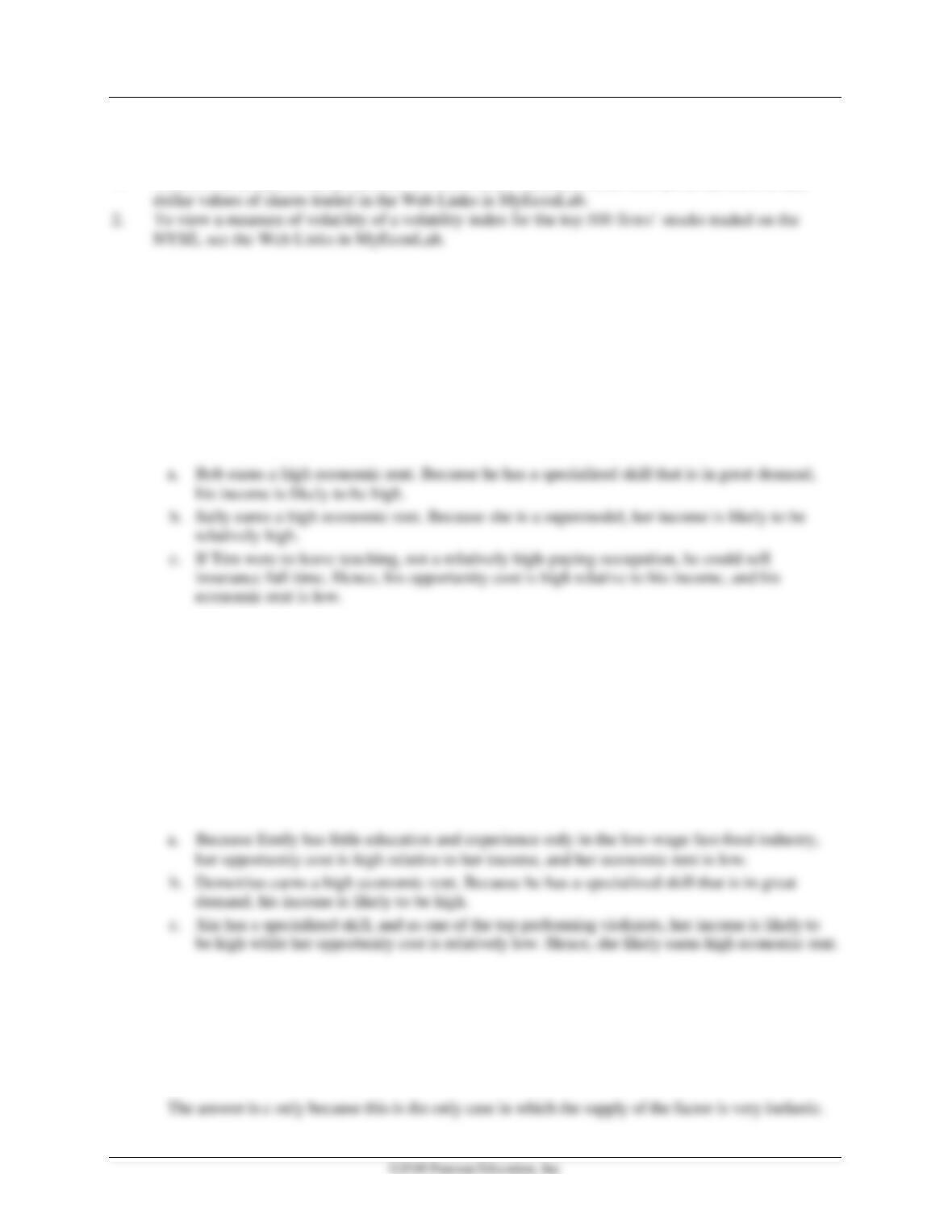
21-1. Which of the following individuals would you expect to have a high level of economic rent,
and which would you expect to have a low level of economic rent? Explain why for each.
a. Bob has a highly specialized medical skill shared by very few individuals.
b. Sally has never attended school. She is 25 years old and is an internationally known
supermodel.
c. Tim is a high school teacher and sells insurance part time.
21-2. Which of the following individuals would you expect to have a high level of economic rent,
and which would you expect to have a low level of economic rent? Explain why for each.
a. Emily quit high school at age 17, and she has since worked for several years as a
waitress in fast-food restaurants.
b. Demetrius earned a Ph.D. in financial economics, and he is among a handful of experts
who specialize in assessing the values of highly complex securities traded in bond
markets.
c. Xin was a child prodigy on the violin, and after years of developing her skills, she is now
rated among the most talented performing violinists in the world.
21-3. In which of the following situation(s) will owners who supply factors of production be most
likely to earn economic rents?
a. Highly elastic supply of the factor; highly elastic demand for the factor
b. Highly elastic supply of the factor; highly inelastic demand for the factor
c. Highly inelastic supply of the factor; highly inelastic demand for the factor
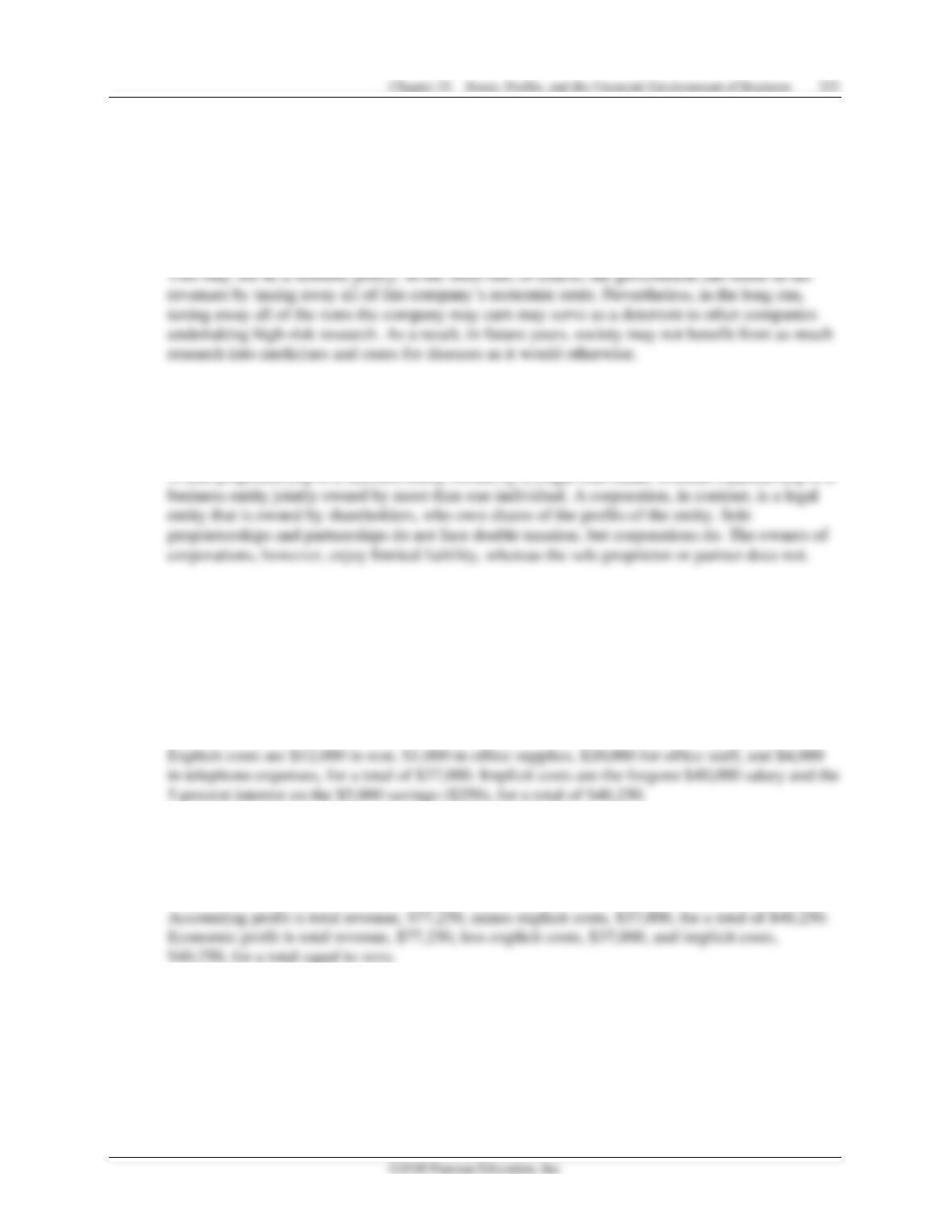
21-4. A British pharmaceutical company spent several years and considerable funds on the
development of a treatment for HIV patients. Now, with the protection afforded by patent
rights, the company has the potential to reap enormous gains. The government, in response,
has threatened to tax away any economic rents the company may earn. Is this an advisable
policy? Why or why not? (Hint: Contrast the short-run and long-run effects of taxing away
the economic rents.)
21-5. Write a brief explanation of the differences among a sole proprietorship, a partnership, and
a corporation. In addition, list one advantage and one disadvantage of a proprietorship, a
partnership, and a corporation.
21-6. After graduation, you face a choice. One option is to work for a multinational consulting
firm and earn a starting salary (benefits included) of $40,000. The other option is to use
$5,000 in savings to start your own consulting firm. You could earn an interest return of 5
percent on your savings. You choose to start your own consulting firm. At the end of the
first year, you add up all of your expenses and revenues. Your total includes $12,000 in rent,
$1,000 in office supplies, $20,000 for office staff, and $4,000 in telecommunications
expenses. What are your total explicit costs and total implicit costs?
21-7. Suppose, as in Problem 21-6, that you have now operated your consulting firm for a year.
At the end of the first year, your total revenues are $77,250. Based on the information in
Problem 21-6, what is the accounting profit, and what is your economic profit?
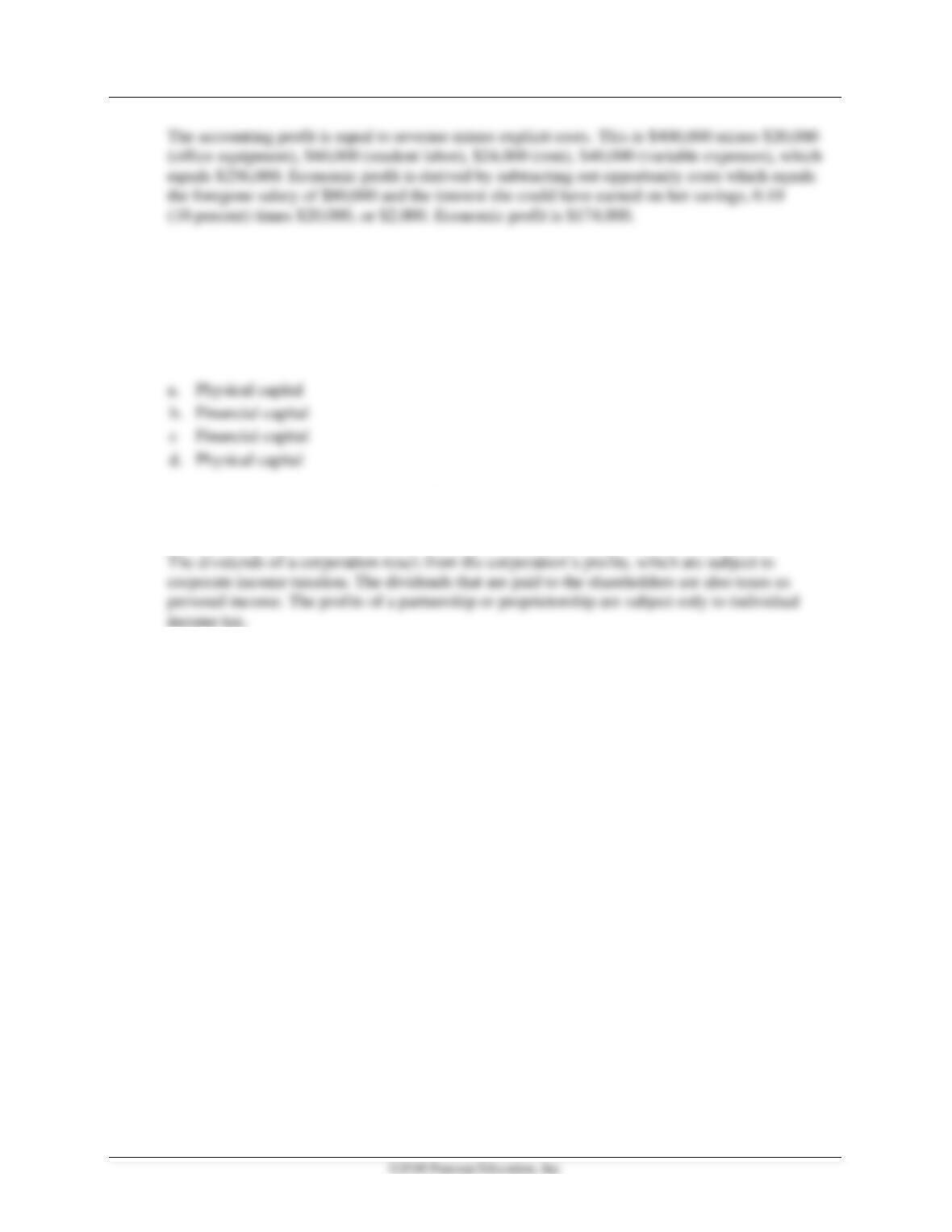
21-8. An individual leaves a college faculty, where she was earning $80,000 a year, to begin a new
venture. She invests her savings of $20,000, which were earning 10 percent annually. She
then spends $40,000 renting office equipment, hires two students at $60,000 a year each,
rents office space for $24,000, and has other variable expenses of $80,000. At the end of the
year, her revenues are $400,000. What are her accounting profit and her economic profit
for the year?
326 Miller • Economics Today, Nineteenth Edition
21-9. Classify the following items as either financial capital or physical capital.
a. A computer server owned by an information-processing company
b. $100,000 set aside in an account to purchase a computer server
c. Funds raised through a bond offer to expand plant and equipment
d. A warehouse owned by a shipping company
21-10. Explain the difference between the dividends of a corporation and the profits of a
proprietorship or partnership, particularly in their tax treatment.
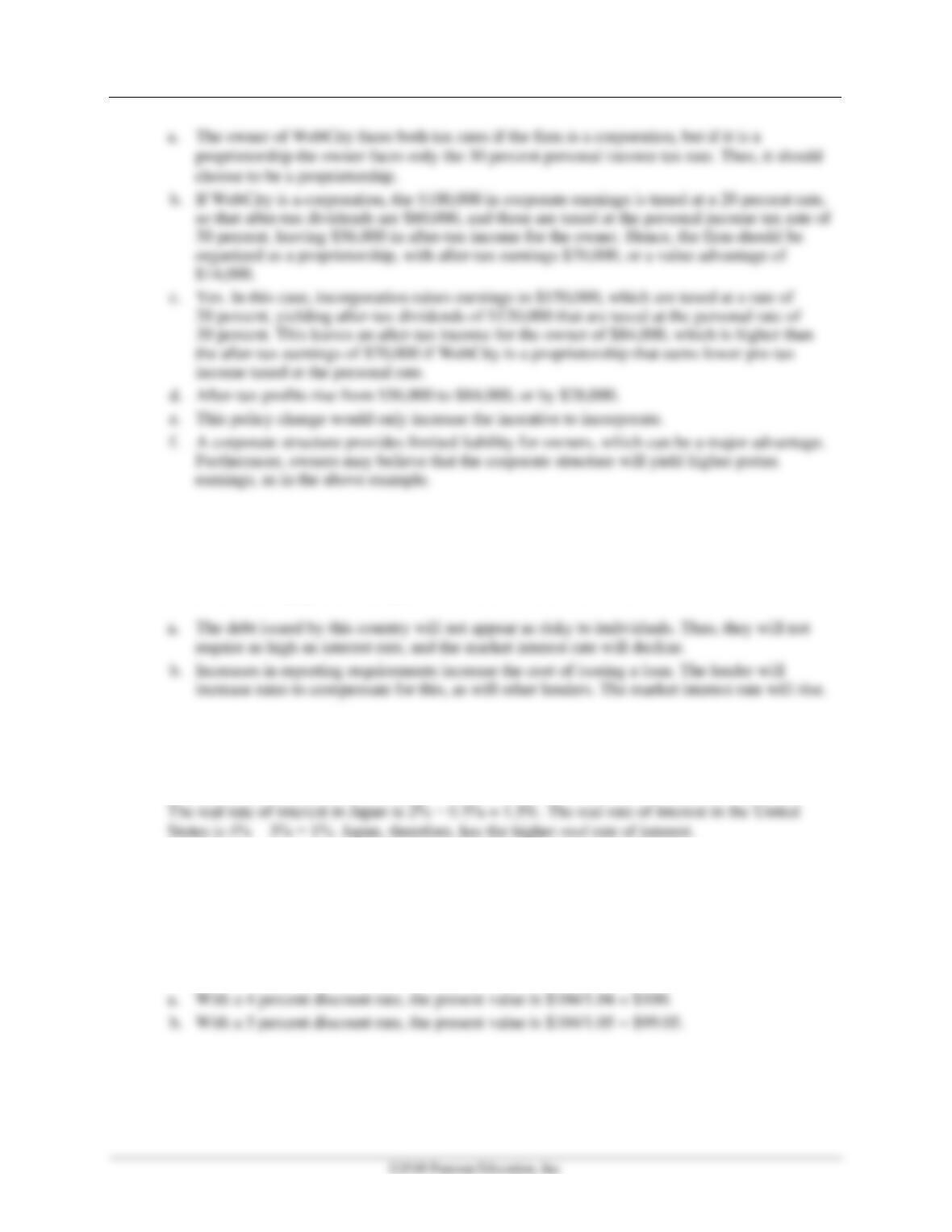
21-11. The owner of WebCity is trying to decide whether to remain a proprietorship or to
incorporate. Suppose that the corporate tax rate on profits is 20 percent and the personal
income tax rate is 30 percent. For simplicity, assume that all corporate profits (after
corporate taxes are paid) are distributed as dividends in the year they are earned and that
such dividends are subject to tax at the personal income tax rate.
a. If the owner of WebCity expects to earn $100,000 in before-tax profits this year,
regardless of whether the firm is a proprietorship or a corporation, which method of
organization should be chosen?
b. What is the dollar value of the after-tax advantage of the form of organization
determined in part (a)?
c. Suppose that the corporate form of organization has cost advantages that will raise
before-tax profits by $50,000. Should the owner of WebCity incorporate?
d. Based on parts (a) and (c), by how much will after-tax profits change due to
incorporation?
e. Suppose that tax policy is changed to completely exempt from personal taxation the first
$40,000 per year in dividends. Would this change in policy affect the decision made in
part (a)?
f. How can you explain the fact that even though corporate profits are subject to double
taxation, most business in the United States is conducted by corporations rather than by
proprietorships or partnerships?
Chapter 21 Rents, Profits, and the Financial Environment of Business 327
21-12. Explain how the following events would likely affect the relevant interest rate.
a. A major bond-rating agency has improved the risk rating of a developing nation.
b. The government has passed legislation requiring bank regulators to significantly
increase the paperwork required when a bank makes a loan.
21-13. Suppose that the interest rate in Japan is only 2 percent, while the comparable rate in the
United States is 4 percent. Japan’s rate of inflation is 0.5 percent, while the U.S. inflation
rate is 3 percent. Which economy has the higher real interest rate?
21-14. You expect to receive a payment of $104 one year from now.
a. Your rate of discount is 4 percent. What is the present value of the payment to be
received?
b. Suppose that your rate of discount rises to 5 percent. What is the present value of the
payment to be received?
21-15. Outline the differences between common stock and preferred stock.
21-16. Explain the basic differences between a share of stock and a bond.
A share of stock is a legal claim on the firm and a claim to future profits of the firm. A bond is a
21-17. Suppose that one of your classmates informs you that he has developed a method of
forecasting stock market returns based on past trends. With a monetary investment from
you, he claims that the two of you could profit handsomely from this forecasting method.
How should you respond to your classmate?
21-18. Suppose that you are trying to decide whether to spend $1,000 on stocks issued by
WildWeb or on bonds issued by the same company. There is a 50 percent chance that the
value of the stock will rise to $2,200 at the end of the year and a 50 percent chance that
the stock will be worthless at the end of the year. The bonds promise an interest rate of
20 percent per year, and it is certain that the bonds and interest will be repaid at the end
of the year.
a. Assuming that your time horizon is exactly one year, will you choose the stocks or the
bonds?
b. By how much is your expected end-of-year wealth reduced if you make the wrong
choice?
c. Suppose the odds of success improve for WildWeb: Now there is a 60 percent chance
that the value of the stock will be $2,200 at year’s end and only a 40 percent chance that
it will be worthless. Should you now choose the stocks or the bonds?
d. By how much did your expected end-of-year wealth rise as a result of the improved
outlook for WildWeb?
a. The average value of stocks at the end of the year is (0.5 × $2,200) + (0.5 × $0) = $1,100,
21-19. Take a look at Figure 21-1. Suppose that Q1 = 10 acres and P1 = $2,000 per acre. What is the
dollar amount of economic rents received during the current period, and why is this amount
classified as economic rents?
21-20. Reconsider Figure 21-1 and the data provided in Problem 21-19, and suppose that
P2 = $2,800 per acre. By how much do economic rents change when the rental rate
on land rises from P1 to P2 in the figure?
21-21. Consider Figure 21-2. Explain why the figure indicates that if the normal rate of return on
investment were to remain unchanged while accounting profit increased, economic profit
also would increase?
21-22. Take a look at Figure 21-2. Explain why the figure implies that if the amount of accounting
profit were to shrink to zero while the normal rate of return on investment remained
unchanged, economic profit necessarily would become negative?
21-23. Take a look at Table 21-1. Suppose that you are planning your retirement. The appropriate
interest rate for computing the present values of future dollars to be received is 8 percent,
and you plan to “cash in” all of what you save for retirement this year in exactly 30 years.
How many dollars would you have to save this year to ensure being able to have a total of
$50,000 accumulated 30 years from now?
21-24. Reconsider Table 21-1, and assume that as in Problem 21-23, you wish to save enough this
year to have $50,000 available for your planned retirement 30 years into the future. How
many dollars would you have to save this year to ensure that a total amount of $50,000
would be accumulated 30 years into the future if the interest rate appropriate for
discounting decreases to 3 percent?
◼ Selected References
Berle, Adolf A., Power Without Property, New York: Harcourt, Brace, and World, 1959.
Cootner Paul H., ed., The Random Character of Stock Market Price, Cambridge, MA: MIT Press, 1964.