
Chapter 20 – Income Inequality and Poverty
20-1
Chapter 20 Income Inequality and Poverty
QUESTIONS
1. Use quintiles to briefly summarize the degree of income inequality in the United States. How
and to what extent does government reduce income inequality? LO1
Answer: The income share received by the highest 20 percent was 50 percent in 2008,
which is more than ten times the 3.4 percent received by the lowest 20 percent. The
middle three quintiles receive under 50 percent of the total before-tax income. The top
two quintiles receive twice as much as the bottom three quintiles combined; in fact, the
2. Assume that Al, Beth, Carol, David, and Ed receive incomes of $500, $250, $125, $75, and
$50, respectively. Construct and interpret a Lorenz curve for this five-person economy. What
percentage of total income is received by the richest quintile and by the poorest quintile? LO1
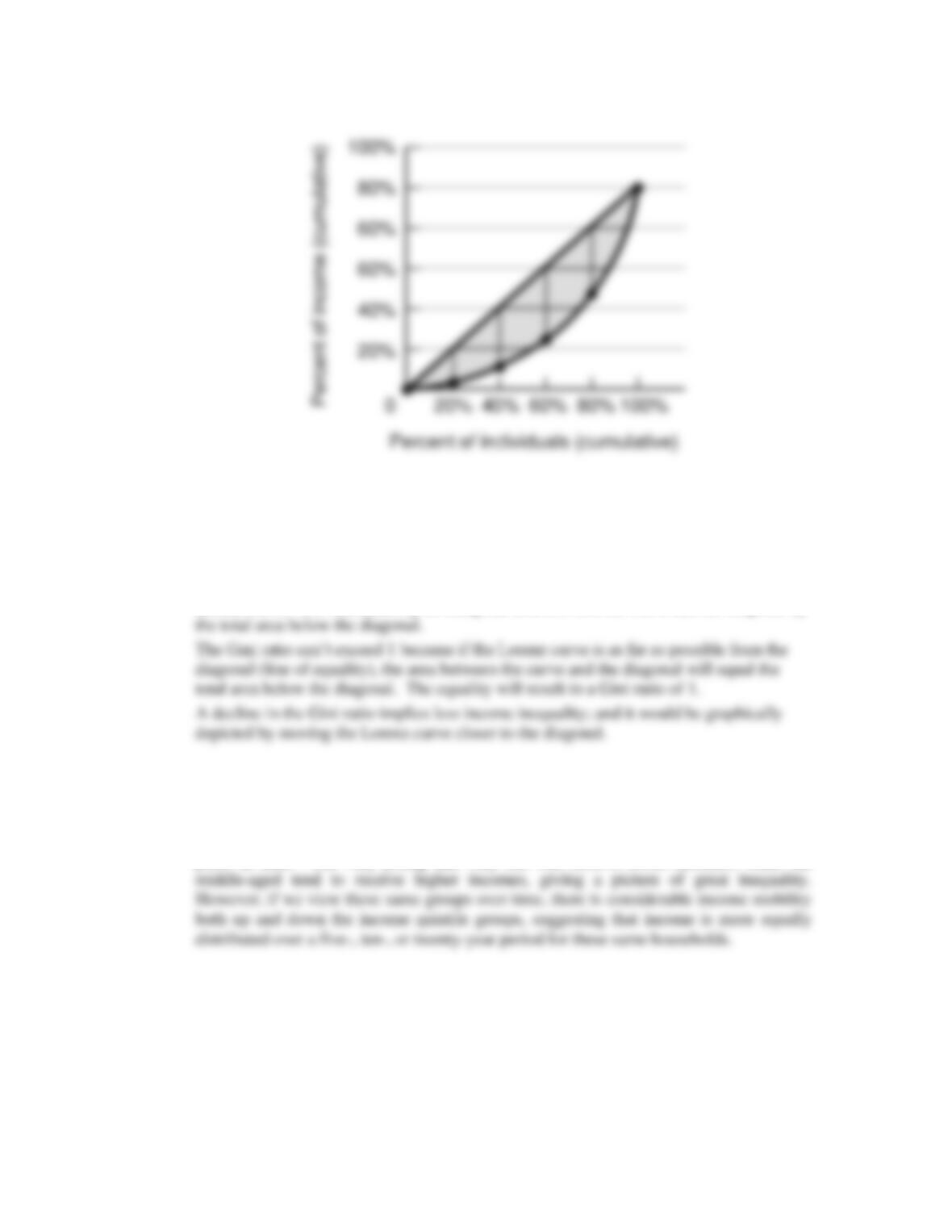
Answer: See the figure below. In this simple economy each person represents a
complete income quintile—20 percent of the total population. The richest quintile (Al)
Chapter 20 – Income Inequality and Poverty
20-2
3. How does the Gini ratio relate to the Lorenz curve? Why can’t the Gini ratio exceed 1? What is
implied about the direction of income inequality if the Gini ratio declines from 0.42 to 0.35? How
would one show that change of inequality in the Lorenz diagram? LO1
Answer: The Gini ratio is the numerical measurement of the inequality depicted by the
Lorenz curve. It is calculated by dividing the area between the curve and the diagonal by
4. Why is the lifetime distribution of income more equal than the distribution in any specific
year? LO1
Answer: The disparity of incomes in a single year reflects the income distribution at a
point in time. The very young and very old will receive lower incomes, while the

Chapter 20 – Income Inequality and Poverty
20-3
5. Briefly discuss the major causes of income inequality. With respect to income inequality, is
there any difference between inheriting property and inheriting a high IQ? Explain. LO2
Answer: The reasons for income inequality are: differences in abilities and talents among
individuals, differences in the amount of education and training an individual obtains,
6. What factors have contributed to increased income inequality since 1970? LO3
Answer: Several factors have contributed to the increase in income inequality since
1970. The overriding factor is the structural changes that have occurred in the U.S.
7. Should a nation’s income be distributed to its members according to their contributions to the
production of that total income or according to the members’ needs? Should society attempt to
equalize income or economic opportunities? Are the issues of equity and equality in the
distribution of income synonymous? To what degree, if any, is income inequality equitable? LO4
Answer: The answer to this question is inextricably tied to value judgments, but most of
us probably favor a combination of the two types of income distribution. A purely
Chapter 20 – Income Inequality and Poverty
20-4
8. Do you agree or disagree? Explain your reasoning. “There need be no trade‐off between
equality and efficiency. An ‘efficient’ economy that yields an income distribution that many
regard as unfair may cause those with meager incomes to become discouraged and stop trying. So
efficiency may be undermined. A fairer distribution of rewards may generate a higher average
productive effort on the part of the population, thereby enhancing efficiency. If people think they
are playing a fair economic game and this belief causes them to try harder, an economy with an
equitable income distribution may be efficient as well. LO4
Answer: While there is certainly an “efficiency wages” aspect to a more equal
distribution, it is hard to imagine that the disincentive effects on both high– and
low-income earners of income redistribution will be swamped by an increased interest on
9. Comment on or explain: LO4
a. Endowing everyone with equal income will make for very unequal enjoyment and satisfaction.
b. Equality is a “superior good”; the richer we become, the more of it we can afford.
c. The mob goes in search of bread, and the means it employs is generally to wreck the bakeries.
d. Some freedoms may be more important in the long run than freedom from want on the part of
every individual.
e. Capitalism and democracy are really a most improbable mixture. Maybe that is why they need
each other—to put some rationality into equality and some humanity into efficiency.
f. The incentives created by the attempt to bring about a more equal distribution of income are in
conflict with the incentives needed to generate increased income.
Chapter 20 – Income Inequality and Poverty
20-5
Answer:
(a) No distribution of income can ensure equal enjoyment. Using marginal utility
theory, it can be argued that by equalizing incomes in an economy, there is the
10. How do government statisticians determine the poverty rate? How could the poverty rate fall
while the number of people in poverty rises? Which group in each of the following pairs has the
higher poverty rate: (a) children or people age 65 or over? (b) African Americans or foreign‐born
noncitizens? (c) Asians or Hispanics? LO5
Answer: Government statisticians determine who is officially in poverty by comparing
family incomes to a threshold based on family size. The threshold is intended to
Chapter 20 – Income Inequality and Poverty
20-6
11. What are the essential differences between social insurance and public assistance programs?
Why is Medicare a social insurance program whereas Medicaid is a public assistance program?
Why is the earned‐income tax credit considered to be a public assistance program? LO6
Answer: Social insurance programs provide aid to those who are retired or suffering
from temporary distress. They are usually financed through payroll levies and are viewed
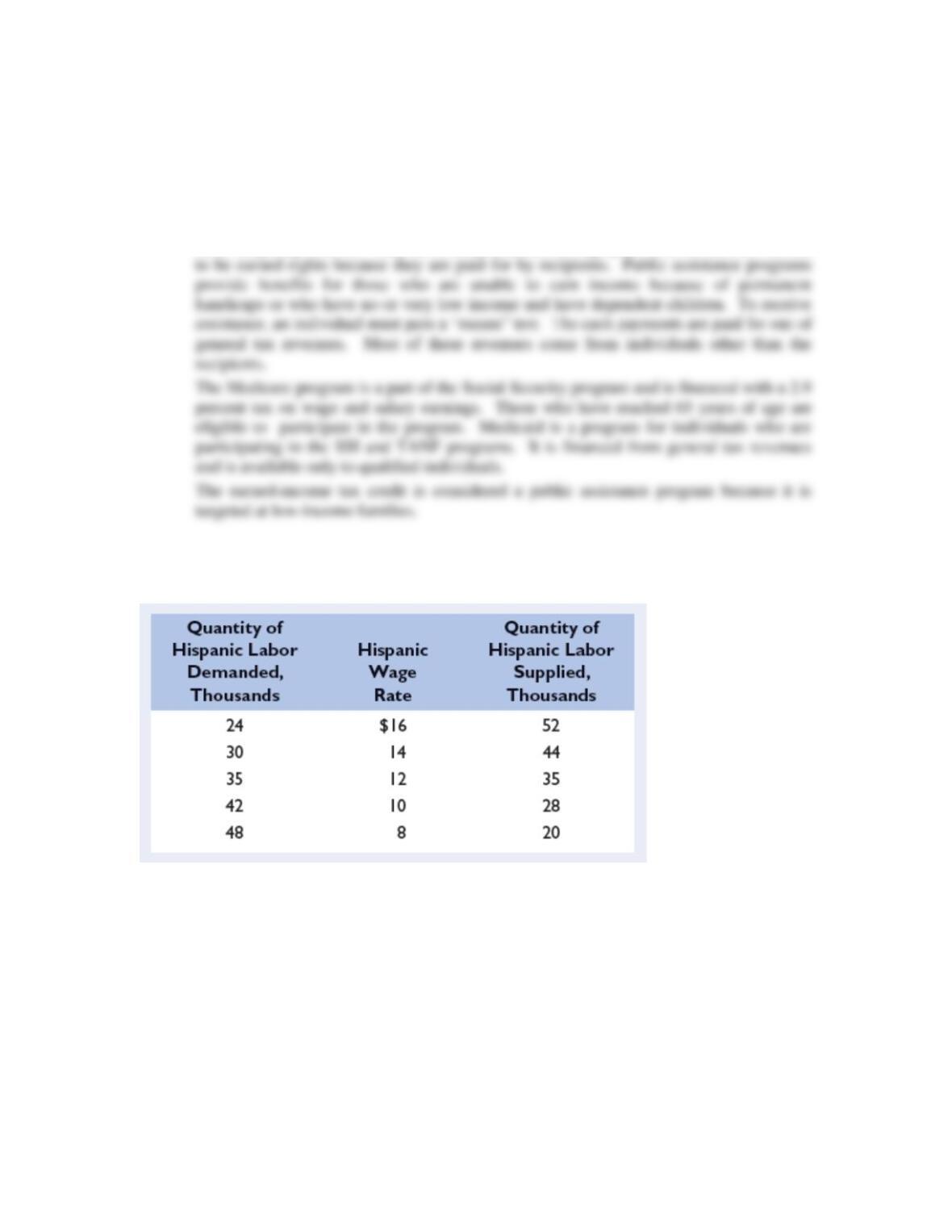
12. The labor demand and supply data in the following table relate to a single occupation. Use
them to answer the questions that follow. Base your answers on the taste‐for‐discrimination
model. LO7
a. Plot the labor demand and supply curves for Hispanic workers in this occupation.
b. What are the equilibrium Hispanic wage rate and quantity of Hispanic employment?
c. Suppose the white wage rate in this occupation is $16. What is the Hispanic‐to–white wage
ratio?
d. Suppose a particular employer has a discrimination coefficient d of $5 per hour. Will that
employer hire Hispanic or white workers at the Hispanic‐white wage ratio indicated in part c?
Explain.
e. Suppose employers as a group become less prejudiced against Hispanics and demand 14 more
units of Hispanic labor at each Hispanic wage rate in the table. What are the new equilibrium
Hispanic wage rate and level of Hispanic employment? Does the Hispanic‐white wage ratio rise
or fall? Explain.

Chapter 20 – Income Inequality and Poverty
20-7
f. Suppose Hispanics as a group increase their labor services in that occupation, collectively
offering 14 more units of labor at each Hispanic wage rate. Disregarding the changes indicated in
part e, what are the new equilibrium Hispanic wage rate and level of Hispanic employment? Does
the Hispanic‐white wage ratio rise, or does it fall?
Answer:
(a)
S
Wage

Chapter 20 – Income Inequality and Poverty
20-8
13. Males under the age of 25 must pay far higher auto insurance premiums than females in this
age group. How does this fact relate to statistical discrimination? Statistical discrimination
implies that discrimination can persist indefinitely, while the taste‐for‐discrimination model
suggests that competition might reduce discrimination in the long run. Explain the difference.
LO7
Answer: Statistical discrimination occurs when people are judged on the basis of the
average characteristics of the group to which they belong. Insurance companies base
14. Use a demand and supply model to explain the impact of occupational segregation or
“crowding” on the relative wage rates and earnings of men and women. Who gains and who loses
from the elimination of occupational segregation? Is there a net gain or a net loss to society?
Explain. LO7
Answer: See Figure 20.7. Discrimination against women in two of the three occupations
15. LAST WORD Go to Table 1 in the Last Word and compute the ratio of average wealth to
median wealth for each of the 5 years. What trend do you find? What is your explanation for the
trend? The Federal estate tax redistributes wealth in two ways: by encouraging charitable giving,
which reduces the taxable estate, and by heavily taxing extraordinarily large estates and using the
proceeds to fund government programs. Do you favor repealing the estate tax? Explain.
Answer: The average wealth was 3.67 times greater than median wealth in 1995, 3.94
times greater in 1998, 4.59 times greater in 2001, 4.82 times greater in 2004, and 4.63

Chapter 20 – Income Inequality and Poverty
20-9
PROBLEMS
1. In 2010, Forbes magazine listed Bill Gates, the founder of Microsoft, as the richest person in
the United States. His personal wealth was estimated to be $53 billion. Given that there were
about 309 million people living in the United States that year, how much could each person have
received if Gates’ wealth had been divided equally among the population of the United States?
(Hint: A billion is a 1 followed by 9 zeros while a million is a 1 followed by six zeros.) LO1
Answer: $171.52
Feedback: Consider the following example. In 2010, Forbes magazine listed Bill Gates,
the founder of Microsoft, as the richest person in the United States. His personal wealth
was estimated to be $53 billion. Given that there were about 309 million people living in
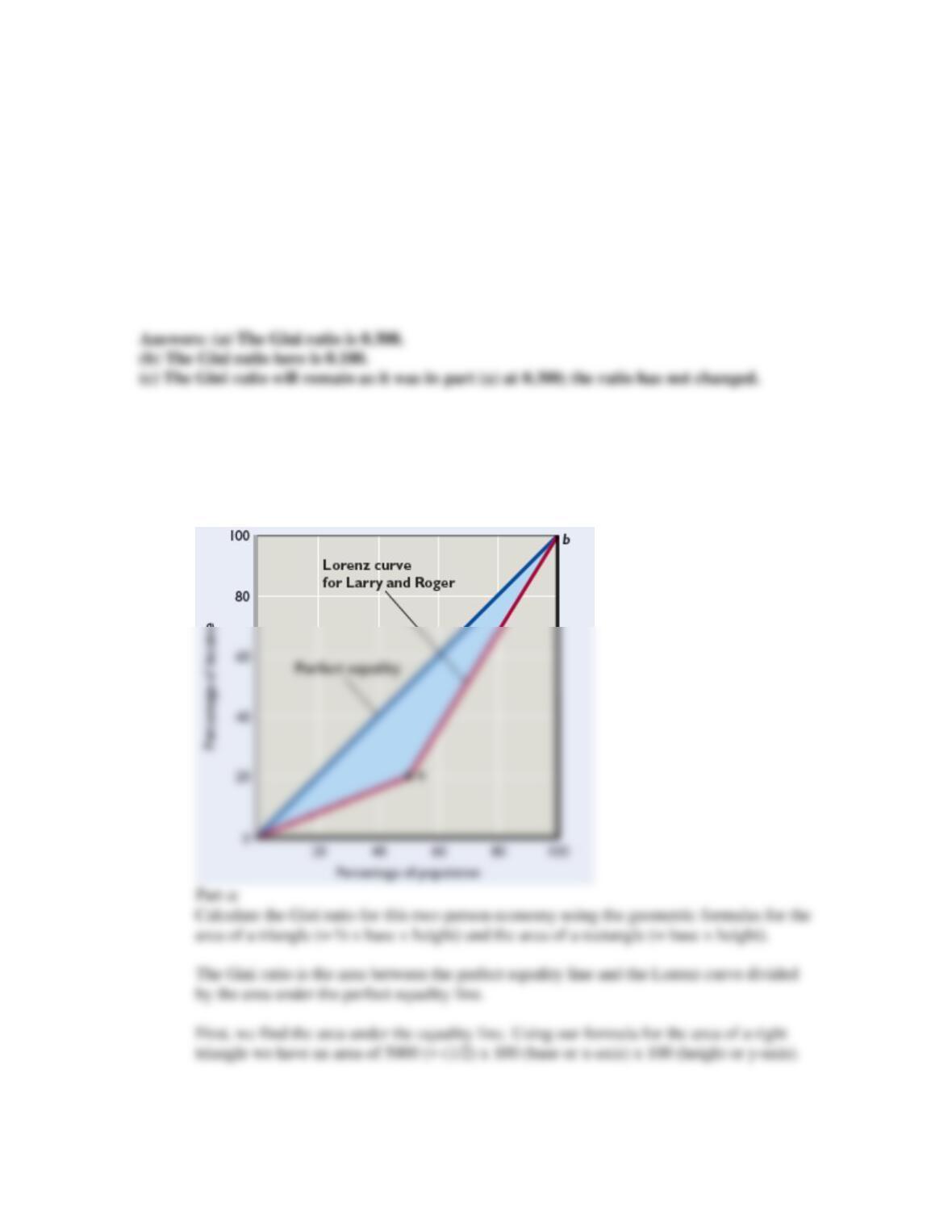
2. Imagine an economy with only two people. Larry earns $20,000 per year while Roger earns
$80,000 per year. As shown in the following figure, the Lorenz curve for this two‐person
economy consists of two line segments. The first runs from the origin to point a while the second
runs from point a to point b. LO1
Chapter 20 – Income Inequality and Poverty
20–10
a. Calculate the Gini ratio for this two‐person economy using the geometric formulas for the area
of a triangle (= ½ x base x height) and the area of a rectangle (= base x height). Hint: The area
under the line segment from point a to point b can be thought of as the sum of the area of a
particular triangle and the area of a particular rectangle.
b. What would the Gini ratio be if the government taxed $20,000 away from Roger and gave it to
Larry? (Hint: The figure will change.)
c. Start again with Larry earning $20,000 per year and Roger earning $80,000 per year. What
would the Gini ratio be if both their incomes doubled? How much has the Gini ratio changed
from before the doubling in incomes to after the doubling in incomes?
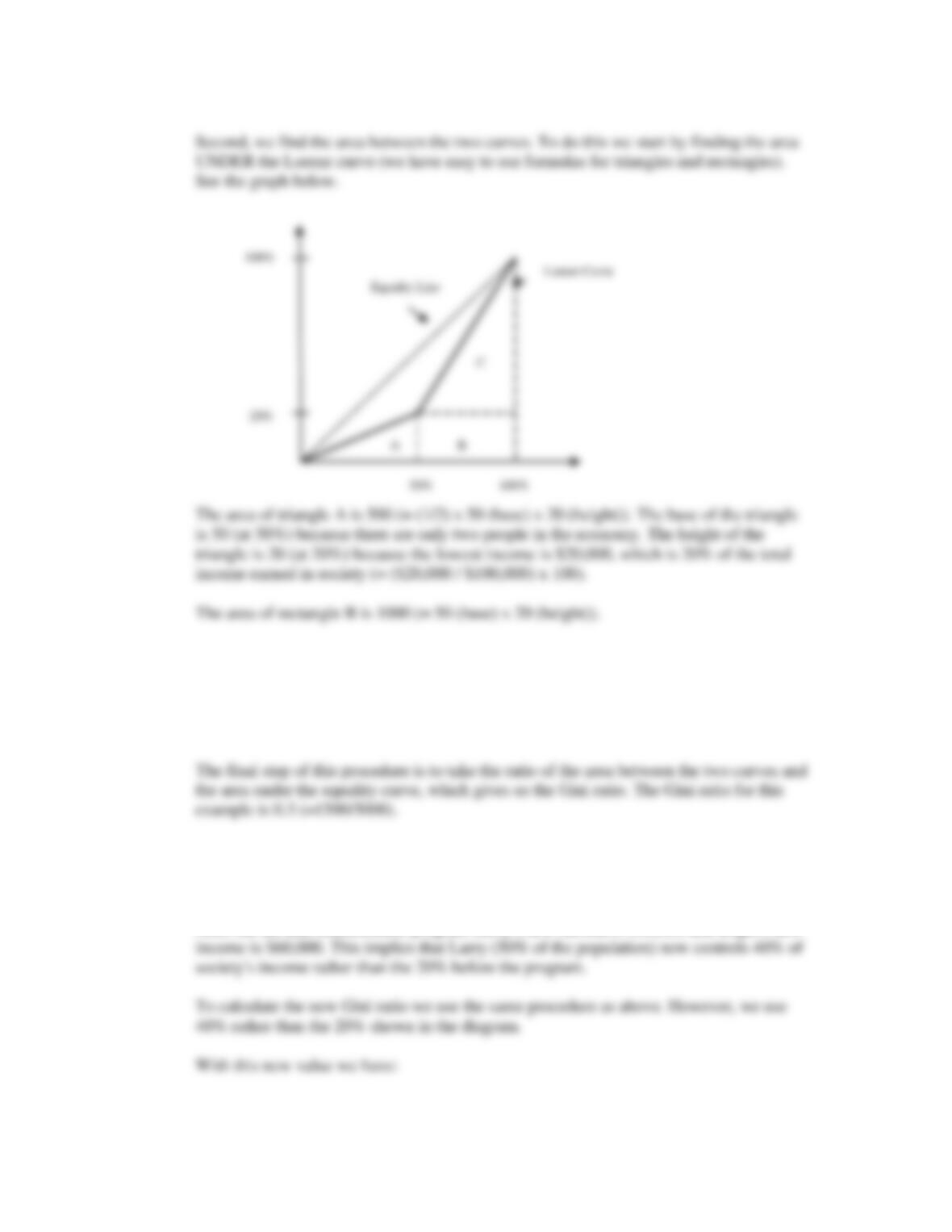
Feedback: Consider the following example. Imagine an economy with only two people.
Larry earns $20,000 per year while Roger earns $80,000 per year. As shown in the
following figure, the Lorenz curve for this two‐person economy consists of two line
segments. The first runs from the origin to point a while the second runs from point a to
point b.
Chapter 20 – Income Inequality and Poverty
20–11
The area of triangle C is 2000 (= (1/2) x 50 (base) x 80 (height).
The total area under the Lorenz Curve is 3500. We can now find the area between the two
curves, which is 1500 (= 5000 (the area under the equality curve) – 3500 (the area under
the Lorenz curve)).
Part b:
What would the Gini ratio be if the government taxed $20,000 away from Roger and
gave it to Larry? (Hint: The figure will change.)
After the tax and redistribution program Larry’s new income is $40,000 and Roger’s new

Chapter 20 – Income Inequality and Poverty
20–12
Part c:
Start again with Larry earning $20,000 per year and Roger earning $80,000 per year.
What would the Gini ratio be if both their incomes doubled? How much has the Gini ratio
changed from before the doubling in incomes to after the doubling in incomes?
If incomes double, Larry earns $40,000 and Roger earns $160,000. The total income in
3. In 2010, many unskilled workers in the United States earned the Federal minimum wage of
$7.25 per hour. By contrast, average earnings in 2010 were about $22 per hour and certain highly
skilled professionals such as doctors and lawyers earned $100 or more per hour. LO6
a. If we assume that wage differences are caused solely by differences in productivity, how many
times more productive was the average worker than a worker being paid the Federal minimum
wage? How many times more productive was a $100‐per‐hour lawyer compared to a worker
earning minimum wage?
b. Assume that there are 20 minimum‐wage workers in the economy for each $100‐ per‐hour
lawyer. Also assume that both lawyers and minimum‐wage workers work the same number of
hours per week. If everyone works 40 hours per week, how much does a $100‐per hour lawyer
earn a week? How much does a minimum‐wage worker earn a week?
c. Suppose that the government pairs each $100‐per‐hour lawyer with 20 nearby minimum‐wage
workers. If the government taxes 25 percent of each lawyer’s income each week and distributes it
equally among the 20 minimum‐wage workers with whom each lawyer is paired, how much will
each of those minimum‐wage workers receive each week? If we divide by the number of hours
worked each week, how much does each minimum‐wage worker’s weekly transfer amount to on
an hourly basis?
d. What if instead the government taxed each lawyer 100 percent before dividing the money
equally among the 20 minimum‐wage workers with whom each lawyer is paired—how much per
week will each minimum wage worker receive (assuming the lawyer continues to work)? And
how much is that on an hourly basis?

Chapter 20 – Income Inequality and Poverty
20–13
Feedback: Consider the following example. In 2010, many unskilled workers in the
United States earned the Federal minimum wage of $7.25 per hour. By contrast, average
earnings in 2010 were about $22 per hour and certain highly skilled professionals such as
doctors and lawyers earned $100 or more per hour.
Part a:
If we assume that wage differences are caused solely by differences in productivity, how
many times more productive was the average worker than a worker being paid the
Federal minimum wage? How many times more productive was a $100‐per‐hour lawyer
compared to a worker earning minimum wage?
Since wage differences are solely due to differences in productivity in the current
Part b:
Assume that there are 20 minimum‐wage workers in the economy for each $100‐
per‐hour lawyer. Also assume that both lawyers and minimum‐wage workers work the
same number of hours per week. If everyone works 40 hours per week, how much does a
$100‐per hour lawyer earn a week? How much does a minimum‐wage worker earn a
week?
The lawyer earns $4000 per week (= $100 (hourly wage) x 40 (hours worked per week)).
Part c:
Suppose that the government pairs each $100‐per‐hour lawyer with 20 nearby
minimum‐wage workers. If the government taxes 25 percent of each lawyer’s income
each week and distributes it equally among the 20 minimum‐wage workers with whom
each lawyer is paired, how much will each of those minimum‐wage workers receive each
week? If we divide by the number of hours worked each week, how much does each
minimum‐wage worker’s weekly transfer amount to on an hourly basis?

Chapter 20 – Income Inequality and Poverty
20–14
First, calculate government revenue from the tax on lawyers. At the tax rate of 25% on
Part d:
What if instead the government taxed each lawyer 100 percent before dividing the money
equally among the 20 minimum‐wage workers with whom each lawyer is paired—how
much per week will each minimum wage worker receive (assuming the lawyer continues
to work. Might want to add this for clarification)? And how much is that on an hourly
basis?
For this case government revenue will equal $4000 assuming the lawyer continues to
4. The desire to maximize profits can work against racial and other types of discrimination. To
see this, consider two equally productive accountants named Ted and Jared. Ted is black, and
Jared is white. Both can complete 10 audits per month. LO7
a. Suppose that for any accounting firm that hires either Ted or Jared, all the other costs of
performing an audit (besides paying either Ted or Jared) come to $1000 per audit. If the going
rate that must be paid to hire an accountant is $7000 per month, how much will it cost an
accounting firm to produce one audit if it hires either Ted or Jared to do the work?
b. If the market price that accounting firms charge their clients for an audit is $1800, what would
the accounting profit per audit be for a firm that hired either Ted or Jared? What is the profit rate
as a percentage?
c. Suppose that firm A dislikes hiring black accountants while firm B is happy to hire them. So
Ted ends up working at firm B rather than firm A. If Ted works 11 months per year, how many
audits will he complete for firm B each year? How much in accounting profits will firm B earn
each year from those audits?
d. Since firm A passed on hiring Ted because he was black, firm A is forgoing the profits it could
have earned if it had hired Ted. If the firm is willing to forgo up to $5,000 per year in profit to
avoid hiring blacks, by how many dollars will firm A regret its decision not to hire Ted?
Feedback: Consider the following example. The desire to maximize profits can work
against racial and other types of discrimination. To see this, consider two equally
productive accountants named Ted and Jared. Ted is black, and Jared is white. Both can
complete 10 audits per month.
Part a:

Chapter 20 – Income Inequality and Poverty
20–15
Part b:
If the market price that accounting firms charge their clients for an audit is $1800, what
would the accounting profit per audit be for a firm that hired either Ted or Jared? What is
the profit rate as a percentage?
Since the cost per audit is $1700 (from part a) and the price the firm charges per audit is
Part c:
Suppose that firm A dislikes hiring black accountants while firm B is happy to hire them.
So Ted ends up working at firm B rather than firm A. If Ted works 11 months per year,
how many audits will he complete for firm B each year? How much in accounting profits
will firm B earn each year from those audits?
Ted will complete 110 audits working 11 months per year ( = 10 (audits per month) x 11
(months)).
Part d:
Since firm A passed on hiring Ted because he was black, firm A is forgoing the profits it
could have earned if it had hired Ted. If the firm is willing to forgo up to $5,000 per year
in profit to avoid hiring blacks, by how many dollars will firm A regret its decision not to
hire Ted?