Time 4 onward:
Price level continues to grow at the rate of the money supply, and real money
demand remains unchanged at 4,608 billions. See the previous table.
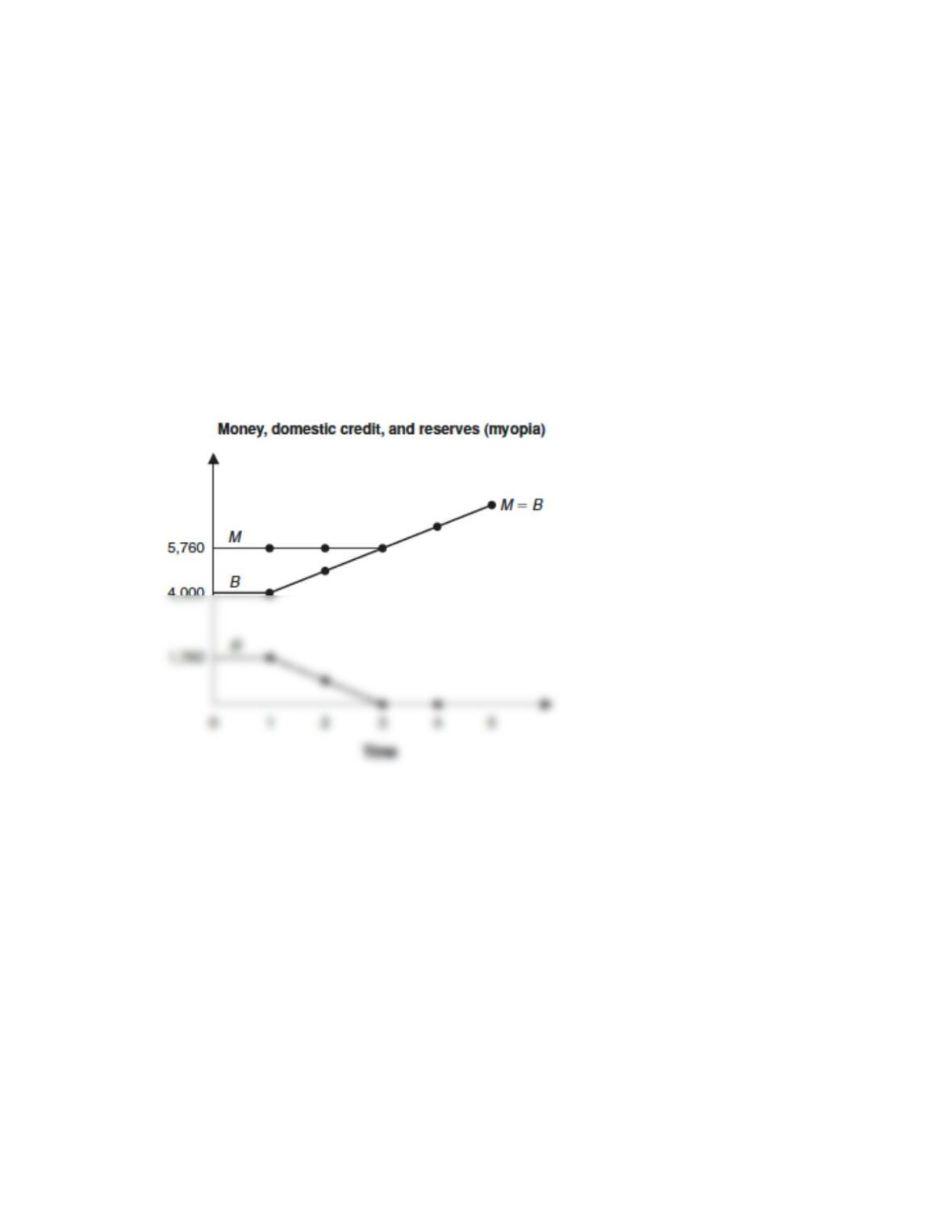
e. Illustrate the behavior of the following variables between t = 1 and t = 5: domestic
credit, reserves, and the money supply.
Answer: See the following diagram.
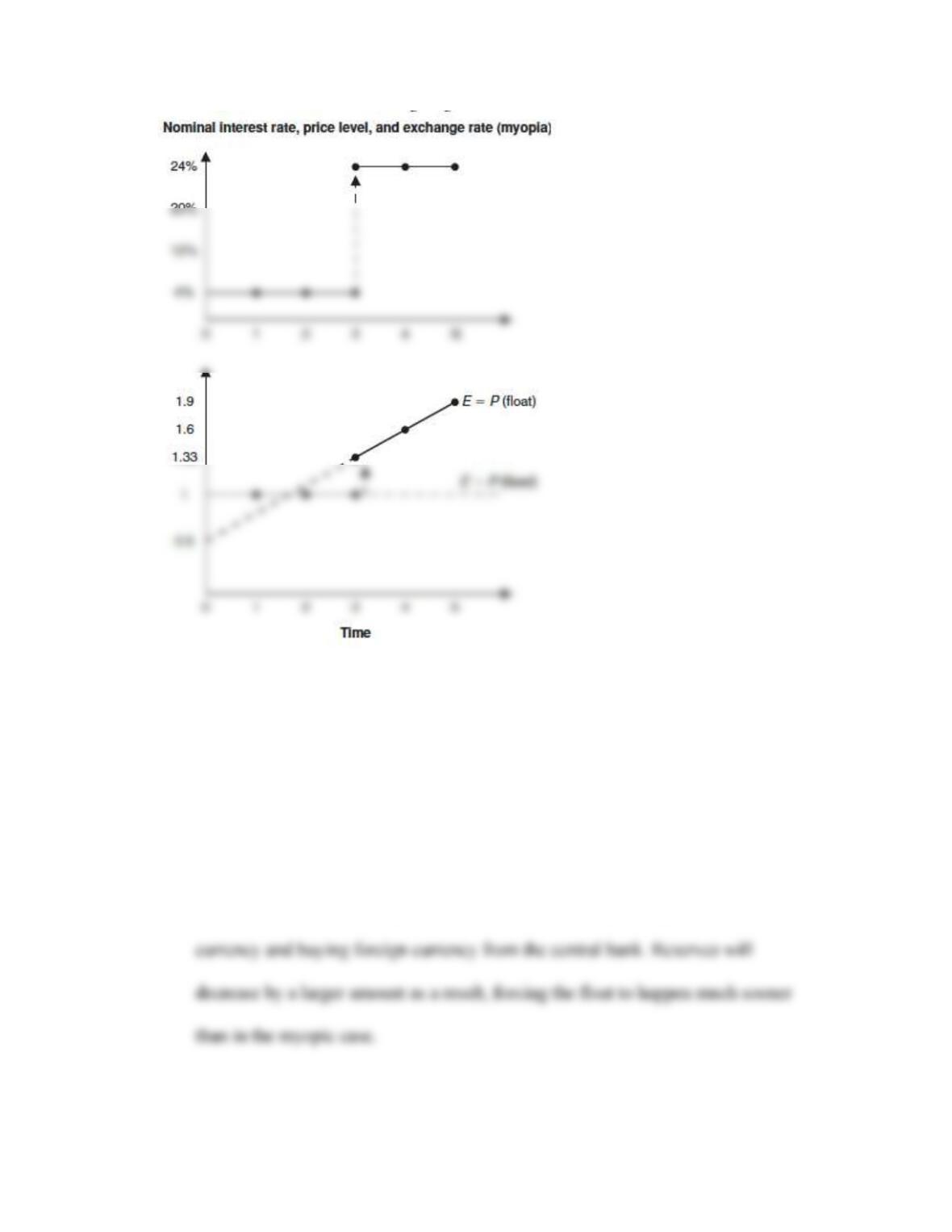
f. Illustrate the behavior of the following variables between t = 1 and t = 5: the
nominal interest rate, the price level, and the exchange rate.
Answer: See the following diagrams.
8. Consider the previous question. In this case, we assume investors are forward-looking
and hear news that the government deficit will grow at 20% each year.
a. How will investors respond to the announcement of the budget deficit? What
happens to reserves as a result?
Answer: Investors will respond to the announcement by selling domestic
b. Calculate the level of critical reserves at which the speculative attack occurs. Is
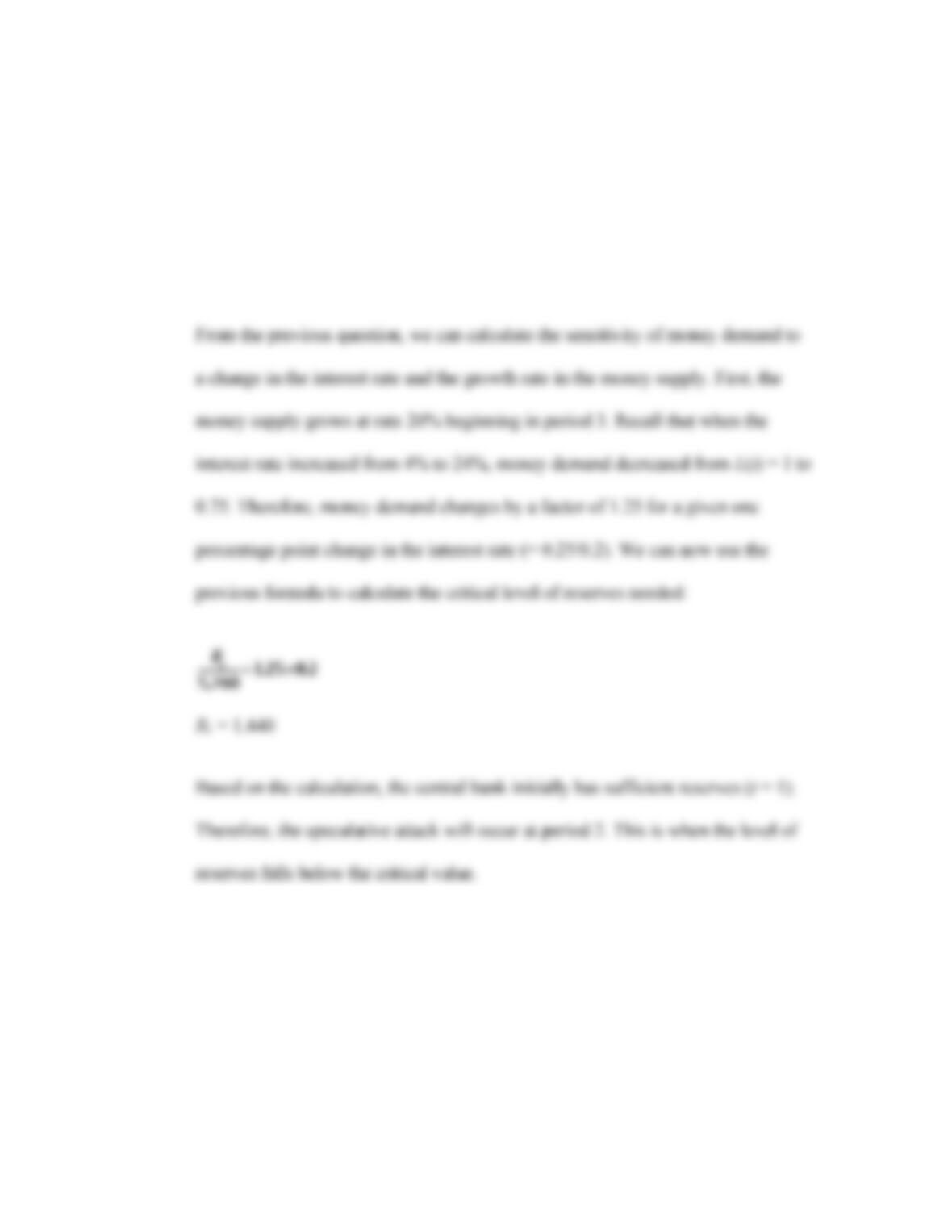
this central bank holding sufficient reserves to prevent a speculative attack?
According to your calculation, when should the speculative attack occur?
Answer: The critical level of reserves is given by
Rc/M = –∆M/M =
ϕ
×
µ
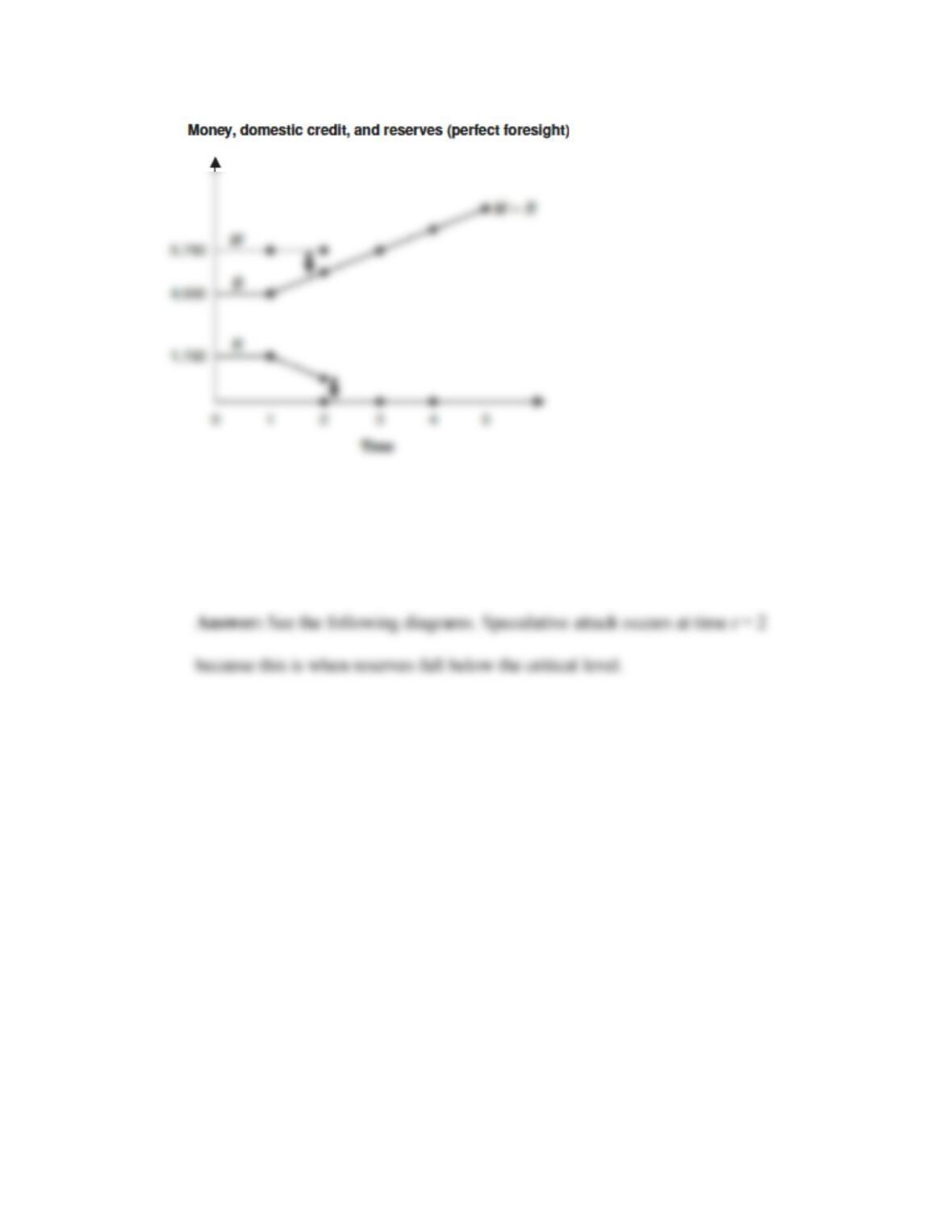
c. Illustrate the behavior of the following variables between t = 1 and t = 5: domestic
credit, reserves, and the money supply.
Answer: See the following diagrams. Speculative attack occurs at time t = 2
because this is when reserves fall below the critical level.
d. Illustrate the behavior of the following variables between t = 1 and t = 5: the
nominal interest rate, the price level, and the exchange rate.
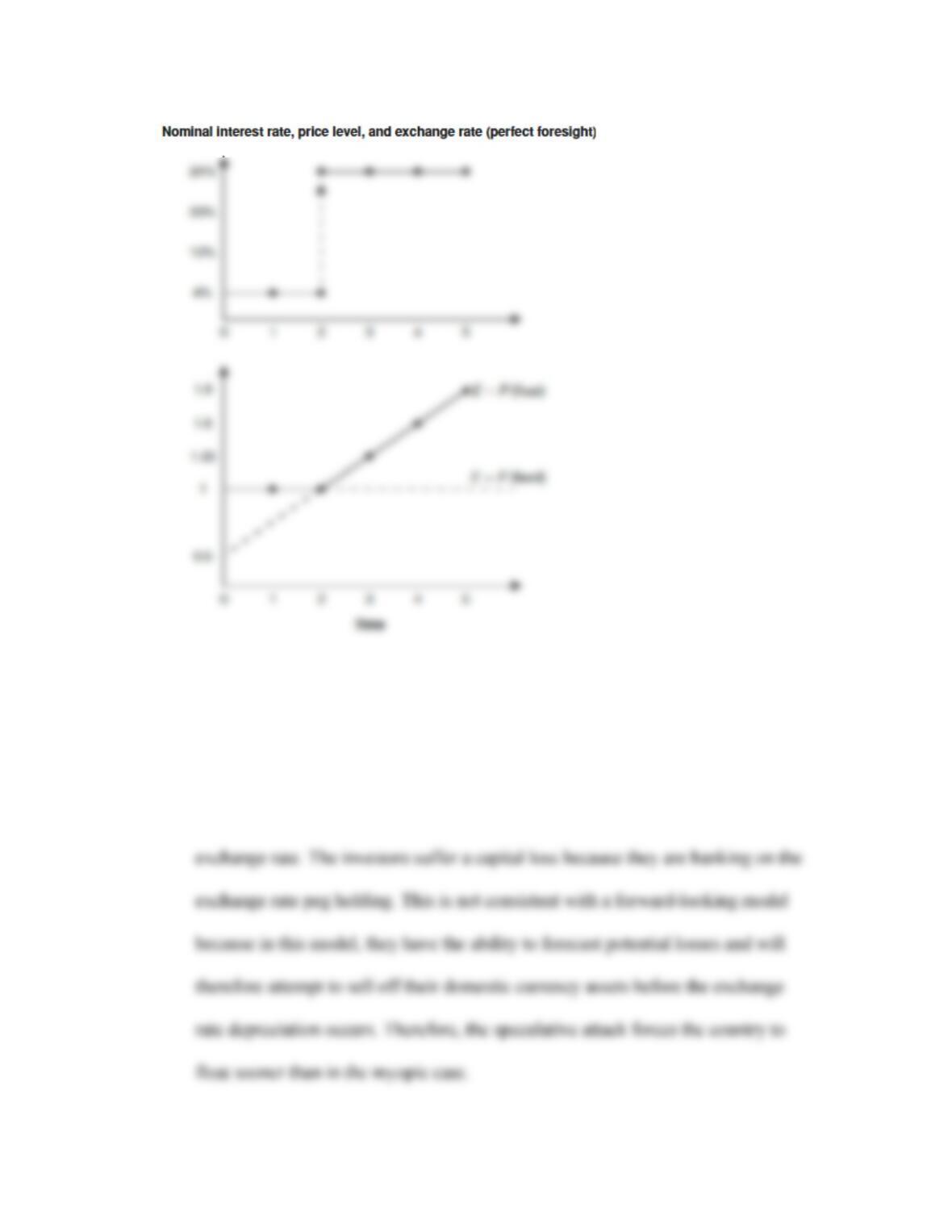
e. Why does the price level “jump” when the country switches from fixed to float in
the myopic case? Why is this not possible in the forward-looking case?
Answer: The price level jump is caused by the unanticipated change in the
9. The textbook examines what happens when governments run persistent budget
deficits in a first-generation model. Suppose that a country begins running large
budget surpluses. In this case, will the country be forced to float? In the forward–
looking model, is a speculative attack possible in this case? Explain.
Answer: No, because budget surpluses contract domestic credit, expanding the
10. Consider a second-generation model of crises. Assume that the benefit of maintaining
an exchange rate peg is equal to 4% (measured in output gap terms). Examine each of
the following cases, assuming the economy experiences a recession. For each case,
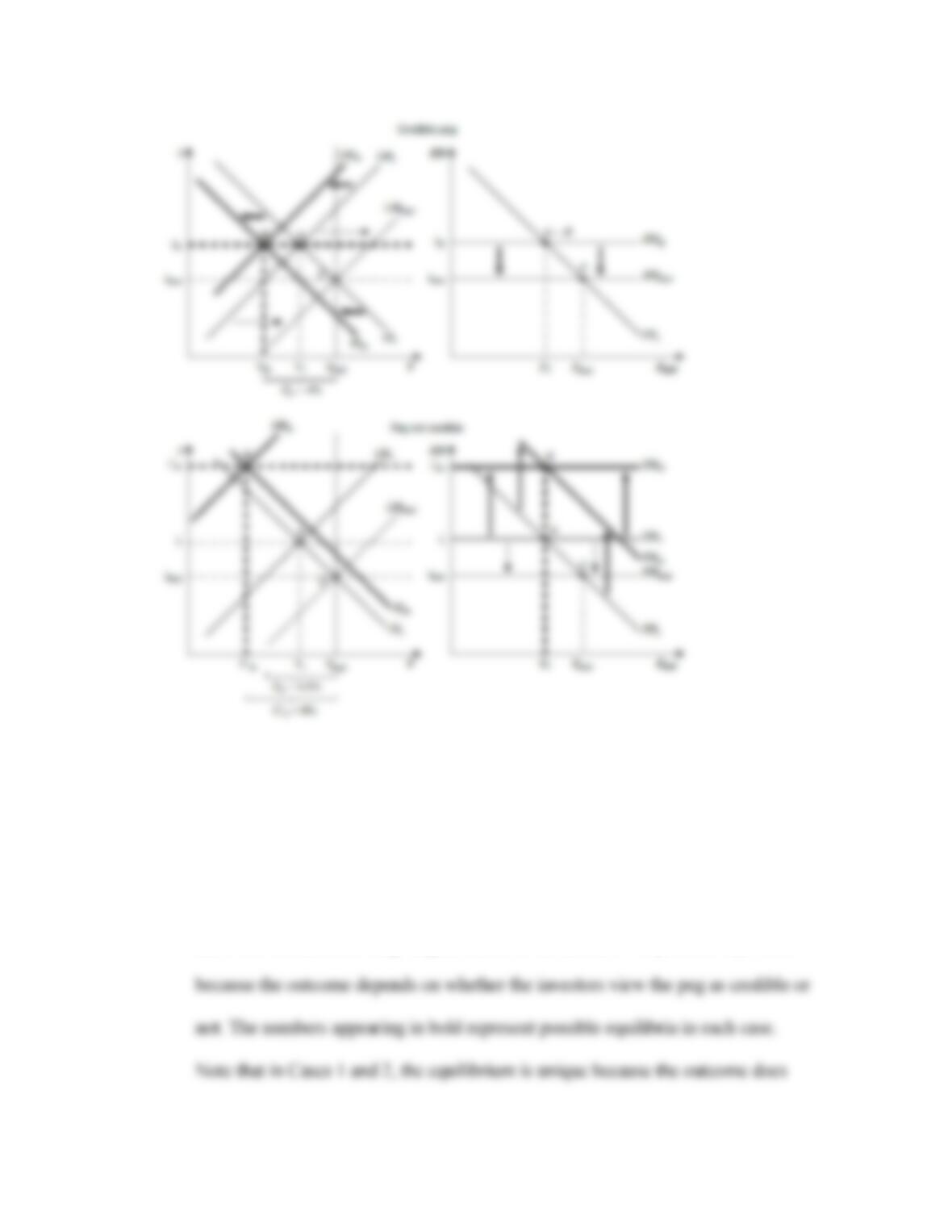
illustrate the IS‒LM‒FX model and determine whether the country will (1) peg, (2)
float, or (3) peg or float, depending on the peg’s credibility. On your diagrams,
indicate relevant shifts in the curves.
a. Case 1. If the country defends the exchange rate peg, the output gap is equal to
5%. If the peg is not credible, the output gap is equal to 8.5%. Will investors view
the peg as credible in this case? Explain.
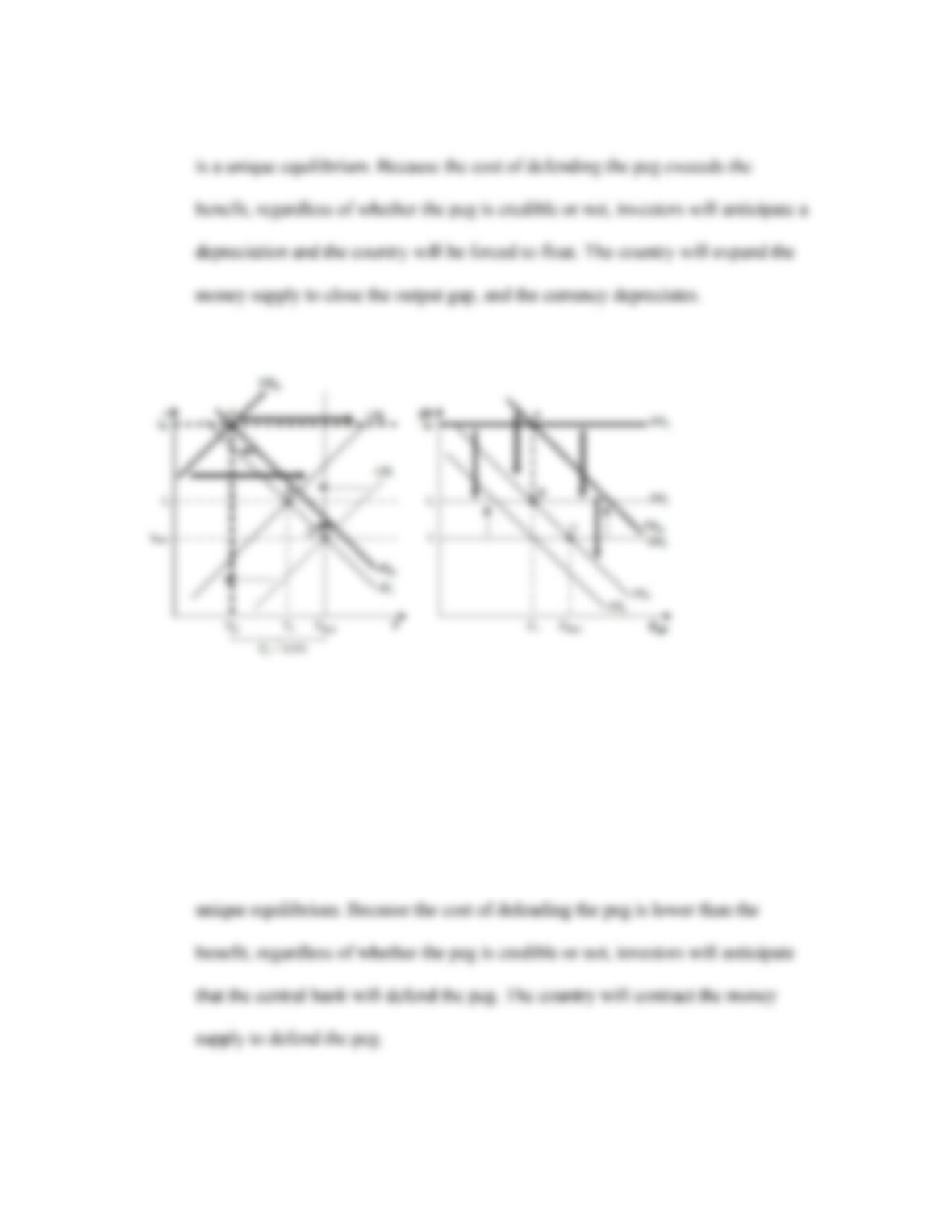
Answer: See the following diagrams. No, the peg is not credible. Therefore, there
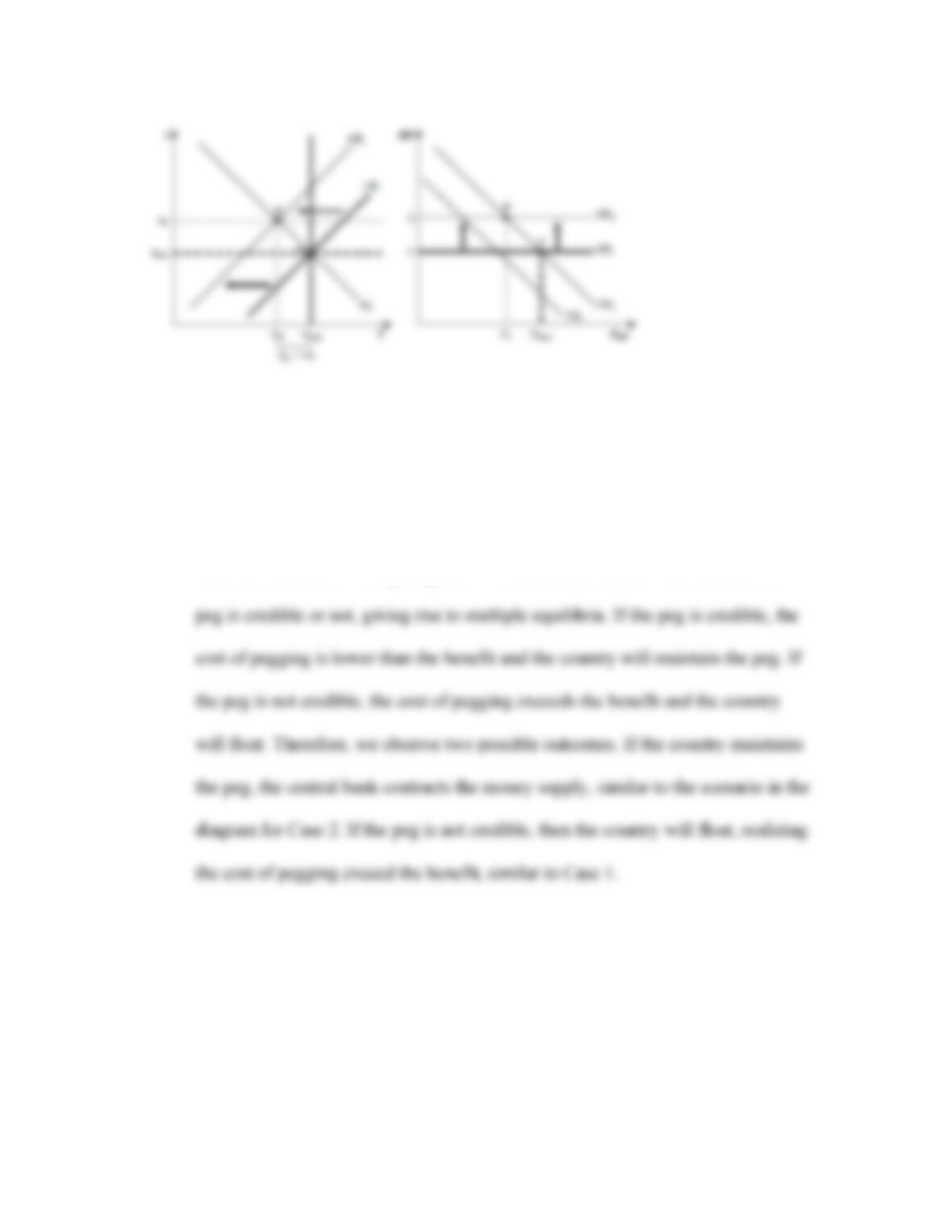
b. Case 2. If the country defends the exchange rate peg, the output gap is equal to
1%. If the peg is not credible, the output gap is equal to 1.5%. Will investors view
the peg as credible in this case? Explain.
Answer: See the following diagrams. Yes, the peg is credible and there is a
c. Case 3. If the country defends the exchange rate peg, the output gap is equal to
3.5%. If the peg is not credible, the output gap is equal to 5.5%. Will investors
view the peg as credible in this case? Explain.
Answer: See the following diagrams. We are unable to determine whether the
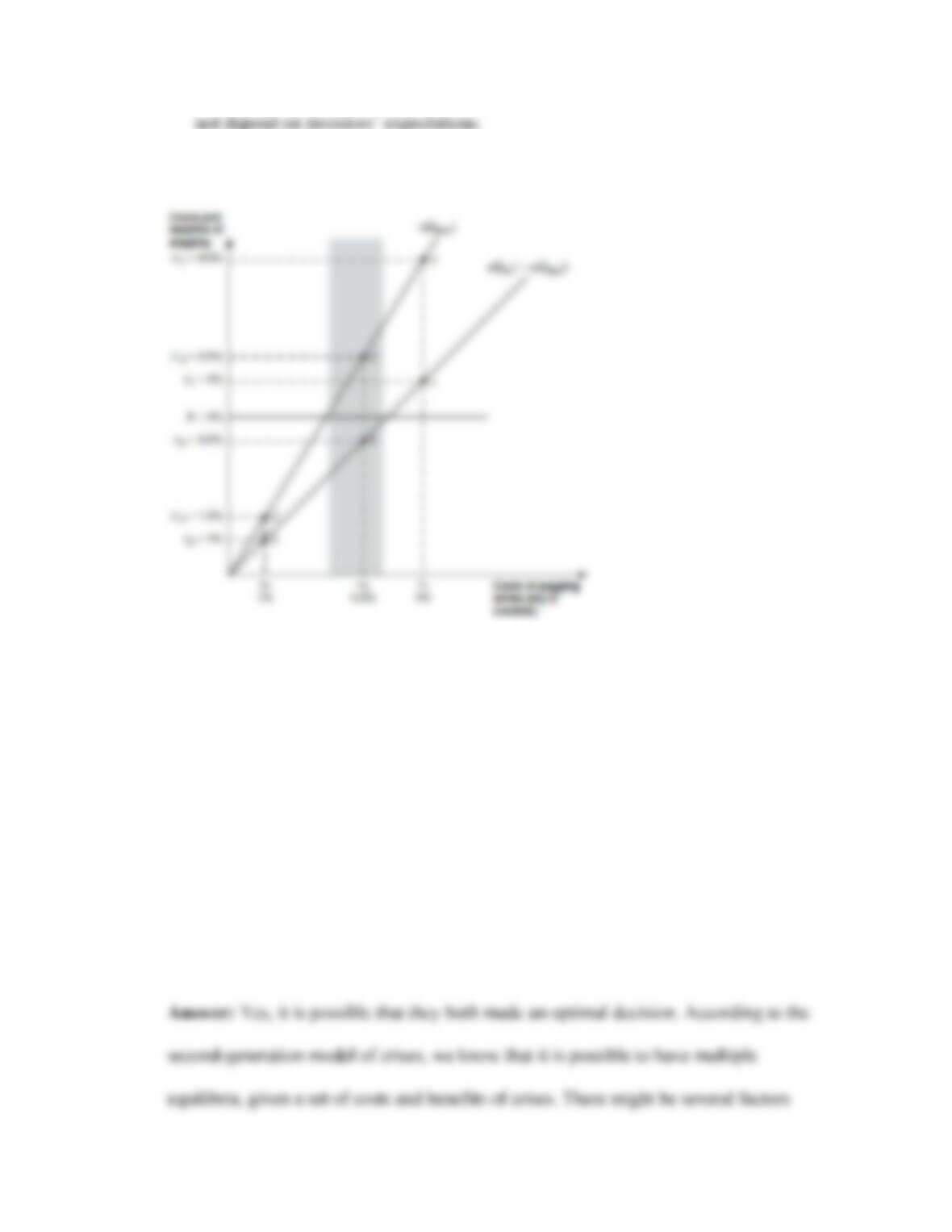
d. Illustrate the previous three cases using a diagram similar to Figure 20-17 in the
text. In which case do multiple equilibria arise, and why? Why don’t investor
expectations affect outcomes in the other two cases?
Answer: See the following diagram. In Case 3, there are two possible equilibria
11. During the East Asian currency crisis, some countries opted to float their currencies
relative to the U.S. dollar, whereas others did not. Consider two countries: South
Korea and Malaysia. South Korea floated its currency (the won) against the dollar in
the autumn of 1997. Malaysia did not, and still maintains a fixed exchange rate
relative to the U.S. dollar. For simplicity, suppose that these two countries faced
exactly the same costs and benefits of maintaining a credible exchange rate peg. In
this case, is it possible that they both made an optimal decision? Explain.
12. Throughout the chapter, there are applications citing the dramatic accumulation of
reserves among selected emerging markets and developing countries.
a. What are the causes of this reserve accumulation?
b. What are the costs of reserve accumulation? Why might a country decide to
accumulate reserves, even in the face of relatively large interest rate spreads
between domestic and foreign bonds?
Answer: Sterilization bonds must pay higher interest than the interest received on
c. Explain how reserve accumulation could affect outcomes in a first-generation
model of crises.
Answer: In the first-generation model, countries experience exchange rate crises
d. Explain how reserve accumulation could affect outcomes in a second-generation
model of crises.
Answer: In the second-generation model, the costs of maintaining an exchange
rate peg depend on whether or not a peg is credible, giving rise to multiple