Chapter 20
The Labor Market, Employment, and Unemployment
◼ Chapter Outline, Overview, and Teaching Tips
Chapter Outline
Developments in the U.S. Labor Market
Employment Ratio
Supply and Demand in the Labor Market
The Demand Curve for Labor
Response of Employment and Wages to Changes in Labor Demand and Labor Supply
Changes in Labor Demand
Changes in Labor Supply
Application: Why Has Labor Force Participation of Women Increased?
Application: Why Are Returns to Education and Income Inequity Increasing?
Causes of Unemployment
Frictional Unemployment
Policy and Practice: Unemployment Insurance and Unemployment
Structural Unemployment
Chapter 20 The Labor Market, Employment, and Unemployment 231
Chapter Overview and Teaching Tips
Chapter 20 provides an analysis of the labor market and answers basic questions such as: Why has the
labor force participation of women increased so much? Why have the returns to college education risen?
Why has income inequality increased? What explains fluctuations in the natural rate of unemployment,
and why is it generally higher in Europe than in the United States?
The rest of the chapter focuses on the dynamics and causes of unemployment. It is important to get students
to understand how dynamic the labor markets are with large flows into and out of unemployment, with
some workers having very long spells of unemployment. Then students should be introduced to the idea
that some unemployment is frictional and other is structural, often occurring as a result of wage rigidity.
This helps them see that the natural rate of unemployment, the unemployment rate that remains even when
◼ Answers to End of Chapter Review Questions and Problems
Answers to Review Questions
Developments in the U.S. Labor Market
1. The employment ratio, the ratio of employment to the civilian working-age population, has risen
Supply and Demand in the Labor Market
2. Firms’ hiring decisions are made on the basis of profit maximization. Firms compare the marginal
product of labor, the benefit of adding new workers, with the real wage rate, the cost of hiring them.
The marginal product of labor is subject to diminishing returns, so as the firms’ labor force increases
3. The quantity of labor supplied is positively, not inversely, related to the real wage rate. Workers have
two basic choices regarding the allocation of their time—work or leisure (all activities away from their
job). An increase in real wages makes work more rewarding and increases the opportunity cost of leisure
232 Mishkin • Macroeconomics: Policy and Practice, Second Edition
Response of Employment and Wages to Changes in Labor Demand and Labor Supply
4. Negative demand shocks that reduce aggregate demand and lead to lower aggregate output will
reduce the marginal product of labor. The resulting leftward shift of the labor demand curve causes
Dynamics of Unemployment
5. The three categories are employed, unemployed, and not in the labor force. Discouraged workers are
workers who were classified as unemployed but became so discouraged at not finding a job that they
Causes of Unemployment
6. Frictional unemployment is the unemployment that results because workers spend time searching for
good jobs (however they may define that) and firms likewise spend time searching for good candidates to
7. Structural unemployment refers to the chronic unemployment that arises when job applicants do not
possess the skills employers are seeking. This may be because they lack the basic literacy and life
8. Real wage rigidity means that real wages cannot adjust to the level that would equate labor demand
and supply. When the demand for labor decreases or the supply of labor increases, real wages do not
Natural Rate of Unemployment
9. The natural rate of unemployment measures the unemployment that exists in the long run because,
even when wages have time to adjust to changes in demand and supply in the labor market, frictional
and structural unemployment keep the unemployment rate above zero. It is the unemployment rate
Chapter 20 The Labor Market, Employment, and Unemployment 233
10. Cyclical unemployment is the difference between the actual unemployment rate and the natural rate
of unemployment. Cyclical unemployment accounts for most of the increase in unemployment that
Answers to Problems
Supply and Demand in the Labor Market
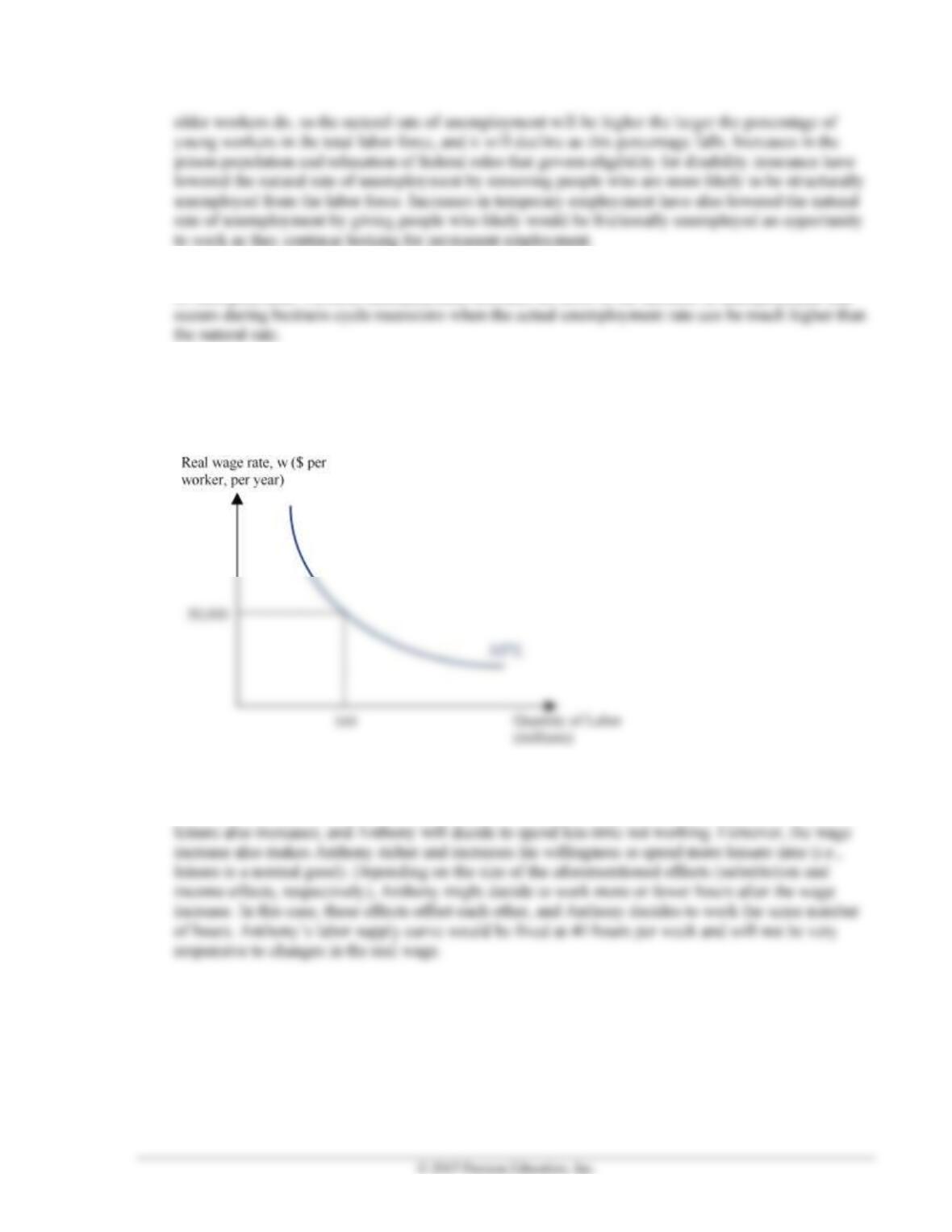
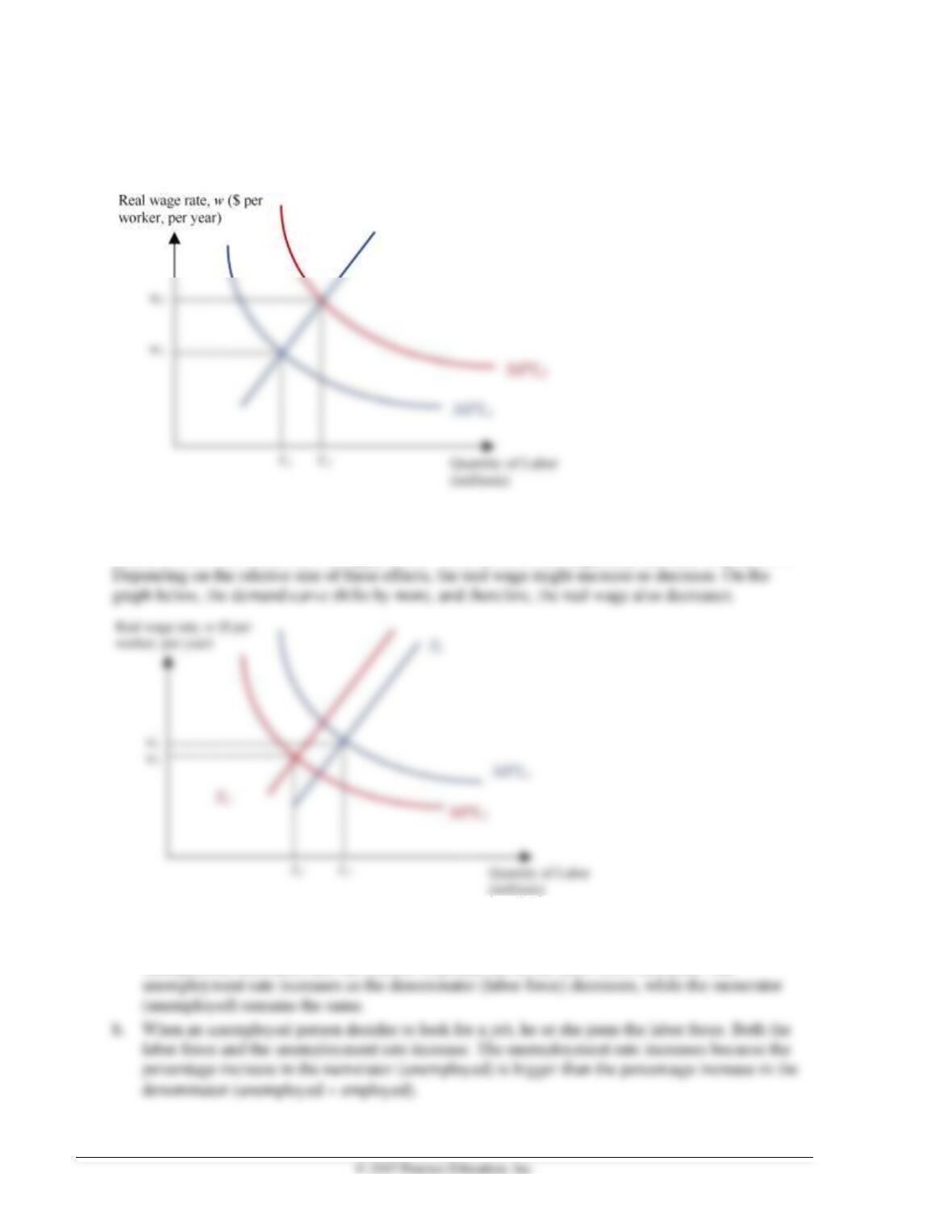
1. a. and b.
2. When wages change, workers’ decisions as to how many hours to work are affected. In this case, a
wage increase will allow Anthony to earn more income and will, therefore, affect Anthony’s decision
to allocate his time between work and leisure. As his hourly wage increases, the opportunity cost of
234 Mishkin • Macroeconomics: Policy and Practice, Second Edition
Response of Employment and Wages to Changes in Labor Demand and Labor Supply
3. The marginal product of labor curve shifts to the right and the real wage rate rises, as does the
quantity of labor, as is shown in the graph below.
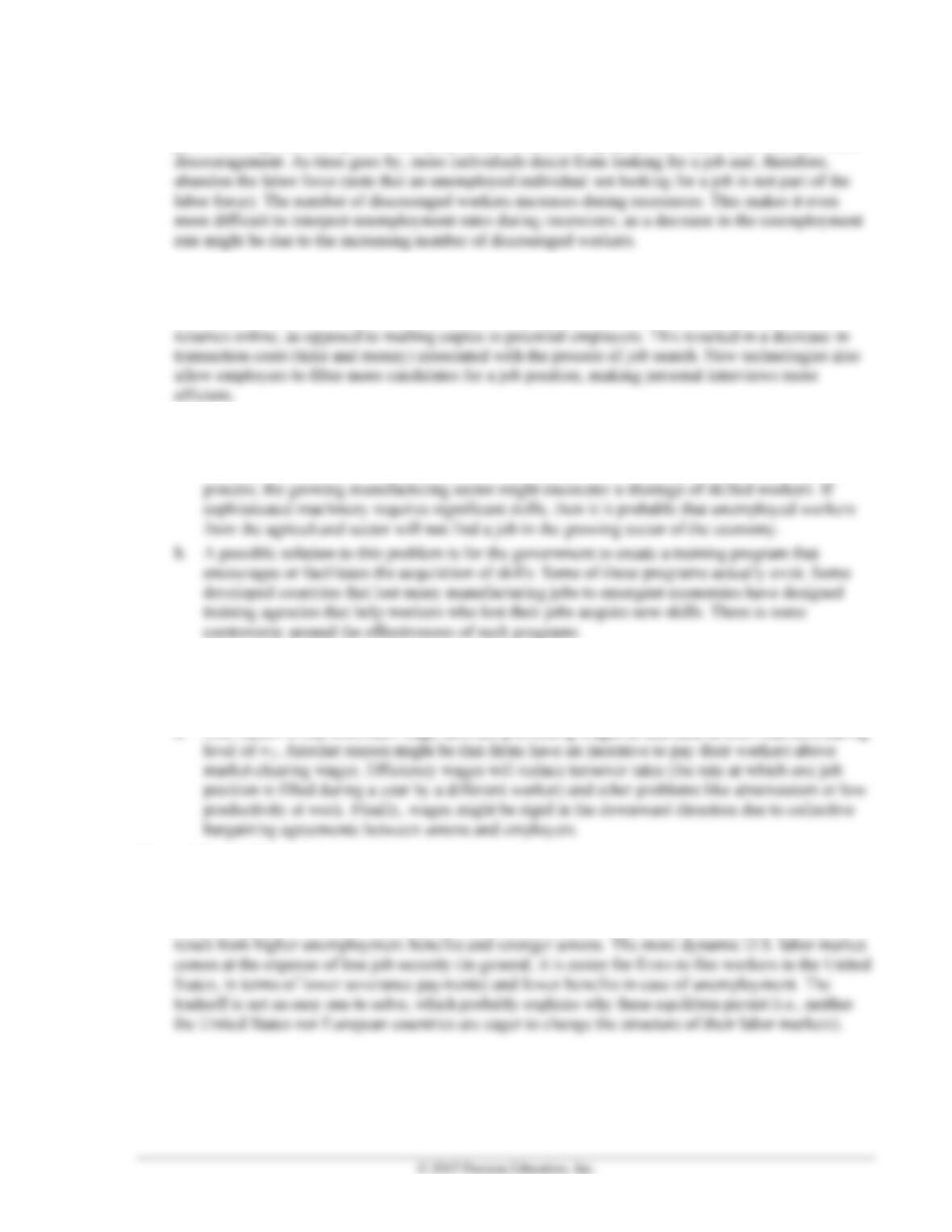
4. A recession shifts the demand for labor curve to the left, while the increase in day care costs will
probably encourage at least one parent to stay home or work part time to take care of children. This
results in a shift to the left of the supply curve. These effects unambiguously decrease employment.
Dynamics of Unemployment
5. a. When an individual quits his job and does not look for a job, the labor force (i.e., employed +
unemployed) decreases, and the number of people not in the labor force increases. The
Chapter 20 The Labor Market, Employment, and Unemployment 235
6. When the unemployment rate increases during recessions, it becomes increasingly difficult to find a
job. This lengthens the spell of unemployment for most unemployed individuals and results in more
Causes of Unemployment
7. The advent of Websites that allow potential workers to process more information more quickly has
definitely had a positive impact on frictional unemployment. Workers are now able to post their
8. a. Structural unemployment will probably increase for some time, depending on the skill level
required to work at factories producing the manufactured goods. As the new sector grows
stronger, more workers will find it profitable to acquire the newly required skills. During this
9. a. Unemployment is the surplus of labor that prevails at a wage equal to w1: L3 – L2. Put differently,
at a wage equal to w1 there are L3 – L2 million workers who would work for such a wage but
cannot find a job.
b. One reason is that minimum wage laws are preventing wages to decrease to their market clearing
Natural Rate of Unemployment
10. Quite naturally, the U.S. labor market should look more promising to you than the French labor
market. Everything else the same, the probability of finding a job would be higher in the United
States. Higher natural rates of unemployment in France, as in many European countries, usually
236 Mishkin • Macroeconomics: Policy and Practice, Second Edition
◼ Answers to Data Analysis Problems
1. a. From 2012:Q4 to 2013:Q1, real wages decreased from 103.91 to 102.54, or –1.33%, and
employment increased very slightly from 143,303,000 to 143,367,000 or +0.04%. This is
2. a. The labor force for July 2013 equals 144,285,000 (E) + 11,514,000 (U) = 155,799,000. The
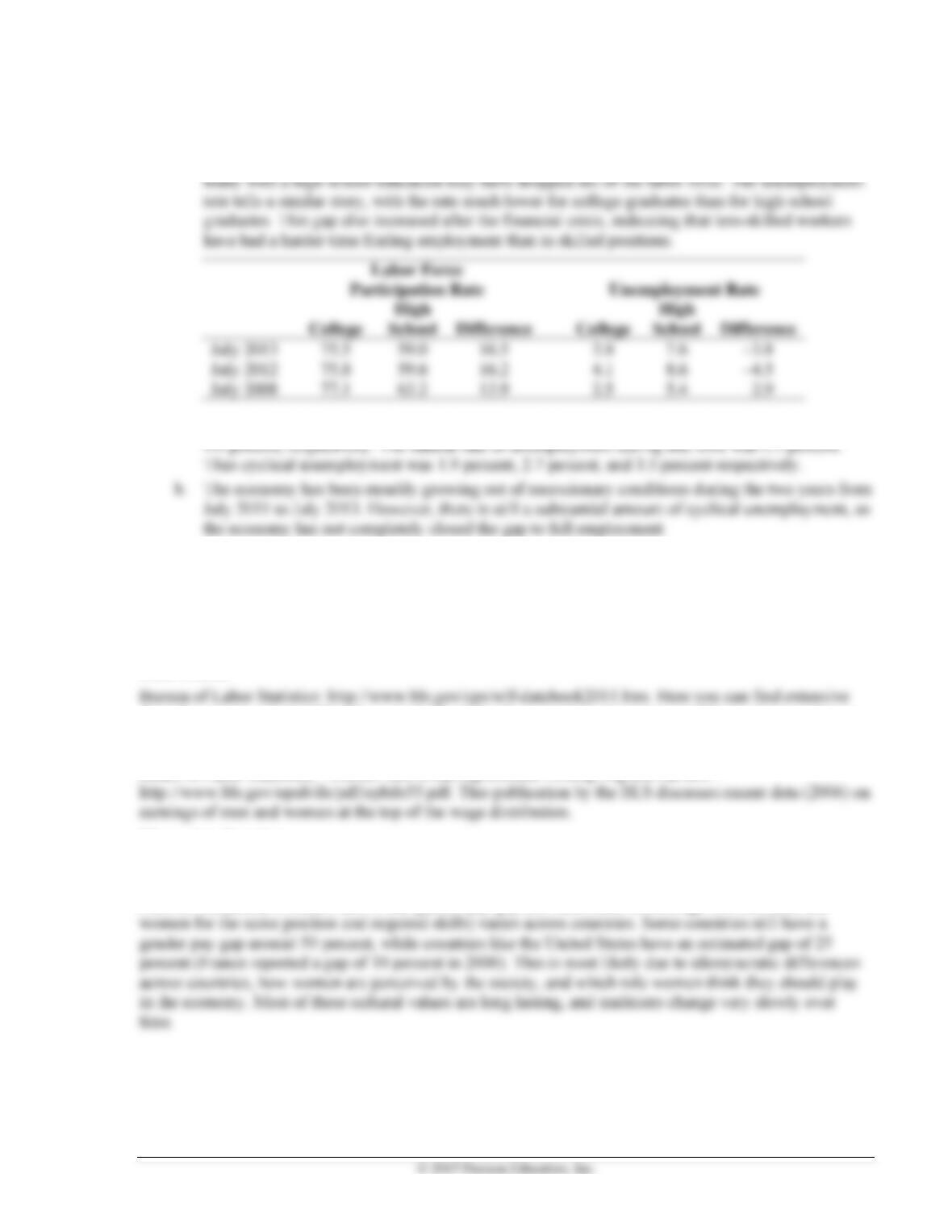
3. a. See table below. In general, the labor force participation rate has held fairly constant between
both groups, although the gap has narrowed somewhat in the last five years. Overall, labor force
b. See table below. The labor force participation rate between African American and whites has
been fairly steady, with white workers having about 2.5 percentage points higher participation
than African Americans. The unemployment rate is a different story, with a very large gap
Chapter 20 The Labor Market, Employment, and Unemployment 237
c. See table below. Labor force participation among college graduates is high, and much higher
than for workers with just a high school education. Moreover, this gap has increased from 14
percentage points to more than 16 percentage points after the financial crisis, suggesting that
4. a. The unemployment rate for July 2013, July 2012, and July 2011 was 7.4 percent, 8.2 percent, and
◼ Data Sources, Related Articles, and Discussion Questions
A. For Information About Application: Why Has Labor Force Participation of
Women Increased?
Data Source
data about women in the labor force, including labor force participation rates, weekly earnings, and more.
Related Article
Issues in Labor Statistics, “Women Still Underrepresented Among Highest Earners”:
Discussion Question
Do you expect gender discrimination in the labor market to be similar across countries? Explain.
Answer: Empirical evidence shows that gender pay gap (the difference in earnings between men and
238 Mishkin • Macroeconomics: Policy and Practice, Second Edition
B. For Information About Application: Why Are Returns to Education and
Income Inequity Increasing?
Data Source
Education,” select “archives,” and then the most recent data. Check table 6 for information on the
employment status of the civilian noninstitutional population by education attainment.
Related Article
comprehensive study on the returns to education in the United States. (Inside you can find data and charts
about this topic.)
Discussion Question
Assuming that skill-biased technical change and globalization are the reasons for the wage premium
increase, do you expect that income inequality will increase or decrease in the future?
Answer: If skill-biased technical change and globalization are the reasons for the wage premium increase,
C. For Information About Policy and Practice: Unemployment Insurance and
Unemployment
Data Source
insurance weekly claims report. Here you can find current and historical data on unemployment insurance
claims.
Related Article
Summers, Lawrence, “The Economic Case of Extending Unemployment Insurance”:
Discussion Question
Contrast the White House view on unemployment insurance with this article prepared by the Cato
Institute: http://www.cato.org/pubs/handbook/hb107/hb107-32.pdf.
Answer: The White House perspective and the Cato Institute’s view about unemployment insurance show
Chapter 20 The Labor Market, Employment, and Unemployment 239
D. For Information About Policy and Practice: Minimum Wage Laws
Data Source
characteristics of minimum wage workers for 2012.
Related Article
Cato Institute, “Minimum Wage Hikes Deserve Share of Blame for High Unemployment”:
Discussion Question
Which would be the effect of an increase in the minimum wage on income inequality?
Answer: In order to settle this question, one would have to measure the effect of the minimum wage
E. For Information About Application: Why Are European Unemployment
Rates Generally Much Higher Than U.S. Unemployment Rates?
Data Source
020&tableSelection=1&plugin=1. Here you can find unemployment rates for individual European
countries as well as the European Union.
Related Article
Walker, Marcus and Roger Thurow, “U.S., Europe Are an Ocean Apart on Human Toll of Joblessness”
Discussion Question
Consider the different structures of the U.S. and European labor markets (i.e., workers’ benefits, unions,
work rules). Which region do you think will see a faster return to its previous unemployment rate (i.e., after
both recover from the 2007–2009 financial crisis)?
Answer: The structure of the European labor market makes it more rigid than the U.S. labor market. This
means that the U.S. labor market responds faster to changes in economic conditions. For example, because