S-9
interactive activity
Chapter 2
Economic Models:
Trade-offs and Trade
1. Two important industries on the island of Bermuda are fishing and tourism.
According to data from the Food and Agriculture Organization of the United
Nations and the Bermuda Department of Statistics, in 2014 the 315 registered fish–
ermen in Bermuda caught 497 metric tons of marine fish. And the 2,446 people
a. If all 315 registered fishermen were to be employed by hotels (in addition
to the 2,446 people already working in hotels), how many hotel stays could
Bermuda produce?
b. If all 2,446 hotel employees were to become fishermen (in addition to the
315 fishermen already working in the fishing industry), how many metric tons
of fish could Bermuda produce?
1. a. Forgoing the production of 1 metric ton of fish allows Bermuda to produce
2,000 additional hotel stays. Therefore, forgoing the production of 497 metric
b. Forgoing the production of 2,000 hotel stays allows Bermuda to produce 1 addi–
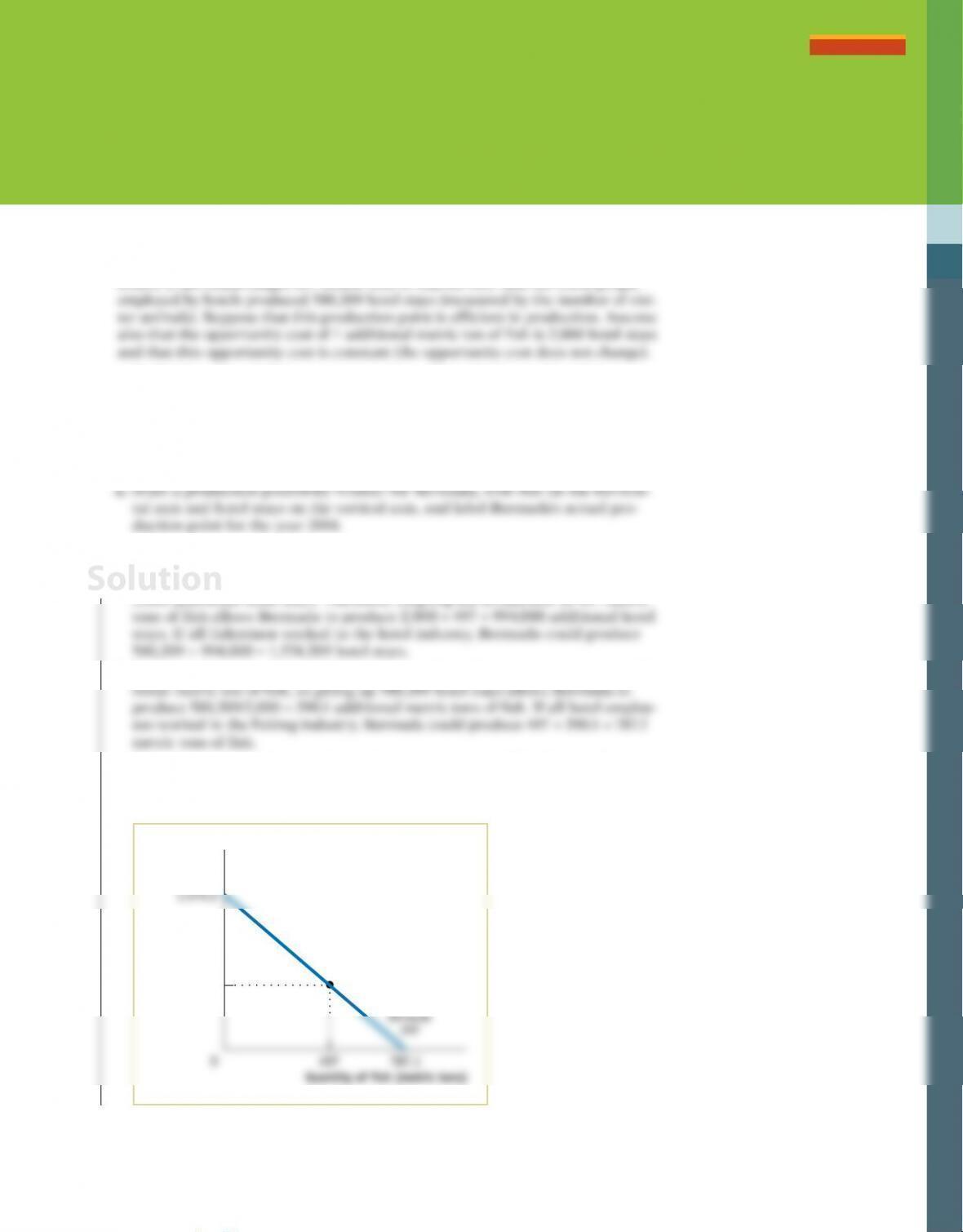
c. The accompanying diagram shows the production possibility frontier for
Bermuda. Note that it is a straight line because the opportunity cost is con-
stant. Point A is Bermuda’s actual production point.
A
Quantity of
hotel stays
(thousands)
Bermuda
PPF
Quantity of fish (metric tons)
1,574.2
580.2
Solution
2. According to data from the U.S. Department of Agriculture’s National Agricul–
tural Statistics Service, 124 million acres of land in the United States were used
for wheat or corn farming in a recent year. Of those 124 million acres, farmers
used 50 million acres to grow 2.158 billion bushels of wheat and 74 million acres
b. From their original production point, farmers transfer 40 million acres of land
from corn to wheat production. They now produce 3.158 billion bushels of
wheat and 10.107 bushels of corn.
c. Farmers reduce their production of wheat to 2 billion bushels and increase
2. a. This point is feasible but not efficient in production. Producing 1.8 billion
bushels of wheat and 9 billion bushels of corn is less of both wheat and corn
than is possible. They could produce more if all the available farmland were
cultivated.
b. At this new production point, farmers would now produce 1 billion more
bushels of wheat and 1.7 billion fewer bushels of corn than at their original
production point. This reflects an opportunity cost of 1.7 bushels of corn per
c. This new production point is feasible and efficient in production. Along the
production possibility frontier, the economy must forgo 0.666 bushel of wheat
3. In the ancient country of Roma, only two goods, spaghetti and meatballs, are
produced. There are two tribes in Roma, the Tivoli and the Frivoli. By them-
a. Assume that all production possibility frontiers are straight lines. Draw one
diagram showing the monthly production possibility frontier for the Tivoli and
b. Which tribe has the comparative advantage in spaghetti production? In meat–
ball production?
Solution
Chapter 2 Economic modEls: TradE-offs and TradE S-11
In a.d. 100 the Frivoli discover a new technique for making meatballs that dou-
bles the quantity of meatballs they can produce each month.
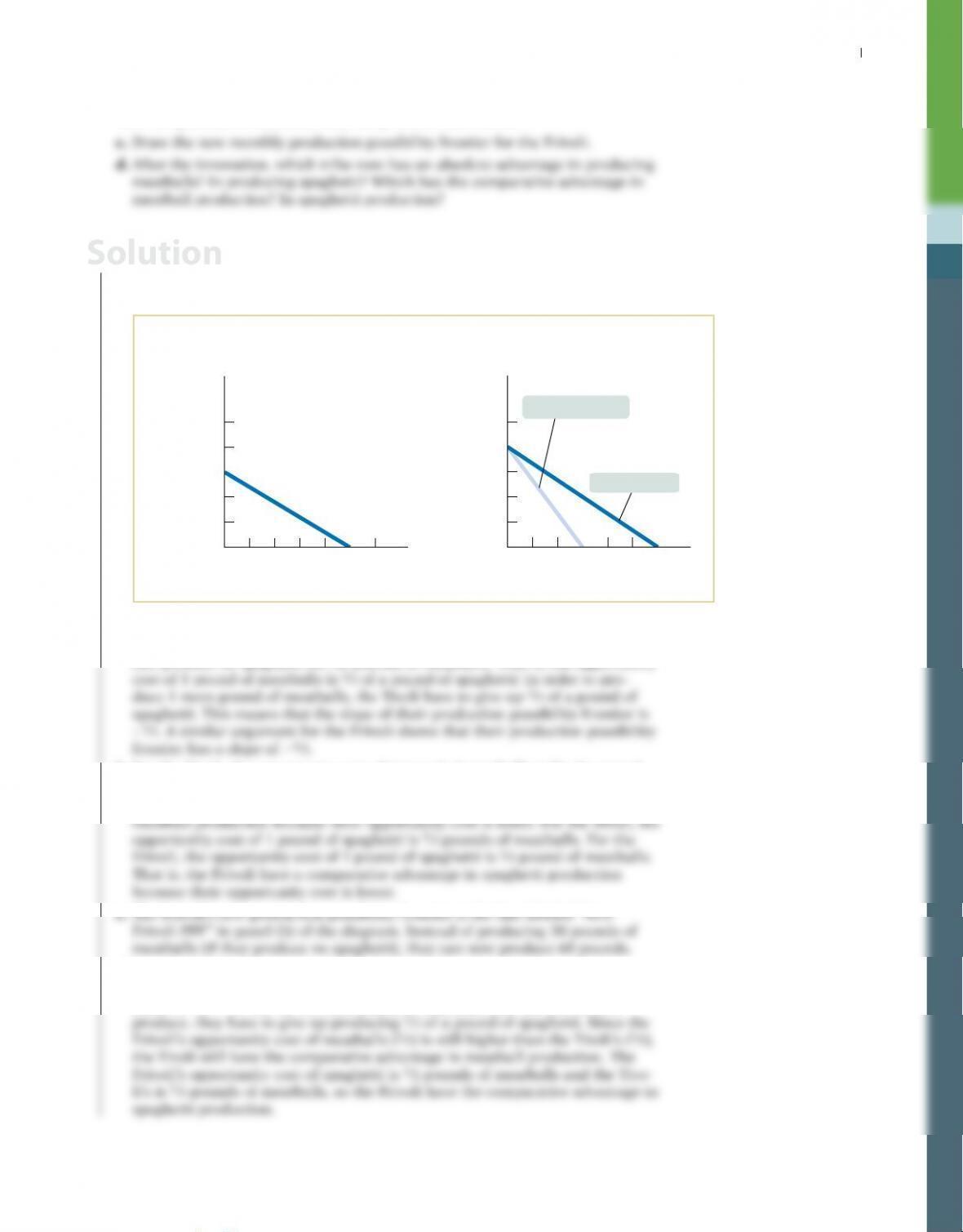
3. a. The accompanying diagram shows the production possibility frontier for the
Tivoli in panel (a) and for the Frivoli as the line labeled “Original Frivoli PPF”
in panel (b).
50
40
30
20
10
0
Quantity
of
spaghetti
(pounds)
Quantity of meatballs (pounds)
2010 5040 6030
(a) Production possibility frontier
for the Tivoli
50
40
30
20
10
0
Quantity
of spaghetti
(pounds)
Quantity of meatballs (pounds)
2010 5040 6030
Original Frivoli PPF
New Frivoli PPF
(b) Production possibility frontier
for the Frivoli
The production possibility frontier for the Tivoli was calculated as follows: the
Tivoli can produce either 30 pounds of spaghetti and no meatballs, or they
can produce no spaghetti but 50 pounds of meatballs. That is, the opportunity
b. For the Tivoli, the opportunity cost of 1 pound of meatballs is 3
/
5 of a pound
of spaghetti. For the Frivoli, the opportunity cost of 1 pound of meatballs is
4
/
3 pounds of spaghetti. That is, the Tivoli have a comparative advantage in
d. Now the Frivoli have the absolute advantage in both meatball production and
spaghetti production. The Frivoli’s opportunity cost of meatballs has now
fallen to 4
/
6 = 2
/
3; that is, for each pound of meatballs that the Frivoli now
Solution
4. One July, the United States sold aircraft worth $1 billion to China and bought
aircraft worth only $19,000 from China. During the same month, however, the
a. Which country has the comparative advantage in aircraft production?
In production of trousers, slacks, and jeans?
4. a. Since countries gain from specializing in production of the goods and services
5. Peter Pundit, an economics reporter, states that the European Union (EU) is
increasing its productivity very rapidly in all industries. He claims that this pro–
ductivity advance is so rapid that output from the EU in these industries will soon
exceed that of the United States and, as a result, the United States will no longer
benefit from trade with the EU.
a. Do you think Peter Pundit is correct or not? If not, what do you think is the
source of his mistake?
5. a. Peter Pundit is not correct. He confuses absolute and comparative advantage.
6. You are in charge of allocating residents to your dormitory’s baseball and
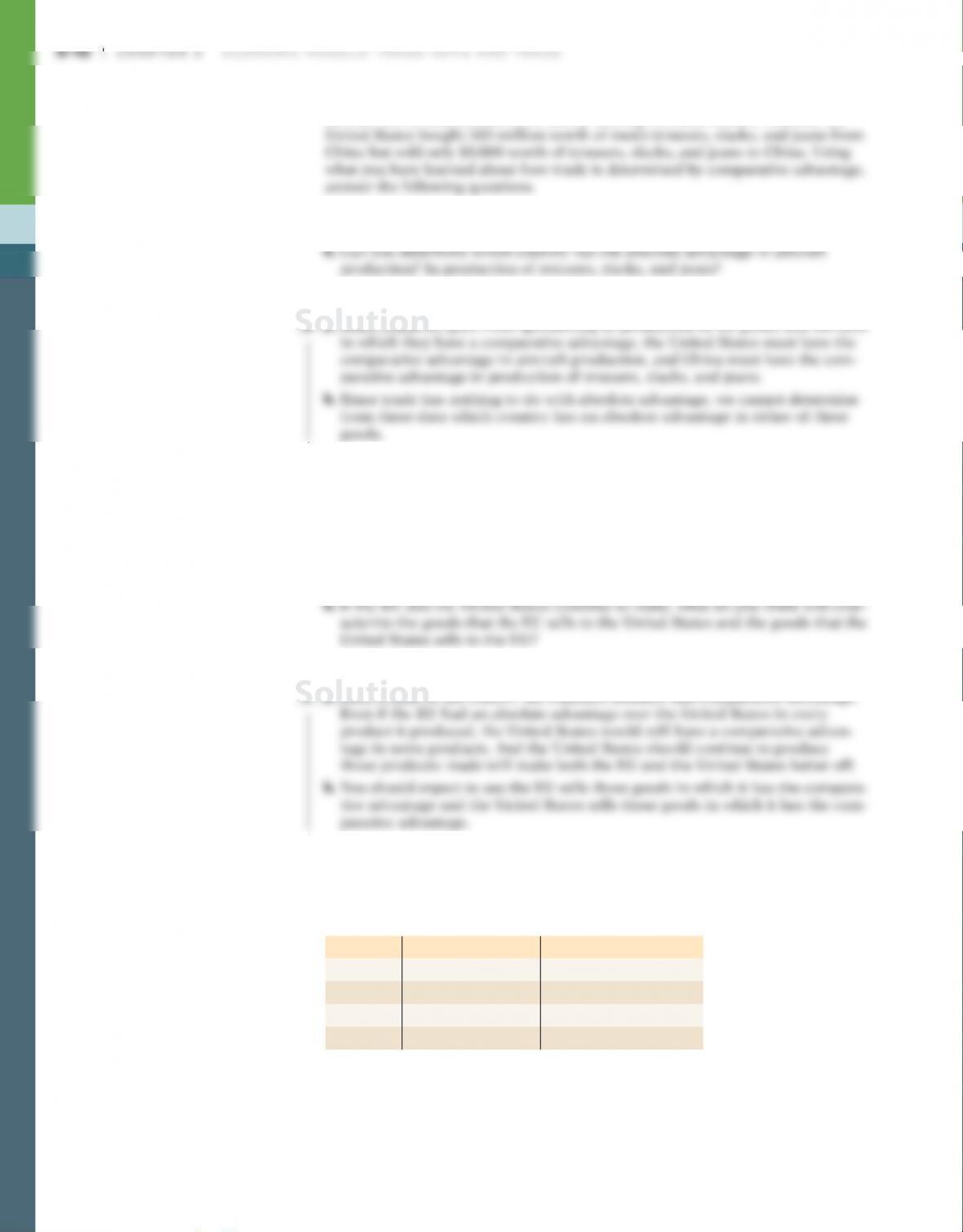
basketball teams. You are down to the last four people, two of whom must be
allocated to baseball and two to basketball. The accompanying table gives each
person’s batting average and free-throw average.
Name Batting average Free-throw average
Kelley 70% 60%
Jackie 50% 50%
Curt 10% 30%
Gerry 80% 70%
a. Explain how you would use the concept of comparative advantage to allocate
the players. Begin by establishing each player’s opportunity cost of free throws
in terms of batting average.
Solution
Solution
Chapter 2 Economic modEls: TradE-offs and TradE S-13
b. Why is it likely that the other basketball players will be unhappy about this
arrangement but the other baseball players will be satisfied? Nonetheless, why
/
6. Similarly, Jackie’s opportunity cost of playing basketball is 1; Curt’s oppor–
tunity cost of playing basketball is 1
/
3, and Gerry’s opportunity cost of playing
basketball is 8
/
7. Jackie and Curt have the lowest opportunity costs of playing
basketball; that is, they have the comparative advantage in basketball. Therefore,
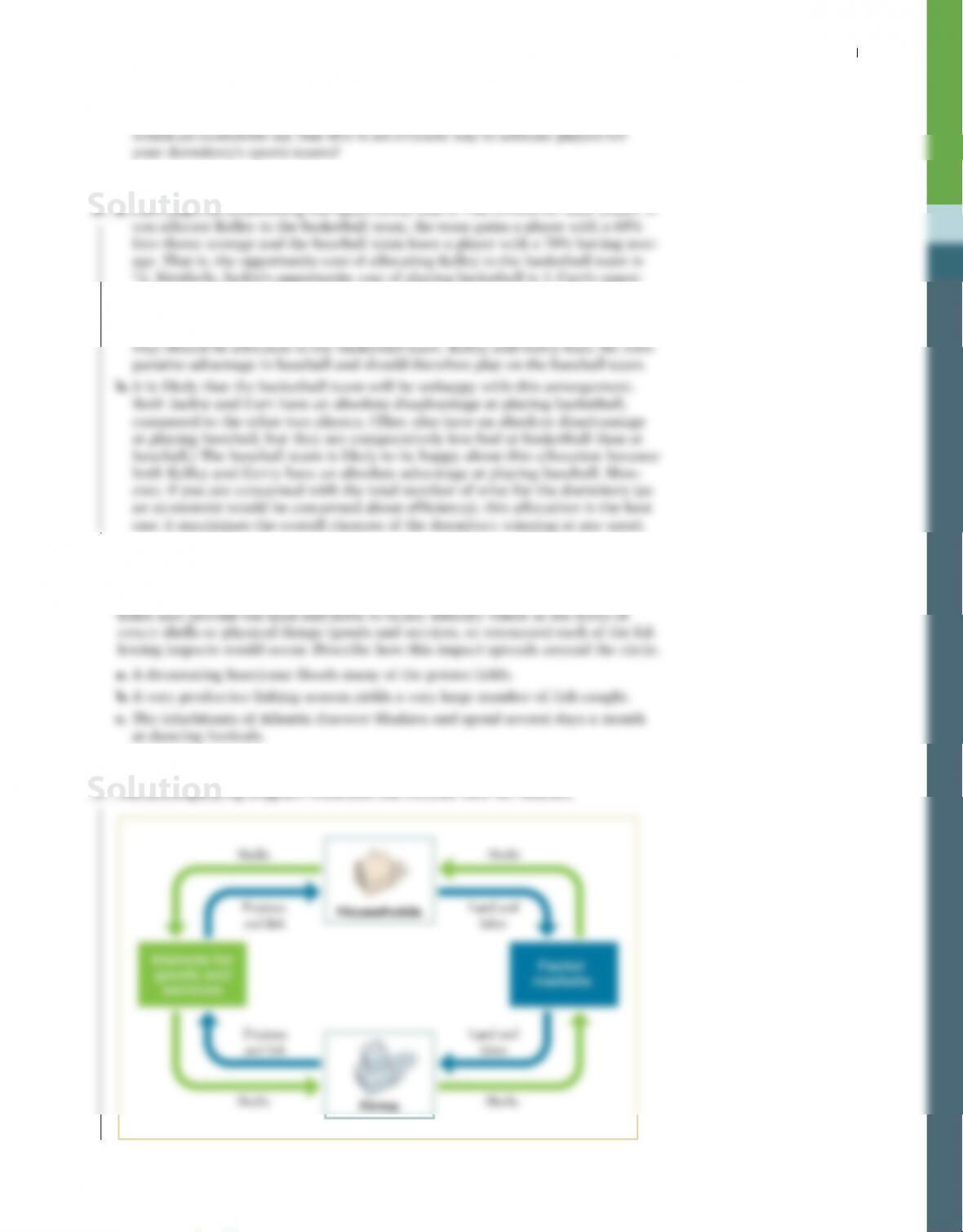
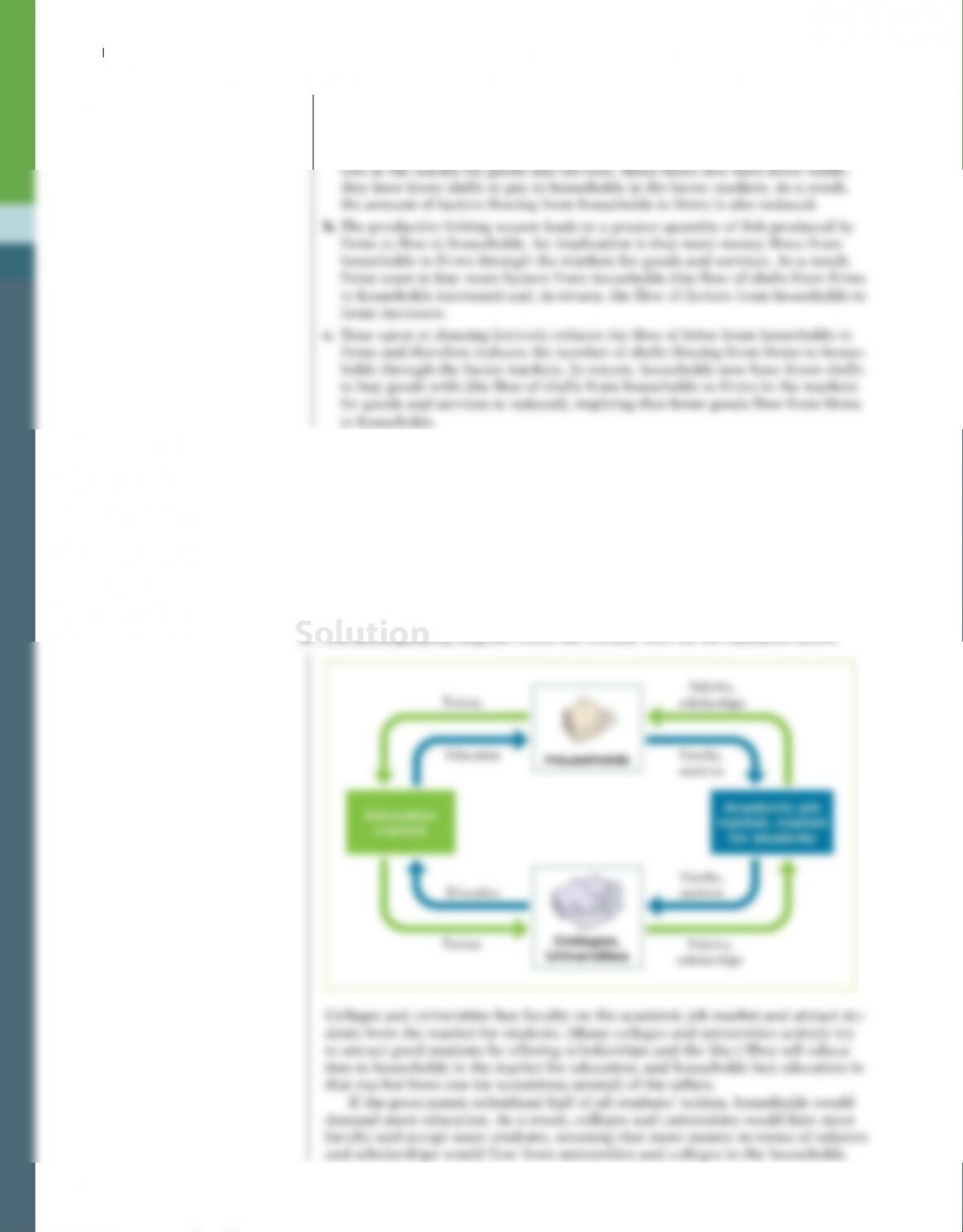
7. The inhabitants of the fictional economy of Atlantis use money in the form of
cowry shells. Draw a circular-flow diagram showing households and firms.
Firms produce potatoes and fish, and households buy potatoes and fish. House–
S-14 Chapter 2 Economic modEls: TradE-offs and TradE
a. The flooding of the fields will destroy the potato crop. Destruction of the
potato crop reduces the flow of goods from firms to households: fewer potatoes
produced by firms now are sold to households. An implication, of course, is
that fewer cowry shells flow from households to firms as payment for the pota–
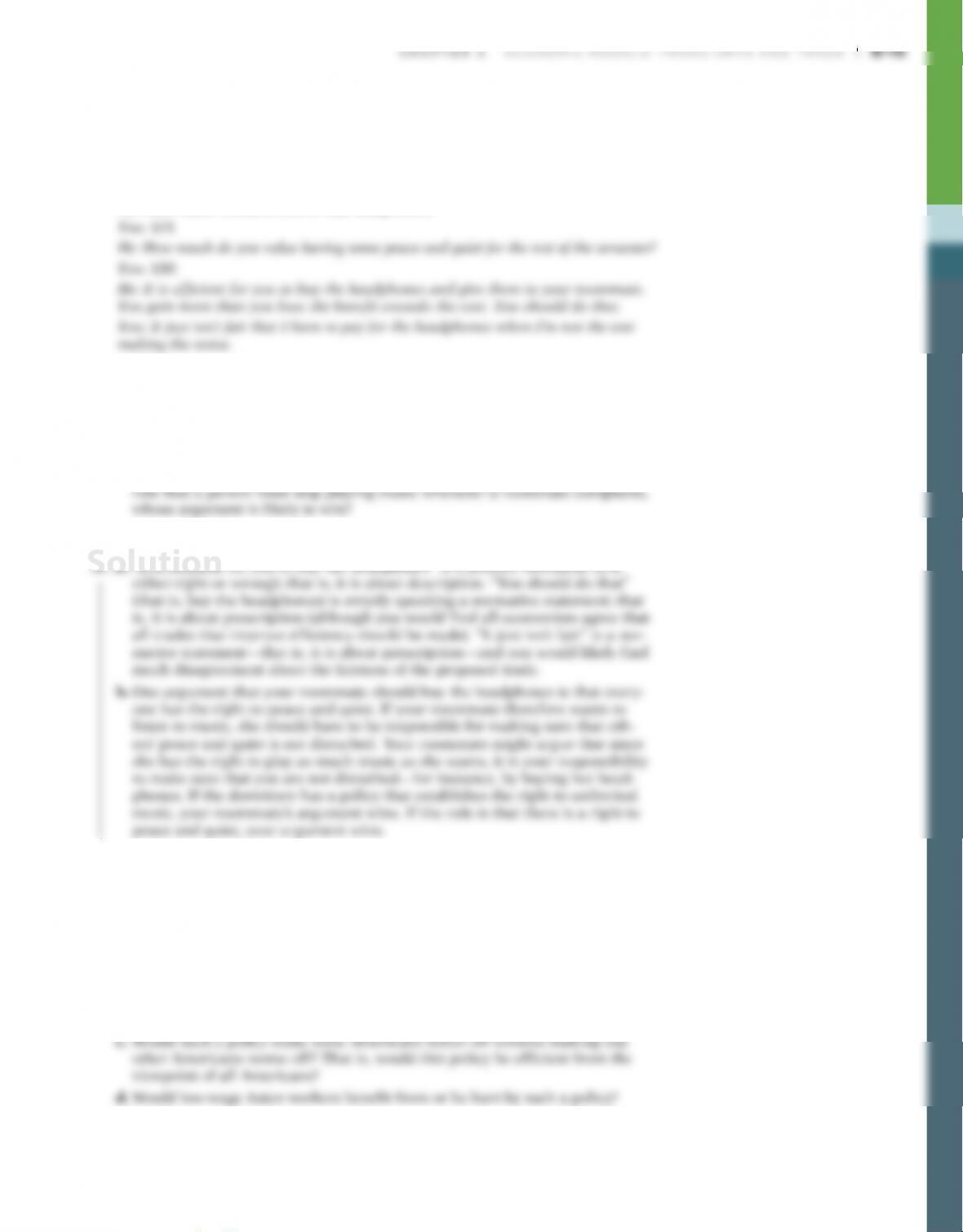
8. An economist might say that colleges and universities “produce” education, using
faculty members and students as inputs. According to this line of reasoning, edu–
cation is then “consumed” by households. Construct a circular-flow diagram to
represent the sector of the economy devoted to college education: colleges and uni–
versities represent firms, and households both consume education and provide fac–
ulty and students to universities. What are the relevant markets in this diagram?
What is being bought and sold in each direction? What would happen in the dia–
gram if the government decided to subsidize 50% of all college students’ tuition?
8. The accompanying diagram shows the circular flow for the education sector.
Salaries,
Solution
9. Your dormitory roommate plays loud music most of the time; you, however,
would prefer more peace and quiet. You suggest that she buy some headphones.
She responds that although she would be happy to use headphones, she has
many other things that she would prefer to spend her money on right now. You
discuss this situation with a friend who is an economics major. The following
exchange takes place:
He: How much would it cost to buy headphones?
a. Which parts of this conversation contain positive statements and which parts
contain normative statements?
b. Construct an argument supporting your viewpoint that your roommate
should be the one to change her behavior. Similarly, construct an argument
from the viewpoint of your roommate that you should be the one to buy the
headphones. If your dormitory has a policy that gives residents the unlimited
right to play music, whose argument is likely to win? If your dormitory has a
9. a. “It is efficient for you to buy the headphones” is a positive statement (it is
10. A representative of the American clothing industry recently made the following
statement: “Workers in Asia often work in sweatshop conditions earning only pen–
nies an hour. American workers are more productive and as a result earn higher
wages. In order to preserve the dignity of the American workplace, the govern–
ment should enact legislation banning imports of low-wage Asian clothing.”
a. Which parts of this quote are positive statements? Which parts are normative
statements?
b. Is the policy that is being advocated consistent with the preceding statements
about the wages and productivities of American and Asian workers?
Solution
S-16 Chapter 2 Economic modEls: TradE-offs and TradE
11. Are the following statements true or false? Explain your answers.
12. Evaluate the following statement: “It is easier to build an economic model that
accurately reflects events that have already occurred than to build an economic
model to forecast future events.” Do you think this is true or not? Why? What
does this imply about the difficulties of building good economic models?
13. Economists who work for the government are often called on to make policy
recommendations. Why do you think it is important for the public to be
able to differentiate normative statements from positive statements in these
recommendations?
13. Positive statements are those based on fact—or at least on our best estimate of
14. The mayor of Gotham City, worried about a potential epidemic of deadly influ-
enza this winter, asks an economic adviser the following series of questions.
Determine whether a question requires the economic adviser to make a positive
assessment or a normative assessment.
a. How much vaccine will be in stock in the city by the end of November?
b. If we offer to pay 10% more per dose to the pharmaceutical companies provid-
ing the vaccines, will they provide additional doses?
c. If there is a shortage of vaccine in the city, whom should we vaccinate
first—the elderly or the very young? (Assume that a person from one group
has an equal likelihood of dying from influenza as a person from the other
group.)
d. If the city charges $25 per shot, how many people will pay?
15. Assess the accuracy of the following statement: “If economists just had enough
data, they could solve all policy questions in a way that maximizes the social
Solution
16. Atlantis is a small, isolated island in the South Atlantic. The inhabitants
grow potatoes and catch fish. The accompanying table shows the maxi–
mum annual output combinations of potatoes and fish that can be pro–
duced. Obviously, given their limited resources and available technology,
as they use more of their resources for potato production, there are fewer
resources available for catching fish.
Maximum annual
output options
Quantity of potatoes
(pounds)
Quantity of fish
(pounds)
A1,000 0
B 800 300
C 600 500
D 400 600
E 200 650
F 0 675
a. Draw a production possibility frontier with potatoes on the horizontal axis
and fish on the vertical axis illustrating these options, showing points A–F.
b. Can Atlantis produce 500 pounds of fish and 800 pounds of potatoes?
Explain. Where would this point lie relative to the production possibility
frontier?
c. What is the opportunity cost of increasing the annual output of potatoes
from 600 to 800 pounds?
d. What is the opportunity cost of increasing the annual output of potatoes
from 200 to 400 pounds?
e. Can you explain why the answers to parts c and d are not the same? What
does this imply about the slope of the production possibility frontier?
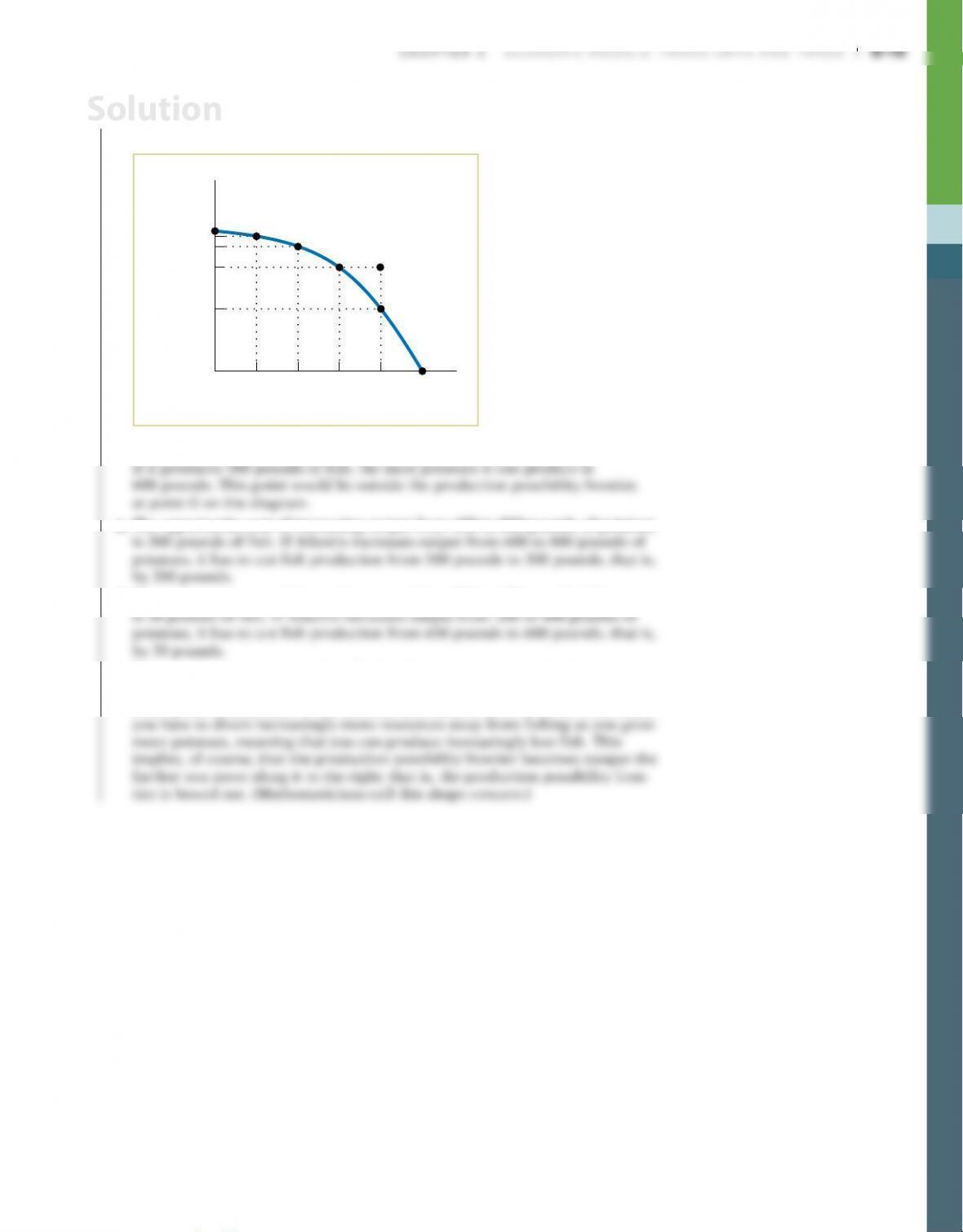
16. a . The accompanying diagram shows the production possibility frontier for
Atlantis.
600
650
FE
G
D
C
B
A
0
Quantity
of fish
(pounds)
Quantity of potatoes (pounds)
675
500
300
200 400 600 1,000800
Atlantis
PPF
b. No, Atlantis cannot produce 500 pounds of fish and 800 pounds of potatoes.
c. The opportunity cost of increasing output from 600 to 800 pounds of potatoes
d. The opportunity cost of increasing output from 200 to 400 pounds of potatoes
e. The answers to parts c and d imply that the more potatoes Atlantis produces,
the higher the opportunity cost becomes. For instance, as you grow more and
more potatoes, you have to use less and less suitable land to do so. As a result,
Solution