CHAPTER 2
ECONOMIC TOOLS AND ECONOMIC SYSTEMS
In this chapter, you will find:
Learning Outcomes
Chapter Outline with PowerPoint Script
Chapter Summary
Teaching Points (as on Prep Card)
Solutions to Problems Appendix
Experiential Assignment
INTRODUCTION
This chapter emphasizes key ideas in economic analysis, such as opportunity cost, the production
LEARNING OUTCOMES
2-1 Describe the relationship between choice and opportunity
Resources are scarce, but human wants are unlimited. Because you cannot satisfy all your wants, you
2-2 Explain how comparative advantage, specialization, and exchange affect economic outcomes
(output)
The law of comparative advantage says that the individual, firm, region, or country with the lowest
opportunity cost of producing a particular good should specialize in that good. Specialization accord-
2-3 Outline how economies function as production systems
The production possibilities frontier, or PPF, shows the productive capabilities of an economy when
all resources are used efficiently. The frontier’s bowed-out shape reflects the law of increasing oppor-
2-4 Describe different economic systems and the decision-making rules that define them
Chapter 2 Economic Tools and Economic Systems 18
All economic systems, regardless of their decision-making processes, must answer three basic ques-
tions: What is to be produced? How is it to be produced? And for whom is it to be produced? Econo-
CHAPTER OUTLINE WITH POWERPOINT SCRIPT
Choice and Opportunity Cost
USE POWERPOINT SLIDE 2 FOR THE FOLLOWING SECTION
Opportunity Cost: The value of the best alternative that is forgone. Because of scarcity, whenever people
make a choice, another opportunity is forgone.
USE POWERPOINT SLIDE 3 FOR THE FOLLOWING SECTION
USE POWERPOINT SLIDE 4 FOR THE FOLLOWING SECTION
Sunk Cost and Choice
Comparative Advantage, Specialization, and Exchange
USE POWERPOINT SLIDES 5-6 FOR THE FOLLOWING SECTION
The law of comparative advantage: The individual, firm, region or country with the lower opportunity
cost of producing a particular output should specialize in producing that output.
USE POWERPOINT SLIDE 7 FOR THE FOLLOWING SECTION
Specialization and Exchange
• Barter: A system of exchange in which products are traded directly for other products.
• Money: A medium of exchange in economies with extensive specialization.
USE POWERPOINT SLIDES 8-9 FOR THE FOLLOWING SECTION
Division of Labor and Gains from Specialization
• Specialization of labor
– Takes advantage of individual preferences and natural abilities
The Economy’s Production Possibilities
USE POWERPOINT SLIDES 10-13 FOR THE FOLLOWING SECTION
Efficiency and the Production Possibilities Frontier
Chapter 2 Economic Tools and Economic Systems 19
• The production possibilities frontier (PPF) is a simple model designed to depict the production
capabilities of an economy given current resources. The PPF assumes:
– Output is limited to two broad classes of products: consumer goods and capital goods.
USE POWERPOINT SLIDE 14 FOR THE FOLLOWING SECTION
Shape of the Production Possibilities Frontier
• The PPF derives its bowed-out (concave) shape from the law of increasing opportunity cost.
USE POWERPOINT SLIDES 15-18 FOR THE FOLLOWING SECTION
What Can Shift the Production Possibilities Frontier?
• Economic Growth: is reflected by an outward shift of the PPF.
USE POWERPOINT SLIDE 19 FOR THE FOLLOWING SECTION
What We Learn from the PPF
• It illustrates the concepts of efficiency, scarcity, opportunity cost, economic growth, and the need for
choice.
USE POWERPOINT SLIDE 20 FOR THE FOLLOWING SECTION
Three Questions Every Economic System Must Answer:
USE POWERPOINT SLIDES 21-26 FOR THE FOLLOWING SECTION
Economic Systems
Pure Capitalism: Individual decision making through markets
• Private ownership of all resources.
Chapter 2 Economic Tools and Economic Systems 20
• Market prices generated in free markets guide resources to their most productive use.
• Goods and services are channeled to consumers who value them the most.
• In theory, property is owned communally; central plans spell out answers to what, for whom, and how
much; and individual choices are incorporated into central plans (communism).
• Flaws of a pure command system:
– Running an economy is so complicated that some resources are used inefficiently.
USE POWERPOINT SLIDE 27 FOR THE FOLLOWING SECTION
Mixed and Transitional Economies
• No country exemplifies either type of economic system in its pure form.
CHAPTER SUMMARY
Resources are scarce, but human wants are unlimited. Because you cannot satisfy all your wants, you must
choose, and whenever you choose, you must forgo some option. Choice involves an opportunity cost. The
opportunity cost of the selected option is the value of the best alternative forgone.
Chapter 2 Economic Tools and Economic Systems 21
Over time, the frontier can shift in or out as a result of changes in the availability of resources, in
technology, or in the rules of the game. The frontier demonstrates several economic concepts, including
efficiency, scarcity, opportunity cost, the law of increasing opportunity cost, economic growth, and the
need for choice.
TEACHING POINTS
1. This chapter contains several fundamental concepts that should be fully discussed because they are used
throughout the text to discuss economic choice in a variety of settings. When discussing opportunity
2. Comparative advantage is a second important concept emphasized in this chapter. For additional
examples of comparative advantage, consider the classic example in which an attorney can type and
file faster and more accurately than a secretary. Because of comparative advantage, it will usually pay
3. When drawing the production possibilities frontier, partition the horizontal axis into equal segments,
and then show the ever-increasing amounts of the alternative good that must be sacrificed to obtain
4. Sometimes people claim that the PPF is bowed out because of the law of diminishing returns.
Diminishing returns, of course, assumes an increase in one type of resource, holding other resources
5. Once the PPF is understood in terms of its construction and shape, it is important to emphasize the
concepts that it illustrates. Scarcity is reflected by the fact that some output combinations are not
Chapter 2 Economic Tools and Economic Systems 22
6. A discussion of shifts in the production possibilities frontier leads naturally to a consideration of the
sources of economic growth. Technological advance shifts the PPF. Such advances take time and
7. This chapter closes by considering how different economic systems answer the three economic
SOLUTIONS TO PROBLEMS APPENDIX
1. (Sunk Cost and Choices) Suppose you go to a restaurant and buy an expensive meal. Halfway
through, despite feeling full, you decide to clean your plate. After all, you think, you paid for the
meal, so you are going to eat all of it. What’s wrong with this thinking?
This question highlights the importance of ignoring sunk costs in marginal decision making. Once you
2. (Opportunity Cost) You can either spend spring break working at home for $80 per day for five days
or go to Florida for the week. If you stay home, your expenses will total about $100. If you go to
Florida, the airfare, hotel, food and miscellaneous expenses will total about $700. What’s your
opportunity cost of going to Florida?
The opportunity cost is the total cost of going to Florida and includes dollar costs incurred as well as
3. (Absolute and Comparative Advantage) You have the following information concerning the
production of wheat and cloth in the United States and the United Kingdom:
Labor Hours Required to Produce One Unit
United Kingdom United States
Wheat 2 1
Cloth 6 5
a. What is the opportunity cost of producing a unit of wheat in the United Kingdom? In the United
States?
b. Which country has an absolute advantage in producing wheat? In producing cloth?
c. Which country has a comparative advantage in producing wheat? In producing cloth?
d. Which country should specialize in producing wheat? In producing cloth?
Chapter 2 Economic Tools and Economic Systems 23
a. In the United Kingdom, the opportunity cost of one unit of wheat is 1/3 unit of cloth (producing
one unit of wheat takes 2 hours, the time that would allow you to produce only 1/3 of a unit of
4. (Specialization) Provide some examples of specialized markets or retail outlets. What makes the
Web so conducive to specialization?
Students’ answers will vary according to their experiences. One specialized market is that for
military weapons. The stock exchange provides a specialized market for buying and selling company
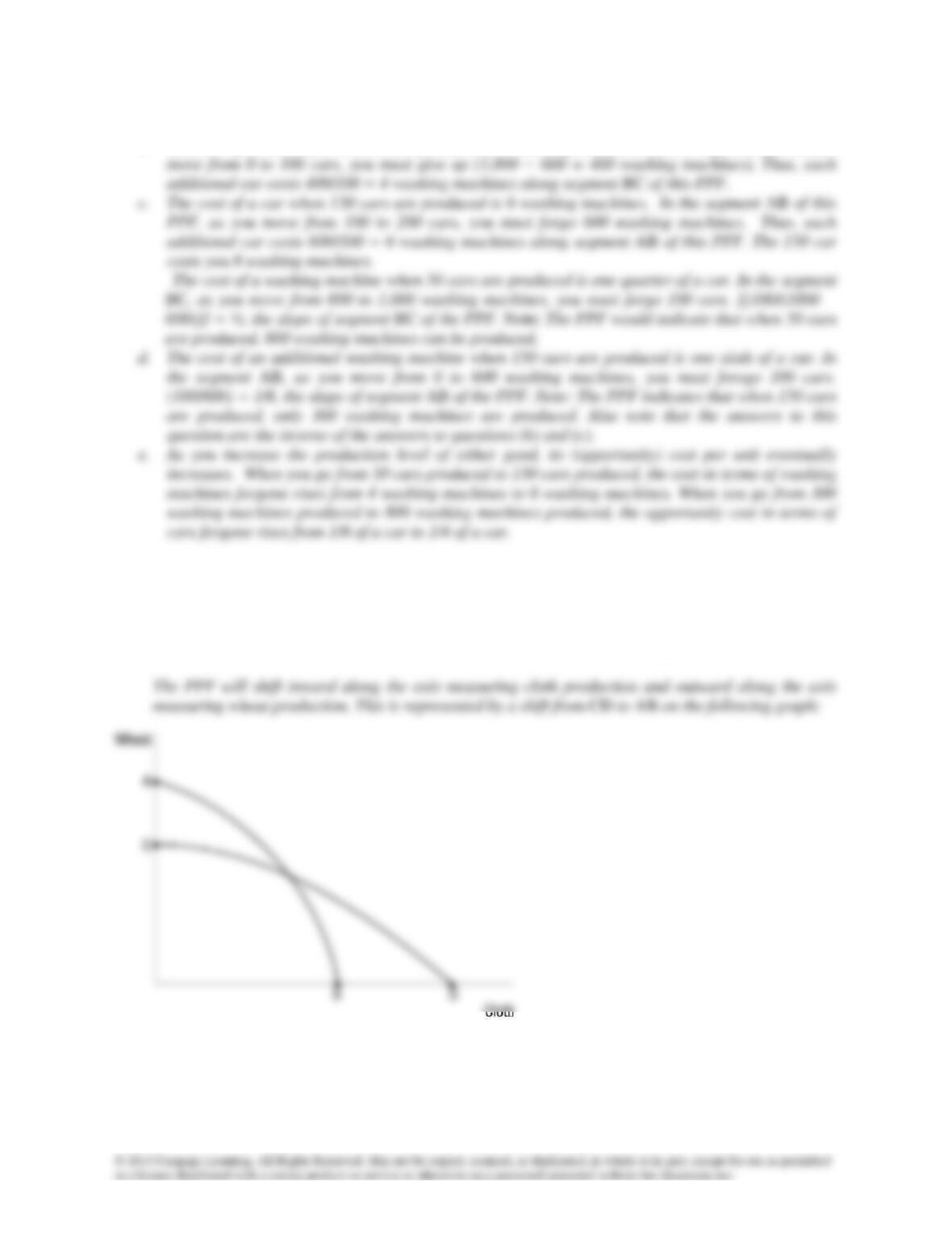
5. (Shape of the PPF) Suppose a production possibilities frontier includes the following combinations:
Cars Washing Machines
0 1,000
100 600
200 0
a. Graph the PPF, assuming that it has no curved segments.
b. What is the cost of producing an additional car when 50 cars are being produced?
c. What is the cost of producing an additional car when 150 cars are being produced?
d. What is the cost of producing an additional washing machine when 50 cars are being produced?
When 150 cars are being produced?
e. What do your answers tell you about opportunity costs?
Chapter 2 Economic Tools and Economic Systems 24
a. The PPF drawn above is composed of two straight-line segments, AB and BC.
b. The cost of a car when 50 cars are produced is 4 washing machines. In the segment BC, as you
6. (Production Possibilities) Suppose an economy uses two resources (labor and capital) to produce
two goods (wheat and cloth). Capital is relatively more useful in producing cloth, and labor is
relatively more useful in producing wheat. If the supply of capital falls by 10 percent and the supply
of labor increases by 10 percent, how will the PPF for wheat and cloth change?
7. (Production Possibilities) There’s no reason why a production possibilities frontier could not be used
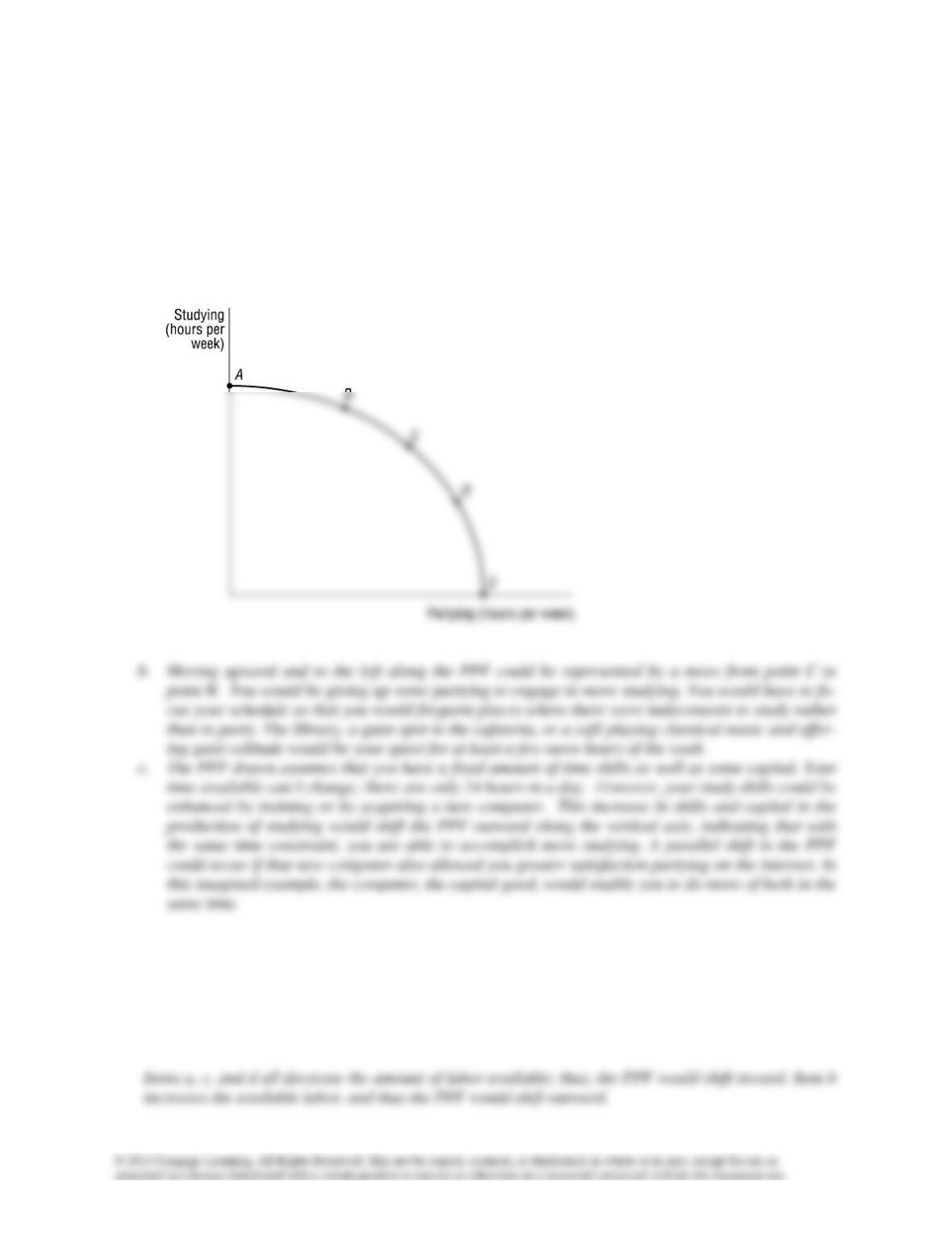
to represent the situation facing an individual. Imagine your own PPF. Right now—today—you
have certain resources—your time, your skills, perhaps some capital. And you can produce various
outputs. Suppose you can produce combinations of two outputs, call them studying and partying.
Chapter 2 Economic Tools and Economic Systems 25
a. Draw your PPF for studying and partying. Be sure to label the axes of the diagram appropriately.
Label the points where the PPF intersects the axes, as well as several other points along the
frontier.
b. Explain what it would mean for you to move upward and to the left along your personal PPF.
What kinds of adjustments would you have to make in your life to make such a movement along
the frontier?
c. Under what circumstances would your personal PPF shift outward? Do you think the shift would
be a “parallel” one? Why, or why not?
a.
8. (Shifting Production Possibilities) Determine whether each of the following would cause the
economy’s PPF to shift inward, outward, or not at all:
a. An increase in average length of annual vacations
b. An increase in immigration
c. A decrease in the average retirement age
d. The migration of skilled workers to other countries
Chapter 2 Economic Tools and Economic Systems 26
9. (Economic Systems) The United States is best described as having a “mixed” economy. What are
some elements of command in the U.S. economy? What are some traditional elements?
The government represents an element of command in the U.S. economy. Government accounts for
Experiential Assignment
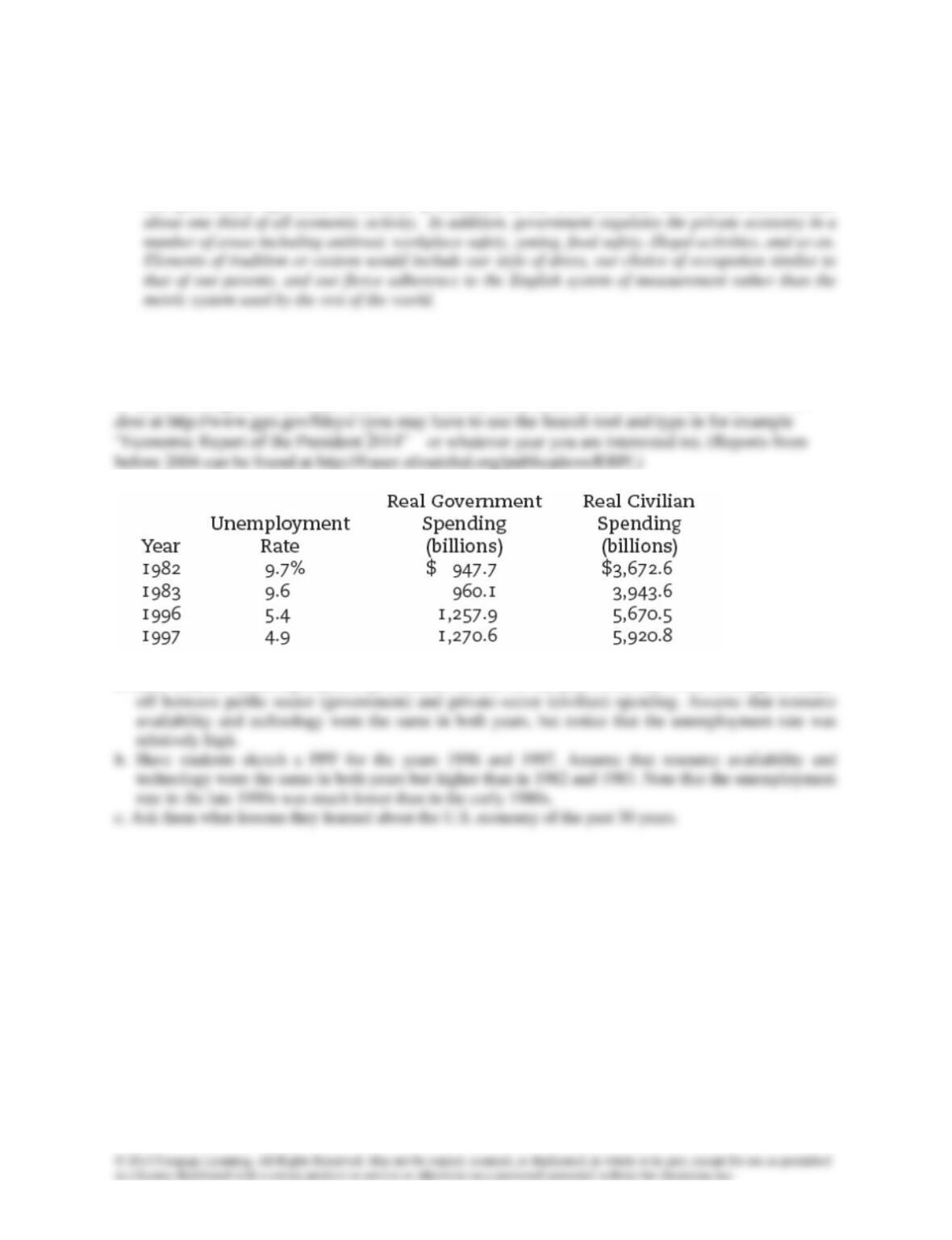
1. The following are some data on the U.S. economy taken from the Economic Report of the Presi-
a. Have students sketch a production possibilities frontier for the years 1982 and 1983, showing the trade-