CHAPTER 2 | Trade-offs, Comparative
Advantage, and the
Market System
Brief Chapter Summary and Learning Objectives
2.1 Production Possibilities Frontiers and Opportunity Costs (pages 42–47)
2.2 Comparative Advantage and Trade (pages 48–54)
2.3 The Market System (pages 54–62)
Explain the basics of how a market system works.
▪ Markets enable buyers and sellers of goods and services to come together to trade.
Key Terms
Absolute advantage, p. 50. The ability of an
individual, a firm, or a country to produce more
of a good or service than competitors, using the
same amount of resources.
Economic growth, p. 47. The ability of the
economy to increase the production of goods
and services.
production—labor, capital, and natural
resources—to produce goods and services.
Factor market, p. 54. A market for the factors
service can be produced or sold or on how a
factor of production can be employed.
Market, p. 54. A group of buyers and sellers
26 CHAPTER 2 | Trade-offs, Comparative Advantage, and the Market System
Opportunity cost, p. 43. The highest-valued
alternative that must be given up to engage
in an activity.
Property rights, p. 60. The rights individuals or
firms have to the exclusive use of their property,
including the right to buy or sell it.
Chapter Outline
Managers at Tesla Motors Face Trade-Offs
All-electric cars have struggled in the marketplace because the batteries that power them are costly and
they have to be recharged about every 300 miles. Although sales of all-electric cars made by Tesla Motors
represented only 0.1 percent of the U.S. car market in 2015, the company planned to introduce a new,
lower-priced model that would appeal to people who had bought gasoline-powered cars. Tesla initially
2.1
Production Possibilities Frontiers and Opportunity Costs (pages 42–47)
Learning Objective: Use a production possibilities frontier to analyze opportunity costs
and trade-offs.
A key fact of economic life is that scarcity requires trade-offs. Scarcity is a situation in which unlimited
wants exceed the limited resources available to fulfill those wants. Goods and services and the resources,
or factors of production, that are used to make goods and services, are scarce.
Opportunity cost is the highest-valued alternative that must be given up to engage in an activity.
CHAPTER 2 | Trade-offs, Comparative Advantage, and the Market System 27
B. Increasing Marginal Opportunity Costs
A production possibilities frontier that is bowed outward illustrates increasing marginal opportunity costs,
C. Economic Growth
Economic growth is the ability of the economy to increase the production of goods and services.
Economic growth can occur if more resources become available or if a technological advance makes
resources more productive. Growth may lead to greater increases in production for one good than another.
About 54 percent of the population has private health insurance, often provided by an employer. When
the fees doctors charge, the cost of prescription drugs, and the cost of hospital stays rise, the cost to
employers of providing health insurance increases. As a result, employers will typically increase the
amount they withhold from employees’ paychecks to pay for the insurance. Some employers—
particularly small firms—will even stop offering health insurance to their employees. In either case, the
price employees pay for health care will rise. How do people respond to rising health care costs? Isn’t
The Congressional Budget Office estimates that as the U.S. population ages and medical costs continue to
rise, federal government spending on Medicare will more than double over the next 10 years. Many
policymakers are concerned that this rapid increase in Medicare spending will force a reduction in
spending on other government programs. Daniel Callahan, a researcher at the Hastings Center for
28 CHAPTER 2 | Trade-offs, Comparative Advantage, and the Market System
Questions & Solutions
1. Suppose the U.S. president is attempting to decide whether the federal government should spend
more on research to find a cure for heart disease. He asks you, one of his economic advisors, to
prepare a report discussing the relevant factors he should consider. Use the concepts of opportunity
cost and trade-offs to discuss some of the main issues you would deal with in your report.
Solution:
If the federal government has a fixed budget for medical research, then the opportunity cost of funding
2. Uwe Reinhardt, an economist at Princeton University, wrote the following in a column in the
New York Times:
[Cost-effectiveness analysis] seeks to establish which of several alternative strategies capable of
achieving a given therapeutic goal is the least-cost strategy. It seems a sensible form of inquiry in
a nation that is dismayed over the rising cost of health care. . . . Opponents of cost-effectiveness
analysis include individuals who sincerely believe that health and life are “priceless.”
Are health and life priceless? Are there any decisions you make during your everyday life that indicate
whether you consider health and life to be priceless?
Source: Uwe E. Reinhardt, “‘Cost-Effectiveness Analysis’ and U.S. Health Care,” The New York Times, March 13, 2009.
Solution:
Nothing is priceless. Every day we makes decisions, such as driving a car or flying in a plane, that
CHAPTER 2 | Trade-offs, Comparative Advantage, and the Market System 29
2.2
Comparative Advantage and Trade (pages 48–54)
Learning Objective: Describe comparative advantage and explain how it serves as the
basis for trade.
Trade is the act of buying and selling. Trade makes it possible for people to become better off by
increasing both their production and their consumption.
A. Specialization and Gains from Trade
PPFs depict the combinations of two goods that can be produced if no trade occurs. We can use PPFs to
B. Absolute Advantage versus Comparative Advantage
Absolute advantage is the ability of an individual, a firm, or a country to produce more of a good or
service than competitors, using the same amount of resources.
C. Comparative Advantage and the Gains from Trade
The basis for trade is comparative advantage, not absolute advantage. Individuals, firms, and countries are
better off if they specialize in producing the goods and services for which they have a comparative
advantage and obtain the other goods and services they need by trading.
Teaching Tips
Even good students have difficulty understanding comparative advantage. A good example of
comparative advantage is the career of baseball legend Babe Ruth. Before he achieved his greatest fame
2.3
The Market System (pages 54–59)
Learning Objective: Explain the basics of how a market system works.
In the United States and most other countries, trade is carried out in markets. A market is a group of
buyers and sellers of a good or service and the institution or arrangement by which they come together to
trade. A product market is a market for goods—such as computers—or services—such as medical
30 CHAPTER 2 | Trade-offs, Comparative Advantage, and the Market System
A. The Circular Flow of Income
A circular-flow diagram is a model that illustrates how participants in markets are linked. The diagram
demonstrates the interaction between firms and households in both product and factor markets.
B. The Gains from Free Markets
A free market is a market with few government restrictions on how a good or service can be produced or
C. The Market Mechanism
A key to understanding Adam Smith’s argument is the assumption that individuals usually act in a
rational, self-interested way. This assumption underlies nearly all economic analysis.
D. The Role of the Entrepreneur in the Market System
Entrepreneurs are an essential part of a market economy. An entrepreneur is someone who operates a
E. The Legal Basis of a Successful Market System
The absence of government intervention is not enough for a market economy to work well. Government
has to provide a legal environment that allows markets to operate efficiently. Property rights are the
rights individuals or firms have to the exclusive use of their property, including the right to buy or sell it.
To protect intellectual property rights, the federal government grants a patent that gives an inventor –
Teaching Tips
To initiate class discussion regarding intellectual property rights, ask students these questions:
1. How many of you have downloaded music via the Internet?
CHAPTER 2 | Trade-offs, Comparative Advantage, and the Market System 31
Extra Solved Problem 2.3
Adam Smith’s “Invisible Hand”
Alan Krueger, an economist at Princeton University who served as chair of the Council of Economic
Advisers in the Obama administration, has argued that Adam Smith “. . . worried that if merchants and
manufacturers pursued their self-interest by seeking government regulation and privilege, the invisible
hand would not work its magic . . . .”
Source: Alan B. Krueger, “Rediscovering the Wealth of Nations,” New York Times, August 16, 2001.
a. What types of regulation and privilege might merchants and manufacturers seek from the
government?
b. How might these regulations and privileges keep the invisible hand from working?
Solving the Problem
Step 1: Review the chapter material.
This problem is about how goods and services are produced and sold and how factors of
production are employed in a free market economic system as described by Adam Smith in
Extra Economics in Your Life:
International Trade and Household Income
Many people believe that outsourcing—firms producing goods and services outside of their home country
—harms their nations’ economies by increasing domestic unemployment and decreasing incomes. But
most economists believe that free trade policies, including allowing goods and services to be produced in
other countries, benefit domestic economies. In a letter dated March 5th 2015, 14 economists
(including R. Glenn Hubbard) who served at chairs of the Council of Economic Advisers under seven
Republican and Democratic presidents, wrote an open letter to congressional leaders expressing their
32 CHAPTER 2 | Trade-offs, Comparative Advantage, and the Market System
support for the renewal of the Trade Promotion Authority in order to reach agreements with U.S. trading
partners through the Trans-Pacific Partnership (TPP) and the Trans-Atlantic Trade and Investment
Partnership (TTIP). The letter read, in part: “International trade is fundamentally good for the U.S.
economy, beneficial to American families over time, and consonant with our domestic priorities.”
Ben Bernanke, former chairman of the Federal Reserve Board, cited a study that examined the effect of
international trade on income in the United States since World War II: “. . . the increase in trade . . . has
boosted U.S. annual incomes on the order of $10,000 per household. The same study found that removing
all remaining barriers to trade would raise incomes anywhere from $4,000 to $12,000 per household.”
Source: N. Gregory Mankiw, “Economists Actually Agree on This: The Wisdom of Free Trade,” New York Times, April 24, 2015; and
Ben Bernanke, “Embracing the Challenge of Free Trade: Competing and Prospering in a Global Economy,” The Federal Reserve
Board, May 1, 2007. http://www.federalreserve.gov/boarddocs/speeches/2007/20070501/default.htm.
Questions: (a) Should the United States accept the advice of economists and support free trade policies
even if this increases the risk of some workers losing their jobs to outsourcing? (b) What type of job
would make you more or less vulnerable to outsourcing?
Answers: (a) Given the opposition from firms and workers in industries that would be harmed by free
CHAPTER 2 | Trade-offs, Comparative Advantage, and the Market System 33
Solutions to End-of-Chapter Exercises
Answers to Thinking Critically Questions
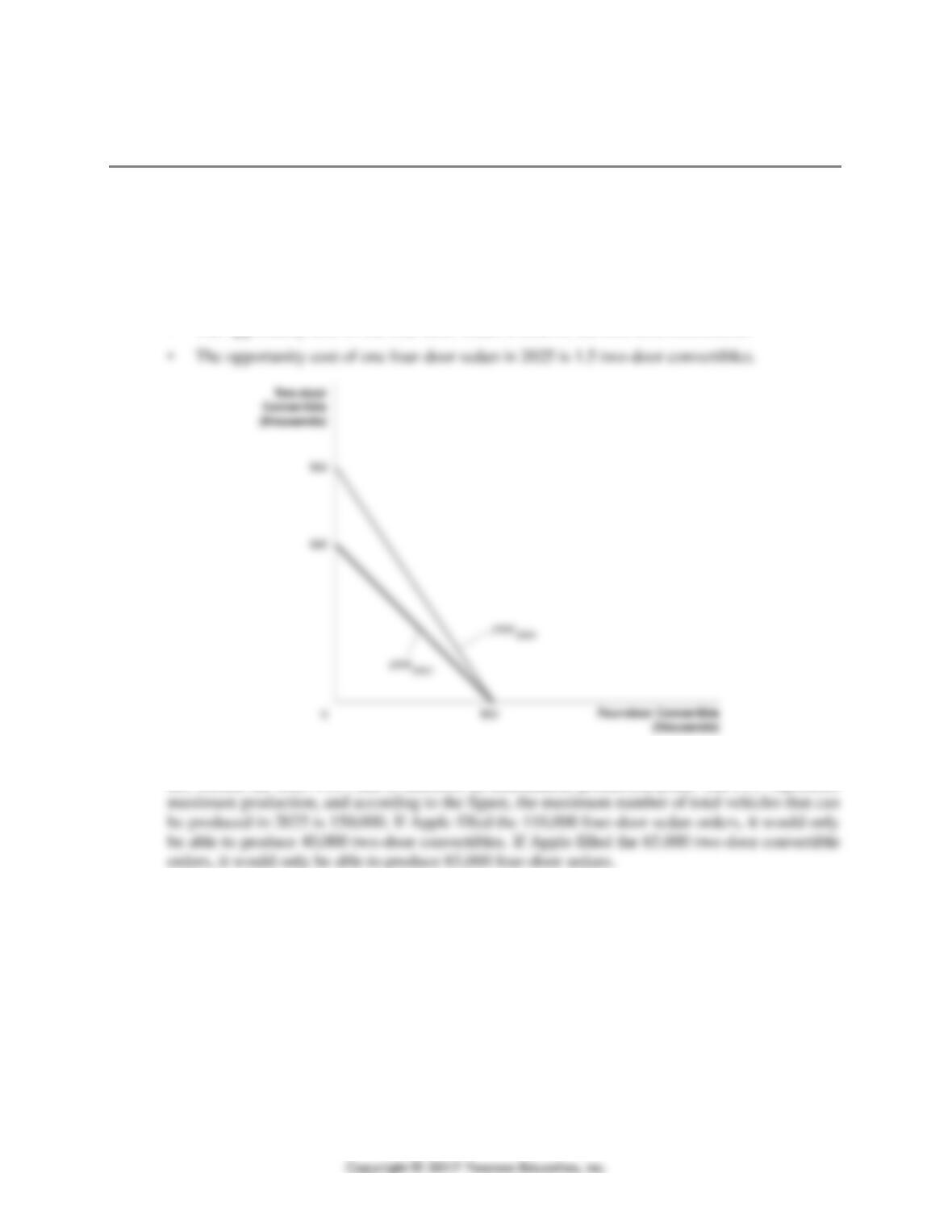
1. In 2020, maximum production is 100,000 two-door convertibles or 100,000 four-door sedans, so
to gain one four-door sedan, Apple must give up producing one two-door convertible. In 2025,
maximum production is 150,000 two-door convertibles or 100,000 four-door sedans, so to gain
one four-door sedan, Apple must give up producing 1.5 two-door convertibles. Therefore:
• The opportunity cost of one four-door sedan in 2020 is one two-door convertible.
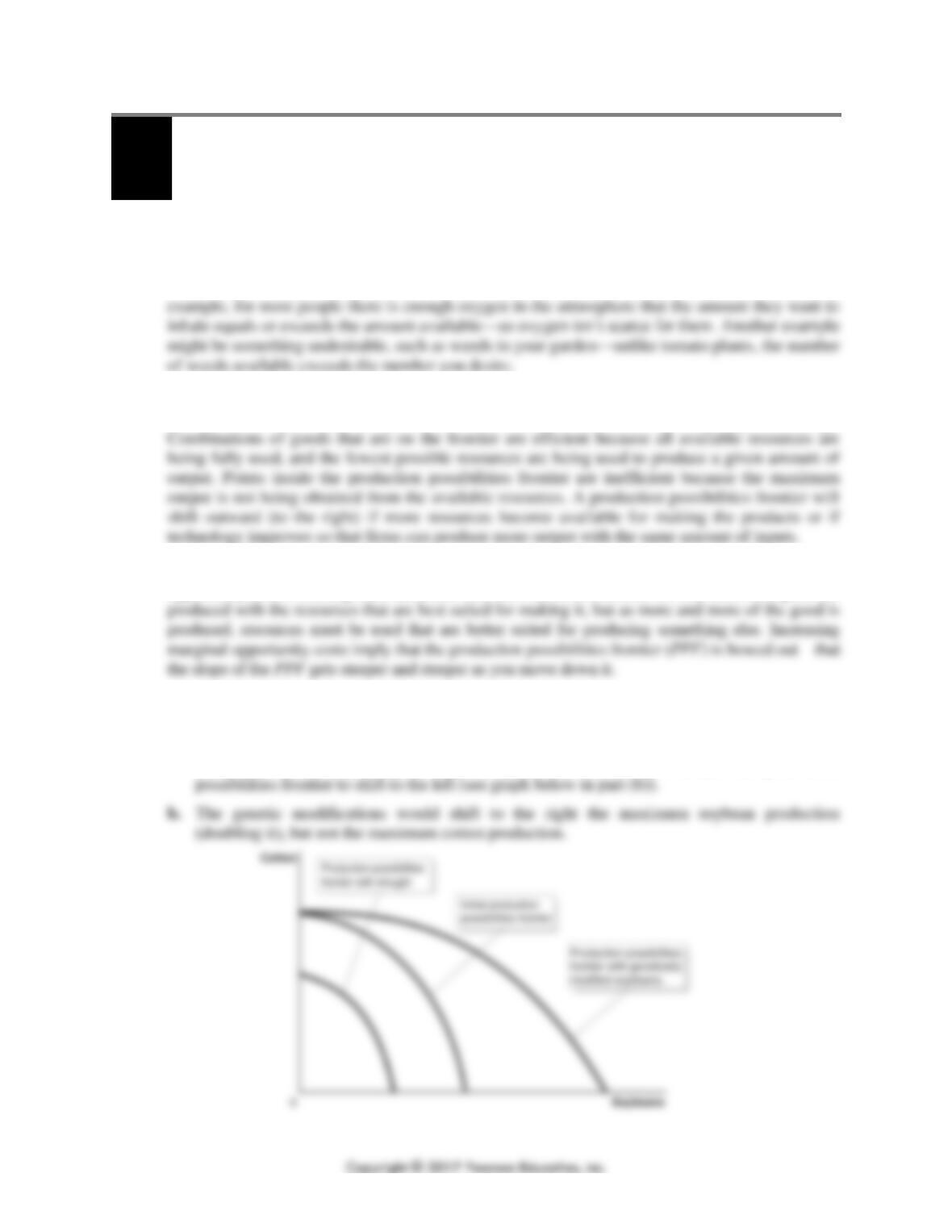
2. The production point representing 110,000 four-door sedans and 65,000 two-door convertibles
lies outside the 2025 PPF, and is therefore an unattainable production point. The PPF represents
34 CHAPTER 2 | Trade-offs, Comparative Advantage, and the Market System
2.1
Production Possibilities Frontiers and Opportunity Costs
Learning Objective: Use a production possibilities frontier to analyze opportunity costs
and trade-offs.
Review Questions
1.1 Scarcity is the situation in which wants exceed the limited resources available to fulfill those
wants. There are some things that are available in such abundance that they exceed our wants. For
1.2 The production possibilities frontier (PPF) is a curve showing all the attainable combinations of
two products that may be produced with available resources and existing technology.
1.3 Increasing marginal opportunity costs means that as more and more of a product is made, the
opportunity cost of making each additional unit rises. It occurs because the first units of a good are
Problems and Applications
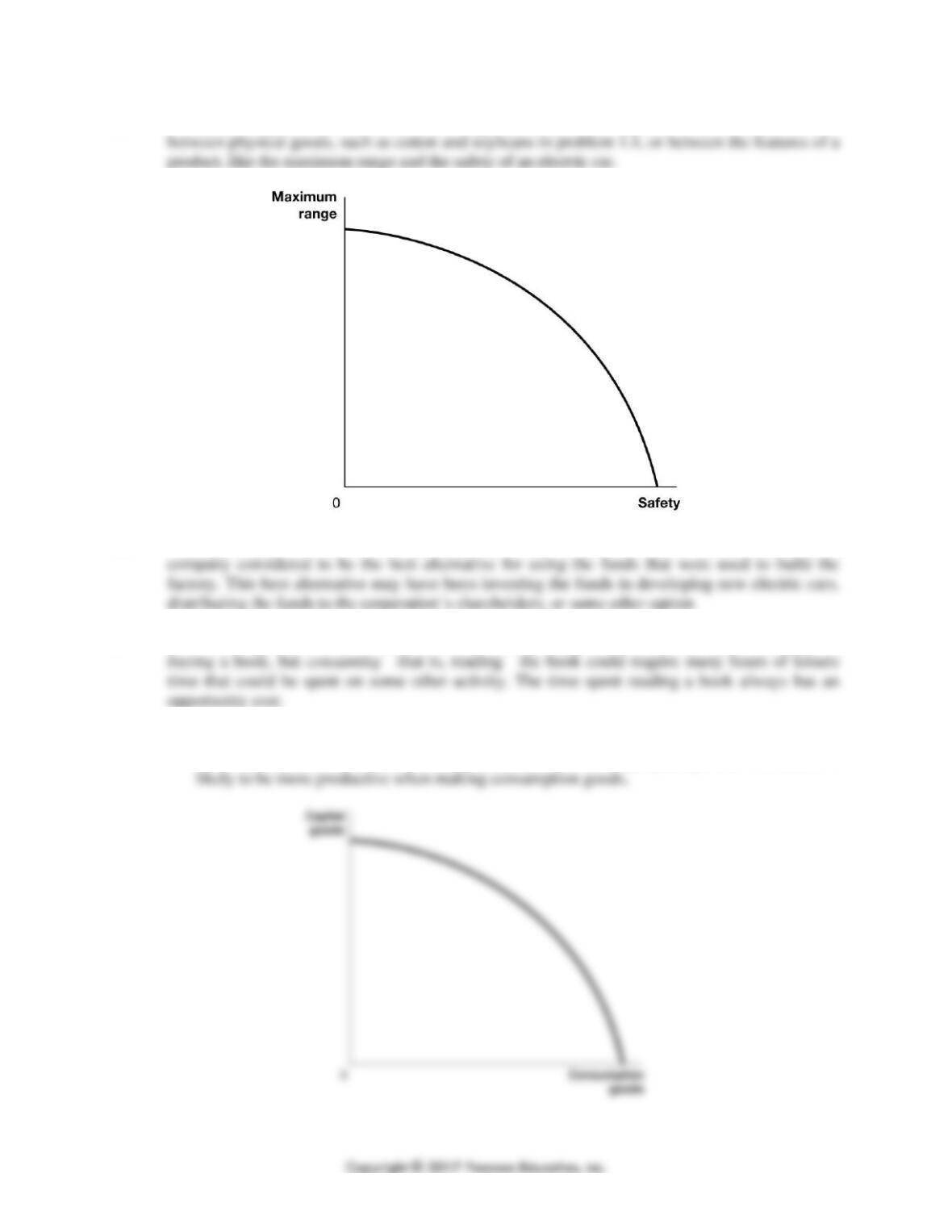
1.4 a. The production possibilities frontiers in the figure are bowed to the right from the origin
because of increasing marginal opportunity costs. The drought causes the production
CHAPTER 2 | Trade-offs, Comparative Advantage, and the Market System 35
1.5 Increased safety will decrease maximum range, as shown in the figure below. Trade-offs can be
1.6 The opportunity cost of Tesla’s investment in a new battery factory in Nevada is what the
1.7 One could argue that the price paid for a book is a close approximation to the opportunity cost of
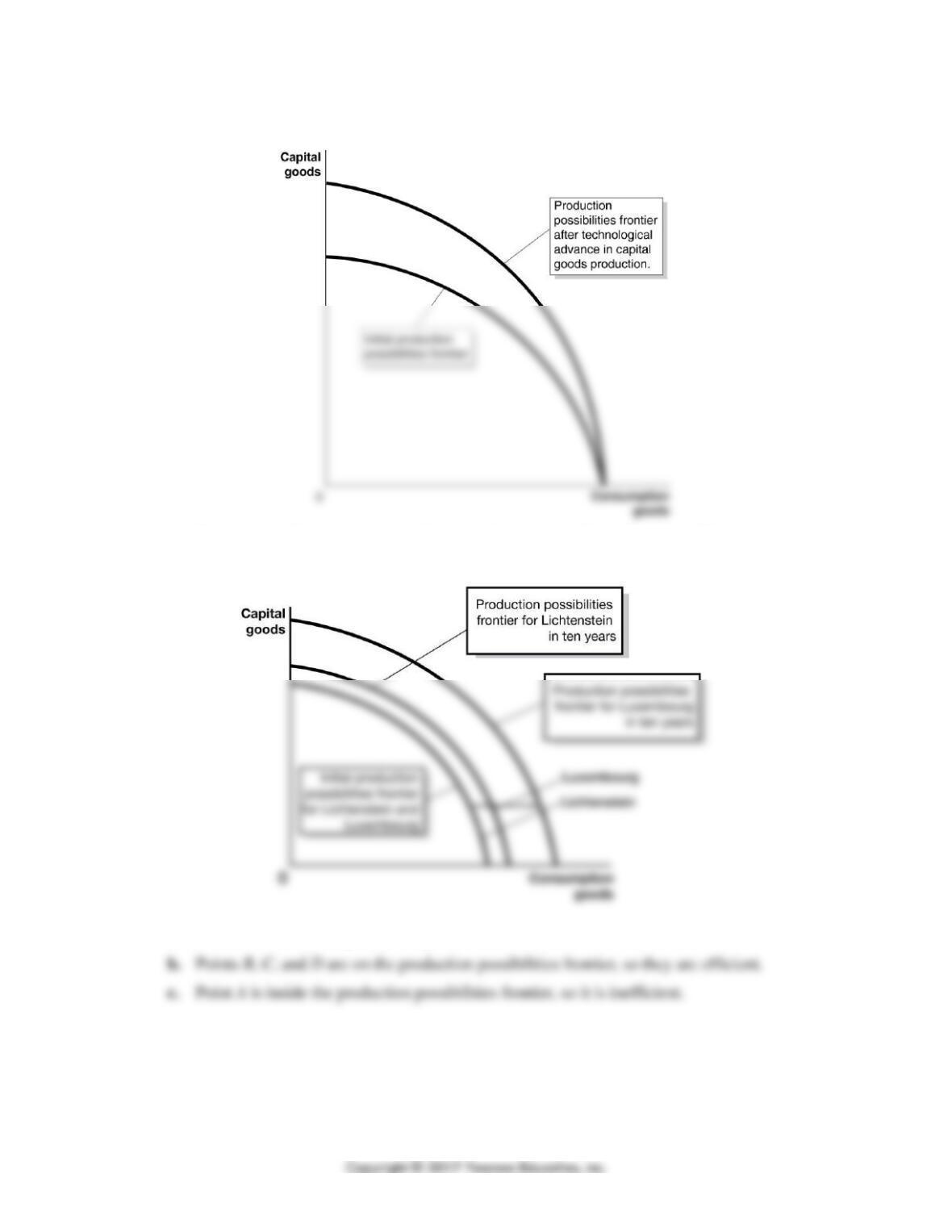
1.8 a. The production possibilities frontier will be bowed out like Figure 2.2 because some
economic inputs are likely to be more productive when making capital goods, and others are
36 CHAPTER 2 | Trade-offs, Comparative Advantage, and the Market System
b.
c. Because it will have more machinery and equipment, Luxembourg is likely to experience
more rapid growth in the future.
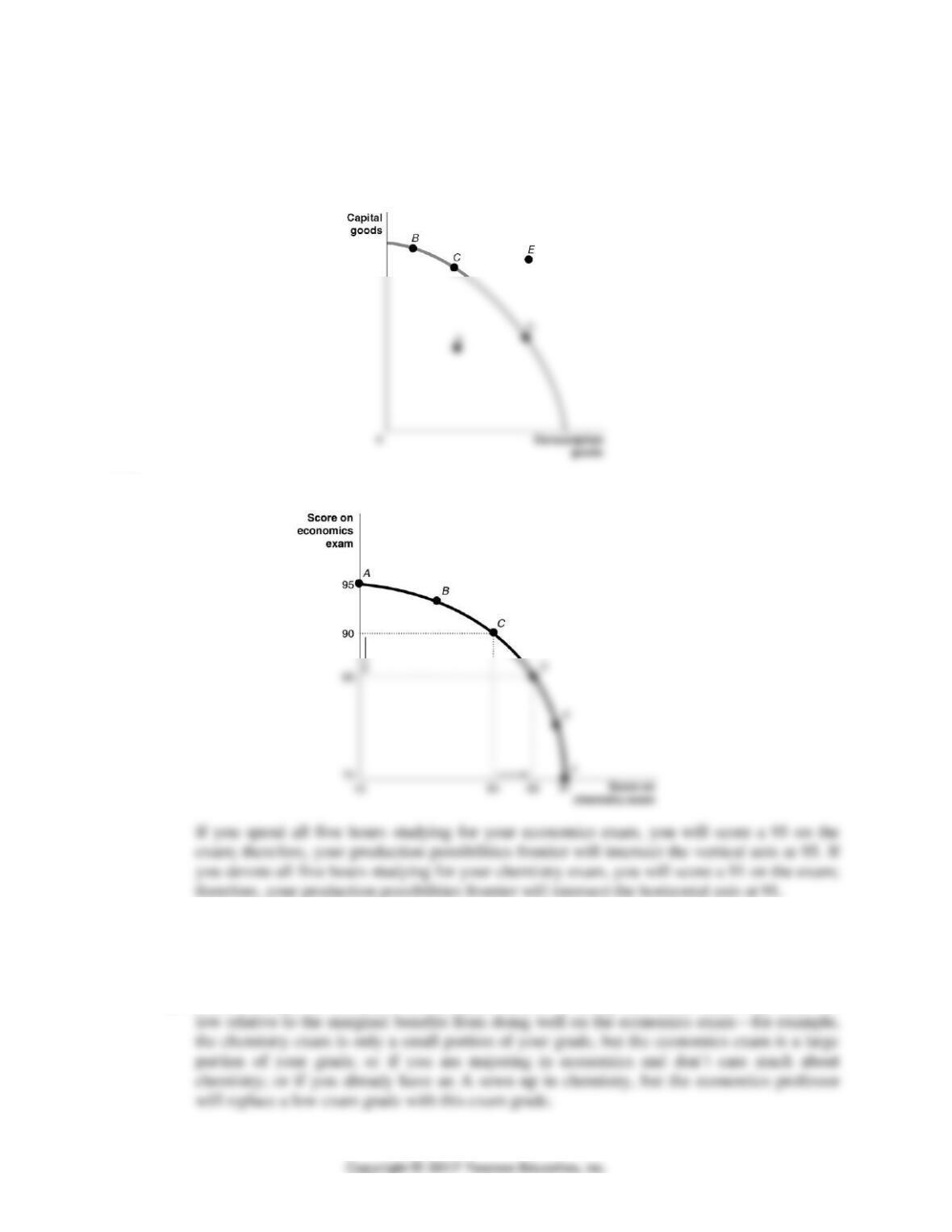
1.9 a. Point E is outside the production possibilities frontier, so it is unattainable.
CHAPTER 2 | Trade-offs, Comparative Advantage, and the Market System 37
d. At point B, the country is devoting the most resources to producing capital goods, so
production at this point is most likely to lead to the highest growth rate. The more capital
goods the country produces, the greater the capacity of the country to produce goods and
services in the future.
1.10 a.
b. The points for choices C and D can be plotted using information from the table. Moving from
choice C to choice D increases your chemistry score by four points but lowers your
economics score by four points. Therefore, the opportunity cost of increasing your chemistry
score by four points is the four point decline in your economics score.
c. Choice A might be sensible if the marginal benefits of doing well on the chemistry exam are
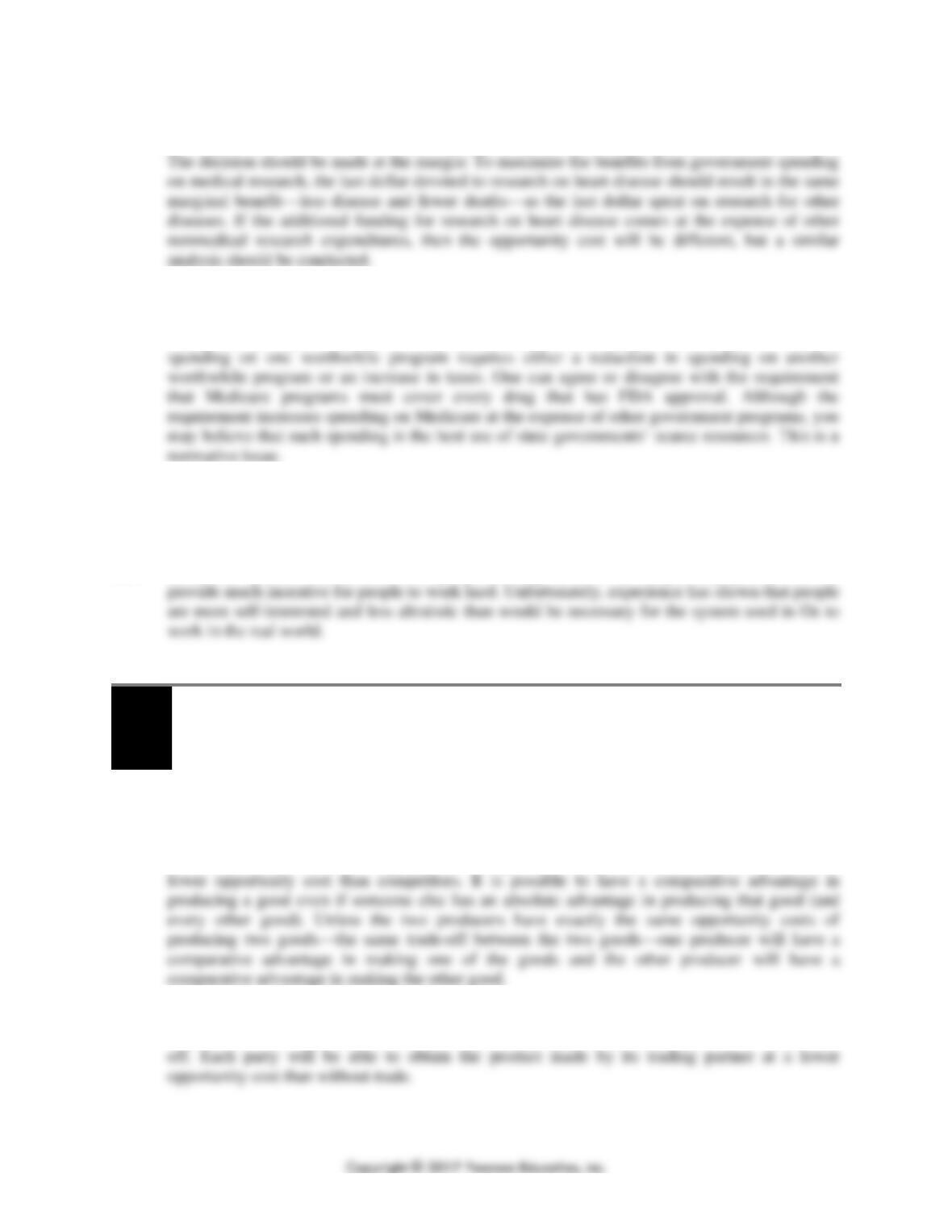
38 CHAPTER 2 | Trade-offs, Comparative Advantage, and the Market System
1.11 If the federal government has a fixed budget for medical research, then the opportunity cost of
funding more research on heart disease is the reduction in funding for research on other diseases.
1.12 State governments have limited budgets. Subsidies paid by governments for prescription drugs
use revenue from taxpayers that could be used to pay for other valuable goods and services.
Nearly all state governments are required to balance their budgets. Therefore, increases in
1.13 Resources used to reduce pollution are not available for other uses, such as saving lives through
medical research, so it is more ethical to take into account the opportunity cost of reducing
pollution.
1.14 Economic systems that do not allow people to keep most of the output they produce do not
2.2
Comparative Advantage and Trade
Learning Objective: Describe comparative advantage and explain how it serves as the
basis for trade.
Review Questions
2.1 Absolute advantage is the ability to produce more of a good or service than competitors using the
same amount of resources. Comparative advantage is the ability to produce a good or service at a
2.2 The basis for trade is comparative advantage. If each party specializes in making the product for
which it has the comparative advantage, they can arrange a trade that makes both of them better
CHAPTER 2 | Trade-offs, Comparative Advantage, and the Market System 39
Problems and Applications
2.3 In the example in Figure 2.4 the opportunity cost of 1 pound of apples is 1 pound of cherries to
you, and 2 pounds of cherries to your neighbor. Any price of apples between 1 and 2 pounds of
TABLE 2.1: A Summary of the Gains from Trade
You
Your Neighbor
Apples
(pounds)
Cherries
(pounds)
Apples
(pounds)
Cherries
(pounds)
Production and consumption without trade
8
12
9
42
Production with trade
0
60
Consumption with trade
Gains from trade (increased consumption)
2
1
2.4 a. Canada has the comparative advantage in making boots. Canada’s opportunity cost of making
1 boot is giving up 1 shirt. In the United States, the opportunity cost of making 1 boot is
giving up 3 shirts. The United States has the comparative advantage in making shirts. In the
United States, the opportunity cost of making one shirt is giving up 1/3 boot, but Canada’s
opportunity cost of making 1 shirt is 1 boot.
b. Neither country has an absolute advantage in making both goods. The United States has the
absolute advantage in making shirts, but Canada has the absolute advantage in making boots.
2.5 Yes, the United States would have benefited from importing those products for which Britain had
a comparative advantage, which, in fact, is what happened.
2.6 a. When the United Kingdom produces one more barrel of fish oil, it produces one barrel less
of crude oil. When Norway produces 1 more barrel of fish oil, it produces 1 less barrel of
40 CHAPTER 2 | Trade-offs, Comparative Advantage, and the Market System
b. No, the countries can’t gain from trade. Trading across the border would result in the same
trade-offs that can be made within each country.
2.7 a. When France produces 1 more bottle of wine, it produces 2 fewer pounds of schnitzel. When
Germany produces 1 more bottle of wine, it produces 3 fewer pounds of schnitzel. Therefore,
France’s opportunity cost of producing wine—2 pounds of schnitzel—is less than
Germany’s—3 pounds of schnitzel. When Germany produces 1 more pound of schnitzel, it
2.8 An individual or a country cannot produce beyond its production possibilities frontier. The
production possibilities frontier shows the most that an individual or country can produce for a
2.9 Colombia could have the comparative advantage in producing coffee if Nicaragua has an even
larger absolute advantage relative to Colombia at producing another product. Say Nicaragua can
produce four times more cashews than Colombia can using the same resources, then Colombia
will have a comparative advantage in producing coffee.
2.10 Andrew and you are using absolute advantage, not comparative advantage, to decide what to do.
Andrew has a comparative advantage at playing quarterback, even though he is five times better
2.11 Countries benefit when they import goods and services that other countries produce at a lower
cost, and export goods and services that they can produce at a lower cost than other countries can.
2.12 Falling transportation costs allowed people to trade more easily and to specialize on the basis of
comparative advantage. If people were able to specialize, they could be more productive and, in
turn, earn more income.
CHAPTER 2 | Trade-offs, Comparative Advantage, and the Market System 41
2.13 Importing only products that could not be produced here would result in the United States
2.14 Even though you are better at unloading the dishwasher, you might be even better relative to the
other members of the household at other household chores. You have an absolute advantage in
2.15 The amount of time that family members spend on household chores has changed over the years
for a number of reasons, including changes in the average number of children per household and
2.3
The Market System
Learning Objective: Explain the basics of how a market system works.
Review Questions
3.1 The circular-flow diagram illustrates how participants in markets are linked. It shows that in
3.2 The two main categories of market participants are households and firms. Households as
3.3 A free market is one with few government restrictions on how goods or services can be produced
or sold, or on how factors of production can be employed. In a free market economy, buyers and
3.4 An entrepreneur operates a business. Entrepreneurs play a key role in the economy by bringing
together the factors of production—labor, capital, and natural resources—to produce goods and
42 CHAPTER 2 | Trade-offs, Comparative Advantage, and the Market System
3.5 Firms are likely to produce more of a good or service if consumers want more of it. As consumer
3.6 Private property rights are the rights individuals or firms have to the exclusive use of their
property, including the right to buy or sell it. If individuals and firms believe that property rights
Problems and Applications
3.7 a. An auto purchase takes place in the product market. The household (George) demands the
good, and the firm (Tesla Motors) supplies the good.
3.8 Firms typically are trying to make the most profit possible, while consumers are trying to spend
their incomes in a way that gives them the greatest satisfaction. Neither firms nor consumers are
directly interested in increasing economic efficiency or the standard of living of the average
3.9 It was not necessary for the managers of any of the firms that participated in the making of the
pencils described in Leonard Read’s story to know how the components they produced were used
3.10 Adam Smith realized—as economists today realize—that people’s motives can be complex. But
in analyzing people in the act of buying and selling, economists have concluded that in most
instances, the motivation of financial reward provides the best explanation for the actions people
CHAPTER 2 | Trade-offs, Comparative Advantage, and the Market System 43
3.11 Whether self-interest is an “ignoble human trait” is a matter of opinion. There are certainly more
noble traits than self-interest, but without at least some self-interest, a person wouldn’t survive. A
3.12 a. “Psychic rewards” refer to the psychological benefits of, in this case, buying lottery tickets,
which provide the excitement of playing the lottery and the chance of winning big.
b. An entrepreneur might receive the psychic rewards of creating and running his or her own
3.13 The protection of property rights will increase economic growth in a developing or low-income
country that adopts a market economy. Property rights–including intellectual rights to new
3.14 a. The farmers responded to the skyrocketing price of chemical fertilizers by switching to the
organic pig manure fertilizer.
3.15 Copyrights give the creator of a book (or film or piece of music) the exclusive right to use his or
her creation, which restricts the reproduction and supply of the copyrighted material. The
3.16 It is difficult, perhaps impossible, to determine the most economically efficient length of time that
Congress should give authors copyright protection. By providing Arthur Conan Doyle, other
authors, and their descendants exclusive rights to their stories, copyright protection provides
incentives for writers to write books that they might not have written if other people could freely