Chapter 2
Scarcity and the World of Trade-Offs
◼ Overview
This chapter introduces the central concept of economics, scarcity. It is the existence of scarcity that
requires people to make choices, both individually and collectively. Along with the concept of scarcity,
the chapter introduces the tools that economists use to analyze choice. These are the concepts of
opportunity costs, trade-offs, and the production possibilities model. The production possibilities model is
used not only to analyze trade-offs but also to illustrate economic growth and the implications of an
inefficient use of resources. Specialization is introduced along with a discussion of the basis for trade,
comparative advantage.
◼ Learning Objectives
After studying this chapter students should be able to:
• 2.1 Evaluate why everyone, whether poor or affluent, faces the problem of scarcity
• 2.2 Explain why the scarcity problem causes people to consider opportunity costs and trade-offs
among choices
◼ Outline
I. Scarcity: Scarcity is a situation in which the ingredients for producing the things that people desire
are insufficient to satisfy all wants at a zero price. It exists in all societies and at all income levels
because human wants exceed what can be produced with the limited resources and time that nature
makes available.
A. What Scarcity Is Not: Scarcity is not a shortage. It is also not poverty. High incomes do not
reduce scarcity.
B. Scarcity and Resources: Resources or factors of production are inputs used in the production
of things that people want. Production is any activity that results in the conversion of resources
into products that can be used in consumption.
2. Labor: Labor is the human resource that includes all productive contributions made by
3. Physical Capital: Capital is all manufactured resources that are used for production. It
also includes improvements to natural resources, such as irrigation ditches.
5. Entrepreneurship: Human resources that perform the functions of organizing, managing,
and assembling the other factors of production to create and operate business ventures and
C. Goods versus Economic Goods: All things from which individuals derive satisfaction or
happiness.
1. Economic Goods: Goods that are scarce. The quantity of such goods desired exceeds the
quantity that is available at a zero price.
2. Services: Mental or physical labor or help purchased by consumers. They can be viewed as
intangible goods.
II. Opportunity Cost, Trade-Offs, and Choices: Scarcity requires choices be made. When one
choice is made, then another is given up.
A. Valuing Forgone Alternatives: Only the individual can determine the value of each choice
that is available.
B. Opportunity Cost: The highest valued, next-best alternative that must be sacrificed for the
choice that was made. In economics, cost is always a forgone opportunity.
C. The World of Trade-Offs: Whenever you engage in any activity using any resource you are
(See Figure 2-1.)
D. Graphical Analysis: How Figure 2-1 is set up is explained.
E. The Production Possibilities Curve (PPC): A curve representing the maximum possible
combinations of total output that could be produced assuming a fixed amount of resources of a
given quality.
1. Production Possibilities for Course Grades: A straight-line production possibilities
2. Measuring Trade-Offs Along a Production Possibilities Curve: A movement from one
III. The Economic Choices a Nation’s People Face: The production possibilities curve does not in
practice have constant trade-offs of one good for another and is typically a curve that is bowed
outward. (See Figure 2-2.)
A. A Two-Good Example
B. Production Trade-Offs (See Figure 2-2.)
C. Assumptions Underlying the Production Possibilities Curve:
2. Production takes place over a specific time period—for example, one year.
Chapter 2 Scarcity and the World of Trade-Offs 19
4. Technology does not change over this period of time.
D. Being off the Production Possibilities Curve: Any point outside the PPC cannot be reached
for the time period assumed. Any point inside the PPC is attainable, but resources are not being
fully utilized. (See Figure 2-2.)
E. Efficiency: The case in which a given level of inputs is used to produce the maximum output
F. The Law of Increasing Additional Cost: The fact that the opportunity cost of additional units
of a good generally increases as society attempts to produce more of that good. This accounts
for the bowed-out shape of the production possibilities curve. (See Figure 2-3.)
1. Increasing Additional Costs: As society takes more and more resources and applies them
2. Explaining the Law of Increasing Additional Cost: The more highly specialized
resources are, the more bowed outward the PPC will be.
IV. Economic Growth, Production Possibilities, and the Trade-Off between Present and Future
A. Economic Growth and the Production Possibilities Curve: Economic growth is illustrated
by an outward shift of the production possibilities curve. (See Figure 2-4.)
B. The Trade-Off between the Present and the Future
2. Forgoing Current Consumption: When existing resources are used to produce capital
3. The Trade-Off between Consumption Goods and Capital Goods: To have more
V. Specialization, Comparative Advantage, and Trade: Specialization means working at a relatively
well-defined, limited activity. It means the organization of economic activity so that what each
person or region consumes is not identical to what each person or region produces.
A. Comparative Advantage: The ability to produce a good or service at a lower opportunity cost
compared to other producers. This is the basis for specialization.
B. Absolute Advantage: The ability to produce more units of a good or service using a given
1. Absolute Advantage versus Comparative Advantage: Only comparative advantage, not
2. Comparative Advantage in Sports: Babe Ruth had an absolute advantage in both hitting
and pitching baseball, but he had a comparative advantage in hitting home runs than pitching.
C. Scarcity, Self-Interest, and Specialization: Persons who are making decisions that further
result is that they choose their comparative advantage and end up specializing.
D. The Division of Labor: The segregation of a resource into different specific tasks.
E. Comparative Advantage and Trade among Nations: The analysis of absolute advantage,
comparative advantage, and specialization applies equally to nations.
1. Trade among Regions: Specialization along lines of comparative advantage in
agricultural products in the plains states and industrial products in the northeastern states
2. International Aspects of Trade: A producer in one part of the United States must adapt
◼ Points to Emphasize
Graphing
Graphs are usually difficult for students to grasp. It is worthwhile spending some time going over basic
graphing techniques and terminology from the Appendix to Chapter 1 before getting into this chapter.
Scarcity
This is the central concept in economics. All economic analysis derives from this condition. Stress that
scarcity arises because at any given time people want more than their resources will allow them to
Resources
Resources or inputs are things that produce goods and services. At any given time, resources are fixed.
Generally, students will agree that this is so. Thus, at any given time, the amount of goods and services
that can be produced is limited. Over time, resources have increased. Indeed, 150 years ago petroleum
was not even a resource. Today, it is one of the most important resources. Advances in technology allow
Choice
After the scarcity problem is analyzed, the problem of choice should be presented. Because of scarcity, that
Specialization and Comparative Advantage
After the tools for analyzing choice are developed, the chapter discusses specialization based on
comparative advantage. The relationship between these two is essential to develop because it is the basis
◼ For Those Who Wish to Stress Theory
Production Possibilities Curve
An in-depth analysis of the production possibilities curve (PPC) can be especially valuable. In particular,
consider the following:
2. Consider the PPC when inputs are equally suited to producing both of the goods. The x and y
3. Note that when some resources are better suited to either output, there are two important differences
in the PPC.
a. It is no longer linear. Instead, it is now concave to the origin due to increasing resource cost.
As we move from producing all x to all y, we initially produce units of y by releasing greater
22 Miller • Economics Today, Nineteenth Edition
◼ Further Questions for Class Discussion
1. In recent years, online news sites such as the ones at MSNBC and Yahoo! have designed a business
model in which they collect stories from the online pages of newspapers and wire services, such as
the Associated Press (AP), and allow free access to the articles for visitors to their Web sites. The
2. Does the federal government face a scarcity constraint? In discussions of the federal government,
3. Students will usually agree that specialization along lines of comparative advantage and then trade
is beneficial. Point out Adam Smith’s statement in The Wealth of Nations that no “prudent master
[will] make at home what it will cost him more to make than to buy.” Consider outsourcing where
4. A major political issue revolves around tax policy and its effect on investment and economic
◼ Adam Smith (1723–1790): Scottish Economist
“I have never known much good done by those who affected to trade for the public good,” Adam Smith
once remarked. If he put little stock in good intentions, Smith did invest heavily in demonstrating that
selfish intentions could lead to public good. In The Theory of Moral Sentiments (1759), his first book,
Smith tried to show how altruism could come out of self-interest. In his second, more famous book, he
Chapter 2 Scarcity and the World of Trade-Offs 23
attempted to reveal how the self-interest of private individuals could be transformed by the sleight of an
invisible hand (the unfettered market) into social harmony and public benefit, producing the wealth of the
nation in the best of all possible ways. The result of this effort was An Inquiry into the Nature and Causes
of the Wealth of Nations (1776), perhaps the most influential economics treatise ever written, one that has
set the tone for capitalist ideology for more than two centuries.
◼ Answers to Questions for Critical Analysis
Why the “Free File” Tax Services Is Not Really “Free” (p. 30)
Why might a person pay a firm at a mall to prepare her tax forms while she shops instead of
allocating the same amount of time to finding a qualifying Free-File tax preparation service?
An Economic Explanation for Monogamy (p. 32)
What must be true of the trade-off perceived by people who have multiple sex partners?
The Substantial Trade-off of Satisfying U.N. Development Goals (p. 34)
If the U.N. follows through on a proposal to add production targets for 148 more items to its
Sustainable Development Goals, why might we expect that the opportunity cost in terms of other
goods and services that must be forgone could be even greater? Explain briefly.
24 Miller • Economics Today, Nineteenth Edition
The Airline Industry Confronts the Law of Increasing Additional Cost (p. 36)
Why might the production possibilities curve relating the number of electronic-gadget-accessory
boxes at passenger seats to the quantity of seats on a plane be bowed? Explain your reasoning.
◼ You Are There
Reducing the Opportunity Cost of Waiting in Gridlocked Traffic, at a Price (p. 42)
1. How must the dollar values of the opportunity costs of time compare for a typical purchaser
of a vehicle converted by Becker Automotive, Inc., versus commuters who do not purchase
them? Explain briefly.
2. Why do you suppose that economists have estimated the dollar value of the combined
opportunity costs of time that U.S. commuters spend in gridlocked traffic to be in excess of
$150 billion per year? Explain our reasoning.
◼ Issues & Applications
The U.S. Navy Expands Production Possibilities via a New Technology (pp. 42–43)
1. In spite of the lower opportunity cost of rail-gun projectiles instead of missiles, does the U.S.
Navy continue to face an increasing additional cost, in terms of forgone ship production, to
obtain additional weapons? Explain briefly.
2. Could the U.S. Navy expand its production of both ships and weapons after switching from
missiles to rail-gun weapons? Explain your reasoning. (Hint: Are there points along PPC2
involving combinations of both more ships and more weapons than is feasible at point A
on PPC1?)
Chapter 2 Scarcity and the World of Trade-Offs 25
◼ Research Project
1. Learn more about the U.S. Navy’s rail-gun technology in the Web Links in MyEconLab.
◼ Answers to Problems
2-1. Define opportunity cost. What is your opportunity cost of attending a class at 11:00 A.M.?
How does it differ from your opportunity cost of attending a class at 8:00 A.M.?
2-2. If you receive a ticket to a concert at no charge, what, if anything, is your opportunity cost of
attending the concert? How does your opportunity cost change if miserable weather on the
night of the concert requires you to leave much earlier for the concert hall and greatly
extends the time it takes to get home afterward?
2-3. You and a friend decide to spend $100 each on concert tickets. Each of you alternatively could
have spent the $100 to purchase a textbook, a meal at a highly rated local restaurant, or several
Internet movie downloads. As you are on the way to the concert, your friend tells you that if she
2-4. After the concert discussed in Problem 2-3 is over and you and your friend are traveling
home, you discuss how each of you might otherwise have used the four hours devoted to
attending the concert. The four hours could have been used to study, to watch a sporting
event on TV, or to get some extra sleep. Your friend decides that if she had not spent four
hours attending the concert, she would have chosen to study, and you reply that you otherwise
would have watched the televised sporting event. Identify the relevant opportunity costs for
you and your friend for allocating your four hours to attending the concert. Explain briefly.
The opportunity cost is the cost of the single, next-highest-value forgone alternative to the four
2-5. Recently, a woman named Mary Krawiec attended an auction in Troy, New York. At the
auction, a bank was seeking to sell a foreclosed property: a large Victorian house suffering
from years of neglect in a neighborhood in which many properties had been on the market for
years yet remained unsold. Her $10 offer was the highest bid in the auction, and she handed
over a $10 bill for a title to ownership. Once she acquired the house, however, she became
responsible for all taxes on the property and for an overdue water bill of $2,000. In addition,
to make the house habitable, she and her husband devoted months of time and unpaid labor
to renovating the property. In the process, they incurred explicit expenses totaling $65,000.
Why do you suppose that the bank was willing to sell the house to Ms. Krawiec for only $10?
(Hint: Contemplate the bank’s expected gain, net of all explicit and opportunity costs, if it had
attempted to make the house habitable.)
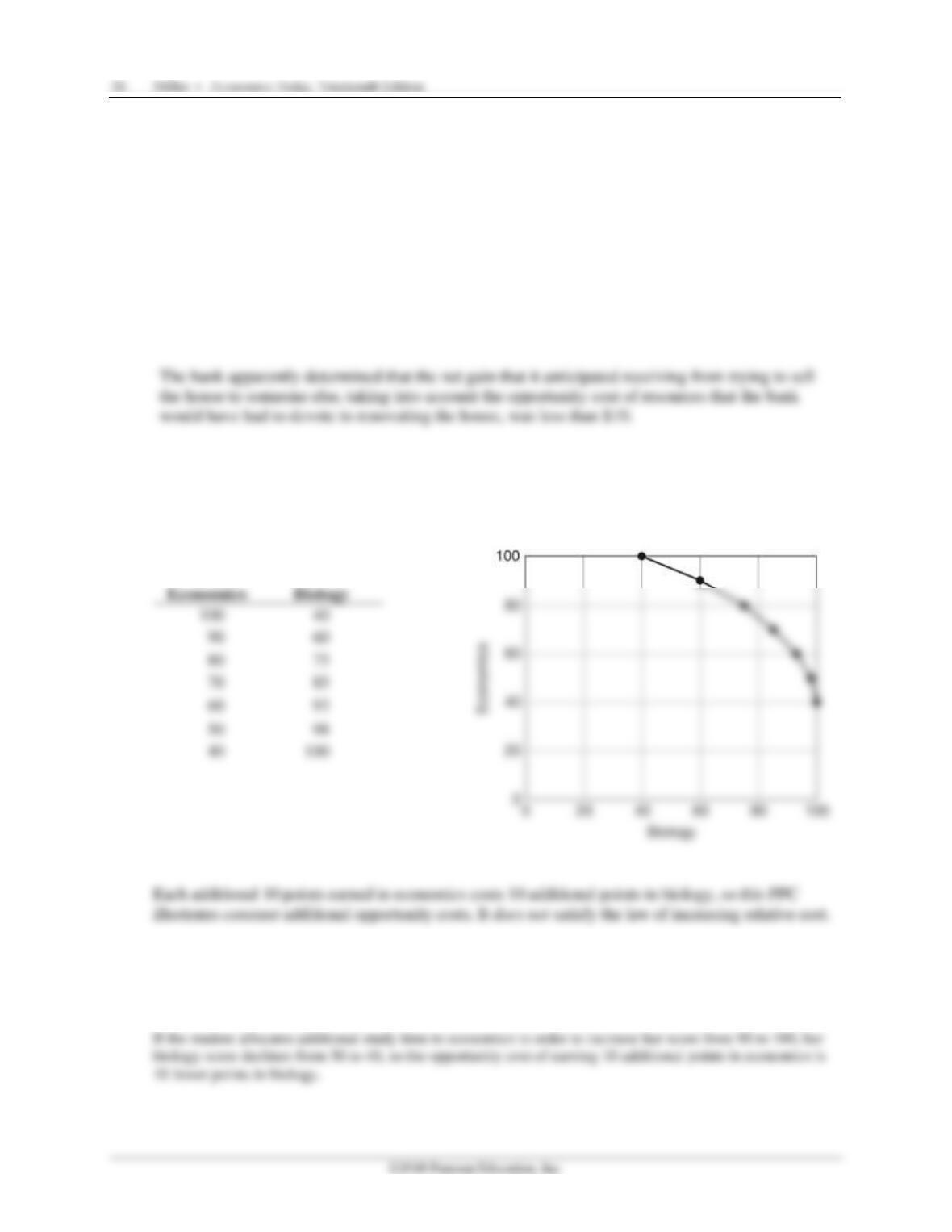
2-6. The following table illustrates the points a student can earn on examinations in economics
and biology if the student uses all available hours for study. Plot this student’s production
possibilities curve. Does the PPC illustrate the law of increasing additional cost?
2-7. Based on the information provided in Problem 2-6, what is the opportunity cost to this
student of allocating enough additional study time on economics to move her grade up from a
90 to a 100?
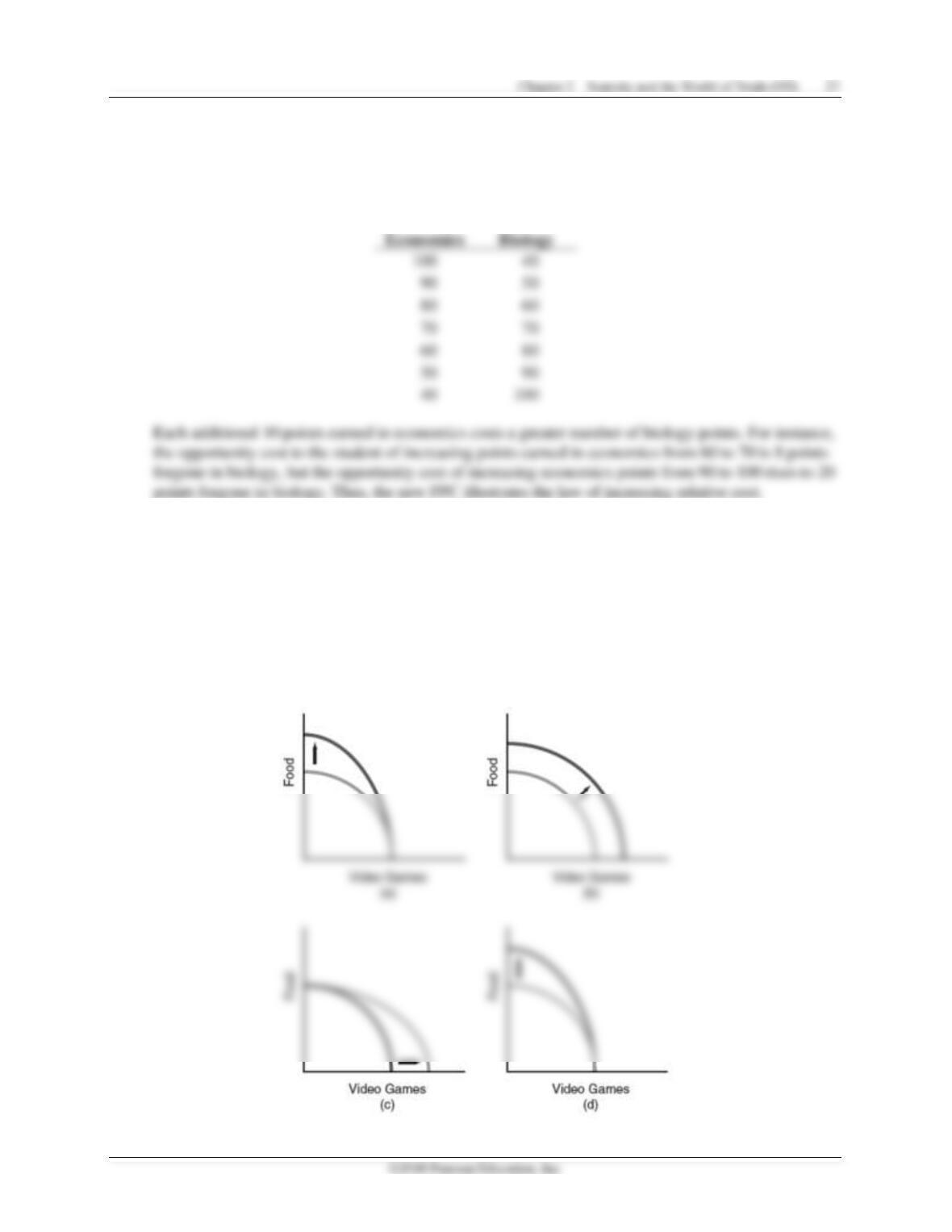
2-8. Consider a change in the table in Problem 2-6. The student’s set of opportunities is now as
follows: Does the PPC illustrate the law of increasing additional cost? What is the opportunity
cost to this student for the additional amount of study time on economics required to move
her grade from 60 to 70? From 90 to 100?
2-9. Construct a production possibilities curve for a nation facing increasing opportunity costs for
producing food and video games. Show how the PPC changes given the following events.
a. A new and better fertilizer is invented.
b. Immigration occurs, and immigrants’ labor can be employed in both the agricultural
sector and the video game sector.
c. People invent a new programming language that is much less costly to code and is more
memory-efficient.
d. A heat wave and drought result in a 10 percent decrease in usable farmland.
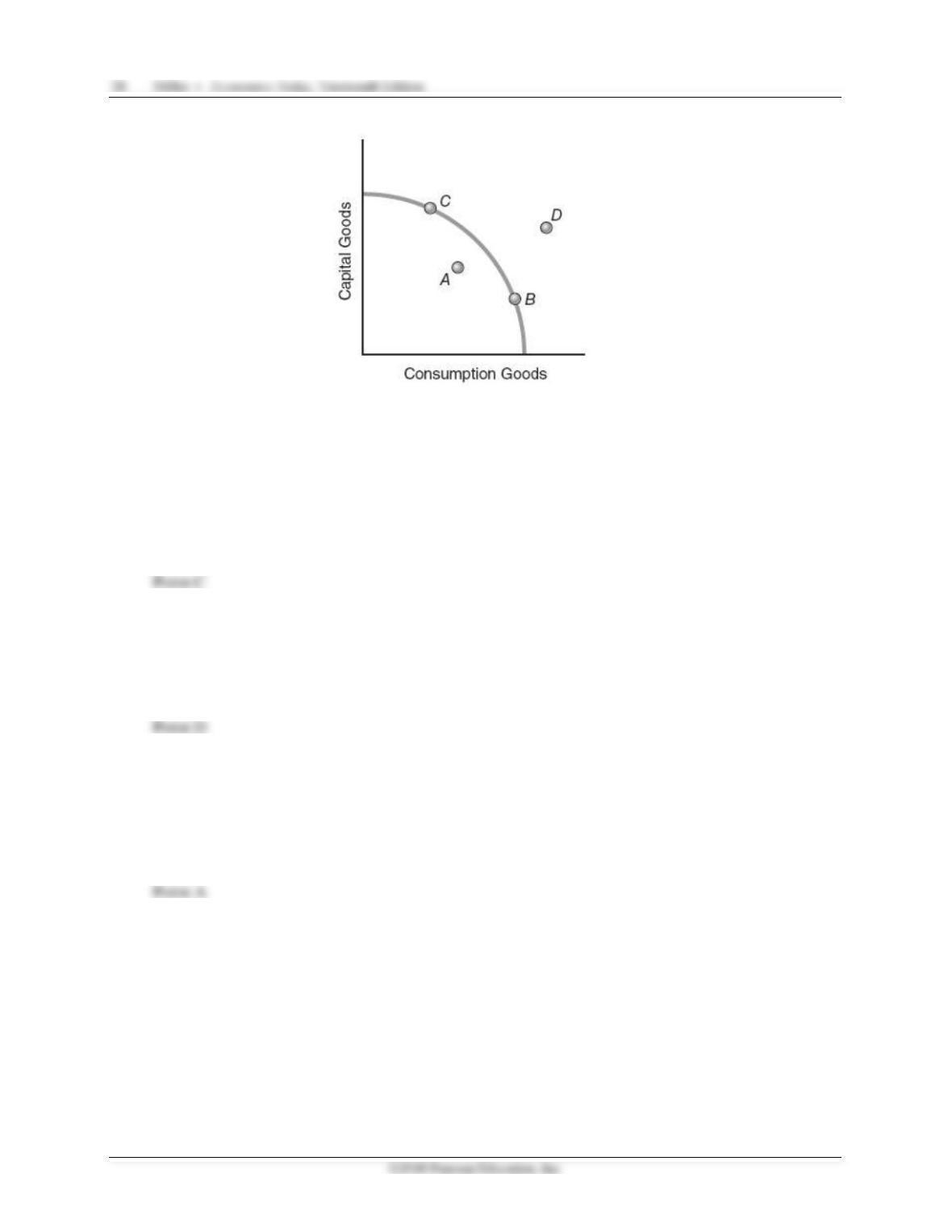
2-10. During a debate on the floor of the U.S. Senate, Senator Creighton states, “Our nation
should not devote so many of its fully employed resources to producing capital goods
because we already are not producing enough consumption goods for our citizens.”
Compared with the other labeled points on the diagram, which one could be consistent
with the current production combination choice that Senator Creighton believes the nation
has made?
2-11. In response to Senator Creighton’s statement reported in Problem 2-10, Senator Long replies,
“We must remain at our current production combination if we want to be able to produce
more consumption goods in the future.” Of the labeled points on the diagram, which one
could depict the future production combination Senator Long has in mind?
2-12. Senator Borman interjects the following comment after the statements by Senators Creighton
and Long reported in Problems 2-10 and 2-11: “In fact, both of my esteemed colleagues are
wrong, because an unacceptably large portion of our nation’s resources is currently
unemployed.” Of the labeled points on the diagram, which one is consistent with Senator
Borman’s position?
2-13. A nation’s residents can allocate their scarce resources either to producing consumption
goods or to producing human capital—that is, providing themselves with training and
education. The table at the top of next column displays the production possibilities for this
nation:
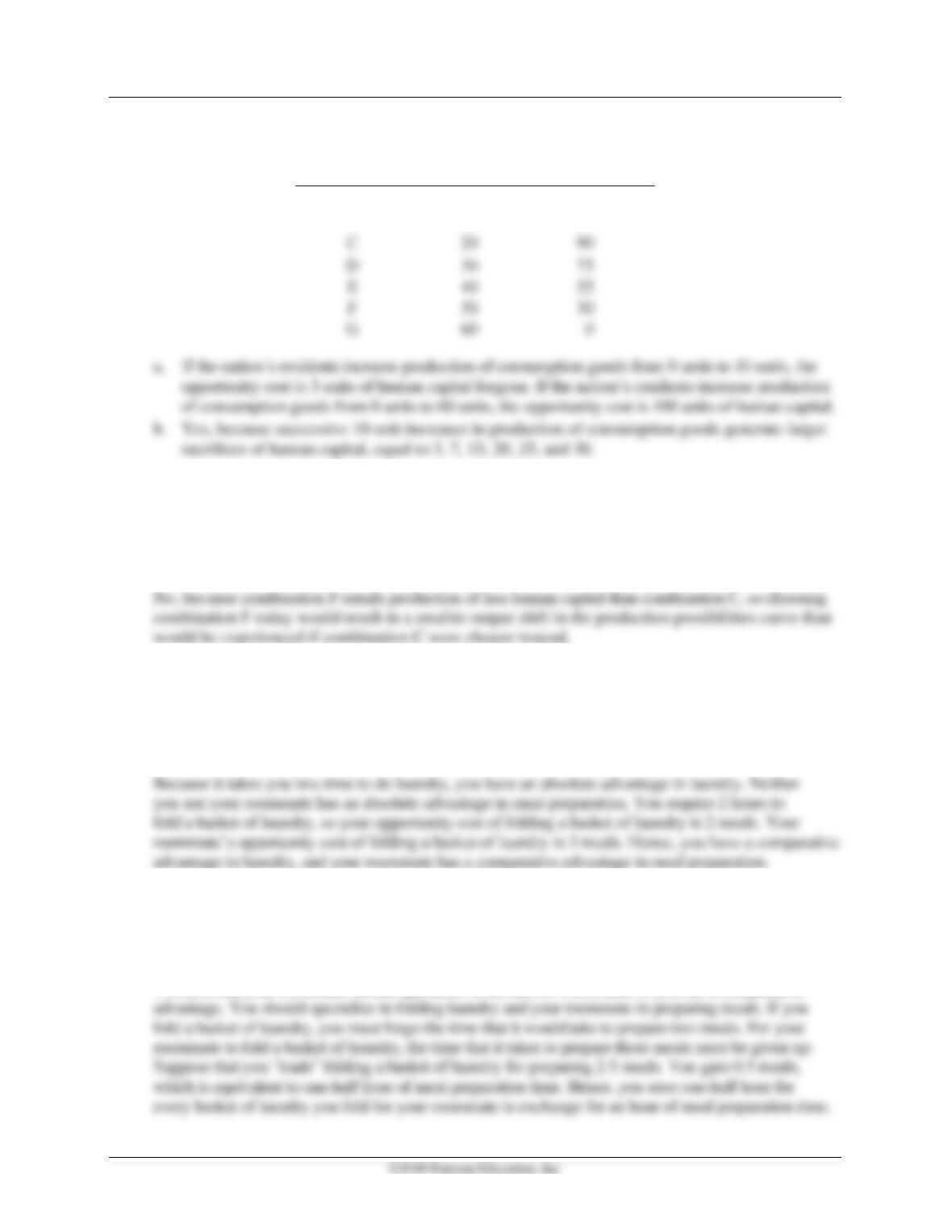
a. Suppose that the nation’s residents currently produce combination A. What is the
opportunity cost of increasing production of consumption goods by 10 units? By 60 units?
b. Does the law of increasing additional cost hold true for this nation? Why or why not?
Chapter 2 Scarcity and the World of Trade-Offs 29
Units of
Production
Consumption
Units of
Combination
Goods
Human Capital
A
0
100
B
10
97
C
20
90
D
30
75
F
50
30
2-14. Like physical capital, human capital produced in the present can be applied to the production
of future goods and services. Consider the table in Problem 2-13, and suppose that the
nation’s residents are trying to choose between combination C and combination F. Other
things being equal, will the future production possibilities curve for this nation be located
farther outward if the nation chooses combination F instead of combination C? Explain.
2-15. You can wash, fold, and iron a basket of laundry in two hours and prepare a meal in one
hour. Your roommate can wash, fold, and iron a basket of laundry in three hours and
prepare a meal in one hour. Who has the absolute advantage in laundry, and who has an
absolute advantage in meal preparation? Who has the comparative advantage in laundry, and
who has a comparative advantage in meal preparation?
2-16. Based on the information in Problem 2-15, should you and your roommate specialize in a
particular task? Why? If so, who should specialize in which task? Show how much labor time
you save if you choose to “trade” an appropriate task with your roommate as opposed to
doing it yourself.
Yes, you and your roommate should specialize in the task in which each of you has a comparative
2-17. Using only the concept of comparative advantage, evaluate this statement: “A professor with
a Ph.D. in physics should never mow his or her own lawn, because this would fail to take into
account the professor’s comparative advantage.”
2-18. Country A and country B produce the same consumption goods and capital goods and
currently have identical production possibilities curves. They also have the same resources at
present, and they have access to the same technology.
a. At present, does either country have a comparative advantage in producing capital
goods? Consumption goods?
b. Currently, country A has chosen to produce more consumption goods, compared with
country B. Other things being equal, which country will experience the larger outward
shift of its PPC during the next year?
2-19. Suppose that in Figure 2-1, a student currently is allocating her study time in such a way that
she is earning a C in mathematics and a C in economics. What is the opportunity cost,
measured in terms of the resulting grade change, if this student wishes to reallocate her study
time in order to raise her mathematics grade by one letter, from a C to a B?
2-20. Suppose that in Figure 2-1, a student currently is allocating her study time in such a way that
she is earning a C in mathematics and a C in economics. If the student desires to boost her
economics grade to an A, how must she alter the number of hours per week that she studies
economics? How must she alter the number of hours per week that she studies mathematics?
2-21. Suppose that in Figure 2-2, the nation currently is producing combination D in the table and
on the graph of the production possibilities curve. What is the opportunity cost of producing
5 million more smartphones and moving to production combination C?
2-22. Suppose that in Figure 2-2, the nation currently is producing combination D in the table and
on the graph of the production possibilities curve. What is the opportunity cost of producing
20 million more tablet devices and moving to production combination F?
To move from combination D to combination F and produce 20 million more tablet devices at point F,
2-23. Suppose that in Figure 2-4, the nation currently has sufficient resources to produce
combinations located along only the innermost production possibilities curve. In addition,
suppose that the nation’s residents have determined that smartphones function mainly as
consumption goods while tablet devices function primarily as capital goods. If the nation
produces no additional tablets this year, will the intermediate-shifted PPC resulting from
minimal economic growth or the farthest-shifted PPC caused by more significant economic
growth be more likely to apply next year?
2-24. Suppose that in Figure 2-4, the nation with otherwise the same background conditions as
in Problem 2-23 currently has sufficient resources to produce combinations located along
only the innermost production possibilities curve. If the nation produce s no additional
smartphones this year, will the intermediate-shifted PPC resulting from minimal economic
growth or the farthest-shifted PPC caused by more significant economic growth be more
likely to apply next year?
The nation is said to have determined that tablet devices are capital goods that can be used to produce
◼ Selected References