2: Introducing Universal Design for Learning
Learning Outcomes
After studying this chapter, students should be able to:
• 2-1 Define the term universal design.
• 2-2 Explain what universal design for learning (UDL) is and how it evolved.
• 2-3 Discuss the three essential qualities of UDL.
• 2-4 Compare and contrast UDL and differentiated instruction.
INTASC Standards
Standard #1: Learner Development. The teacher understands how learners grow and develop,
recognizing that patterns of learning and development vary individually within and across the
Council for Exceptional Children
Special educators are to have knowledge of the following:
Standard #1: Learner Development and Individual Learning Differences: Beginning special
education professionals understand how exceptionalities may interact with development and
Chapter Outline
2-1 The Concept of Universal Design
2-1a Background in Architecture
2-1c Universal Design Applications in Society
2-2 The Development of Universal Design for Learning
2-2b Cognitive–Social Learning Theories
2-2d Implications for Teaching and Learning
2-3 Three Essential Qualities of UDL: Representation, Engagement, and Expression
2-3a Multiple Means of Representation
2-3c Multiple Means of Expression
2-4 UDL and Differentiated Instruction
2-4a The Benefits of Flexible Options
Key Concepts and Terms
affective systems: Part of the three–part framework of brain processing that impacts the
engagement or social interaction of the learner.
differentiated instruction: An instructional process that offers teachers flexibility in
ways to offer more support or greater challenge when teaching individuals or groups of
students who have different learning styles, strengths, and needs.
executive functioning: The management of cognitive processes (including working
expert learner: Strategic, self–regulated, and reflective learners who take charge of their
learning.
metacognition: To think about one’s own learning or thinking process.
multiple intelligences: A theory developed by Howard Gardner that identifies and
describes eight intelligence areas in which all individuals exhibit varying degrees of
proficiency.
multiple means of engagement: To use a variety of methods to motivate students; one
of three qualities of universal design for learning that focuses on affective learning.
multiple means of representation: To provide students with a variety of ways to
receive and interpret information; one of three qualities of universal design for learning
that focuses on recognition learning.
recognition system: The part of the brain used to recognize patterns in received
information; part of the three–part framework of brain processing.
spiral curriculum: A curriculum in which the basic concepts are taught and
subsequently revisited as needed to enable students to use concepts as a springboard
for more advanced learning.
zone of proximal development: The area or difference between a person’s actual
independent level of learning/problem–solving and his or her potential level of
development of higher–level learning/problem solving.
Lecture Notes
The term universal design for learning was coined in the field of architecture in response
to the vision of an architect with a physical disability. The Americans with Disabilities Act
(ADA) paved the way for widespread implementation.
Universal design for learning (UDL) evolved from universal design principles. It has been
found to benefit learners with a diverse set of needs.
By revisiting the work of cognitive–social theorists, thoughts and findings about how
people learn support universal design for learning principles. Revisiting work done with
learning styles, multiple intelligences, and Bloom’s taxonomy will be helpful to design
and implement UDL environments.
Suggestions for In–Class or Online Activities
1. Assign the MindTap scenario. Have the students work in small groups or
individually to prepare the assignment that accompanies the scenario.
2. Put the students into groups and give each group a box of random building
3. Play a musical CD for the class. Ask the students how the music made them feel.
Discussion Questions
1. Who benefits when the principles of universal design are followed? Explain your
answer.
3. Which part(s) of the CAST framework for how the brain works do you think are
affected by the learner’s culture? Explain why.
4. Should a UDL curriculum require sequential movement through progressive
stages of thinking or development, such as Piaget’s developmental stages or
Bloom’s taxonomy? Why or why not?
5. In what ways could a UDL curriculum address the needs of global learners?
6. Using Vygotsky’s Theory, explain how a curriculum designed around the “3 M’s of
UDL” would reflect his findings.
8. How can Bloom’s taxonomy be used with universal design for learning?
9. Choose one of Gardner’s multiple intelligences and explain how UDL would be
used to work with that intelligence.
10. What is your learning preference? How does knowing that help you to study for
tests and prepare for class?
Field Experiences
1. Visit a local school and ask to observe a classroom. While observing, note how
the teacher interacts with the students. Does he/she utilize any of the
components of UDL? Explain how.
3. Observe a group of children at play, indoors or outdoors. Make note of the
activities the children are engaged in. Using Gardner’s Multiple Intelligence
Theory, predict which intelligence is dominant in each group of children.
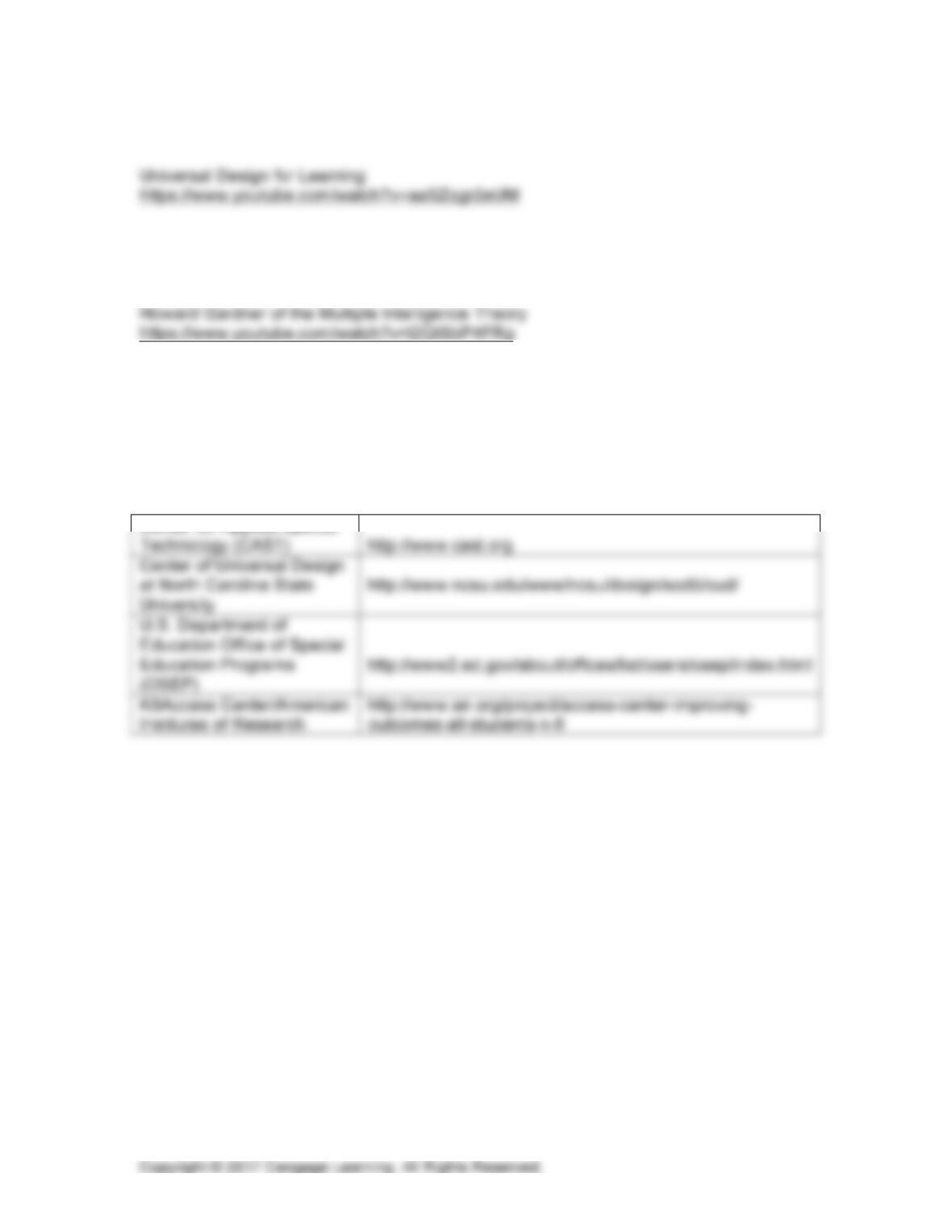
Videos
1. The video defines and explains UDL. How would you use UDL in your
classroom? Give at least 2 different examples.
2. How can the principles of architecture help you to evaluate your lessons?
1. After watching this video, describe yourself using one or more of the multiple
intelligences.
2. Why is it important to recognize that students have multiple intelligences? How
does that change how you plan your lessons?
Web Resources
Center for Applied Special