Chapter 2
Measuring Macroeconomic Data
◼ Chapter Outline, Overview, and Teaching Tips
Chapter Outline
Measuring Economic Activity: National Income Accounting
Measuring GDP: The Production Approach
Market Value
Policy and Practice: Can GDP Buy Happiness?
Measuring GDP: The Expenditure Approach
Consumption Expenditure
Measuring GDP: The Income Approach
Categories of Income
Income Measures
Real Versus Nominal GDP
Nominal Variables
Measuring Inflation
GDP Deflator
Policy and Practice: Policy and Overstatements of the Cost of Living
Inflation Rate
Percentage Change Method and the Inflation Rate
Measuring Unemployment
14 Mishkin • Macroeconomics: Policy and Practice, Second Edition
Macroeconomics in the News: Interest Rates
Real Versus Nominal Interest Rates
The Important Distinction Between Real and Nominal Interest Rates
Chapter Overview and Teaching Tips
This chapter examines how economists define and measure the most important data in macroeconomics.
Some instructors will want to cover this material in detail in class, but others will prefer to just cover the
main points and let students read the chapter on their own as background.
Although the material in this chapter can be dry, discussing in class the Policy and Practice cases in the
chapter, “Can GDP Buy Happiness?” and “Policy and Overstatements of the Cost of Living,” liven up the
material. It also helps students recognize that understanding and measuring macroeconomic data is
important to getting policy right.
◼ Answers to End of Chapter Review Questions and Problems
Answers to Review Questions
Measuring Economic Activity: National Income Accounting
1. The fundamental identity of national income accounting states that Total Production = Total
Measuring GDP: The Production Approach
2. GDP is defined as the market value of all final goods and services newly produced in the economy
during a fixed period of time. When a market value or price is not available for a good or service, its
contribution to the value of total output is either ignored—as in the case of most household services
3. A flow measure is a quantity per period of time and a stock measure is an amount at a given point in
time. For example, your car’s speedometer, by telling you how fast you are driving in miles per hour,
provides you a flow measure associated with a period of time. Its odometer gives you a stock measure
Chapter 2 Measuring Macroeconomic Data 15
4. Intermediate goods and services are used up completely in the production of final goods and services
during a given time period. Because this is so, their value is completely incorporated into the value of
those final goods and services and is not counted separately. This is not the case with capital goods
and inventories. A capital good is a final good that is produced during a given time period and is then
Measuring GDP: The Expenditure Approach
5. According to the national income identity, GDP (Y) can be measured by summing consumption
expenditure (C), investment expenditure (I), government purchases of goods and services (G), and
Measuring GDP: The Income Approach
6. The major income items in national income are employee compensation, proprietors’ income, rental
income of persons, corporate profits, and net interest. The total of these income categories does not
equal the GDP because depreciation, which is treated as an expense and therefore reduces proprietors’
Real Versus Nominal GDP
7. Variables measured in terms of dollars or other monetary units, such as GDP and its various income
and expenditure components, can be measured using either current market prices or the prices of a
base year. The nominal value of a variable is measured using current market prices and will change
16 Mishkin • Macroeconomics: Policy and Practice, Second Edition
output falls and thus is a better measure of changes in economic activity and well-being.
8. The GDP deflator is a measure of the price level obtained by dividing nominal GDP by real GDP for
Measuring Inflation
9. The consumer price index (CPI) is a widely followed measure of the average prices of the goods
and services a typical urban consumer purchases. The Bureau of Labor Statistics (BLS) conducts
periodic expenditure surveys to determine the items in a typical urban consumer’s “basket of goods
Measuring Unemployment
10. The unemployment rate, calculated monthly by the BLS, measures the fraction of civilians who want
to work but do not have jobs. To estimate this fraction, the BLS surveys about 60,000 households each
Measuring Interest Rates
11. A nominal interest rate is the interest rate stated on a loan or other financial instrument that is not
adjusted for inflation. The nominal interest rate on a loan, for example, indicates how much money
the borrower will pay in interest to the lender, but it does not measure that interest payment in real
Answers to Problems
Measuring Economic Activity: National Income Accounting
1. It is not correct to assume that a household’s total income will equal its total expenditure. This might
happen as a particular case, but in general, households choose either not to spend all their income
(i.e., to save) or to spend more than their total income (i.e., to accumulate debt). This conclusion is
the same if we consider a firm (rather than a household) that produces any good or service: Its income
Chapter 2 Measuring Macroeconomic Data 17
or service.
Measuring GDP: The Production Approach
2. a. According to the production approach, which measures GDP by adding the value added from
each firm, GDP will increase in this case. This is interpreted as good news, as this measure is
intended to measure economic activity.
b. We cannot say that both countries are better off for sure. We can say that economic activity has
increased in both countries, but GDP cannot measure, by definition, many important aspects of
Measuring GDP: The Expenditure Approach
3. a. A household purchase of a home built in 2005 will not affect GDP because only currently produced
goods and services are considered by the GDP measure. Counting previously produced goods
will overestimate GDP, as these goods were already counted the year they were produced.
b. A household purchase of a newly built dishwasher will count toward GDP and will be included
Measuring GDP: The Income Approach
4. a. To calculate other income, subtract the figures for employee compensation and corporate profits
from national income: Other income = $14,313 − $8,737 − $2,021 = $3,555 billion.
b. Net factor income is the difference between gross national product, which measures the value
18 Mishkin • Macroeconomics: Policy and Practice, Second Edition
Real Versus Nominal GDP
5. a. Lucia is right. In order to properly assess whether a country and its residents are better off, one
has to consider the evolution of real GDP, not nominal GDP. Real and nominal GDP might
describe the same changes in economic activity, but this happens only under particular
circumstances. Nominal GDP might increase even if the quantity of goods and services does not
Measuring Inflation
6. a. If transportation services for the typical U.S. household increase by 10 percent, one can calculate
the change in CPI caused by this price change, assuming that no other price has changed. The
CPI change can be calculated as: 10% 15% = 1.5%.
b. According to the previous information, you will probably not spend 15 percent of your monthly
7. There are at least two problems that the current CPI methodology faces when measuring the change
in the cost of living derived from this scenario. One of them involves the introduction of new goods
and the corresponding increase in consumer welfare. The consumer basket is a list of many goods and
Measuring Unemployment
8. a. Labor force = unemployed + employed = 7 + 88 = 95
Chapter 2 Measuring Macroeconomic Data 19
9. The 3 million individuals who are unemployed and decide not to look for a job anymore are no longer
considered “unemployed.” These individuals are not part of the labor force anymore (they are neither
employed nor unemployed). Everything else the same, both the labor force and the labor force
Measuring Interest Rates
10. a. Ex ante real interest rate = nominal interest rate – expected inflation rate = 8%.
b. Ex post real interest rate = nominal interest rate – actual inflation rate = less than 8%. An increase
◼ Answers to Data Analysis Problems
1. a. For 2013:Q1, GDP = $15,984.1 billion and GNP = $16,231.1 billion; net factor income = GDP –
GNP = –$247 billion.
2. a. 2013:Q1 = 116.45; 2012:Q1 = 114.6.
3. For June 2013, UNRATE = 7.6%, CIVPART = 63.5% and CLF16OV = 155,835,000. The number of
people not in the labor force = CLF16OV/CIVPART – CLF16OV = 89,574,449. The number of
4. a. Market participants expected the inflation rate on average to be higher than the nominal interest
rate over that same period, thus the real interest rate, as represented by the difference between the
treasury and TIIS yields, was negative.
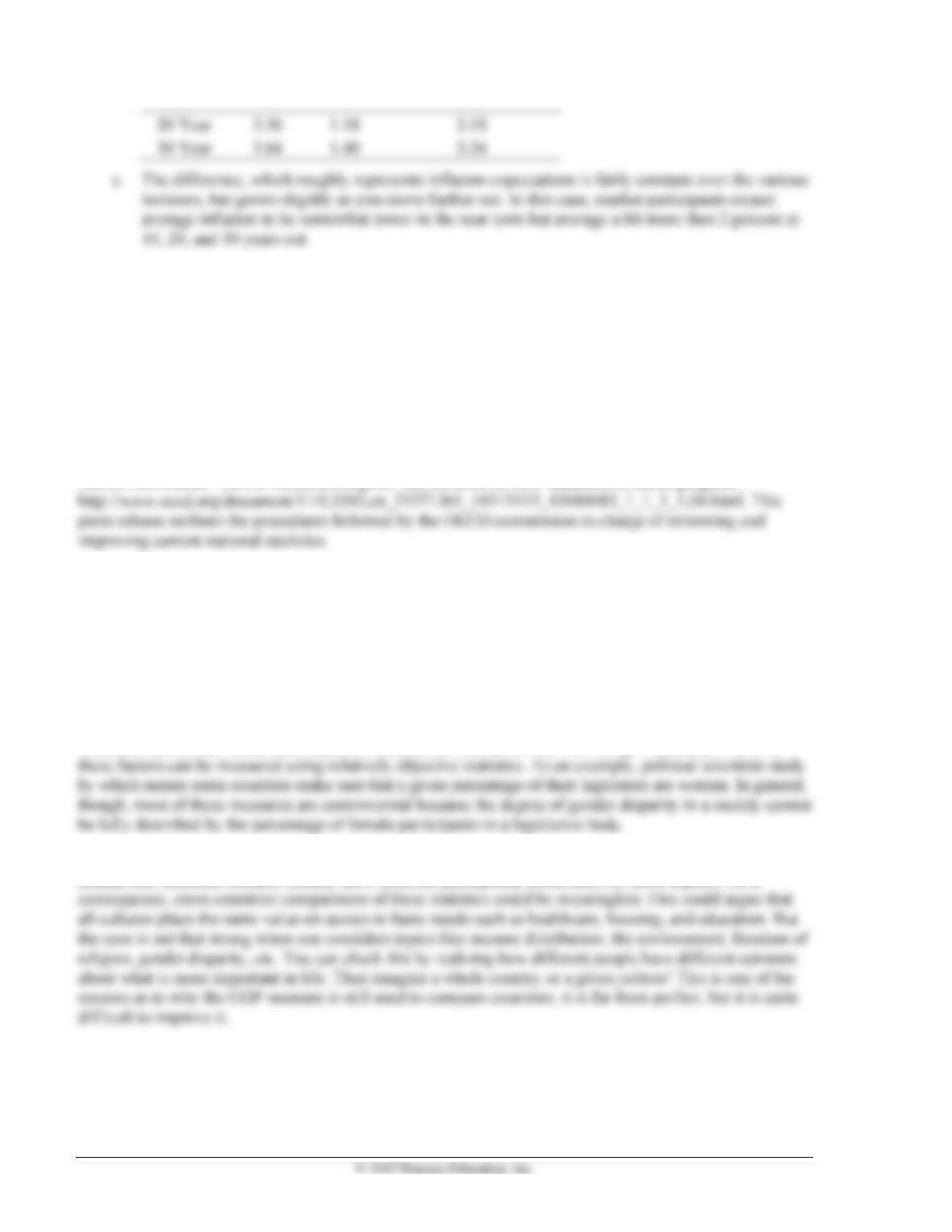
b. The difference between the pairs represents expected inflation over the relevant bond horizon.
Calculations for July 9, 2013, are shown below.
9-Jul-13
Nominal
TIIS
Difference (Inflation
Expectations)
20 Mishkin • Macroeconomics: Policy and Practice, Second Edition
◼ Data Sources, Related Articles, and Discussion Questions
A. For information About Policy and Practice: Can GDP Buy Happiness?
Data Source
The United Nations’ HDI ranking: http://hdr.undp.org/en/statistics/. You can use this resource to compare
the situation of a “Low Human Development” country and a “Very High Human Development” country
(click on the name of a country to obtain the information).
Related Article
OECD Newsroom, “OECD welcomes experts’ call on need for new measures of social progress”:
Discussion Questions
1. Propose alternative factors to be included in a more comprehensive measure of human satisfaction.
How would you suggest these factors should be measured?
2. Suppose national statistics measure other aspects of human life, like gender inequality or access to
freedom of religion. Do you think these statistics can be used to compare countries’ achievements in
these areas? Why or why not?
Answer 1: Alternative factors might include the quality of the environment, gender disparity, domestic
violence, racism, and many other aspects of human life that affect our well-being. Potentially, some of
Answer 2: Even if a national statistic could accurately incorporate (i.e., correctly measure) other aspects of
human life, different cultures usually have different perceptions about most of these aspects. As a
Chapter 2 Measuring Macroeconomic Data 21
B. For information About Policy and Practice: Policy and Overstatements of
the Cost of Living
Data Source
Related Article
Greenspan, Alan, “Bias in the Consumer Price Index”:
Discussion Question
Do you think that the “chained CPI” is a perfect measure of the cost of living? Why or why not?
Answer: Although the “chained CPI” represents an improvement over the standard CPI, it is not a perfect
measure of the cost of living. The “chained CPI” methodology tries to incorporate the fact that individuals
substitute away from more expensive goods when possible. Even if one could argue that this effect is
entirely captured by the “chained CPI” methodology, other aspects of measuring the cost of living are still
left out (e.g., changes in quality).
C. For Information About Unemployment
Data Source
The Bureau of Labor Statistics, “International Labor Comparisons”:
Related Article
Bluestone, Barry, et al., “After the Recovery: Help Needed”:
Discussion Question
According to the BLS, the female (20 years and older) labor force participation rate increased from around
32 percent in the early 1950s to around 60 percent in 2010. Provide alternative explanations for this
phenomenon.
Answer: The female labor force participation rate has been increasing since the early 1950s in the United
States. Many cultural and technological aspects determined this transition: Some claim that WWII helped,
in no small part, to introduce women into the labor market. Some sources assert that the extensive use of
electronic appliances in households freed women’s time and allowed women to participate in the labor