Chapter 19
Investment
◼ Chapter Outline, Overview, and Teaching Tips
Chapter Outline
Data on Investment Spending
The Neoclassical Theory of Investment
Determining the Level of Capital Stock
Inventory Investment
Motivation for Holding Inventories
The Theory of Inventory Investment
Tobin’s q and Investment
Application: Stock Market Crashes and Recessions
Residential Investment
Policy and Practice: U.S. Government Policies and the Housing Market
Chapter 19 Web Appendix: A Model of Housing Prices and Residential Investment
Determination of Housing Prices
Application: Boom and Bust in the Housing Market, 2001-2009
Chapter Overview and Teaching Tips
This chapter continues the discussion of the microeconomic foundations by developing two basic models
Chapter 19 Investment 221
marginal product of capital to the rental cost of capital; second, the rental cost of capital is linked to the
concept of the user cost of capital; and third, showing how the desired level of capital determines investment.
The theory of inventory investment is then described briefly because it is just a variant of the neoclassical
theory, and then the chapter develops Tobin’s q theory. It is important to get across to students that Tobin’s
q theory is completely consistent with neoclassical theory but emphasizes the impact of asset prices on
Student interest given the recent housing boom and bust is so high that teaching a more complete model
that discusses the determination of housing prices and investment can be very interesting. The more
extensive model is described in an online appendix that can be found on the Companion Website at
www.pearsonhighered.com/mishkin. The model on the Website is a combination of the neoclassical model
and Tobin’s q theory, so teaching it also has the advantage of giving students more practice with both
theories. It proceeds step by step, with the neoclassical model being used to show how housing prices are
◼ Answers to End of Chapter Review Questions and Problems
Answers to Review Questions
Data on Investment Spending
1. The three components of investment spending are business fixed investment, which includes
The Neoclassical Theory of Investment
2. The user cost of capital is the expected real cost of using (or renting) a unit of capital over a particular
time period. It is determined by the real price of a unit of capital, the real interest rate (which measures
the interest cost or opportunity cost of the funds used to purchase the unit of capital), the expected
222 Mishkin • Macroeconomics: Policy and Practice, Second Edition
3. The user cost of capital is fixed by the values of the real price of a unit of capital, the real interest
rate, the expected rate of change in the real price of capital, and the depreciation rate. As the capital
stock increases, the expected marginal product of capital diminishes. The desired level of capital is
4. Firms compare their desired level of capital with their current capital stock to determine the change in
their capital stock that will bring it to the desired level. The net investment spending they must undertake
5. The expected marginal product of capital changes when expected future income changes. If total factor
productivity or employment is expected to rise, expected future income rises, firms’ expected marginal
product of capital increases, and the desired levels of capital and investment both go up. When expected
Inventory Investment
6. Firms hold inventories for several reasons. Inventories of raw materials, components, spare parts, and
work in progress are important resources used in the production of goods and services. Holding
inventories of finished goods enables firms to maintain stable flows of production even if their sales
most volatile component of investment spending and plays an important role in business cycles.
Tobin’s q and Investment
7. Tobin’s q is the ratio of the market value of installed capital to the replacement cost of that capital.
For an individual firm, the market value of installed capital is reckoned as the stock market’s
valuation of the firm’s stock. When q is greater than 1, the stock market values the firm more highly
Chapter 19 Investment 223
8. The prediction from Tobin’s q theory that investment will increase when stock prices rise is reflected
in the neoclassical prediction that investment will increase when expected profits from adding capital
Residential Investment
9. There are four determinants of residential investment. A rise in mortgage rates raises the user cost of
housing and, hence, lowers the desired residential capital stock and residential investment. A rise in
10. The U.S. government has given tax preferences to encourage home ownership by allowing tax
deductibility of mortgage interest payments. It has also encouraged home ownership by establishing
Answers to Problems
The Neoclassical Theory of Investment
1. a. User cost for construction equipment = $600,000 (0.05 – 0 + 0.10) = $90,000
2.
224 Mishkin • Macroeconomics: Policy and Practice, Second Edition
3. a. Everything else the same, easing monetary policy implies lower real interest rates, which results
in a decrease in the user cost of capital. The decrease in the user cost of capital translates into a
4. The Obama administration announced an investment tax credit as a part of a more comprehensive
plan (the American Recovery and Investment Act of 2009) to encourage investment and employment
in the United States during the 2007–2009 crisis. An investment tax credit of 30 percent is applied to
5. Less-developed financial systems often result in more difficult access to funds for firms that want to
increase their capital stock. The relative inefficiency of developing countries’ financial systems usually
arises from improperly designed property rights and the prevalence of asymmetric information problems.
6. a. New or stricter regulations that ask for tighter controls or enhanced security usually result in
more expensive drilling operations. Everything else the same, the user cost of capital increases,
Inventory Investment
7. Private inventories did not change by much during the first quarters of 2007. As the subprime
financial crisis affected the economy and firms observed a decline in the demand for their products,
production fell and companies decreased their inventories of finished goods and raw materials at a
relatively low pace. (Change in inventories was still positive for some time, as firms could not sell
Chapter 19 Investment 225
Tobin’s q and Investment
8. The doubling of stock prices raised the market value of firms relative to the replacement cost of
Residential Investment
9. The recent trend of single-person households can be interpreted as an increase in the demand for
housing, as more individuals demand housing. In the short run, the increase in housing demand
10. An increase in real interest rates would increase the user cost of residential investment, and so the
desired stock of residential housing would fall, leading to a decline in residential investment.
◼ Answers to Data Analysis Problems
1. a. Inventory investment for 2013:Q2 equals total investment minus business fixed investment minus
residential investment, which is $66.65 billion; thus, there was a net increase in inventories for
the quarter.
b. From 2000:Q1 to 2013:Q2, the average share of inventory investment is 1.22 percent. Although
2. a. For 2013:Q2, net investment is $594.1 billion, and gross investment is $3,225.2 billion. The two
are not equal, as the difference represents the amount of capital depreciation. There is a
3. a. Between 2012:Q2 and 2013:Q2, the average mortgage rate decreased from 3.80 percent to 3.69
percent; during this same period, residential investment increased from $425.7 billion to $513
billion, an increase of 20.5 percent. This is sensible because lower mortgage rates should
decrease the user cost of capital and thereby increase residential investment.
226 Mishkin • Macroeconomics: Policy and Practice, Second Edition
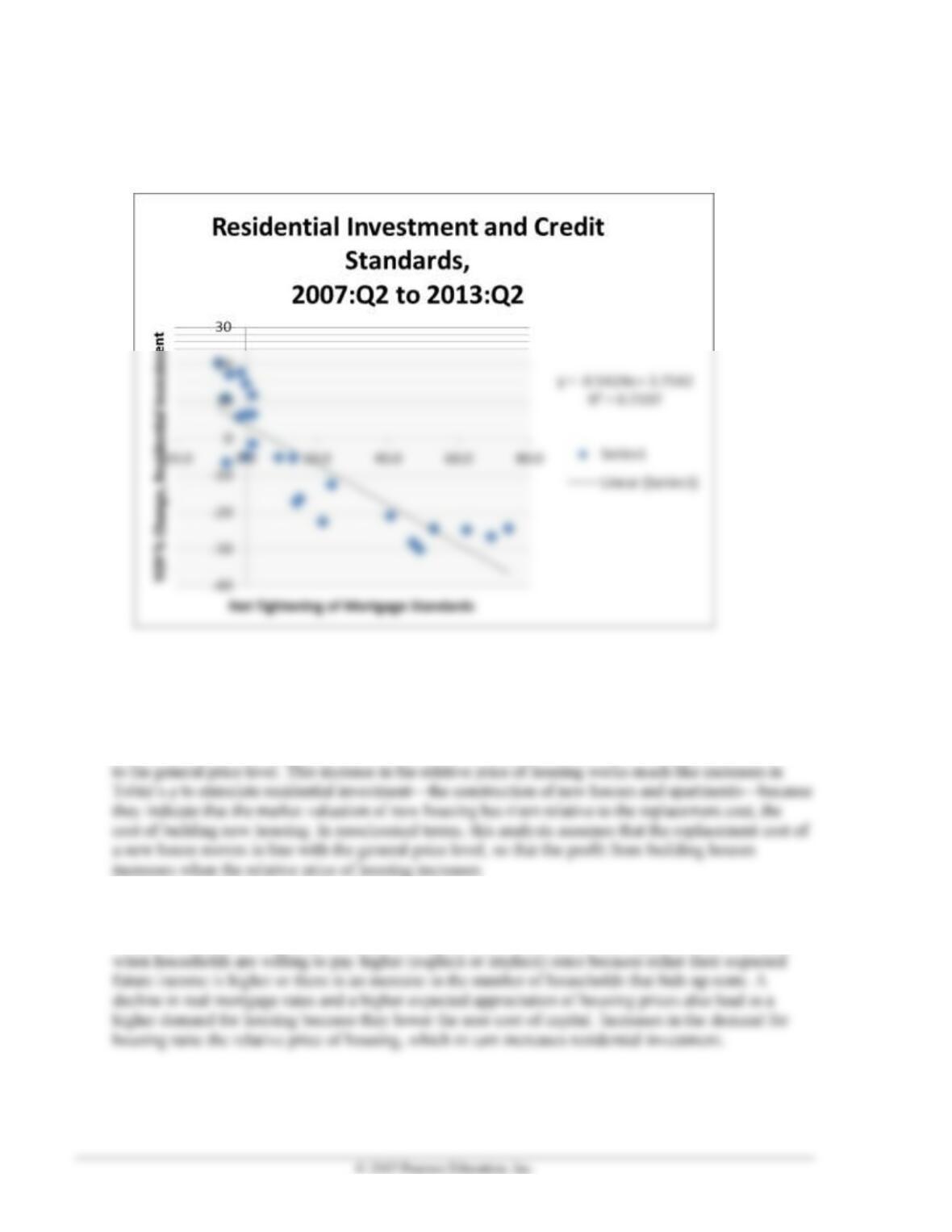
c. See scatterplot below. The fitted equation is %ΔRI = –0.5424NT + 3.7542, with a reasonably
good fit to the data as R2 = 0.71. For every 10 percentage point increase (tightening) of credit
standards (NT), residential investment growth (%ΔRI) is predicted to decrease by about 5.4
percentage points.
◼ Answers to Review Questions and Problems in Web Appendix, “A
Model of Housing Prices and Residential Investment”
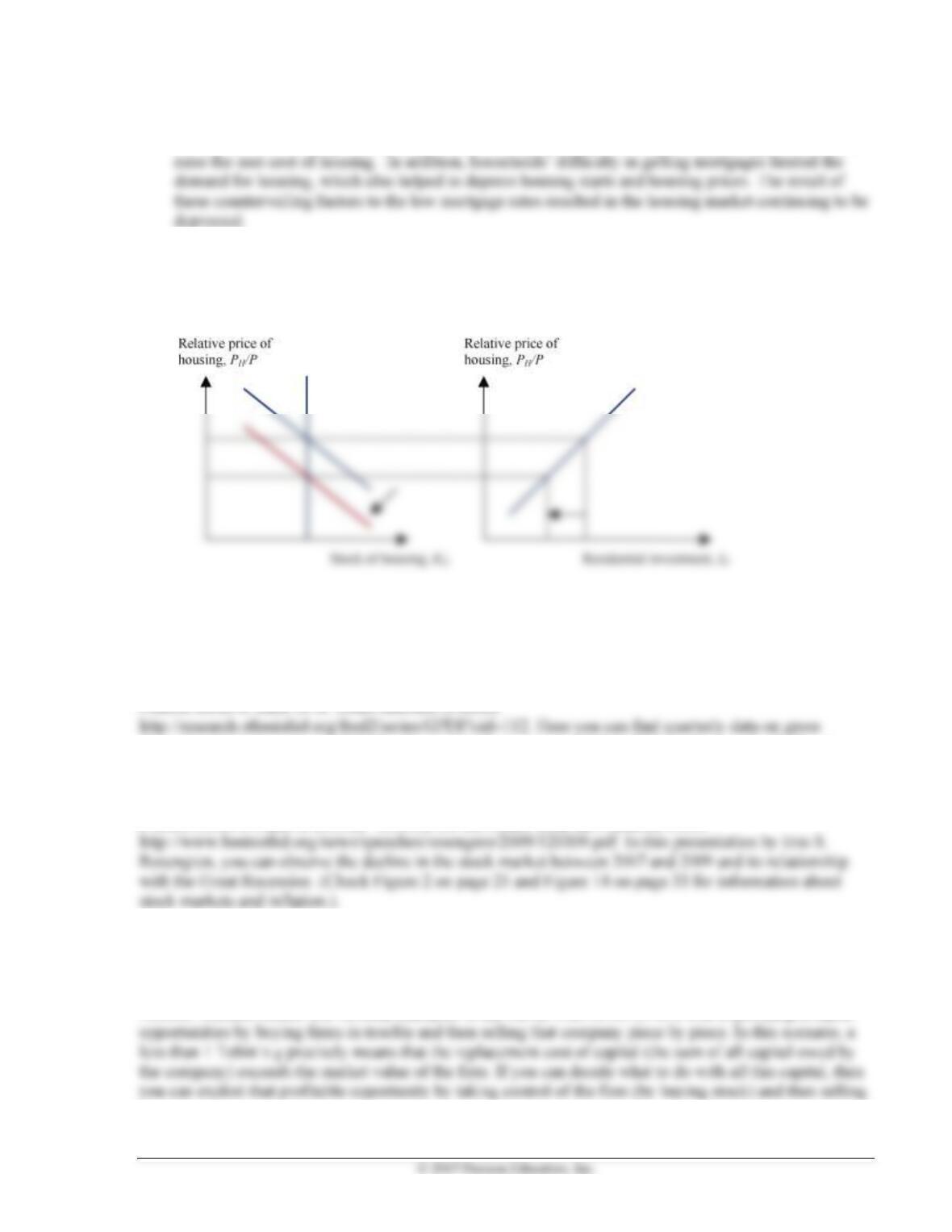
1. At any given time, the existing stock of houses is fixed, and fluctuations in housing prices result from
fluctuations in demand. Increases in the demand for housing cause the price of housing to rise relative
2. The neoclassical theory of investment provides the answers here. In neoclassical theory, the desired
level of capital depends on the expected marginal product of capital and the user cost of capital.
When the expected marginal product of housing rises, the demand for housing increases. This occurs
Chapter 19 Investment 227
3. The positive effect on housing prices and housing starts of low mortgage rates, which would lower
the user cost of housing, was offset by concerns that housing prices might keep falling which would
4. An increase in real interest rates increases the user cost of residential investment and, therefore,
decreases the demand for housing. Graphically, the demand curve shifts to the left, and the new
equilibrium point determines a lower relative price of housing. In turn, residential investment
decreases as the relative price of housing decreases.
◼ Data Sources, Related Articles, and Discussion Questions
A. For Information About Application: Stock Market Crashes and Recessions
Data Source
Federal Reserve Bank of St. Louis database (FRED):
domestic private investment. Edit the observation date range to 2006 to 2010 to observe the decline in
gross domestic private investment in that period.
Related Article
Federal Reserve Bank of Boston, “Lessons for the Future from the Financial Crisis”:
Discussion Question
Suppose that Tobin’s q for a given company is currently less than 1. What would you do if you were
Gordon Gekko?
Answer: Gordon Gekko is a fictional character in the movie Wall Street (1987) who exploited profitable
228 Mishkin • Macroeconomics: Policy and Practice, Second Edition
B. For Information About Policy and Practice: U.S. Government Policies and
the Housing Market
Data Source
find a lot of information about the Obama administration’s home ownership policy.
Related Article
Washington Times, “Cover story: Buying home still American dream” (11/22/2010):
Discussion Questions
Besides being part of the “American Dream,” as some claim, what are the other benefits of becoming a
homeowner? Are these reasons enough to justify government policies to promote home ownership?
Answer: Although having one’s own home might well be the most important reason individuals choose to
C. For Information About Application: Boom and Bust in the Housing Market,
2001–2009
Data Source
S&P Case/Shiller Housing Price Index: http://us.spindices.com/index-family/real-estate/sp-case-shiller
Here you can find the index and year-to–year changes in housing prices in the United States during the
2000s.
Related Article
Board of Governors of the Federal Reserve System, “A View from the Federal Reserve Board: The
Mortgage Market and Housing Conditions”:
Discussion Question
The Federal Reserve lowered the federal funds rate target to near zero in late 2008 and maintained that
target until late 2010. This lowered mortgage rates but did not spur an increase in residential investment.
Using the neoclassical theory of investment, explain why this decrease in mortgage rates did not result in
increased residential investment.

Chapter 19 Investment 229
Answer: Even if mortgage rates were low during 2008–2010, residential investment did not increase at the