CHAPTER 19
INTERNATIONAL TRADE
In this chapter, you will find:
Learning Outcomes
Chapter Outline with PowerPoint Script
Chapter Summary
Teaching Points (as on Prep Card)
Solutions to Problems Appendix
Experiential Assignments
INTRODUCTION
The first half of this chapter considers comparative advantage and the gains from international trade. Once
the gains from trade are discussed, the second half of the chapter examines trade restrictions, the welfare
loss imposed on the economy, and the reasons for restrictions to persist. A theme of this chapter is that the
LEARNING OUTCOMES
19-1 Outline the gains from trade, and explain why countries might still decide to trade even if no
country has a comparative advantage.
The law of comparative advantage says that the individual with the lowest opportunity cost of produc-
ing a particular good should specialize in that good. Just as individuals benefit from specialization
19-2 Explain how trade restrictions harm an economy, and why they persist.
Market exchange usually generates a surplus, or a bonus, for both consumers and producers. Gov-
ernments try to regulate surpluses by imposing tariffs (either specific or ad valorem) and
19-3 Identify international efforts to reduce trade barriers.
Trade restrictions impose a variety of strains on the economy besides the higher costs to consumers,
so countries have worked to create free trade agreements and common markets to reduce or eliminate
19-4 Summarize five arguments often used to justify trade restrictions, and describe some unintended
consequences of protecting certain industries from international competition.
Arguments used by producer groups to support trade restrictions include promoting national defense,
nurturing infant industries, preventing foreign producers from dumping goods in domestic markets,
protecting domestic jobs, and allowing declining industries time to wind down and exit the market.
by other countries in retaliation.
CHAPTER OUTLINE WITH POWERPOINT SCRIPT
USE POWERPOINT SLIDES 2-5 FOR THE FOLLOWING SECTION
The Gains from Trade: Each country specializes in making goods with the lowest opportunity cost.
A Profile of Exports and Imports: U.S. exports of goods and services amounted to 14% of GDP in 2012.
USE POWERPOINT SLIDES 6-8 FOR THE FOLLOWING SECTION
Production Possibilities Without Trade: Without international trade, a country’s production possibilities
equal its consumption possibilities.
USE POWERPOINT SLIDES 9-11 FOR THE FOLLOWING SECTION
Consumption Possibilities Based on Comparative Advantage: According to the law of comparative
USE POWERPOINT SLIDES 12-14 FOR THE FOLLOWING SECTION
Reasons for International Specialization
• Differences in Resource Endowments: Countries export products they can produce more cheaply in
USE POWERPOINT SLIDES 15-23 FOR THE FOLLOWING SECTION
Trade Restrictions and Welfare Loss
Consumer Surplus and Producer Surplus from Market Exchange: Market exchange usually generates
a surplus, or a bonus, for both consumers and producers.
Tariffs: Taxes on imports—either specific, such as $5 per barrel of oil—or ad valorem—a percentage of
Chapter 19 International Trade 259
Tariffs and Quotas Compared: The primary difference between tariffs and quotas is the revenues.
Revenues from tariffs go to the government; revenues from quotas go to whomever secures the right to sell
foreign goods in U.S. markets. If quota rights accrue to foreigners, then the domestic economy is worse off
with a quota than with a tariff.
Other Trade Restrictions: Export subsidies, low-interest loans to foreign buyers, domestic content
requirements restrict free trade.
USE POWERPOINT SLIDES 24-25 FOR THE FOLLOWING SECTION
Freer Trade by Multilateral Agreement
• General Agreement on Tariffs and Trade (GATT): An international trade treaty adopted in 1947
USE POWERPOINT SLIDES 26-27 FOR THE FOLLOWING SECTION
Common Markets: Free trade agreements among countries, such as the European Union and NAFTA.
USE POWERPOINT SLIDES 28-31 FOR THE FOLLOWING SECTION
Arguments for Trade Restrictions: These arguments support domestic producers but lead to a loss
in social welfare. Some make more sense than others
National Defense Argument: Protection from import competition because domestic output is vital for
USE POWERPOINT SLIDE 32 FOR THE FOLLOWING SECTION
Problems with Trade Protection:
• Protecting one stage of production may require protecting downstream stages.
• The cost of protection includes the resulting welfare loss AND the cost of resources used to seek
CHAPTER SUMMARY
Even if a country has an absolute advantage in all goods, that country should specialize in producing the
goods in which it has a comparative advantage. If each country specializes and trades according to the law
Chapter 19 International Trade 260
barriers. Subsequent negotiations lowered tariffs and reduced trade restrictions. The Uruguay Round,
ratified in 1994, lowered tariffs, phased out quotas, and created the World Trade Organization (WTO) as
the successor to GATT. The Doha Round was launched in 2001 but failed to reach an agreement as of
2011.
Arguments used by producer groups to support trade restrictions include promoting national defense,
TEACHING POINTS
1. While this chapter contains potentially difficult material, most students are interested in interna-
tional trade and the topic can lead to fruitful classroom discussion.
2. Although the principle of comparative advantage may have made sense to students when you dis-
cussed the importance of specialization and trade in the context of the production possibilities fron-
tier, the emotional elements surrounding the discussion of trade and trade barriers may cause students
3. The text discusses tariffs and quotas as well as their impacts. Exhibits 7 and 8 are very useful in
illustrating these concepts. The principal difference between tariffs and quotas is that tariffs
4. Emphasize that trade restrictions impose a variety of strains on the economy besides the higher
costs to consumers. These include (1) the need to protect downstream stages of production as well,
(2) expenditures made by favored domestic industries to seek and perpetuate trade protection, (3)
SOLUTIONS TO PROBLEMS APPENDIX
1. (Trade Without Comparative Advantage) Even if neither country had a comparative ad-
vantage, why might these countries still experience gains from trade?
Chapter 19 International Trade 261
Just as individuals benefit from specialization and exchange, so do states and, indeed, na-
2. (Comparative Advantage) Suppose that each U.S. worker can produce 8 units of food or 2 units
of clothing daily. In Fredonia, which has the same number of workers, each worker can produce
7 units of food or 1 unit of clothing daily. Why does the United States have an absolute
advantage in both goods? Which country enjoys a comparative advantage in food? Why?
The United States has an absolute advantage because a single worker can produce more of both
3. (Comparative Advantage) The consumption possibilities frontiers shown in the following
exhibit [Exhibit 4] assume terms of trade of 1 unit of clothing for 1 unit of food. What would the
consumption possibilities frontiers look like if the terms of trade were 1 unit of clothing for 2
units of food?
As the “price” of clothing increases from 1 unit of food to 2 units of food, the U.S. consumption
4. (Reasons for International Specialization) What determines which goods a country should
produce and export?
One determinant of specialization is a country’s resource endowments. Countries with a relative
abundance of skilled labor and sophisticated capital should specialize in high-technology
manufactured goods. Those with a relative abundance of unskilled or semiskilled labor should
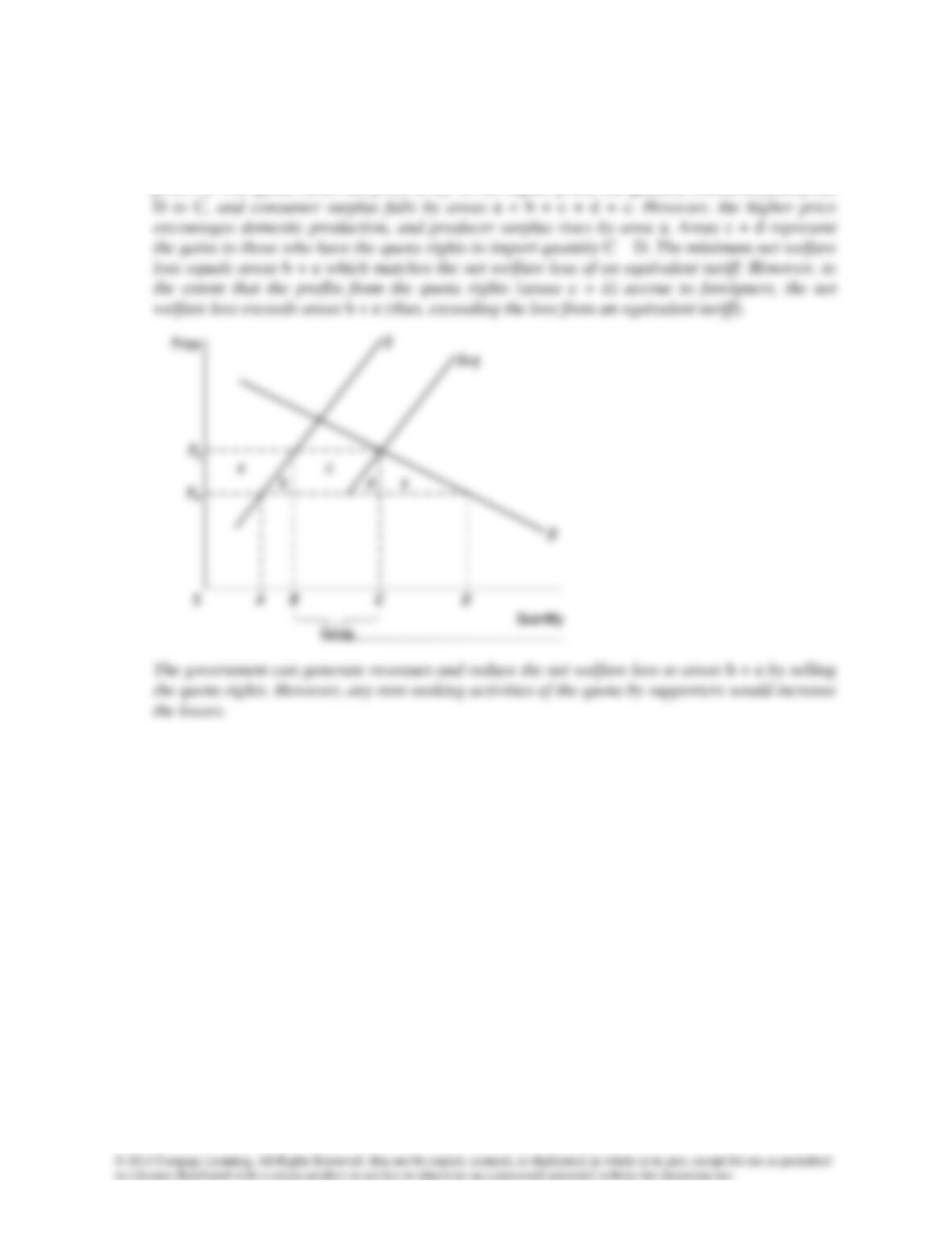
5. (Import Quotas) How low must a quota be in effect to have an impact? Using a demand-and-
supply diagram, illustrate and explain the net welfare loss from imposing such a quota. Under
what circumstances would the net welfare loss from an import quota exceed the net welfare loss
from an equivalent tariff (one that results in the same price and import level as the quota)?
Chapter 19 International Trade 262
An effective import quota holds imports below the level that would occur with free trade. In the
following graph S + q represents domestic supply (S) plus the quota. The horizontal distance
between S and S + q equals the amount of the quota. With free trade, the price equals the world
price Pw. The quota raises the price to Pq. At the higher price, the quantity consumed falls from
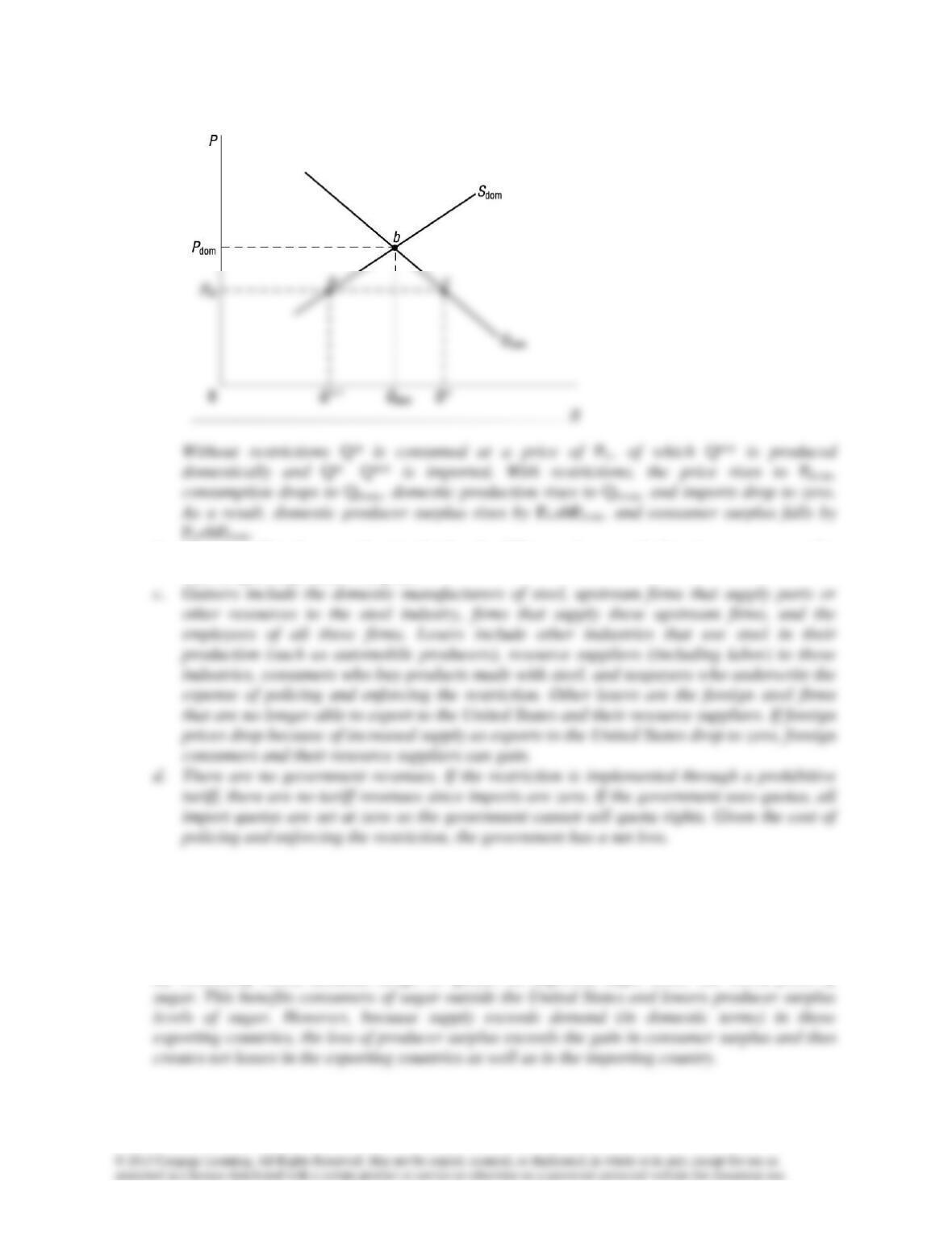
6. (Trade Restrictions) Suppose that the world price for steel is below the U.S. domestic price, but
the government requires that all steel used in the United States be domestically produced.
a. Use a diagram like the one that follows to show the gains and losses from such a policy.
b. How could you estimate the net welfare loss (deadweight loss) from such a diagram?
c. What response to such a policy would you expect from industries (like automobile
producers) that use U.S. steel?
d. What government revenues are generated by this policy?
Chapter 19 International Trade 263
a.
b. The net welfare loss equals triangle abc, the difference between the loss in consumer surplus
and the gain in producer surplus.
7. (Trade Restrictions) The previous three graphs [Exhibits 7 and 8] show net losses to the
economy of the country that imposes tariffs or quotas on imported sugar. What kinds of gains
and losses would occur in the economies of countries that export sugar?
By restricting world demand, tariffs or quotas on imported sugar lower the world price of
Chapter 19 International Trade 264
8. (The World Trade Organization) What is the World Trade Organization (WTO) and how does it
help foster multilateral trade? (Check the WTO website at http://www.wto.org/.)
The World Trade Organization is the legal and institutional body for collective debate about
international trade and restrictions among its more than 150 member countries. It provides
9. (Arguments for Trade Restrictions) Explain the national defense, declining industries, and infant
industry arguments for protecting a domestic industry from international competition.
The national defense argument claims that certain industries need protection because their
output is necessary during war. Military considerations require the existence of a domestic
of scale.
10. (Arguments for Trade Restrictions) Firms hurt by cheap imports typically argue that restricting
trade will save U.S. jobs. What’s wrong with this argument? Are there ever any reasons to
support such trade restrictions?
The chief problems with this argument are that jobs saved by import protection are likely to be
Experiential Exercises
1. Send your students to the Office of the U.S. Trade Representative at http://www.ustr.gov/. The U.S.
Trade Representative is a cabinet member who acts as the principal trade advisor, negotiator, and
spokesperson for the president on trade and related investment matters. Have them read some of the

Chapter 19 International Trade 265
most recent press releases. What are some of the trade-related issues the United States is currently
facing?
2. The Wall Street Journal is one of the world’s best sources of information regarding international
trade—the International page is inside the first section of each day’s edition. Ask students to find