CHAPTER 19 | The International Financial
System
Brief Chapter Summary and Learning Objectives
19.1 Exchange Rate Systems (pages 1046–1047)
Describe how different exchange rate systems operate.
19.2 The Current Exchange Rate System (pages 1047–1059)
Discuss the three key features of the current exchange rate system.
19.3 International Capital Markets (pages 1059–1061)
Discuss the growth of international capital markets.
▪ A key reason that exchange rates fluctuate is that investors seek out the best investments
they can find anywhere in the world.
Appendix: The Gold Standard and the Bretton Woods System (pages 1066–1071)
Explain the gold standard and the Bretton Woods system.
Key Terms
Euro, p. 1047. The common currency of many
European countries.
Managed float exchange rate system, p. 1046.
The current exchange rate system, under which
the value of most currencies is determined by
466 CHAPTER 19 | The International Financial System
Quota, p. 1049. A numerical limit that a
Tariff, p. 1049. A tax imposed by a government
Key Terms—Appendix
Bretton Woods system, p. 1067. An exchange
rate system that lasted from 1944 to 1973, under
International Monetary Fund (IMF), p. 1067.
An international organization that provides
Chapter Outline
Bayer Uses a Weak Euro to Increase Sales
Although most people know the German firm Bayer for its aspirin, the company sells a variety of
pharmaceutical and agricultural products in Latin America, North and South America, Europe and Asia.
19.1
Exchange Rate Systems (pages 1046–1047)
Learning Objective: Describe how different exchange rate systems operate.
Some countries allow their exchange rates to be determined by demand and supply. A floating currency
is the outcome of a country allowing its currency’s exchange rate to be determined by demand and
supply. An exchange rate system is an agreement among countries about how exchange rates should be
CHAPTER 19 | The International Financial System 467
A conference was held in Bretton Woods, New Hampshire, in 1944 to set up an exchange rate system in
which the United States pledged to buy or sell gold at a fixed price of $35 per ounce. The central banks of
Extra Solved Problem 19.1
To Some, Stones Are as Good as Gold
In 1903, anthropologist William Henry Furness visited the tiny island of Yap in Micronesia. He wrote a
book titled The Island of Stone. Famed economist Milton Friedman quoted passages from Furness’ work
in his own book, Money Mischief, that described Yap’s unusual monetary system. Because the island had
no metal to fashion coins, islanders used stone wheels called fei as their medium of exchange. The fei
were too large to move easily, so the natives were content to merely acknowledge that ownership had
been transferred after a transaction had been conducted, and the fei remained on the former owner’s
premises.
Friedman recounted Furness’ explanation of how the German government, which took possession of Yap
from Spain in 1898, used a “fine” to coax the natives to repair paths used for transportation between
Solving the Problem
Step 1: Review the chapter material.
This problem is about different exchange rate systems, so you may want to review the section
“Exchange Rate Systems,” which begins on page 1046 in the textbook.
Step 2: How did Yap’s “stone standard” resemble the gold standard?
Friedman explained the similarity between the two standards in the following passage from
his book, Money Mischief:
468 CHAPTER 19 | The International Financial System
Extra Making
the
Connection
The Canadian Province of...Arizona?
In 2011, there seemed to be a lot of Canadians buying houses in Phoenix and other cities in Arizona. For
many years, some Canadians have found buying a second home in Arizona or Florida a good way to
In late 2001, it took 1.60 Canadian dollars to purchase 1 U.S. dollar. So, a Canadian purchasing a house in
Phoenix priced at $125,000 would have had to pay $200,000 in Canadian dollars. In the summer of 2011,
it took only 0.95 Canadian dollars to purchase 1 U.S. dollar. The stronger Canadian dollar meant that a
Canadian could now purchase a house in Phoenix priced at $125,000 for only $118,750 in Canadian
In addition to individual Canadians looking to buy second homes in Arizona, some Canadian investors
bought multiple properties, hoping to resell them for a profit in the future after local housing prices had
risen and after the value of the U.S. dollar had increased relative to the Canadian dollar. Some Canadian
manufacturers also shifted operations to the United States. For example, E.H. Price, a firm that produces
ventilation systems for commercial buildings and is headquartered in Winnipeg, Canada, doubled the size
Teaching Tips
The end of the chapter in the main text includes a special category of exercises titled Real-Time Data
Exercises. These exercises help students become familiar with a key data source, learn how to locate data,
and develop skills in interpreting data. Those exercises marked with a red circle allow students and
CHAPTER 19 | The International Financial System 469
19.2
The Current Exchange Rate System (pages 1047–1059)
Learning Objective: Discuss the three key features of the current exchange rate system.
The current exchange rate system has three features:
1. The United States allows the dollar to float against other major currencies.
A. The Floating Dollar
Since 1973, the value of the U.S. dollar has fluctuated widely against other major currencies.
B. What Determines Exchange Rates in the Long Run?
In the short run, the two most important causes of exchange rate movements are changes in interest rates
and changes in investors’ expectations about the future values of currencies. Purchasing power parity is
the theory that in the long run exchange rates move to equalize the purchasing powers of different
The four determinants of exchange rates in the long run are:
1. Relative price levels
2. Relative rates of productivity growth
C. The Euro
Most countries in Western Europe have adopted a single currency. By 2015, 28 countries had joined the
European Economic Community, which was renamed the European Union (EU) in 1991. On
control the domestic monetary policies of independent countries.
D. Pegging against the Dollar
Some developing countries have attempted to keep their exchange rates fixed against the dollar or another
major currency. When the exchange rate is fixed, business planning becomes much easier. In the
1980s and 1990s an additional reason developed for having fixed exchange rates. During those decades,
470 CHAPTER 19 | The International Financial System
Pegging refers to a policy by which a country keeps fixed the exchange rate between its currency and
another country’s currency. When a developing country has pegged the value of its currency against the
Extra Making
the
Connection
Spain’s Economy Shows Benefits, Risks of the Euro
Adopting the euro as its currency resulted in low real interest rates and rapid economic growth in Spain in
the first years of the twenty-first century. In fact, the short-term nominal interest rate in Spain, set by the
Spain’s experience underscored the downside of using a currency union that has a monetary policy that
affects many countries, each of which has its own sovereign government and economy. While countries
like Spain and Italy ran trade deficits, Germany and the Netherlands racked up large trade surpluses.
“There is a serious risk that the growth prospects of struggling euro-zone economies will be handicapped
for many years by their inflexibility and the external surpluses of other euro-zone member states,” noted
Simon Tilford, chief economist at the Center for European Reform. “If so, investors will lose confidence
in the credit-worthiness of governments and firms in these countries, leading to a dramatic increase in
their borrowing costs.”
Tilford added that there were three resolutions to the debt crisis:
1. The euro zone countries could move to a full political union.
CHAPTER 19 | The International Financial System 471
Extra Making
the
Connection
Can the Euro Survive?
The euro was first introduced as a currency in 2002. The period from then until the beginning of the
global economic downturn in 2007 was one of relative economic stability in most of Europe. With low
interest rates, low inflation rates, and expanding employment and production, the advantages of the euro
By 2008, however, the global recession was gathering force, and some economists and policymakers
questioned whether the euro was making the recession worse. The countries using the euro cannot pursue
independent monetary policies because the ECB from its headquarters in Frankfurt, Germany, determines
those policies. Countries that were particularly hard hit by the recession—for example, Spain, where the
unemployment rate had more than doubled to 18 percent by 2009 and was nearly 27 percent in 2013—
were unable to pursue a more expansionary policy than the ECB was willing to implement for the euro
zone as a whole. Similarly, countries could not attempt to revive their exports by allowing their currencies
to depreciate because (1) most of their exports were to other euro zone countries, and (2) the value of the
euro was determined by factors affecting the euro zone as a whole.
Problems in the euro zone were made worse by a sovereign debt crisis that developed in 2010. Sovereign
debt refers to bonds issued by a government. The recession of 2007–2009 caused large increases in
government spending and reductions in tax revenues in a number of European countries, particularly
Greece, Ireland, Spain, Portugal, and Italy. Their governments paid for the resulting budget deficits by
issuing government bonds. By the spring of 2010, many investors had come to doubt the ability of
472 CHAPTER 19 | The International Financial System
countries hit hardest by the recession, particularly Spain and Ireland, were suffering from the bursting of
housing bubbles. More expansionary monetary policies or depreciating exchange rates were unlikely to
result in economic recovery until the effects of the collapse in residential construction had run its course.
So, it was unclear that the constraints imposed by the euro were holding back recovery in Europe. Finally,
Question
Jordi Galí, an economist at the Universitat Pompeu Fabra in Spain, noteed that the Spanish economy was
in recession during the early 1990s, but that “in 1992 and 1993 a series of [exchange rate] devaluations
got us out of trouble.” Was Spain able to use exchange rate devaluations to deal with the recession of
2007–2009? Briefly explain.
Answer
Spain was not able to use exchange rate devaluations to deal with the recession of 2007–2009 because
Spain now uses the euro as its currency. The value of the euro is determined by factors affecting the euro
No country may have been more severely affected by the global financial crisis of 2007–2009 than
Iceland. Although a country with a population of only 300,000 and a GDP smaller than that of Jamaica or
Estonia, Iceland temporarily played an important role in the global financial system during the mid-2000s.
In 2006, at the height of the worldwide housing bubble, Iceland’s two largest banks began to accept
online deposits from households and firms outside of the country. Having accepted billions of dollars in
foreign deposits, Icelandic banks used them to make loans in Iceland and elsewhere in Europe, often to
finance housing. By 2007, Icelandic banks had made loans equal to nine times the country’s GDP.
CHAPTER 19 | The International Financial System 473
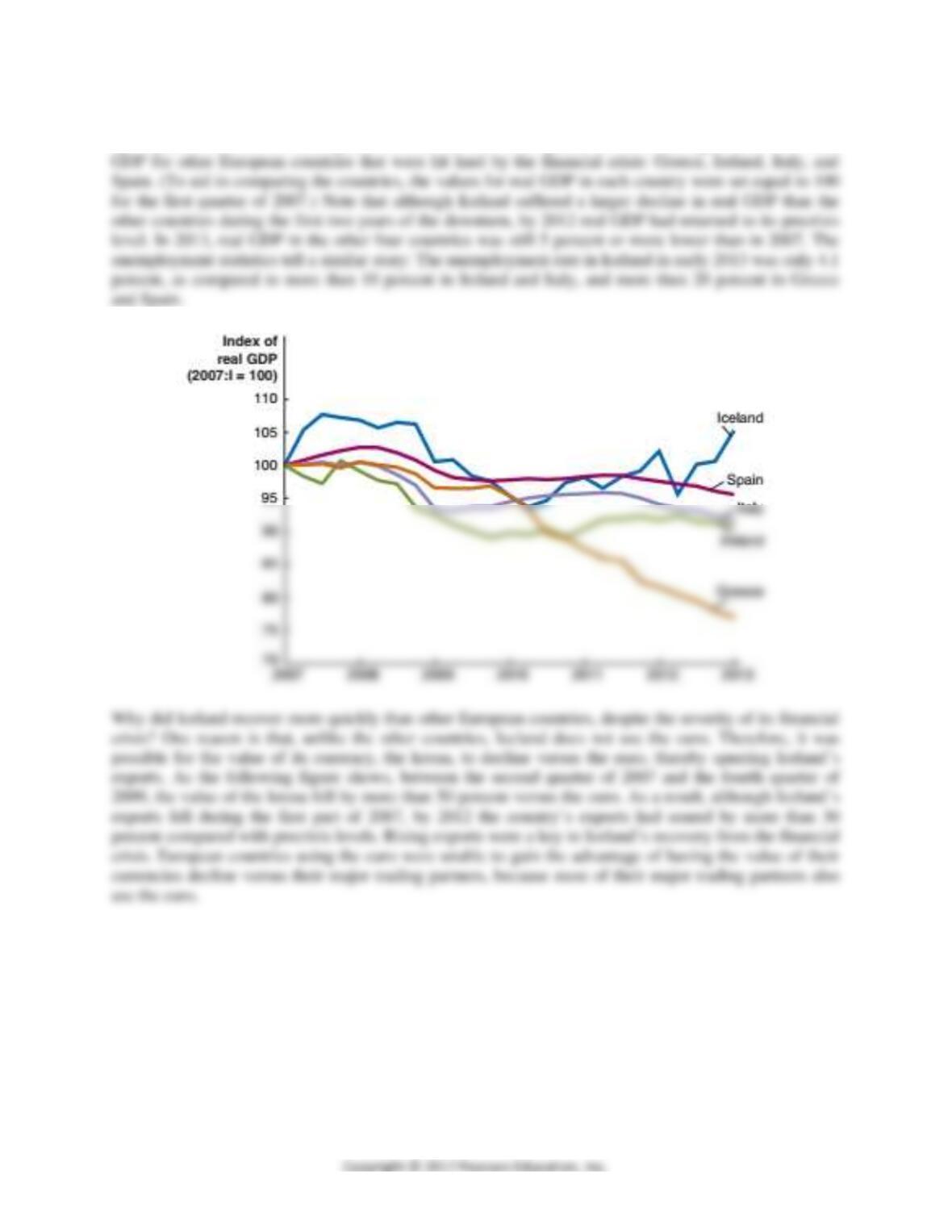
The following figure shows the results of the devastating financial collapse. Real GDP declined in Iceland
by 13 percent between the third quarter of 2007 and the fourth quarter of 2010. The figure also shows real
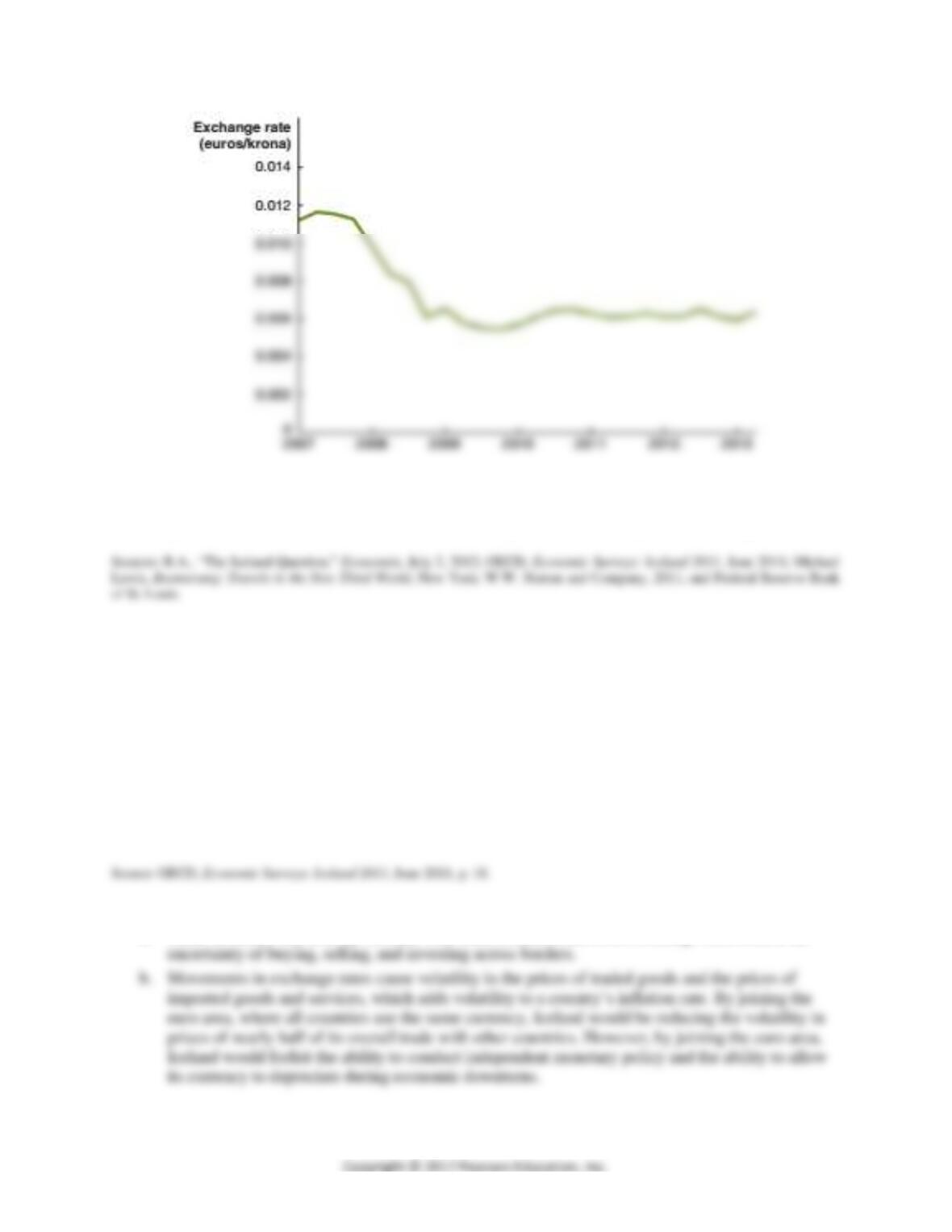
474 CHAPTER 19 | The International Financial System
As we have seen, there are advantages to countries using the euro, and in 2013 Iceland was still
considering whether it should abandon the krona and enter the euro zone. But Iceland’s experience
following the financial crisis shows that a flexible exchange rate can have important advantages.
Question
A report from the Organization for Economic Cooperation and Development (OECD) notes that: “Iceland
appears to have the smallest independent, floating currency in the world. Other countries the size of
Iceland either do not have their own currency (Estonia, Luxembourg, Malta) or peg their currency to that
of another country (Barbados, Bahamas, Belize, Brunei, Latvia, Lithuania, Maldives, Netherlands
Antilles).”
a. Why might small countries decide to not allow their currencies to float?
b. The report also noted that: “Joining the euro area would significantly lower the volatility of
traded good prices and lower overall inflation volatility as nearly half of Iceland’s external trade
is with countries in the euro area or pegged to it.” Why would joining the euro area have these
effects? Are there any reasons why Iceland might not want to join the euro area?
Answer
a. Small countries rely heavily on trade with other countries and fixed exchange rates reduce the
CHAPTER 19 | The International Financial System 475
19.3
International Capital Markets (pages 1059–1061)
Learning Objective: Discuss the growth of international capital markets.
One important reason exchange rates fluctuate is that investors seek out the best investments they can find
anywhere in the world. Shares of stock and long-term debt are bought and sold on capital markets.
Before 1980, most U.S. investors rarely invested in foreign capital markets. In the 1980s and 1990s,
European governments removed many restrictions on foreign investments in their financial markets.
Improvements in communications and technology have made it possible for U.S. investors to receive
better and more timely information about foreign firms and for foreign investors to receive better
information about U.S. firms.
Extra Making
the
Connection
In Black Markets Traders Still Like Dollars
Although low interest rates and large government budget deficits have made the U.S. dollar less attractive
to foreign investors in recent years, there is one market where the dollar has maintained its popularity:
black markets in developing countries. “The U.S. dollar is losing value, but not here in Vietnam,” said Vu
Manh Quynh, who regularly exchanges dong for dollars in Hanoi. “Vietnamese people still keep U.S.
dollars and gold.”
There are no official records of trading volume in the murky black market world, but an estimated
$600 billion worth of U.S. notes is held outside the United States, much of it in countries that have tight
476 CHAPTER 19 | The International Financial System
Extra Economics in Your Life:
Exchange Rates and Your Income
Question: Suppose that you work for a computer company. Because the firm has an office in Germany,
you are asked to move there and work for a two-year period. Your employer gives you the option to
receive pay either in dollars or in euros. Which payment option is better for you? What factors should
affect your decision?
Answer: Because you will be working in Germany for a two-year period, you will need euros in order to