Chapter 19
GOVERNMENT IN THE MARKET ECONOMY
QUESTIONS & ANSWERS
Q19.1 Air pollution costs the U.S. billions of dollars per year in worker absenteeism,
healthcare, pain and suffering, and loss of life. Discuss some of the costs and benefits of
a Pigou tax on air pollution.
Q19.1 ANSWER
Proponents of Pigou taxes argue that they can improve the allocation of resources by
forcing producers and consumers to pay the full costs of production. Advocates of such
taxes sometimes go further and argue that revenues from Pigou taxes could be used to
Q19.2 What role does the price elasticity of demand play in determining the short-run effects of
regulations that increase fixed costs? What if they lead to increased variable costs?
Q19.2 ANSWER
For a profit maximizing firm, a change in fixed costs does not alter the optimal short-run
Q19.3 What is the essential difference between public and private goods? Give some examples
of each and some examples of goods and services that involve elements of both.
Government in the Market Economy 589
Q19.3 ANSWER
If the consumption of a product by one individual does not reduce the amount available
for others, the product is referred to as a public good. Once public goods are provided
The distinguishing characteristic of public goods is the concept of nonrival
consumption. In the case of public goods, use by certain individuals does not reduce
The concept of nonrival consumption must be distinguished from the nonexclusion
concept. A good or service is characterized as nonexclusionary if it is impossible or
consumption would not be provided in the optimal amount by the private sector.
Health-care is a good example of a service that embodies elements of both public
and private goods. Inoculations prevent the spread of communicable disease, and can be
Q19.4 In the 1880s, cattlemen in the American West crowded more and more animals onto
common grazing land to feed a growing nation. Cattlemen contended, “None of us
knows anything about grass outside of the fact that there is lots of it, and we aim to get it
while the getting is good.” Explain this attitude as a manifestation of the tragedy of the
590 Chapter 19
commons, and discuss how to solve the problem. Does resolving the cattlemen’s
dilemma of the 1880s suggest how the world today can save the African elephant?
Q19.4 ANSWER
The commons is an ancient cultural and economic organizing principle. Before the
agricultural revolution, each clan or tribe staked out a territory and all members had the
right to hunt and gather within it. They often did so cooperatively. This worked well so
Q19.5 Does the fact that public decisions are sometimes made by self-interested politicians and
bureaucrats undermine the efficiency of public-sector decision making?
Q19.5 ANSWER
Government in the Market Economy 591
Q19.6 A pipeline break reduced the supply of gasoline to the Phoenix, Arizona, area in August,
2003. Press reports indicated that some stations ran out of gasoline, consumers waited
in line for hours, and some drivers started following gasoline tankers as they made their
deliveries. Explain the efficiency and equity considerations tied to a competitive- market
allocation of supply versus government-controlled rationing in such circumstances.
Q19.6 ANSWER
When an unexpected supply disruption occurs, and both prices and consumer behavior
remained unchanged, there will not be enough gasoline supplied to satisfy consumer
demand at pre-supply disruption prices. The result is a gas shortage. To eliminate such
a shortage, some form of rationing is required to ensure that the quantity of gasoline
Q19.7 In 1848, the idea of cost-benefit analysis originated with a French engineer by the name
of Jules Dupuit. Economists argue that underlying calculations of costs and benefits
must be based upon actual market behavior and not based upon consumer and producer
surveys or “informed estimates.” Why?
Q19.7 ANSWER
Effective estimates of costs and benefits in cost-benefit analysis should be based upon
consumer and producer valuations as revealed by actual market transactions. Consumer
592 Chapter 19
Q19.8 To measure public project desirability, positive and negative aspects of the project must
be expressed in terms of a common monetary unit. Explain the importance of the
present value concept in benefit/cost ratio calculations using a 5 percent interest rate
assumption and a 5-year project life.
Q19.8 ANSWER
Not only do the benefits and costs of a given public project need to be expressed in
terms of monetary value, they have to be expressed in terms of dollars at a particular
point in time. This is not just because of differences in the value of dollars at different
Q19.9 The former chairman of the Federal Communications Commission heralded Voice over
Internet Protocol, or VoIP, as “the most important shift in the entire history of modern
communications since the invention of the telephone.” Using cheap computer software
and the Internet, VoIP offers consumers bargain-priced voice and data communication
services. In the process, VoIP threatens to make obsolete the regional bell operating
Government in the Market Economy 593
companies (RBOCs) $125 billion investment in conventional telephone networks.
Explain the risks involved with regulatory policies that encourage or discourage VoIP
adoption. What should the government do?
Q19.9 ANSWER
The shift to VoIP has the ready potential to unleash powerful new competition in the
historically regulated telecommunications industry. Many new and important players
have already emerged, particularly among the cable-TV operators. While the possibility
VoIP is not just cheaper voice telephone service, it is a cheaper and much better
voice and data communications service. The VoIP technology routes calls in “packets”
From the consumer’s standpoint, VoIP is attractive because it allows new
competitors into the phone business, especially the well-capitalized cable companies. If
regulatory policies are pro-competitive, the coming free-for-all will change the face of
the U.S. telecom business. Some now powerful RBOCs may face strong competitive
594 Chapter 19
Q19.10 “Regulation is often proposed on the basis of equity considerations and opposed on the
basis of efficiency considerations. As a result, the regulation versus deregulation
controversy is not easily resolved.” Discuss this statement.
Q19.10 ANSWER
The regulation versus deregulation debate often involves a tradeoff between equity and
SELF-TEST PROBLEMS AND SOLUTIONS
ST19.1 Pollution Control Costs. Anthony Soprano is head of Satriale Pork Producers, Inc., a
family-run pork producer with a hog-processing facility in Musconetcong, New Jersey.
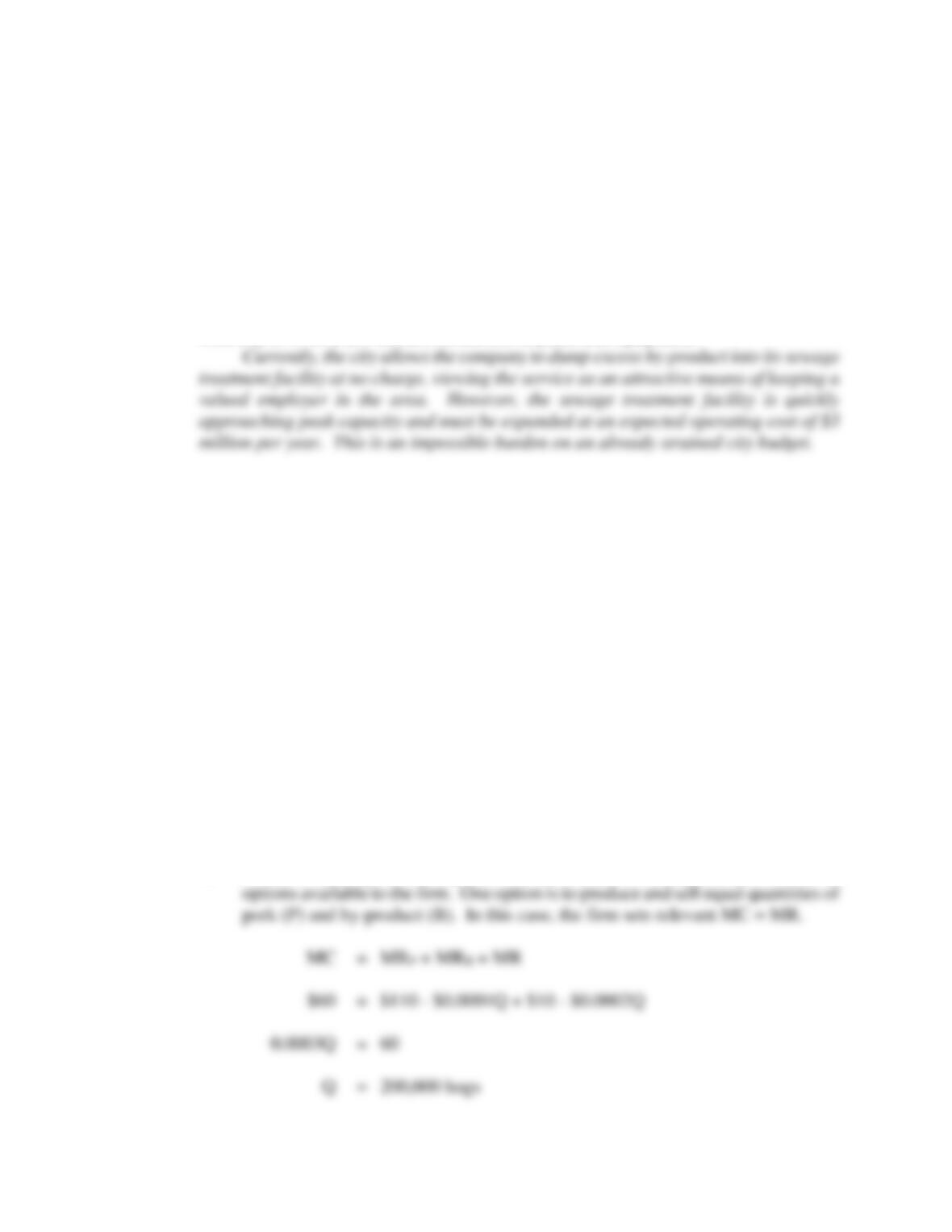
Each hog processed yields both pork and a render by-product in a fixed 1:1 ratio.
Although the by-product is unfit for human consumption, some can be sold to a local pet
food company for further processing. Relevant annual demand and cost relations are as
follows:
PP = $110 – $0.00005QP,
(Demand for pork)
MRP = ∂TRP/∂QP = $110 – $0.0001QP,
(Marginal revenue from pork)
Government in the Market Economy 595
MC = ∂TC/∂Q = $60.
(Marginal cost)
Here, P is price in dollars, Q is the number of hogs processed (with an average weight
of 100 pounds), and QP and QB are pork and render by-product per hog, respectively;
both total and marginal costs are in dollars. Total costs include a risk-adjusted normal
return of 15% on a $50 million investment in plant and equipment.
A. Calculate the profit-maximizing price/output combination and optimal total profit
level for Satriale.
B. How much by-product will the company dump into the Musconetcong sewage
treatment facility at the profit-maximizing activity level?
C. Calculate output and total profits if the city imposes a $35 per unit charge on the
amount of by-product Satriale dumps.
D. Calculate output and total profits if the city imposes a fixed $3-million-per-year
tax on Satriale to pay for the sewage treatment facility expansion.
E. Will either tax alternative permit Satriale to survive in the long run? In your
opinion, what should the city of Musconetcong do about its sewage treatment
problem?
ST19.1 SOLUTION
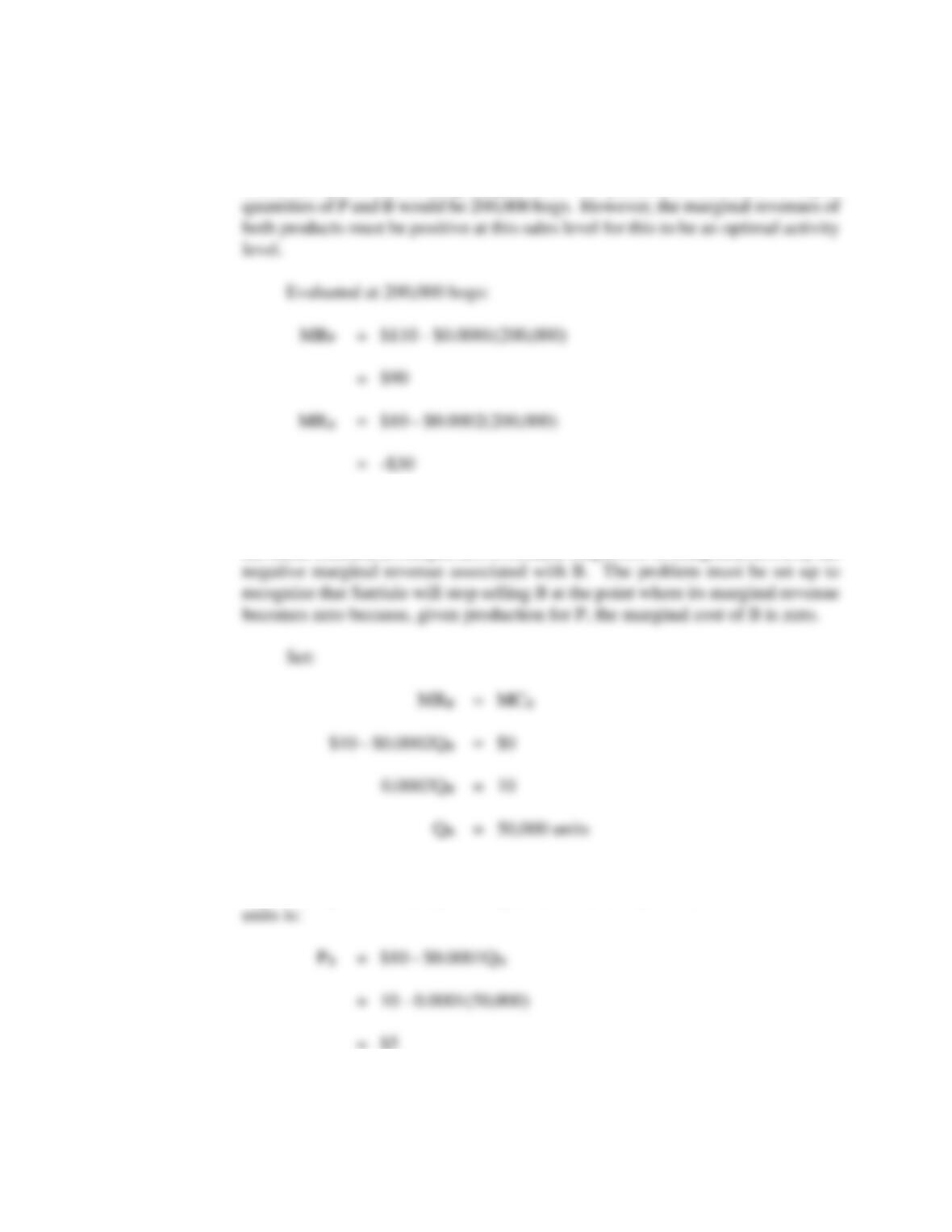
A. Solution to this problem requires that one look at several production and sales
596 Chapter 19
Thus, the profit-maximizing output level for production and sale of equal
Because the marginal revenue for B is negative, and Satriale can costlessly dump
excess production, the sale of 200,000 units of B is suboptimal. This invalidates
the entire solution developed above because output of P is being held down by the
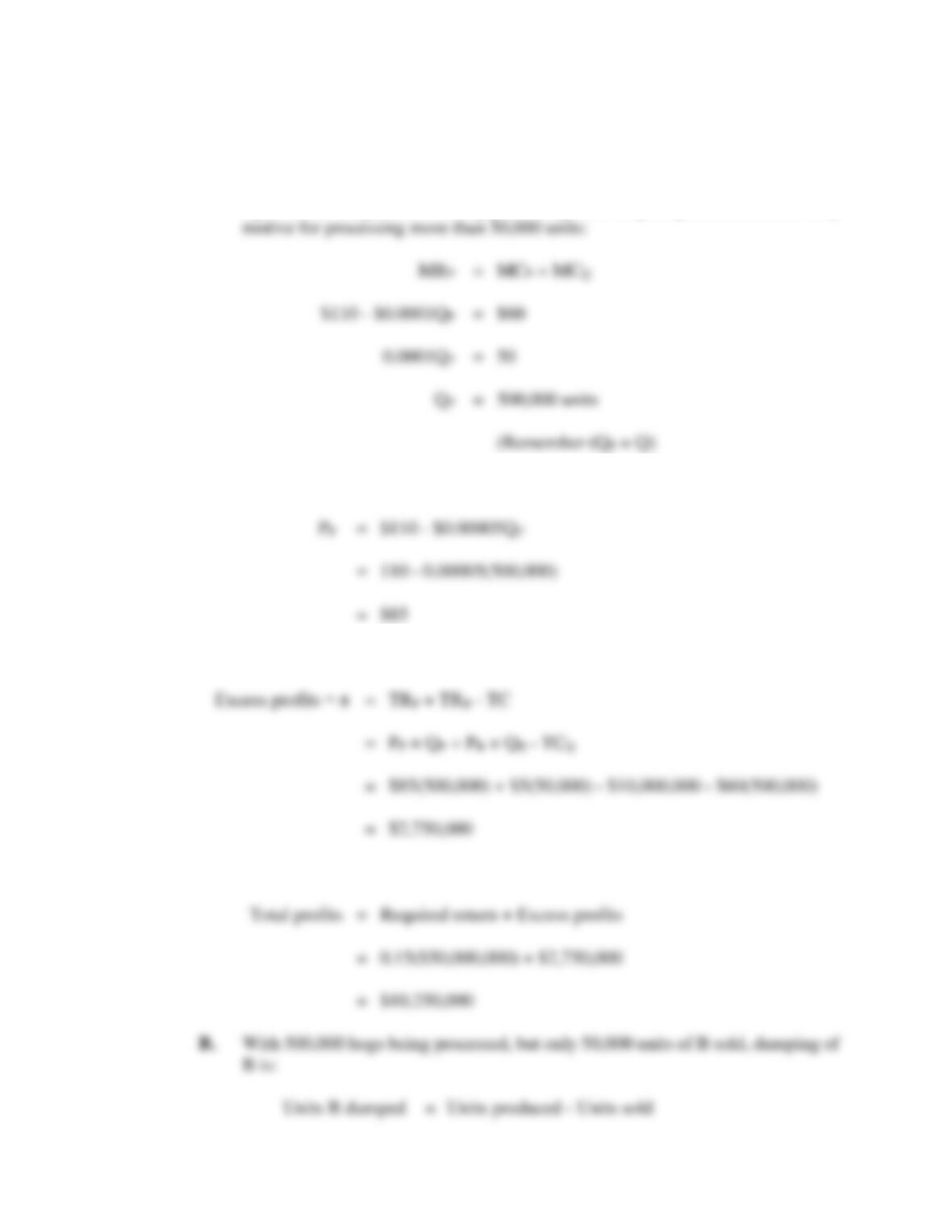
Thus, 50,000 units of B are the maximum that would be sold. Any excess units
will be dumped into the city’s sewage treatment facility. The price for B at 50,000
Government in the Market Economy 597
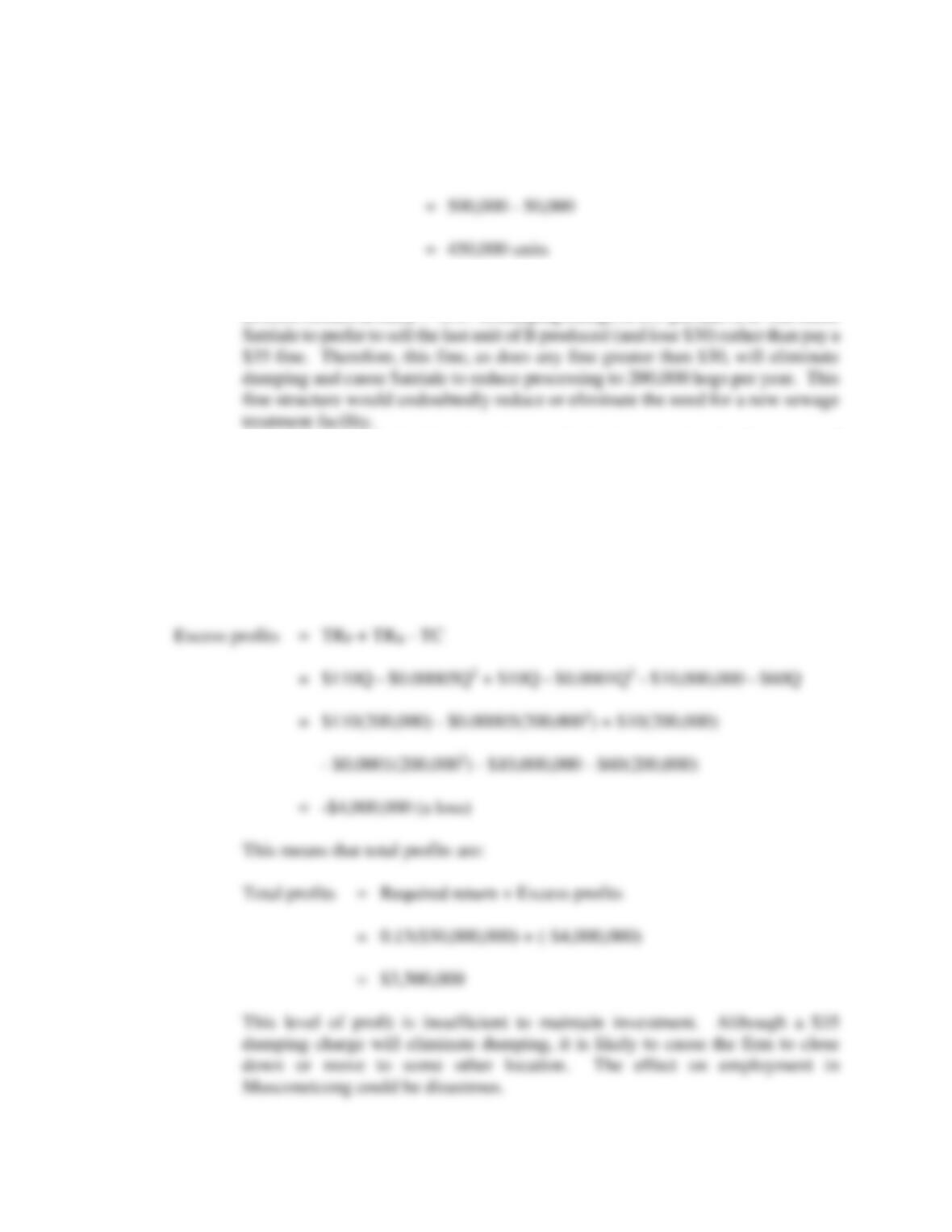
To determine the optimal production of P (pork), set the marginal revenue of P
equal to the marginal cost of hog processing because pork production is the only
and
Excess profits at the optimal activity level for Satriale are:
Because total costs include a normal return of 15% on $50 million in investment,
598 Chapter 19
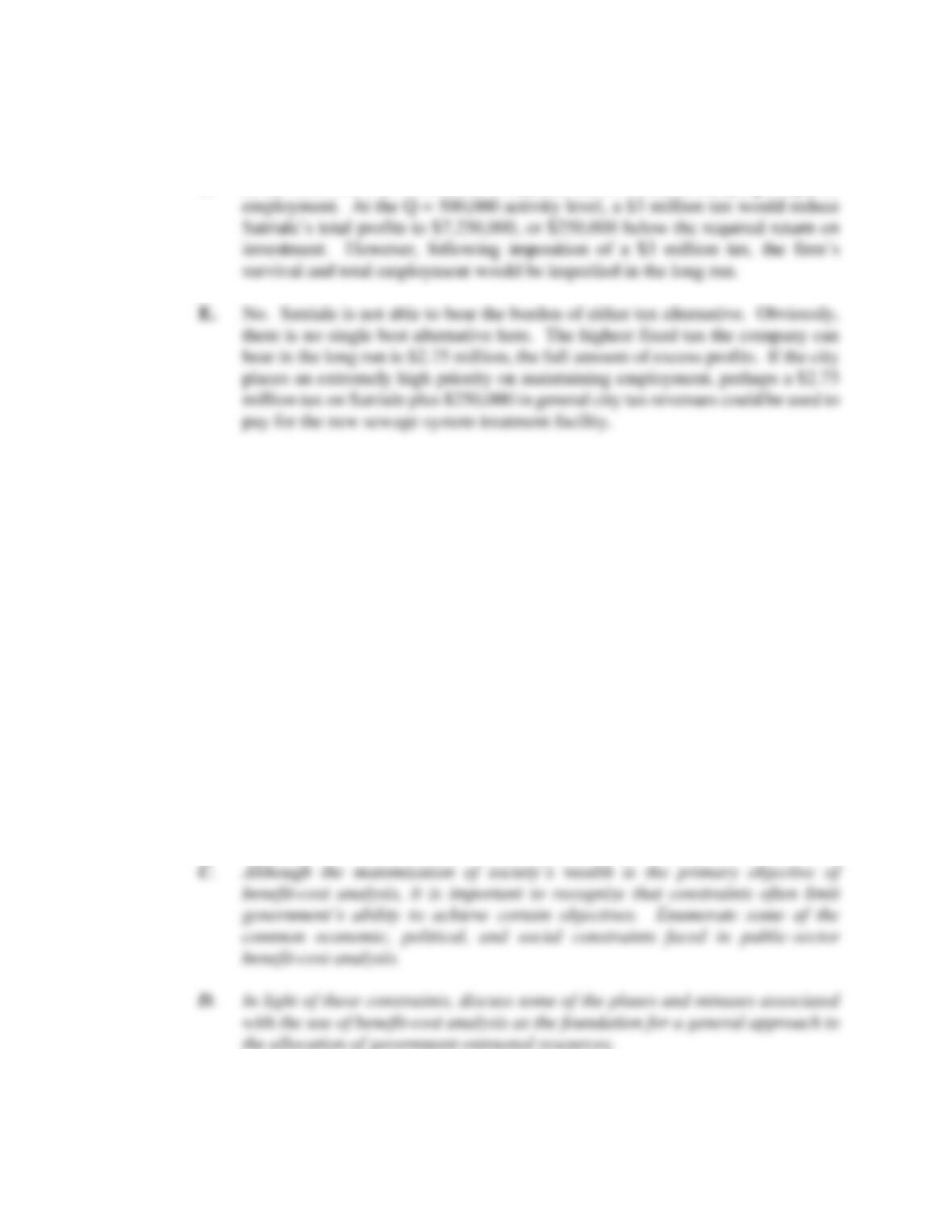
C. In part A, it is shown that if all P and B produced is sold, an activity level of Q =
200,000 results in MRB = -$30. A dumping charge of $35 per unit of B will cause
Although eliminating dumping is obviously attractive in the sense of
reducing sewage treatment costs, the $35 fine has the unfortunate consequence of
cutting output substantially. Pork prices rise to PP = $110 – $0.00005(200,000) =
$100, and by product prices fall to PB = $10 – $0.0001(200,000) = -$10. This
means Satriale will pay the pet food company $10 per unit to accept all of its by–
product sludge. Employment will undoubtedly fall as well. In addition to these
obvious short-run effects, long-run implications may be especially serious. At Q =
200,000, Satriale’s excess profits are:
Government in the Market Economy 599
D. In the short run, a $3 million tax on Satriale has no effect on dumping, output or
ST19.2 Benefit-cost Analysis Methodology. The benefit-cost approach first surfaced in France
during 1844. In this century, benefit-cost analysis has been widely used in the
evaluation of river and harbor projects since as early as 1902. In the United States, the
1936 Flood Control Act authorized federal assistance in developing flood-control
programs “if the benefits to whomsoever they may accrue are in excess of the estimated
costs.” By 1950, federal agency practice required the consideration of both direct and
indirect benefits and costs and that unmeasured intangible influences be listed. Despite
this long history of widespread use, it has only been since 1970 that public-sector
managers have sought to broadly apply the principles of benefit-cost analysis to the
evaluation of agricultural programs, rapid transit projects, highway construction, urban
renewal projects, recreation facility construction, job training programs, health-care
reform, education, research and development projects, and defense policies.
A. Briefly describe major similarities and differences between public-sector
benefit-cost analysis and the private-sector capital budgeting process.
B. What major questions must be answered before meaningful benefit-cost analysis is
possible?
ST19.2 SOLUTION
600 Chapter 19
A. Benefit-cost analysis is a method for assessing the desirability of social programs
B. Before meaningful benefit-cost analysis is possible, a number of important policy
questions must be answered. Among these policy questions are
▪ What is the social objective function that is to be maximized?
C. A number of constraints impinge upon society’s ability to maximize the social
benefits derived from public expenditures. Among these constraints are
Government in the Market Economy 601
D. An important potential use of benefit-cost analysis is as the structure for a general
philosophy of government resource allocation. As such, the results of benefit-cost
studies have the potential to serve as a guide for resource-allocation decisions
Although a benefit-cost approach to evaluating all levels and forms of
government is conceptually appealing on an efficiency basis, it suffers from a
number of serious practical limitations. Perhaps most importantly, the
602 Chapter 19
PROBLEMS & SOLUTIONS
P19.1 Market Imperfections. Markets usually allocate resources in a manner that creates the
greatest net benefit to society. An efficient allocation is one that maximizes the net
benefits to society. Indicate whether each of the following statements is true or false,
and explain your answer.
A. Markets sometimes fail to allocate resources efficiently. Under such
circumstances, it always makes sense for the government to impose taxes in the
case of negative externalities or subsidies in the case of positive externalities.
B. A negative externality exists when a voluntary market transaction between two
parties imposes involuntary costs on a third party.
C. Efficiency mandates that the prices of goods and services reflects all incremental
costs of production, including the cost of inputs, the value of producer time and
effort, and any spillover effects.
D. With a Pigou tax, the costs that pollution imposes on the public will be considered
when the firm decides where to locate a plant, which technologies to use, or how
much to produce.
E. In all cases, the best remedy for externalities is to define property rights and allow
the affected parties to transact privately to achieve mutually beneficial outcomes.
P19.1 SOLUTION
A. False. Poorly designed or unnecessary government regulations can reduce
society’s overall well-being. Costs of government regulation include the expenses
Government in the Market Economy 603
D. True. With an appropriate Pigou tax the costs that pollution imposes on the public
will be considered when the firm decides where to locate a plant, which
technologies to use, or how much to produce. When external costs tied to
P19.2 Negative Externalities. Coal-fired electricity-generating plants emit substantial
amounts of sulfur dioxide and particulate pollution into the atmosphere. Concerned
citizens are appalled at the aesthetic and environmental implications of such pollution,
as well as the potential health hazard to the local population.
In analyzing remedies to the current situation, three general methods used to
control air pollution are generally considered:
▪ Regulations — licenses, permits, compulsory standards, and so on.
604 Chapter 19
Answer the following questions in light of these alternative methods of pollution
control.
A. Pollution is a negative externality and a major cause of market failure. Explain
why markets fail.
B. What is the incentive provided to polluters under each method of pollution
control?
C. Who pays for a clean environment under each form of control?
P19.2 SOLUTION
A. Market failure sometimes occurs because the number of buyers and sellers is too small
B. Each alternative method of pollution control provides producers with a different set of
incentives. With rules and regulations, producers often have an incentive to litigate or
Government in the Market Economy 605
C. When polluters are forced to respond to rules and regulations, the company, customers,
employees, and stockholders are all faced with the prospect of paying the costs of
pollution reduction. The incidence of pollution cleanup costs depends on the elasticity
D. Efficiency considerations typically favor payments and charges over rules and
regulations as the more efficient methods of pollution control. From an efficiency
standpoint, pollution charges are especially attractive in that they recognize pollution as
a sometimes necessary cost of doing business, and they force cleanup costs to be borne
P19.3 Costs of Regulation. Hathaway-Ross Instruments, Inc., manufactures an innovative
piece of diagnostic equipment used in medical laboratories and hospitals. OSHA has
determined that additional safety precautions are necessary to bring radioactive leakage
occurring during use of this equipment down to acceptable levels. Total and marginal
606 Chapter 19
production costs, including a normal rate of return on investment but before additional
safeguards are installed, are as follows:
TC = $5,000,000 + $5,000Q
MC =
TC/
Q = $5,000
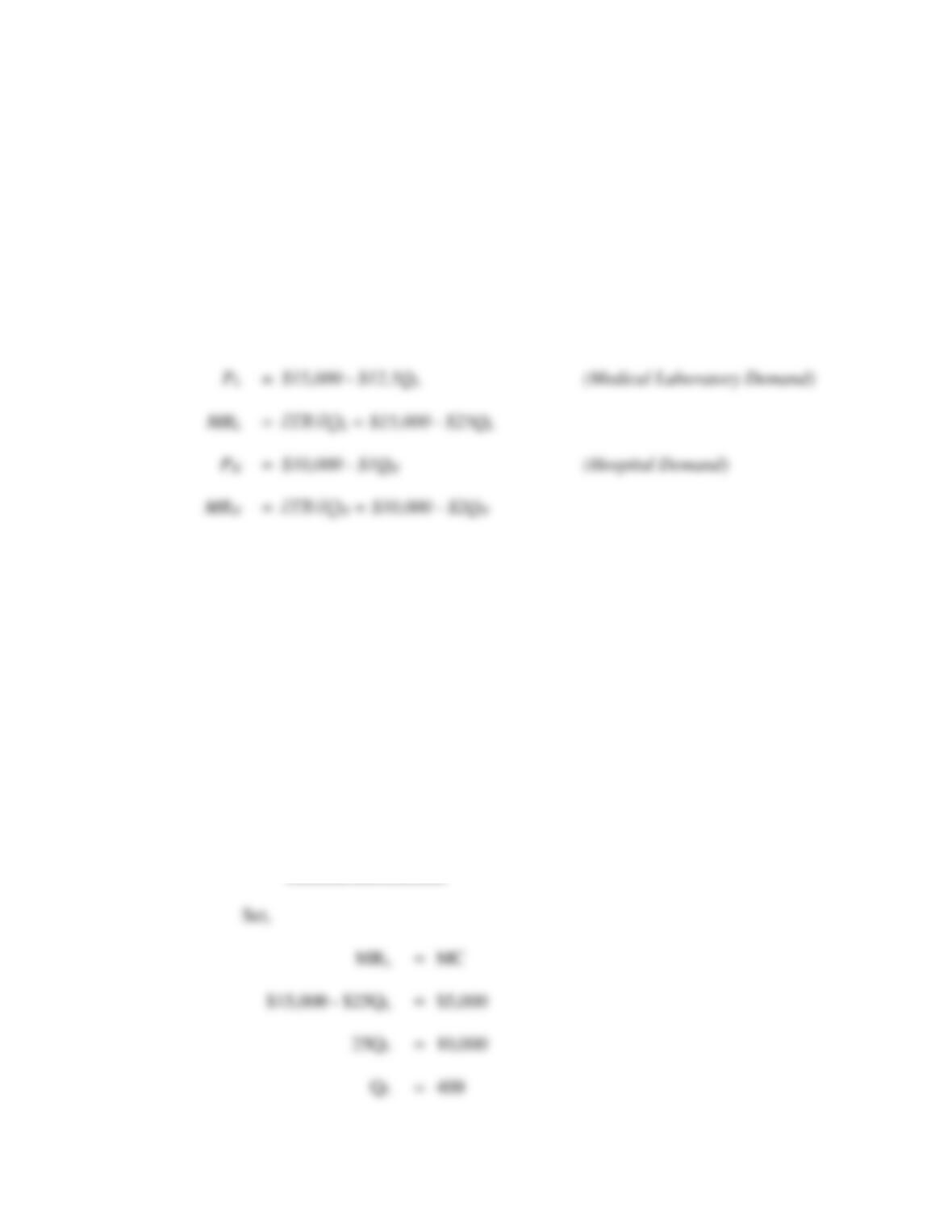
Market demand and marginal revenue relations are the following:
A. Assuming that the company faces two distinct markets, calculate the profit–
maximizing price/output combination in each market and economic profits.
B. Describe the short- and long-run implications of meeting OSHA standards if doing
so raises marginal cost by $1,000 per machine.
C. Calculate the point price elasticity at the initial (part A) profit-maximizing activity
level in each market. Are the differential effects on sales in each market that were
seen in part B typical or atypical?
P19.3 SOLUTION
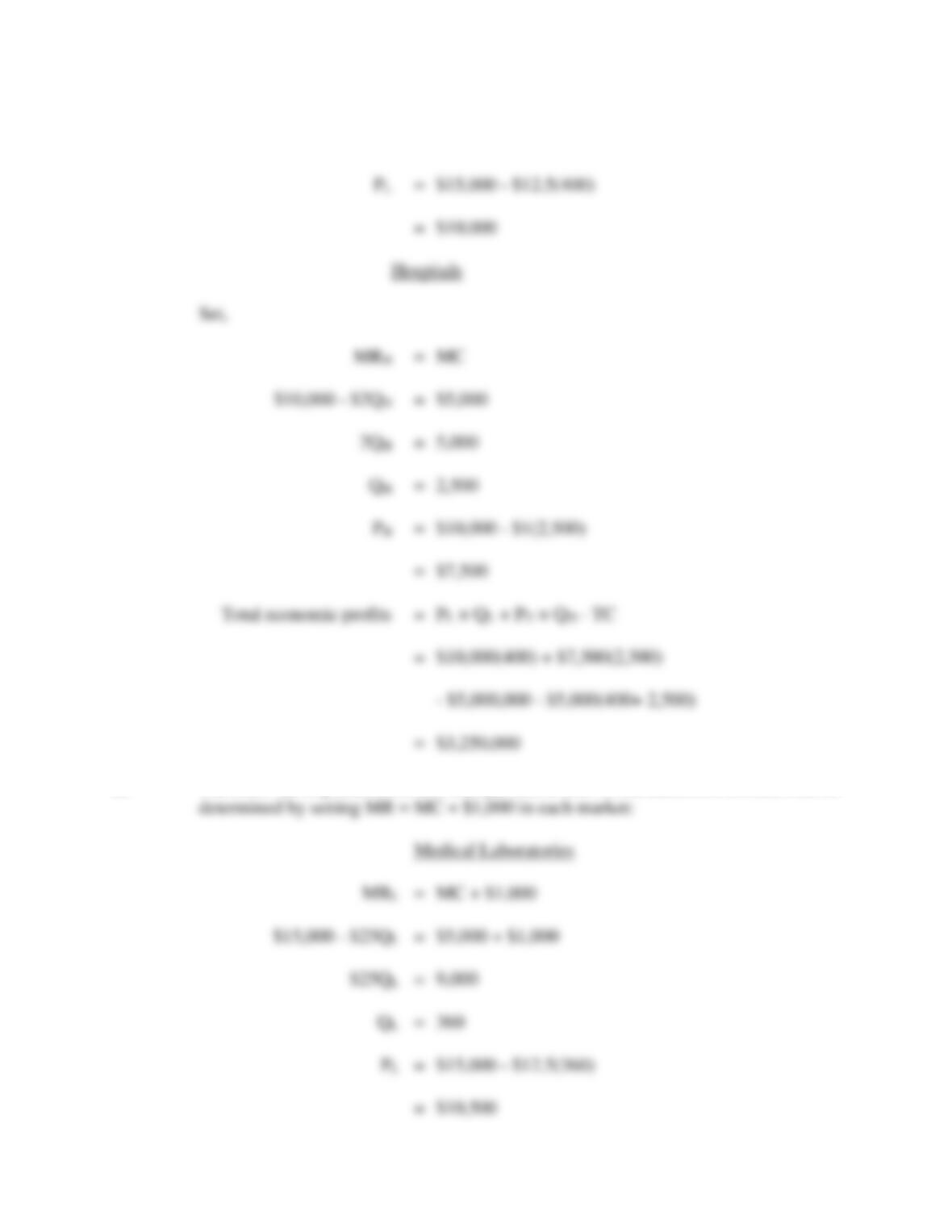
A. With two distinct markets, the company will maximize profits by setting MR = MC in
each market and solving for Q.
Medical Laboratories
Government in the Market Economy 607
B. The short-run implications of a $1,000 per unit in OSHA-mandated cost increases can be