
interactive activity
Chapter 19
Factor Markets and
the Distribution of Income
1. In 2015, national income in the United States was $15,665.3 billion. In the
same year, 148.8 million workers were employed, at an average wage, including
benefits, of $62,187 per worker per year.
a. How much compensation of employees was paid in the United States in 2015?
b. Analyze the factor distribution of income. What percentage of national income
was received in the form of compensation to employees in 2015?
c. Suppose that a huge wave of corporate downsizing leads many terminated
employees to open their own businesses. What is the effect on the factor distri-
bution of income?
59.1%.
c. The effect of this change is to diminish the share of income going to compen-
2. Marty’s Frozen Yogurt has the production function per day shown in the accom-
panying table. The equilibrium wage rate for a worker is $80 per day. Each cup
of frozen yogurt sells for $2.
Quantity of labor
(workers)
Quantity of frozen
yogurt (cups)
0 0
1110
a. Calculate the marginal product of labor for each worker and the value of the
marginal product of labor per worker.
b. How many workers should Marty employ?

S-270 Chapter 19 Factor Markets and the distribution oF incoMe
2. a. The accompanying table shows the marginal product of labor (MPL) and the
value of the marginal product of labor (VMPL) of each worker. Remember that
VMPL = P × MPL. Here that means that VMPL = $2 × MPL.
Quantity of labor
(workers)
Quantity of frozen
yogurt (cups)
MPL
(cups per worker)
VMPL
(per worker)
0 0
110 $220
1110
90 180
2200
70 140
b. Marty should employ 3 workers. The value of the marginal product of the
third worker ($140) is above the wage rate of $80: Marty should hire the third
3. The production function for Patty’s Pizza Parlor is given in the table in Problem 12.
3. The accompanying diagram shows the value of the marginal product of labor
curve and the wage rates of $10 and $15. As the wage rate increases from $10 to
$15, Patty’s demand for workers decreases from 2 workers to 1 worker. So, as the
wage rate increases, Patty should hire fewer workers.
10 2345
$18
Wage
rate
Quantity of labor (workers)
15
8
6
New wage
rate
Solution
Solution

4. Jameel runs a driver education school. The more driving instructors he hires,
the more driving lessons he can sell. But because he owns a limited number of
training automobiles, each additional driving instructor adds less to Jameel’s
output of driving lessons. The accompanying table shows Jameel’s production
function per day. Each driving lesson can be sold at $35 per hour.
Quantity of labor
(driving instructors)
Quantity of driving
lessons (hours)
0 0
1 8
Determine Jameel’s labor demand schedule (his demand schedule for driving
instructors) for each of the following daily wage rates for driving instructors:
$160, $180, $200, $220, $240, and $260.
4. The accompanying table calculates the marginal product of labor (MPL) and the
value of the marginal product of labor (VMPL).
Quantity of labor
(driving instructors)
Quantity of driving
lessons (hours)
MPL (hours per
driving instructor)
VMPL (per driving
instructor)
0 0
8 $280
1 8
If the daily wage rate of driving instructors is $160, Jameel should hire 4 instruc–
tors: the fourth instructor has a value of the marginal product of $175, which
is greater than the wage rate; but the fifth instructor would have a value of the
marginal product of only $140, which is less than the wage rate. By similar rea-
soning for the other wage rates, Jameel’s demand schedule for labor is as shown
in the accompanying table.
Daily wage rate
Quantity of labor
demanded (driving
instructors)
$160 4
260 1
Solution

5. Dale and Dana work at a self-service gas station and convenience store. Dale
opens up every day, and Dana arrives later to help stock the store. They are both
$9.50. This implies that all other workers hired will have an hourly value of the
marginal product higher than $9.50 but will be paid a wage of $9.50. Or to put it
6. A New York Times article observed that the wage of farmworkers in Mexico was
$11 an hour but the wage of immigrant Mexican farmworkers in California was
$9 an hour.
a. Assume that the output sells for the same price in the two countries. Does this
imply that the marginal product of labor of farmworkers is higher in Mexico
b. Now suppose that farmwork in Mexico is more arduous and more dangerous
than farmwork in California. As a result, the quantity supplied of labor for
any given wage rate is not the same for Mexican farmworkers as it is for immi-
6. a. We know that farmworkers are employed up to the point where the value of
the marginal product of labor is just equal to the wage: VMPL = P × MPL = W.
In Mexico, this means that P × MPLMexico = $11 and in California P ×
Solution
Chapter 19 Factor Markets and the distribution oF incoMe S-273
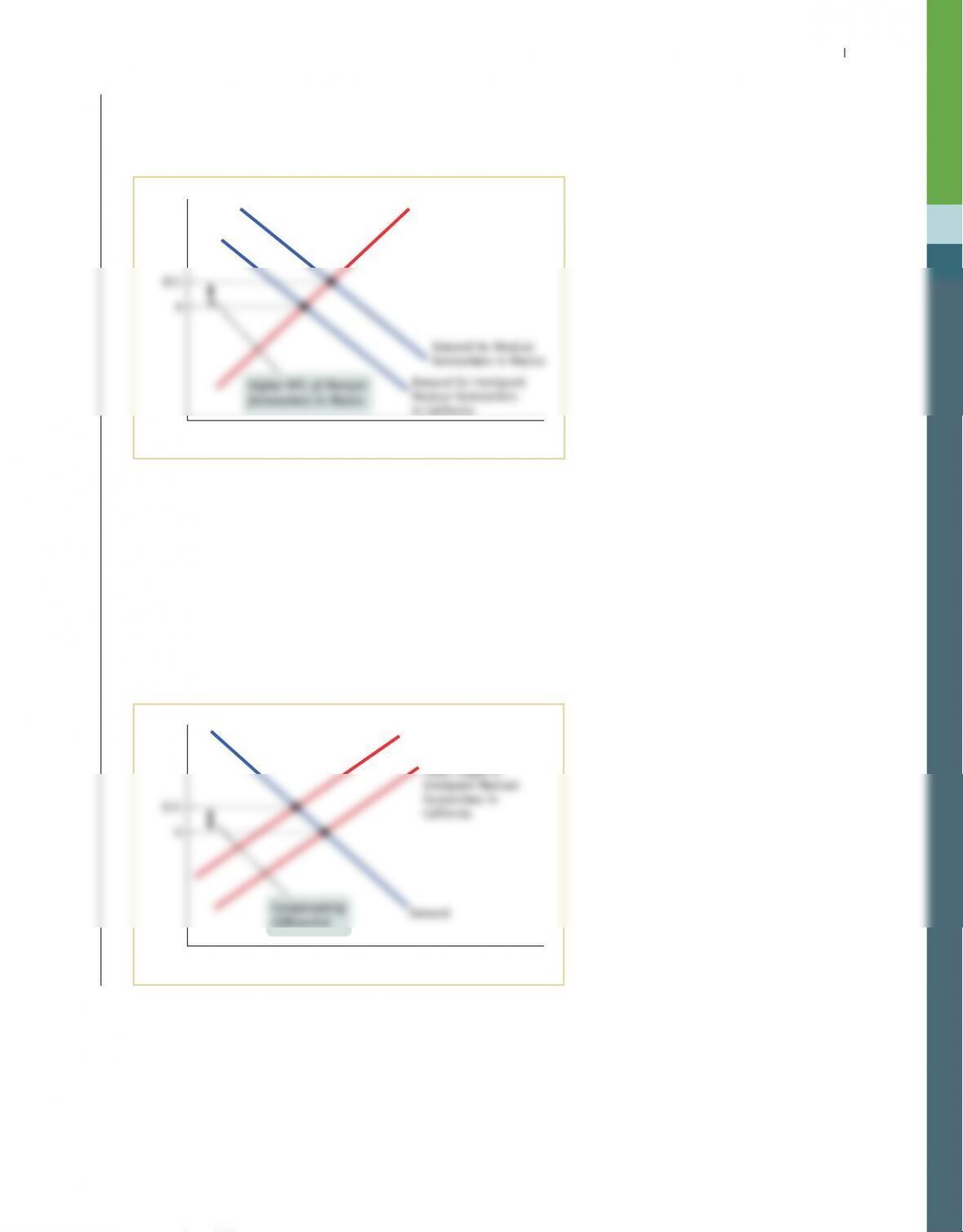
of workers is a result of differences in the demand curves for labor. Because
Mexican farmworkers have a higher marginal product of labor, the demand
curve for their labor lies above and to the right of the demand curve for their
peers in California, as shown in the accompanying diagram.
Supply
0
Wage
Quantity of labor
b. Because farmwork in Mexico is more arduous and dangerous than farmwork
in California, we can no longer infer that the higher wages paid to Mexican
farmworkers is evidence that they have a higher marginal product of labor
than their peers in California. Rather, the difference in wages is a compensat–
ing differential that compensates Mexican farmworkers for the greater diffi-
culty and danger they face.
c. Assuming that the quantity of labor demanded for any given wage rate is the
same for the two groups means that one demand curve can be drawn to repre-
sent employers’ demand responses in both markets. The compensating differ-
ential that Mexican farmworkers demand relative to their peers in California
is illustrated by their supply curve of labor in the accompanying diagram,
which lies above and to the left of the supply curve of their Californian peers.
Labor supply of Mexican
farmworkers in Mexico
0
Wage
Quantity of labor

S-274 Chapter 19 Factor Markets and the distribution oF incoMe
7. Kendra is the owner of Wholesome Farms, a commercial dairy. Kendra employs
labor, land, and capital. In her operations, Kendra can substitute between the
amount of labor she employs and the amount of capital she employs. That is, to
produce the same quantity of output she can use more labor and less capital;
similarly, to produce the same quantity of output she can use less labor and
more capital. Let w* represent the annual cost of labor in the market, let r
L
*
represent the annual cost of a unit of land in the market, and let rK
* represent
the annual cost of a unit of capital in the market.
a. Suppose that Kendra can maximize her profits by employing less labor and
more capital than she is currently using but the same amount of land. What
three conditions must now hold for Kendra’s operations (involving her value of
the marginal product of labor, land, and capital) for this to be true?
8. For each of the following situations in which similar workers are paid different
wages, give the most likely explanation for these wage differences.

9. Research consistently finds that despite nondiscrimination policies, African–
American workers on average receive lower wages than White workers do. What
are the possible reasons for this? Are these reasons consistent with marginal
productivity theory?
10. Greta is an enthusiastic amateur gardener and spends a lot of her free time
working in her yard. She also has a demanding and well-paid job as a freelance
11. You are the governor’s economic policy adviser. The governor wants to put in
place policies that encourage employed people to work more hours at their jobs
and that encourage unemployed people to find and take jobs. Assess each of

11. a. The effect of this policy on the incentive to work is ambiguous. A lower income
tax rate has the effect of raising workers’ wages in a real sense. The substitu-
tion effect will induce people to work more, but the income effect will induce
them to work less. So this is an effective policy only if the substitution effect is
stronger than the income effect.
b. The effect of this policy on the incentive to work is also ambiguous. A higher
income tax rate has the effect of reducing workers’ wages in a real sense. The
WORK IT OUT Interactive step-by-step help with solving this
problem can be found online.
12. Patty’s Pizza Parlor has the production function per hour shown in the
accompanying table. The hourly wage rate for each worker is $10. Each pizza
sells for $2.
Quantity of labor
(workers) Quantity of pizza
0 0
1 9
a. Calculate the marginal product of labor for each worker and the value of
the marginal product of labor per worker.
b. Draw the value of the marginal product of labor curve. Use your diagram
to determine how many workers Patty should employ.
Now let’s assume that Patty buys a new high-tech pizza oven that allows her
workers to become twice as productive as before. That is, the first worker
now produces 18 pizzas per hour instead of 9, and so on.
Solution
12. a. The accompanying table shows the marginal product of labor (MPL) and the
value of the marginal product of labor (VMPL1).
Number of
workers
Quantity
of pizza
MPL
(pizzas per worker)
VMPL1 (per
worker) (price of
pizza = $2)
VMPL2 (per
worker) (price
of pizza = $4)
0 0
9$18 $36
1 9
612 24
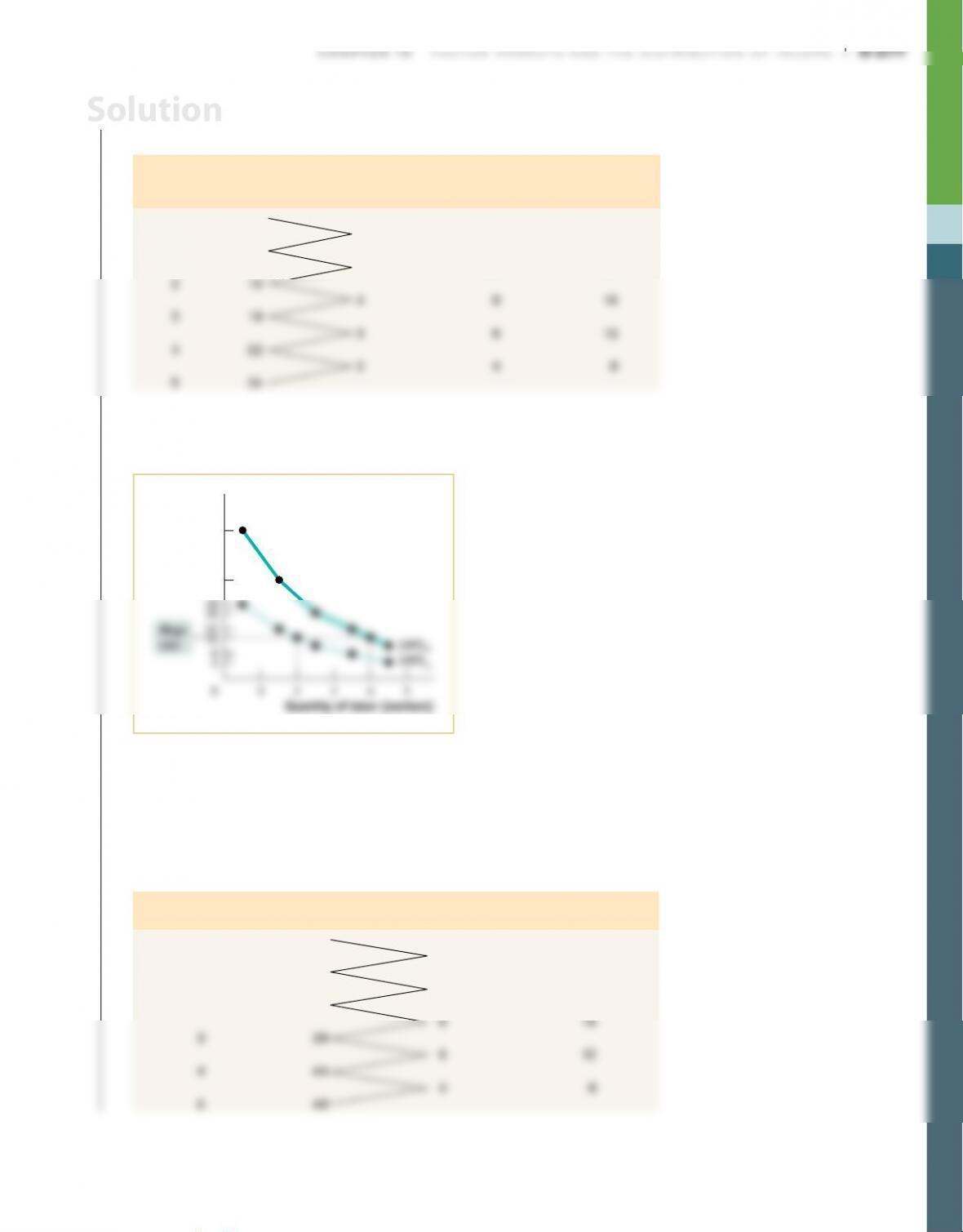
b. The accompanying diagram shows the value of the marginal product of labor
curve (VMPL1). The value of the marginal product of labor equals the wage
rate at 2 workers. So Patty should employ 2 workers.
$36
Wage
rate
Quantity of labor (workers)
24
6
c. The table shows the new value of the marginal product of labor (VMPL2). The
value of the marginal product of labor curve is labeled VMPL2 in the diagram.
The new value of the marginal product of labor equals the wage rate at 4
workers. So Patty should employ 4 workers.
d. The accompanying table shows the new production function for Patty’s Pizza
Parlor, the new marginal product of labor (MPL3), and the new value of the
marginal product of labor (VMPL3).
Quantity of labor
(workers)
Quantity of
pizza
MPL3 (pizzas per
worker) VMPL3 (per worker)
0 0
18 $36
118
12 24
230
Solution
S-278 Chapter 19 Factor Markets and the distribution oF incoMe
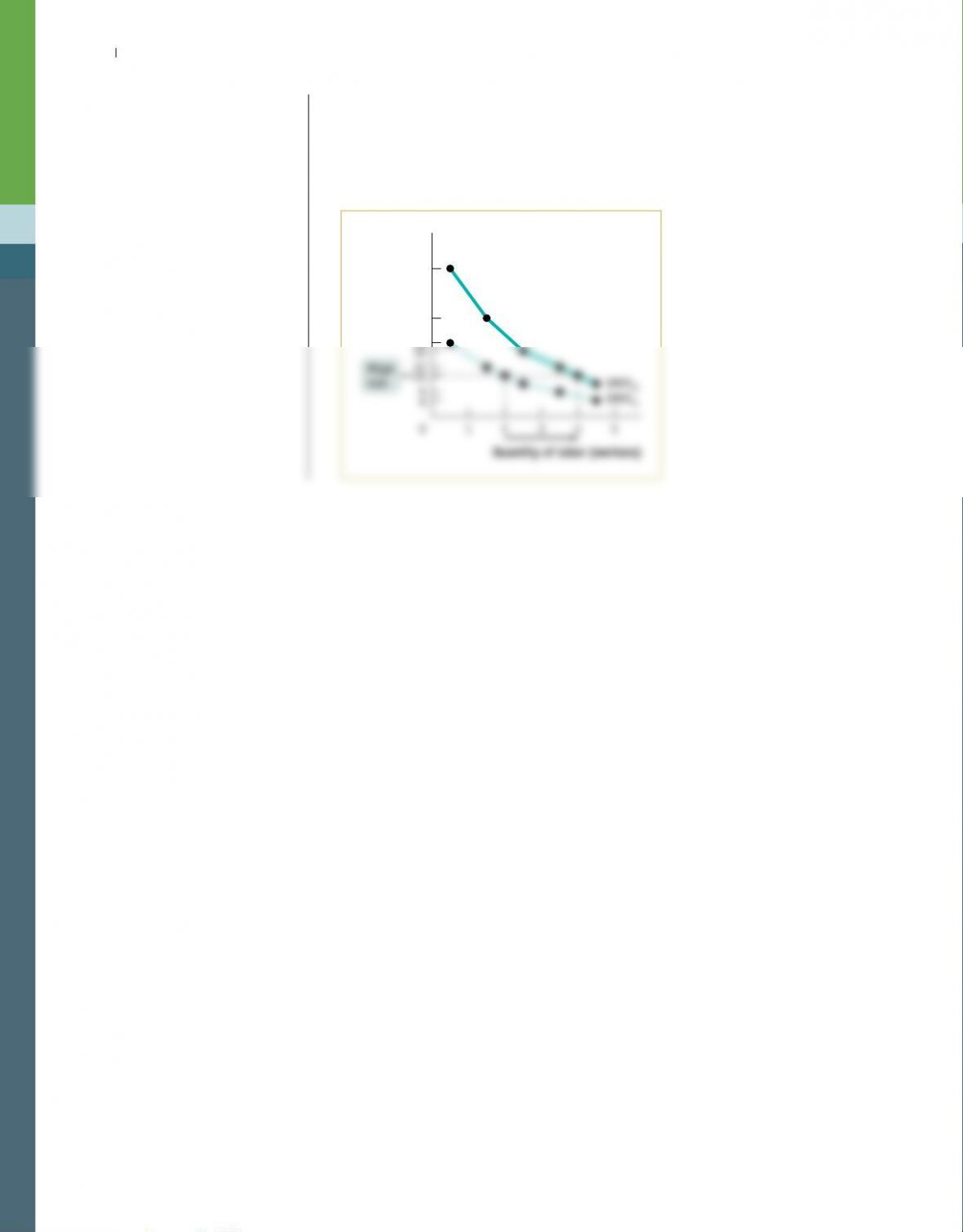
e. The accompanying diagram shows the original value of the marginal product
of labor curve from part b (VMPL1) and the new value of the marginal product
of labor curve (VMPL3). The value of the marginal product of labor now equals
the wage rate at 4 workers. So Patty should employ 4 workers. As the value of
the marginal product of labor increases—in this case as a result of a techno–
logical innovation (the new pizza oven)—Patty should hire more workers.
$36
Wage
rate
Quantity of labor
(
workers
)
24
18
6