8 (19) Fixed Versus Floating: International Monetary Experience
1. Discovering Data Visit the International Monetary Fund’s website
(http://www.imf.org) and locate the latest classification of exchange rate regimes
in all countries around the world. How many countries are fixing and how many
are floating?
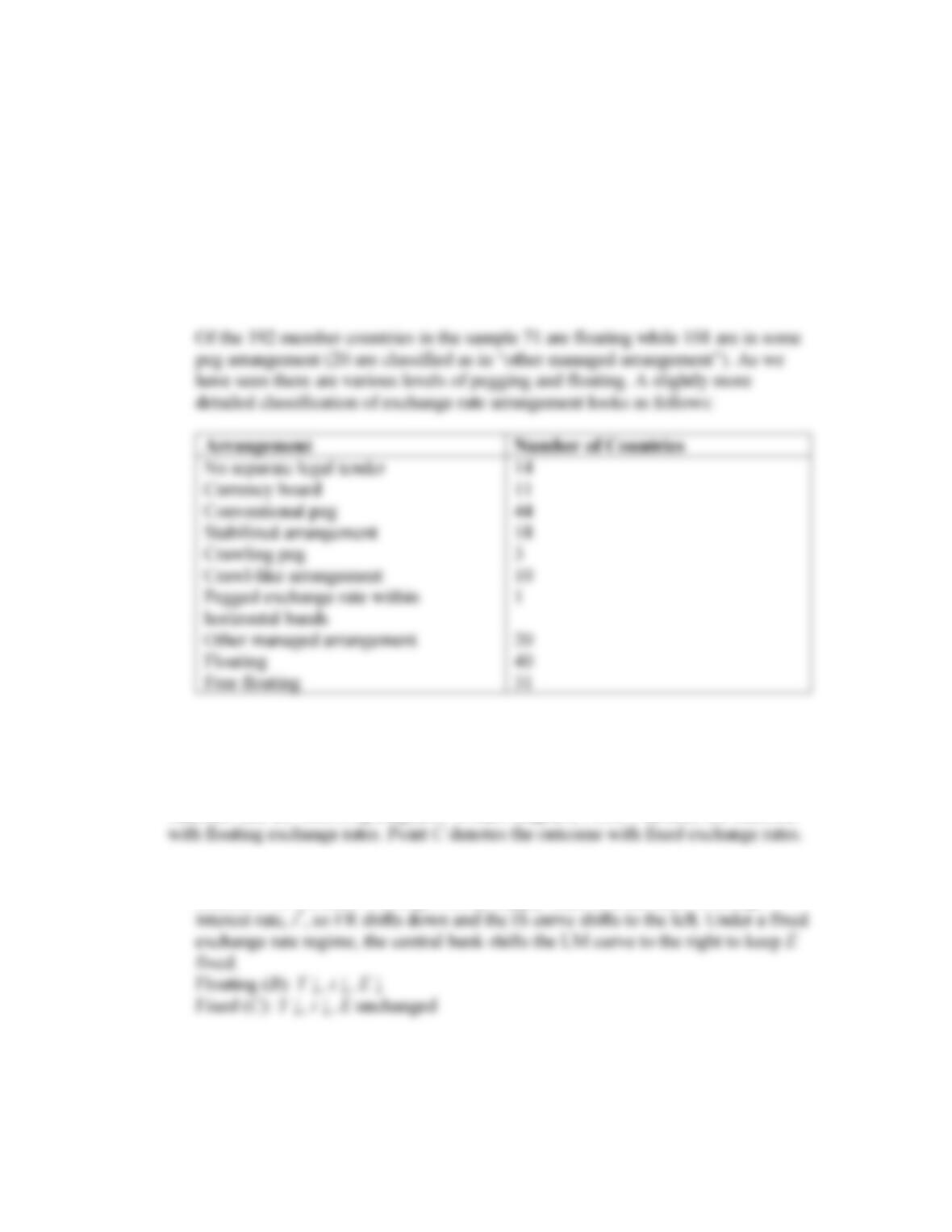
Answer: Answers will vary depending on the year selected. The following
information comes from the IMF publication “Annual Report on Exchange
Arrangements and Exchange Restrictions, 2016.”
2. Using the IS–LM–FX model, illustrate how each of the following scenarios affects
the home country. Compare the outcomes when the home country has a fixed
exchange rate with the outcomes when the home currency floats.
Answer: See the following diagrams. In each diagram, Point B denotes the outcome
a. The foreign country increases the money supply.
Answer: An increase in foreign money supply leads to a decrease in foreign
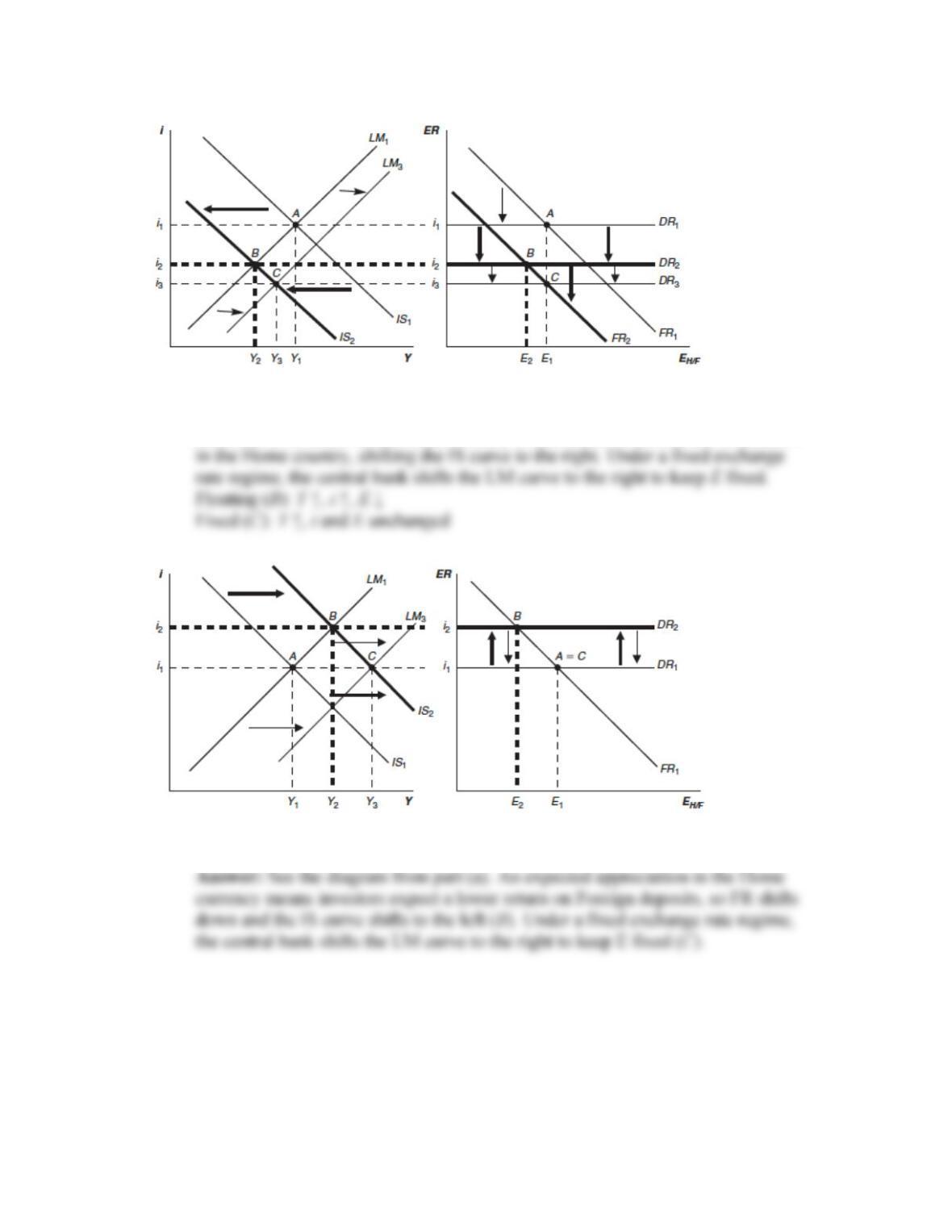
b. The home country cuts taxes.
Answer: A decrease in the Home country’s taxes leads to an increase in demand
c. Investors expect a future appreciation in the home currency.
Work It Out
The Danish krone is currently pegged to the euro. Using the IS–LM–FX model for Home
(Denmark) and Foreign (Eurozone), illustrate how each of the following scenarios
affect Denmark:
a. The Eurozone reduces its money supply.
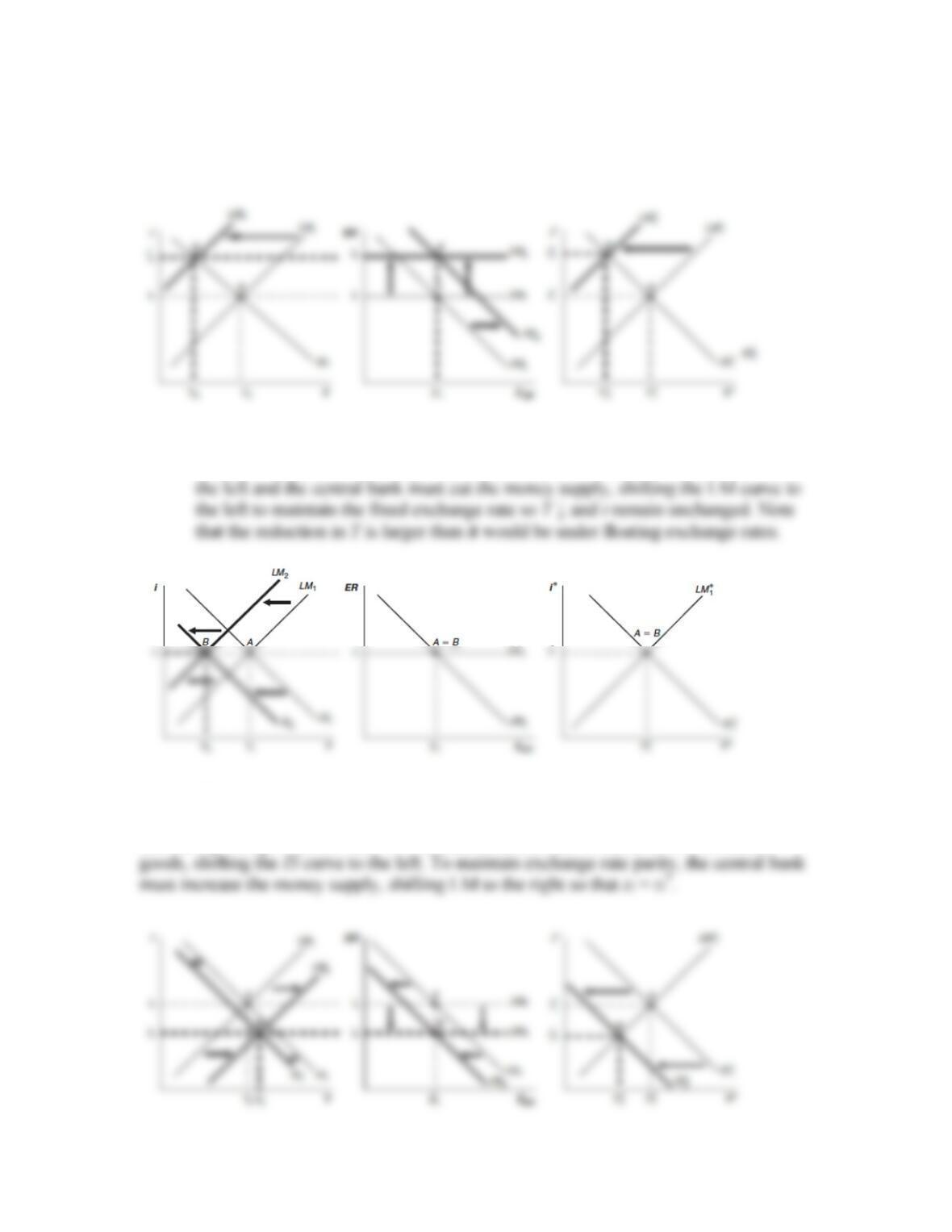
Answer: A decrease in Eurozone money supply leads to an increase in Foreign
interest rate, i*, so FR shifts up. Under a fixed exchange rate regime, the central
bank shifts the LM curve to the left to keep E fixed, so Y ↓ and i2 = i2*.
b. Denmark cuts government spending to reduce its budget deficit.
Answer: When Denmark implements the fiscal contraction, the IS curve shifts to
c. The Eurozone countries increase their taxes.
Answer: When the Eurozone countries raise taxes, the IS curve shifts to the left,
decreasing foreign interest rate, i*. This leads to a decrease in demand for Denmark’s
3. Consider two countries that are currently pegged to the euro: Bulgaria and Comoros.
Bulgaria is a member of the EU, allowing it to trade freely with other EU countries.
Exports to the Eurozone account for the majority of Bulgaria’s outbound trade, which
mainly consists of manufacturing goods, services, and wood. In contrast, Comoros is
an archipelago of islands off the eastern coast of southern Africa that exports food
commodities primarily to the United States and France. Comoros historically
maintained a peg with the French franc, switching to the euro when France joined the
Eurozone. Compare and contrast Bulgaria and Comoros in terms of their likely
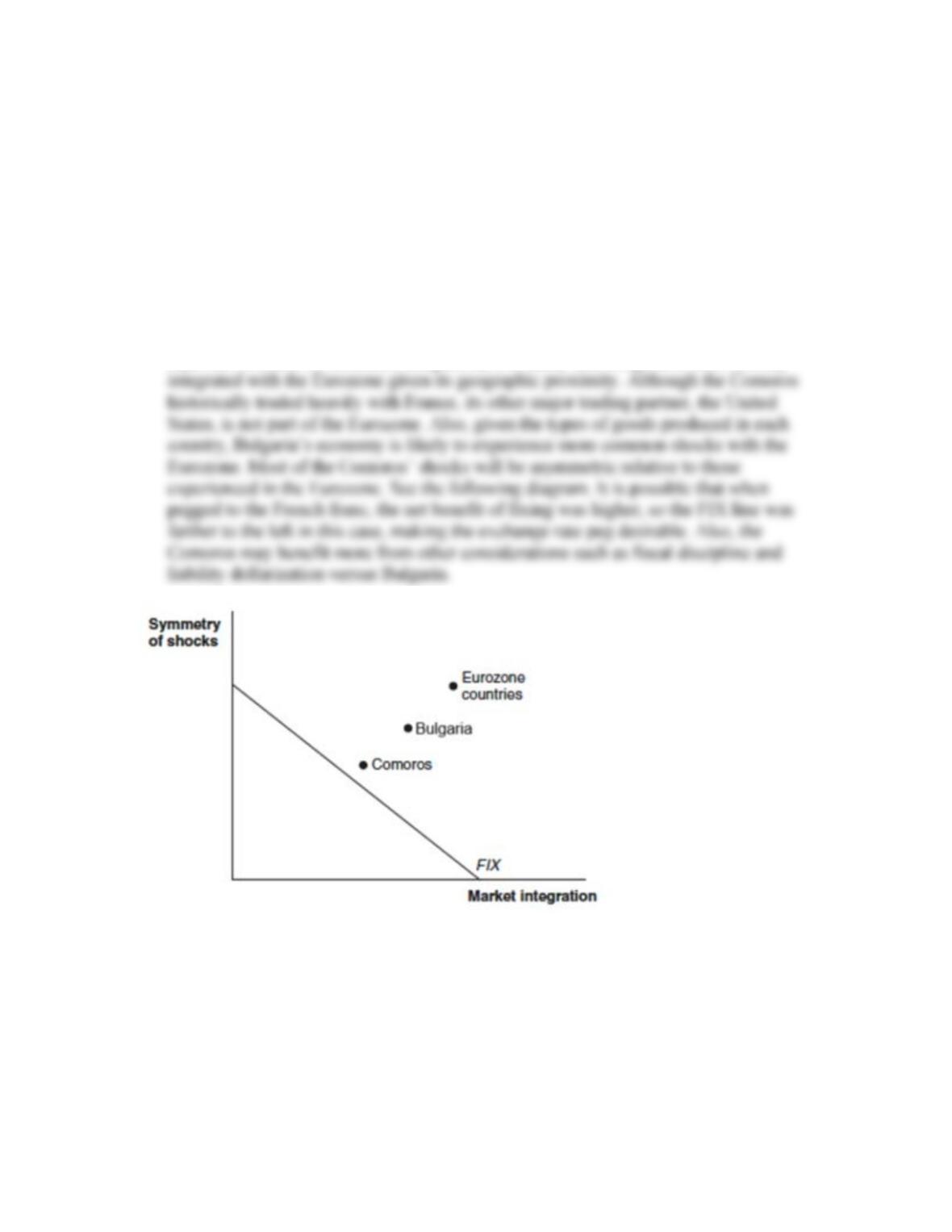
degree of integration symmetry with the Eurozone. Plot Comoros and Bulgaria on a
symmetry–integration diagram as in Figure 8–4 (19-4).
Answer: In terms of economic integration, it is likely that Bulgaria is more closely
4. Use the symmetry–integration diagram as in Figure 8-4 (19-4) to explore the
evolution of international monetary regimes from 1870 to 1939—that is, during the
rise and fall of the gold standard.
a. From 1870 to 1913, world trade flows doubled in size relative to GDP, from about
10% to 20%. Many economic historians believe this was driven by exogenous
declines in transaction costs, some of which were caused by changes in transport
technology. How would you depict this shift for a pair of countries in the
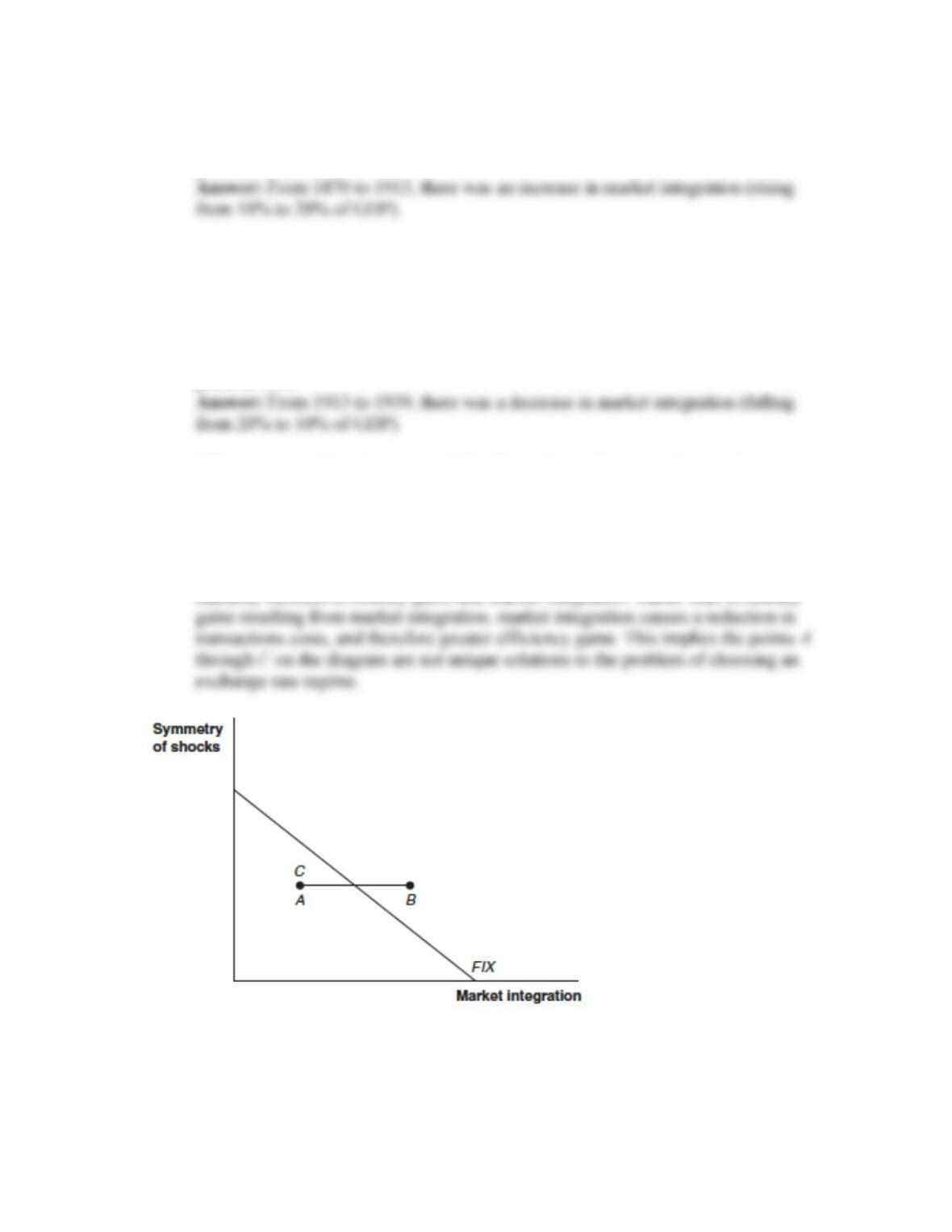
symmetry–integration diagram that started off just below the FIX line in 1870?
Use the letter A to label your starting point in 1870 and use B to label the end
point in 1913.
b. From 1913 to 1939, world trade flows collapsed, falling in half relative to GDP,
from about 20% back to 10%. Many economic historians think this was driven by
exogenous increases in transaction costs from rising transport costs and increases
in tariffs and quotas. How would you depict this shift for a pair of countries in the
symmetry-integration diagram that started off just above the FIX line in 1913?
Use the letter B to label your starting point in 1913 and use C to label the end
point in 1939.
c. Other economic historians contend that these changes in transaction costs arose
endogenously. When countries went on the gold standard, they lowered their
transaction costs and boosted trade. When they left gold, costs increased. If this is
true, then do points A, B, and C represent unique solutions to the problem of
choosing an exchange rate regime?
Answer: If the costs themselves are not exogenous, this implies a reverse
d. Changes in other factors in the 1920s and 1930s had an impact on the
sustainability of the gold standard. These included the following:
i. An increase in country-specific shocks
ii. An increase in democracy
iii. Growth of world output relative to the supply of gold
In each case, explain why these changes might have undermined commitment to
the gold standard.
Answer: Consider how each of the following affects the previous diagram:
5. Many countries experiencing high and rising inflation, or even hyperinflation, will
adopt a fixed exchange rate regime. Discuss the potential costs and benefits of a fixed
exchange rate regime in this case. Comment on fiscal discipline, seigniorage, and
expected future inflation.
Answer: Hyperinflations are the result of excessive printing of money, usually
6. In the late 1970s, several countries in Latin America, notably Mexico, Brazil, and
Argentina, had accumulated large external debt burdens. A significant share of this
debt was denominated in U.S. dollars. The United States pursued contractionary
monetary policy from 1979 to 1982, raising dollar interest rates. How would this
affect the value of the Latin American currencies relative to the U.S. dollar? How
would this affect their external debt in local currency terms? If these countries had
wanted to prevent a change in their external debt, what would have been the
appropriate policy response, and what would be the drawbacks?
Answer: Contractionary monetary policy in the United States would lead to an
7. Home’s currency, the peso, currently trades at an exchange rate of 1 peso per dollar.
Home has external assets of $320 billion, 100% of which are denominated in dollars.
It has external liabilities of $800 billion, 90% of which are denominated in dollars.
a. Is Home a net creditor or debtor? What is Home’s external wealth measured in
pesos?
b. What is Home’s net position in dollar-denominated assets, measured in pesos?
And what is it measured in U.S. dollars?
c. If the peso depreciates to 1.2 pesos per dollar, what is the change in Home’s
external wealth in pesos?
8. Evaluate the empirical evidence on how currency depreciation affects wealth and
output across countries. How does the decision of maintaining a fixed versus floating
exchange rate regime depend on a country’s external wealth position?
Answer: Figure 8-8 (19-8) reports data on the cumulative change in external wealth
9. Home signs a free–trade agreement with Foreign, which lowers tariffs and other
barriers to trade. Both countries are very similar in terms of economic shocks, as they
each produce very similar goods. Use a symmetry-integration diagram as in Figure 8–
4 (19-4) as part of your answer to the following questions.
a. Initially, trade rises. Does the rise in trade make Home more or less likely to peg its
currency to the Foreign currency? Why?
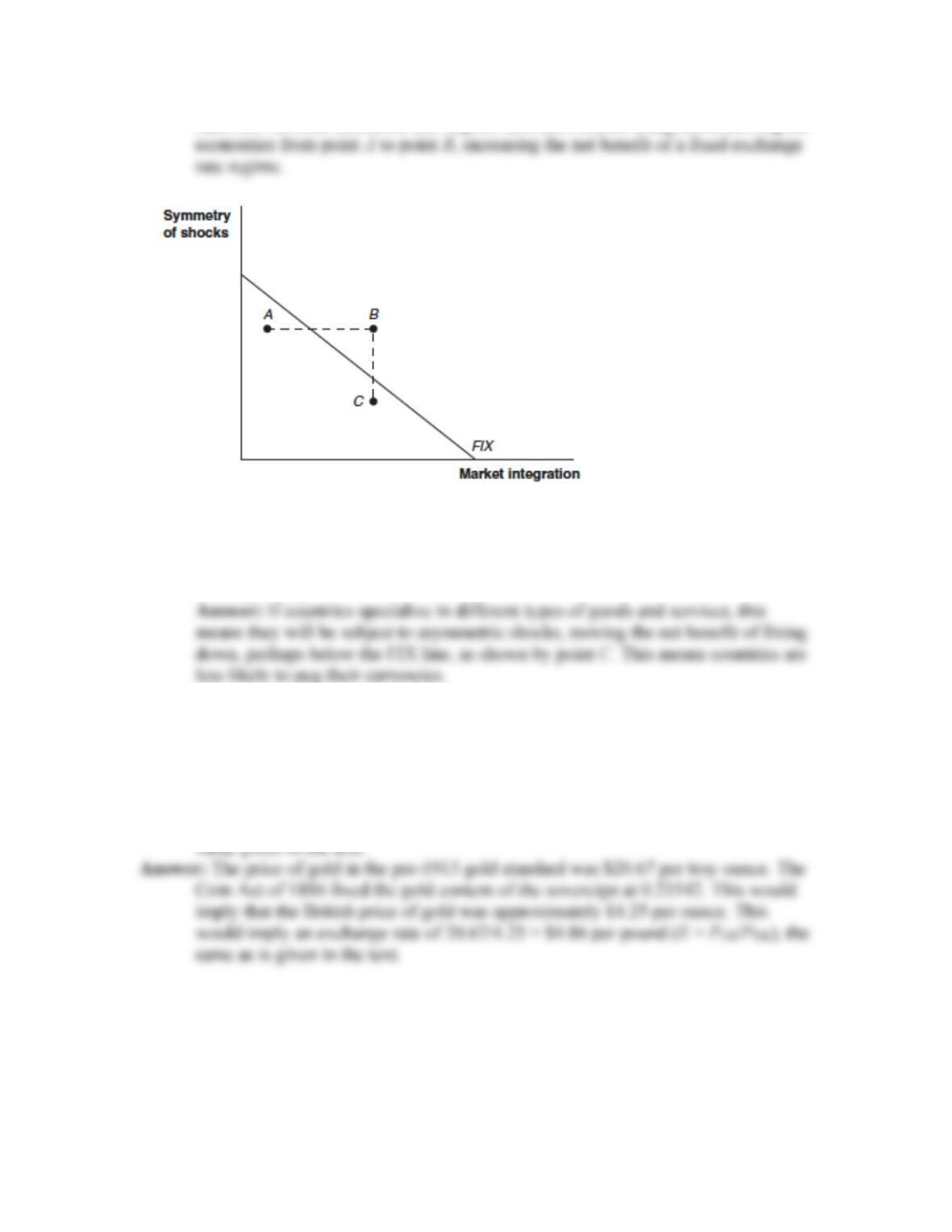
Answer: As trade increases, this implies increased market integration, moving the
b. In the longer run, freer trade causes the countries to follow their comparative
advantage and specialize in producing very different types of goods. Does the rise
in specialization make Home more or less likely to peg its currency to the Foreign
currency? Why?
10. Find the photo of the $20 gold coin in this chapter and refer to the specifications in
the adjoining caption. Calculate the U.S. dollar price of 1 ounce of gold under the
pre-1913 gold standard. Now search the Internet to find details, including gold
content, of a British gold sovereign coin worth £1 in the same era. Calculate the
British pound price of 1 ounce of gold under the pre-1913 gold standard. Now
compute the implied pound–dollar exchange rate. Check your answer against the