Chapter 19
Demand and Supply Elasticity
◼ Overview
Demand and supply elasticity are key concepts that are applied throughout the remainder of the book.
Therefore, price elasticity of demand is defined, and two ways to calculate it are shown. Price elasticity
of demand is then related to the firm’s total revenues, or what is the same thing, the buyer’s total money
◼ Learning Objectives
After studying this chapter, students should be able to:
• 19.1 Calculate price elasticity of demand
◼ Outline
I. Price Elasticity: Elasticity means responsiveness. In this section, the extent to which a change in
price will cause quantity demanded to change, other things held constant.
A. Price Elasticity of Demand: The responsiveness of the quantity demanded of a commodity to
changes in its price. The price elasticity of demand is defined as the percentage change in
quantity demanded divided by the percentage change in price.
1. Relative Quantities Only: In the price elasticity formula, percentage changes in quantity
2. Always Negative: The law of demand states that quantity demanded is inversely related to
286 Miller • Economics Today, Nineteenth Edition
B. Calculating Elasticity: The use of average values of changes in price and quantity avoids the
C. Price Elasticity Ranges: A good has an elastic demand whenever the price elasticity of
D. Extreme Elasticities: Perfectly inelastic demand represents total unresponsiveness of quantity
demanded to price changes, or zero elasticity, while infinitely or perfectly elastic demand
represents total responsiveness of quantity demanded to price changes. (See Figure 19-1.)
II. Elasticity and Total Revenues: There are three relationships among the types of price elasticity
and total revenue. (See Figure 19-2.)
A. Labeling Elasticity:
2. Unit-elastic demand: Changes in price do not change total revenues.
B. Graphic Presentation (See Figure 19-2.)
C. The Elasticity-Revenue Relationship (See Table 19-1.)
III. Determinants of the Price Elasticity of Demand
A. Existence of Substitutes: The closer the substitutes and the more substitutes there are for a
B. Share of the Budget: The greater the percentage of total budget spent on the commodity, the
greater is a person’s price elasticity of demand for that commodity.
C. Time for Adjustment: The longer any price change persists, the greater the price elasticity of
demand, other things held constant. Price elasticity of demand is greater in the long run than in
the short run.
1. Short-Run versus Long-Run Adjustments: The longer any price change persists, the
2. Demand Elasticity in the Short Run and in the Long Run: Elasticity will vary as more
time passes. We can think of an entire family of demand curves around a given price. In
3. How to Define the Short Run and the Long Run: The long run is the period of time
IV. The Cross Price and Income Elasticities of Demand
A. Cross Price Elasticity of Demand: The effect of a change in the price of one good on the
demand for another good.
1. Measuring the Cross Price Elasticity of Demand: The percentage change in the amount
2. Substitutes and Complements: When two goods are substitutes, the cross elasticity of
demand will be positive. When two related goods are complements, the cross elasticity of
demand will be negative.
a. Substitutes and the Cross Price Elasticity of Demand: When two goods are
B. Income Elasticity of Demand: The responsiveness of demand to changes in income holding
the good’s relative price constant.
2. Calculating the Income Elasticity of Demand: Use the following formula to get the same
V. Price Elasticity of Supply: The elasticity supply refers to the responsiveness of the quantity
supplied of a commodity to a change in its price. Price elasticity of supply is the percentage change
in quantity supplied divided by the percentage change in price.
◼ Points to Emphasize
Elasticity and Slope
Elasticity and slope are not the same thing. There are several ways to indicate the differences between
elasticity and slope; several successful classroom methods are presented here.
Point elasticity of demand (Ep) can be defined as
288 Miller • Economics Today, Nineteenth Edition
which can be rewritten as
Now (change in q)/(change in P) is the inverse of the slope. Assuming a linear demand curve, the slope
and its inverse are constant. Rewriting (2) gives:
Another way to differentiate between price elasticity and slope is to graph a simple linear equation on
two separate coordinate systems, using the same scale on both vertical axes but a different scale on the
Explaining One Determinant of Price Elasticity of Demand
One of the determinants of price elasticity of demand discussed in the text is the “importance” of the
commodity in a person’s budget. Importance is measured by the ratio of annual expenditures on the
commodity to annual income. The text points out that this determinant is directly related to elasticity:
The more important the commodity (other things held constant), the higher the price elasticity of demand.
Income Elasticity of Demand
The quantitative significance of the effect of changes in income on demand can be shown through the
Cross Elasticity of Demand
Chapter 19 Demand and Supply Elasticity 289
◼ For Those Who Wish to Stress Theory
Price Elasticity of Demand
Those who want to emphasize theory can apply the elasticity concept. Consider the three examples
presented below.
1. The Price Elasticity of Demand for a Physician’s Services: There are substitutes for a
physician’s services. They include free public clinics, paramedic services, advice from
“knowledgeable” people or relatives, self-prescription, drugs, pain and suffering, etc. Presumably,
2. Why the Price of Salt Does Not Rise: It is generally agreed that, over broad price ranges, consumer
demand for salt is highly inelastic. If this is true, then why don’t salt producers raise the price of
salt? To do so would surely raise total revenues and total profits. The relative price of salt has not
3. Why Alcohol and Cigarettes Are Taxed: Ask the following question: If you were in charge of
◼ Further Questions for Class Discussion
1. What would the consequences of income inelastic demand be for an industry in a growing economy
in the long run? As income rises, demand increases less than proportionately. Thus, in the long run,
2. Using the concept of cross-price elasticity of demand, ask students to explain why nonprescription
supplements have become so popular as prescription drug prices have risen. As prescription drug
3. Ask students to explain why total revenue rises when price is raised by, say, 10 percent and demand
is price inelastic. Students often simply memorize the relationship between price changes and total
4. In California, the quantity of homes sold (demanded) was 13.6 percent higher in August 2017 than
in August 2016. The median price of a new home in August 2017 was 35.3 percent lower in August
2008 than it was in August of 2016. Did Californians spend more on houses (total revenue to
5. For a highly addictive substance such as cocaine, could the market demand for it ever be perfectly
inelastic at all prices? No. A market demand curve could never be perfectly inelastic at all prices for
6. In Table 19-2, showing real world price elasticities, the short-run price elasticity of demand for air
travel is 0.4 for air travel by business travelers and 1.1 for vacation travelers. Ask students to
◼ Answers to Questions for Critical Analysis
The Price Elasticity of Demand for Cable TV Subscriptions (p. 418)
Why does it make sense that there was a negative percentage change in the quantity of cable TV
subscriptions demanded in response to an increase in the price of these subscriptions?
The Price Elasticity of Demand for Movie Tickets (p. 419)
Would the estimated price elasticity of demand for movie tickets have been different if we had not
used the average-values formula? How?
Percent Change in Quantity Demanded = Change in Quantity Demanded/Original Quantity Demanded
If we had not used the average-values formula, the estimated price elasticity of demand for peanuts would
have been lower at 1.95 instead of 2.04.
Chapter 19 Demand and Supply Elasticity 291
Short-Term Stress and the Price Elasticity of Demand for Alcohol (p. 426)
How do you think that reducing experimental subjects’ stress would have affected their price
elasticity of demand for alcohol?
◼ You Are There
Using Price Elasticity of Supply to Assess Effects of Rewards for Academic
Performance (pp. 430–431)
1. Why does it make sense that Fryer found a positive percentage change in the amount of
learning tasks supplied in response to a rise in the monetary reward for performing them?
2. Is the students’ supply of learning tasks relatively elastic or inelastic? Explain.
◼ Issues and Applications
Cotton Subsidies and the Price Elasticity of Cotton Supply in Egypt (p. 431–432)
1. What do you suppose were the likely short-run adjustments to removal of the cotton subsidy
by Egyptian farmers who continued to devote all of their lands to agricultural crops?
2. How will the long-run adjustment of Egyptian cotton supply from elimination of the subsidy
likely affect the number of suppliers—that is, Egyptian cotton farmers? Explain.
◼ Research Project
1. Learn more about developments in the market for Egyptian cotton in the Web Links in
292 Miller • Economics Today, Nineteenth Edition
◼ Answers to Problems
19-1. When the price of shirts emblazoned with a college logo is $20, consumers buy 150 per
week. When the price declines to $19, consumers purchase 200 per week. Based on this
information, calculate the price elasticity of demand for logo-emblazoned shirts.
19-2. Table 19-2 indicates that the short-run price elasticity of demand for tires is 0.9. If an
increase in the price of petroleum (used in producing tires) causes the market prices of tires
to rise from $50 to $60, by what percentage would you expect the quantity of tires
demanded to change?
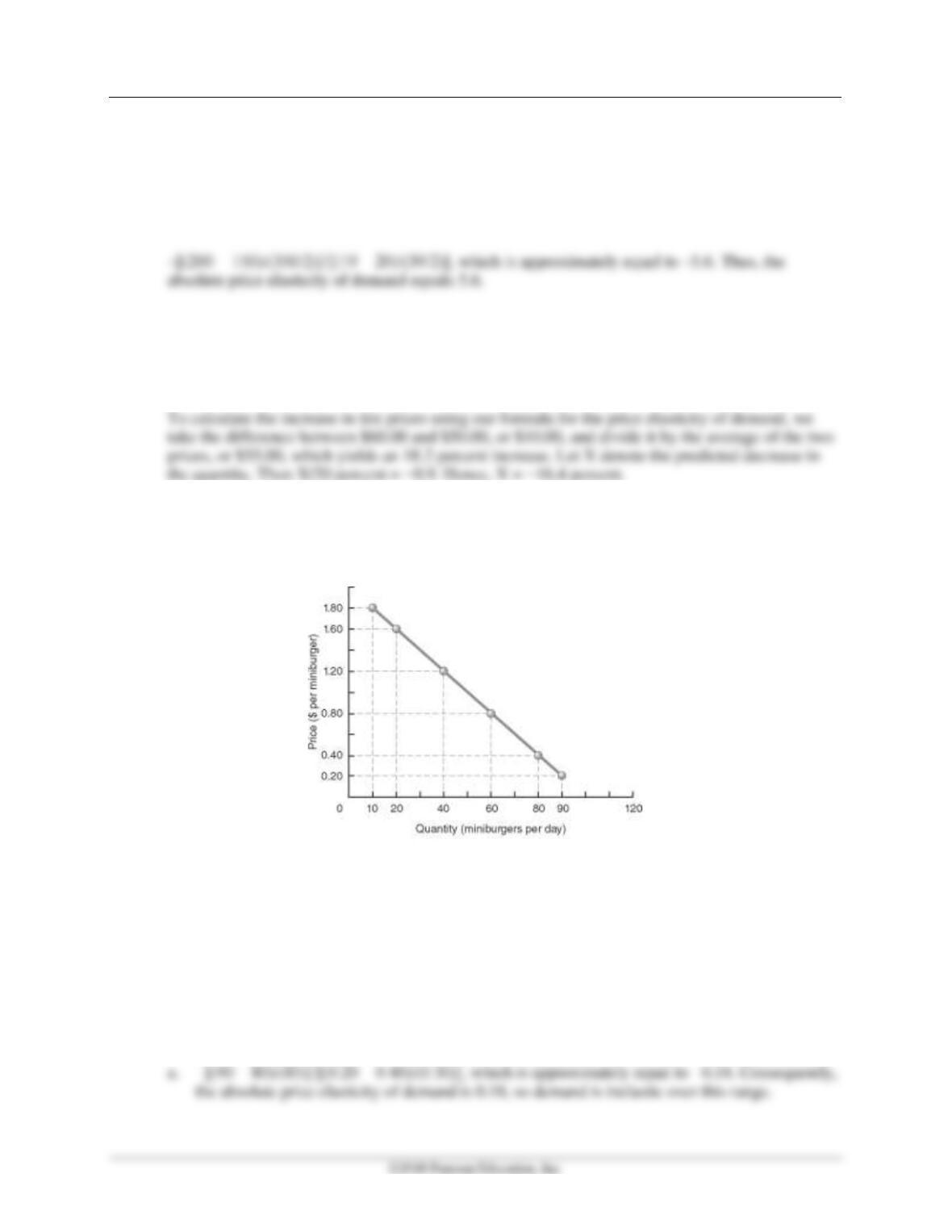
19-3. The diagram below depicts the demand curve for “miniburgers” in a nationwide fast-food
market. Use the information in this diagram to answer the questions that follow.
a. What is the price elasticity of demand along the range of the demand curve between a
price of $0.20 per miniburger and a price of $0.40 per miniburger? Is demand elastic or
inelastic over this range?
b. What is the price elasticity of demand along the range of the demand curve between a
price of $0.80 per miniburger and a price of $1.20 per miniburger? Is demand elastic or
inelastic over this range?
c. What is the price elasticity of demand along the range of the demand curve between a
price of $1.60 per miniburger and a price of $1.80 per miniburger? Is demand elastic or
inelastic over this range?
19-4. In a local market, the monthly price of Internet access service decreases from $20 per
account to $10 per account, and the total quantity of monthly accounts across all Internet
access providers increases from 100,000 to 200,000. What is the price elasticity of demand?
Is demand elastic, unit-elastic, or inelastic?
19-5. At a price of $57.50 to play 18 holes on local golf courses, 1,200 consumers pay to play a game
of golf each day. A rise in the price to $62.50 causes the number of consumers to decline to
800. What is the price elasticity of demand? Is demand elastic, unit-elastic, or inelastic?
19-6. It is very difficult to find goods with perfectly elastic or perfectly inelastic demand. We can,
however, find goods that lie near these extremes. Characterize demands for the following
goods as being near perfectly elastic or near perfectly inelastic.
a. Corn grown and harvested by a small farmer in Iowa
b. Heroin for a drug addict
c. Water for a desert hiker
d. One of several optional textbooks in a pass-fail course
19-7. In the market for hand-made guitars, when the price of guitars is $800, annual revenues are
$640,000. When the price falls to $700, annual revenues decline to $630,000. Over this range
of guitar prices, is the demand for hand-made guitars elastic, unit-elastic, or inelastic?
19-8. Suppose that over a range of prices, the price elasticity of demand varies from 15.0 to 2.5.
Over another range of prices, the price elasticity of demand varies from 1.5 to 0.75. What
can you say about total revenues and the total revenue curve over these two ranges of the
demand curve as price falls?
19-9. Based solely on the information provided below, characterize the demands for the following
goods as being more elastic or more inelastic.
a. A 45-cent box of salt that you buy once a year
b. A type of high-powered ski boat that you can rent from any one of a number of rental
agencies
c. A specific brand of bottled water
d. Automobile insurance in a state that requires autos to be insured but has only a few
insurance companies
e. A 75-cent guitar pick for the lead guitarist of a major rock band
19-10. The value of cross price elasticity of demand between goods X and Y is 1.25, while the cross
price elasticity of demand between goods X and Z is –2.0. Characterize X and Y and X and
Z as substitutes or complements.
19-11. Suppose that the cross price elasticity of demand between eggs and bacon is –0.5. What
would you expect to happen to purchases of bacon if the price of eggs rises by 10 percent?
19-12. A 5 percent increase in the price of digital apps reduces the amount of tablet devices
demanded by 3 percent. What is the cross price elasticity of demand? Are tablet devices and
digital apps complements or substitutes?
19-13. An individual’s income rises from $80,000 per year to $84,000 per year, and as a
consequence, the person’s purchases of movie downloads rise from 48 per year to 72 per
year. What is this individual’s income elasticity of demand? Are movie downloads a normal
or inferior good? (Hint: You may want to refer to the discussion of normal and inferior
goods on page 58 in Chapter 3.)
19-14. Assume that the income elasticity of demand for hot dogs is –1.25 and that the income
elasticity of demand for lobster is 1.25. Based on the fact that the measure for hot dogs is
negative while that for lobster is positive, are these normal or inferior goods?
Chapter 19 Demand and Supply Elasticity 295
19-15. At a price of $25,000, producers of midsized automobiles are willing to manufacture and
sell 75,000 cars per month. At a price of $35,000, they are willing to produce and sell
125,000 a month. Using the same type of calculation method used to compute the price
elasticity of demand, what is the price elasticity of supply? Is supply elastic, unit-elastic,
or inelastic?
19-16. An increase in the market price of men’s haircuts, from $15 per haircut to $25 per haircut,
initially causes a local barbershop to have its employees work overtime to increase the
number of daily haircuts provided from 35 to 45. When the $25 market price remains
unchanged for several weeks and all other things remain equal as well, the barbershop hires
additional employees and provides 65 haircuts per day. What is the short-run price
elasticity of supply? What is the long-run price elasticity of supply?
19-17. Consider panel (a) of Figure 19-1. Use the basic definition of the price elasticity of demand
to explain why the value of the price elasticity of demand is zero for the extremely rare
situation of vertical demand curve?
19-18. Take a look at Figure 19-2. Work out the calculation for the price elasticity of demand
between prices of $11 per reservation and $10 per reservation to prove that the value is 21?
19-19. Consider Figure 19-2. Work out the calculation for the price elasticity of demand between
prices of $1 per reservation and $2 per reservation to prove that the value is 0.158?
296 Miller • Economics Today, Nineteenth Edition
19-20. Take a look at Figure 19-2. Work out the calculation for the price elasticity of demand
between prices of $6 per reservation and $5 per reservation to prove that the value is 1?
19-21. Consider Figure 19-3. Following a price increase, is the quantity demanded more responsive
to the price increase immediately, after an initial passage of time, and then after even more
time has passed? Why is this so?
19-22. Take a look at Figure 19-5. Following a price increase, is the quantity supplied more
responsive to the price increase immediately, after an initial passage of time, and then after
even more time has passed? Why is this so?
◼ Selected References
Allen, R.G.D., “The Concept of Arc Elasticity of Demand,” Review of Economic Studies, Vol. 1,
June 1934, pp. 226–229.
Lerner, A.P., “Geometrical Comparisons of Elasticities,” American Economic Review, Vol. 37,
March 1947, p. 191.
Marshall, Alfred, Principles of Economics, 8th ed., London: Macmillan, 1920.