4. The marginal product of medical care declines as
medical expenditures rise because the improve-
ment in health outcomes is very large when med-
ical care goes from non ex is tent to basic (i.e.,
when medical expenditures are low), but, as the
level of treatment rises (and therefore as expendi-
tures rise), patients tend to undergo treatments
supply of health- care providers. In addition, the
investment required for medical school and resi-
dency keeps the supply of doctors lower than
what might be considered optimal for society. Fur–
thermore, the market power that many health-
care providers enjoy because of imperfect
competition keeps supply lower and prices higher
than they would be in a more competitive market.
Hints and Common Errors: Another
supply- related driver of medical care costs is the
Study Prob lems
1. If my insurance com pany charges me a $25
copay, then the marginal cost of my consultation
to me is $25 (though the marginal cost of the
Questions for Review
1. Asymmetric information is an information
imbalance in which one party in an economic
transaction knows more about product cost, qual-
ity, and so forth than the other party. Asymmet–
ric information matters in the health- care
care system.
2. (Answers here will vary.) Adverse se lection
occurs in the used car market because the sellers
of the cars know more about their quality than
the buyers do, and owners of low- quality cars
are generally more willing to sell their cars at a
given price than are owners of high- quality cars.
This observation causes rational consumers to be
suspicious of people who are willing to sell their
used cars, as the cars that the consumers actu-
3. (Answers here will vary.) For the adverse se lection
prob lem, buyers could use an information source
such as CARFAX to verify the history of the vehi-
cle, or the seller could offer a warranty to both
signal quality and insure the buyer against
Solutions to Chapterfi18 Text Prob lems
from the two plans), we can use the following
equation, where x represents the level of
anticipated medical expense:
medical expenses were $666.67.
8. a. This is adverse se lection because the seller of
the ticket has more information about its
legitimacy and because a seller is more willing
to sell a bogus ticket than a legitimate ticket at
any given price.
your agent in order to look out for your lawn-
mowing interests. Unfortunately for the lawn,
the teenager’s incentives aren’t aligned with
yours, and undermowing results.
10. The key characteristic that distinguish the mar–
11. a. You should book every visit for which the
price you’d be willing to pay is at least equal
to the price you actually have to pay, namely
$300. That is another way of saying that you
should buy up to the point where your
demand curve hits the marginal cost curve.
So, you should plan on four visits.
b. Full coverage means that instead of a constant
3. The insurance com pany uses the physical exam,
to the degree pos si ble, to overcome the adverse
se lection prob lem of asymmetric information.
system.
4. a.
An annual physical for someone between the
ages of 20 and 35 likely has fairly elastic
demand because it’s not a crucial procedure.
b. An MRI used to detect cancer likely has fairly
inelastic demand because it is a crucial proce–
dure with few substitutes.
5. If the sale of kidneys were legalized, the price of a
kidney would rise from the current price of zero
to what ever price would bring the supply and
demand of kidneys into equilibrium. (In contrast,
the price of kidneys in illegitimate markets would
Hints and Common Errors: If, in
contrast, the demand for kidneys were to be
defined by the number of people needing
transplants rather than by willingness to pay,
it’spos si ble that a shortage could still exist.
7. If the consumer anticipated $200 per month in
medical bills, she would expect to pay $100
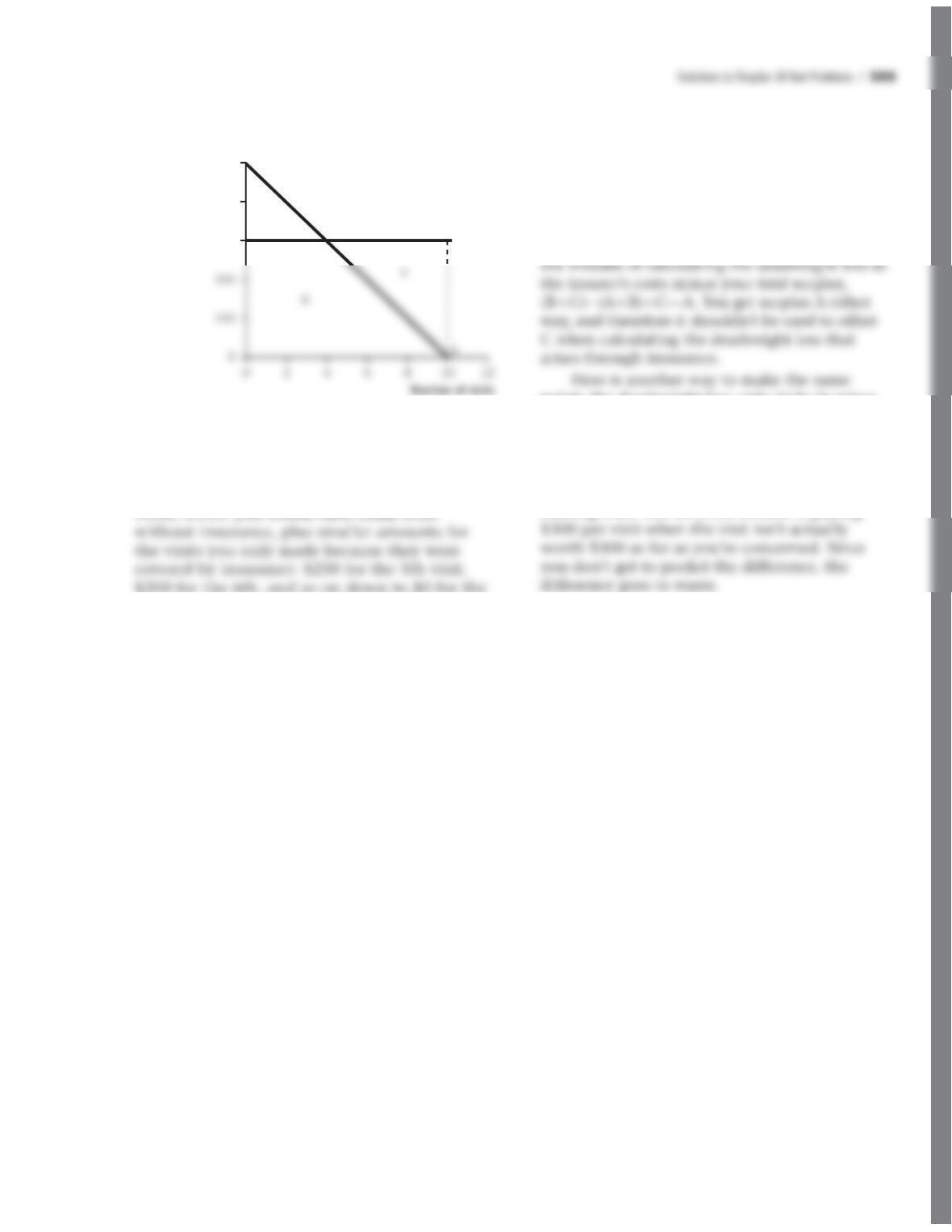
10thvisit, which even with insurance you
were basically indifferent about. Your total
gain in surplus is 4($300) $250 $200 $150
$100 $50 $0 “ $1,950. The difference
between that and the insurer’s cost is
$3,000 $1,950 “ $1,050, and that is the
deadweight loss.
Hints and Common Errors: Don’t make
point: the deadweight loss only kicks in when
your decisions start to be affected. For the four
visits you would have made either way, the $300
insurance coverage is just a transfer from the
insurer to you. There, the insurer’s loss is your
gain, with no benefit going to waste. But
exceeds your gain by area C. That is the dead-
weight loss in graphical terms.
Price
($/visit)
MC
A
$500
400
300
Keeping in mind that visits occur as
discrete units rather than as a continuous
series of fractions, we can calculate the
insurer’s total cost, 10 w $300 “ $3,000. Your
gain in surplus is $300 for each of the first 4