CHAPTER 19 | The International Financial System 477
Appendix
The Gold Standard and the Bretton Woods System
(pages 1066–1071)
Learning Objective: Explain the gold standard and the Bretton Woods System.
A. The Gold Standard
By 1913, every country in Europe, except Spain and Bulgaria, and most countries in the Western
B. The End of the Gold Standard
The greatest drawback of the gold standard was that the central bank lacked control of the money supply.
Because the central bank cannot control how much gold will be discovered, it lacks the control of the
C. The Bretton Woods System
The global economy suffered during the 1930s from tariff wars. As World War II came to an end,
economists and government officials in the United States and Europe concluded that they needed to
Under the Bretton Woods system, central banks were committed to selling dollars in exchange for their
own currencies. This commitment required them to hold dollar reserves. If a central bank ran out of
reserves, it could borrow them from the newly created International Monetary Fund (IMF)—an
D. The Collapse of the Bretton Woods System
By the late 1960s, the Bretton Woods System faced two severe problems. First, after 1963 the total
number of dollars held by foreign central banks was larger than the gold reserves of the United States.
478 CHAPTER 19 | The International Financial System
During the 1960s, most European countries relaxed their capital controls, which are limits on the flow of
foreign exchange and financial investment across countries. Loosening capital controls made it easier for
Extra AN INSIDE LOOK News Article to Use in Class
CHAPTER 19 | The International Financial System 479
Solutions to End-of-Chapter Exercises
19.1
Exchange Rate Systems
Learning Objective: Describe how different exchange rate systems operate.
Review Questions
1.1 An exchange rate system is an agreement among countries on how exchange rates should be
1.2 Under the gold standard, exchange rates were determined by the relative amounts of gold in each
country’s currency. Both the gold standard and Bretton Woods system were fixed exchange rate
Problems and Applications
1.3 You should disagree because the gold in Fort Knox has nothing to do with the amount of paper
1.4 The textbook states: “Under the gold standard, a country’s currency consisted of gold coins and
paper currency the government was committed to redeem for gold.” Normally, during a recession
the Federal Reserve uses open market operations to expand the money supply and lower interest
1.5 The United States and many other countries suffered from severe recession during the 1930s, and
expansionary monetary policies were needed. An expansionary monetary policy would require an
1.6 After World War II, countries would have preferred the Bretton Woods system to reestablishing
the gold standard because the constraints of the gold standard had made countries worse off
during the Great Depression. The gold standard was a fixed exchange rate system under which
the currencies of participating countries were convertible into an agreed-upon amount of gold.
480 CHAPTER 19 | The International Financial System
The quantity of gold held by a country determined its money supply. The Bretton Woods system
of fixed exchange rates was not as tied to gold and had more flexibility. Even though the United
19.2
The Current Exchange Rate System
Learning Objective: Discuss the three key features of the current exchange rate system.
Review Questions
2.1 The theory of purchasing power parity holds that in the long run, exchange rates move to equalize
the purchasing power of different currencies. Three real-world complications keep purchasing
2.2 One determinant of exchange rates in the long run is relative price levels between countries. If the
price level in another country rises faster than the price level in the United States, then the value
of the U.S. dollar will rise. Another determinant is the relative rates of productivity growth
2.3 As of 2015, the following 19 member countries of the European Union used the euro: Austria,
Belgium, Cyprus, Estonia, Finland, France, Germany, Greece, Ireland, Italy, Latvia, Lithuania,
2.4 One currency is pegged against another currency when a country decides to keep the exchange rate
between its currency and another currency fixed. Countries peg their currencies to make planning
easier for firms with extensive trade with another country; to aid firms that have borrowed foreign
CHAPTER 19 | The International Financial System 481
Problems and Applications
2.5 Canadian professional sports teams are better off when the Canadian dollar increases in value
2.6 a. The value of the U.S. dollar will increase relative to other currencies when investors believe
U.S. interest rates will rise because the investors will increase their demand for dollars to buy
2.7 You should disagree because the values of exchange rates are not connected to national wealth.
That it takes more than 1 yen to exchange for 1 U.S. dollar and more than 1 U.S. dollar to
2.8 If Australia’s rate of inflation is greater than the inflation rate in New Zealand, then similar goods
sold in both countries will become more expensive in Australia than in New Zealand. Consumers
2.9 Yes, these data are consistent with purchasing power parity, which argues that in the long run the
most important determinant of exchange rates between two currencies is the relative price levels
2.10 By this standard, Japan, Indonesia, China, Mexico, the United Kingdom and Canada have
undervalued currencies because the implied exchange rate indicates that it should take fewer units
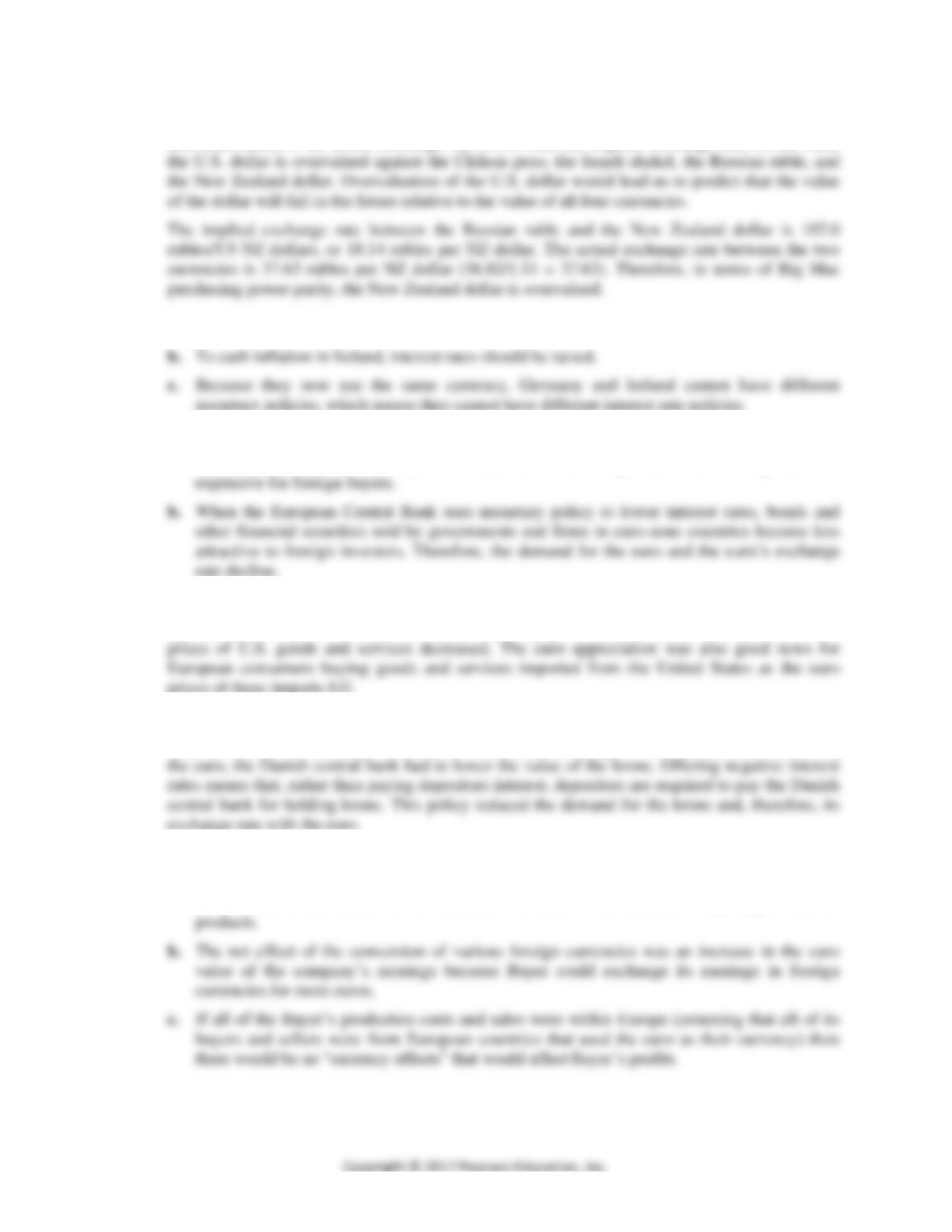
2.11 To calculate the purchasing power exchange rate, divide the foreign currency price of a Big Mac
by the U.S. price ($4.79).
Country
Big Mac Price
Implied Exchange
Rate
Actual Exchange Rate
Chile
2,100.0
pesos
438.41
642.45 pesos per dollar
Israel
shekels
3.78 shekels per dollar
Russia
rubles
56.82 rubles per dollar
482 CHAPTER 19 | The International Financial System
The U.S. dollar is overvalued if the actual exchange rate is greater than the implied exchange rate
and undervalued if the actual exchange rate is less than the implied exchange rate. In this case,
2.12 a. To alleviate recession in Germany, interest rates should be lowered.
2.13 a. The “euro’s fall”–the depreciation of the euro relative to the U.S. dollar and other currencies–
lowers the prices of German exports in dollars and other foreign currencies, making them less
2.14 Between January 2007 and July 2008, the euro appreciated against the U.S. dollar. This
appreciation was good news for U.S. firms exporting goods and services to Europe as the euro
2.15 In January 2015 the European Central Bank began a bond buying program that decreased interest
rates and decreased the value of the euro. To maintain the pegged value of the krone relative to
2.16 a. Bayer AG converts the earnings it receives from foreign sales into euros. “Favorable currency
effects” means that during the second quarter of 2015 there was a decline in the value of the
euro relative to the values of the currencies of some of the countries where Bayer sells its
CHAPTER 19 | The International Financial System 483
2.17 a. There is a shortage of baht in exchange for U.S. dollars because at the pegged exchange rate
2.18 Argentina’s peg collapsed when it stopped fixing the value of the peso against the U.S. dollar,
and the value of the peso declined dramatically. Argentine firms that borrowed dollars had to
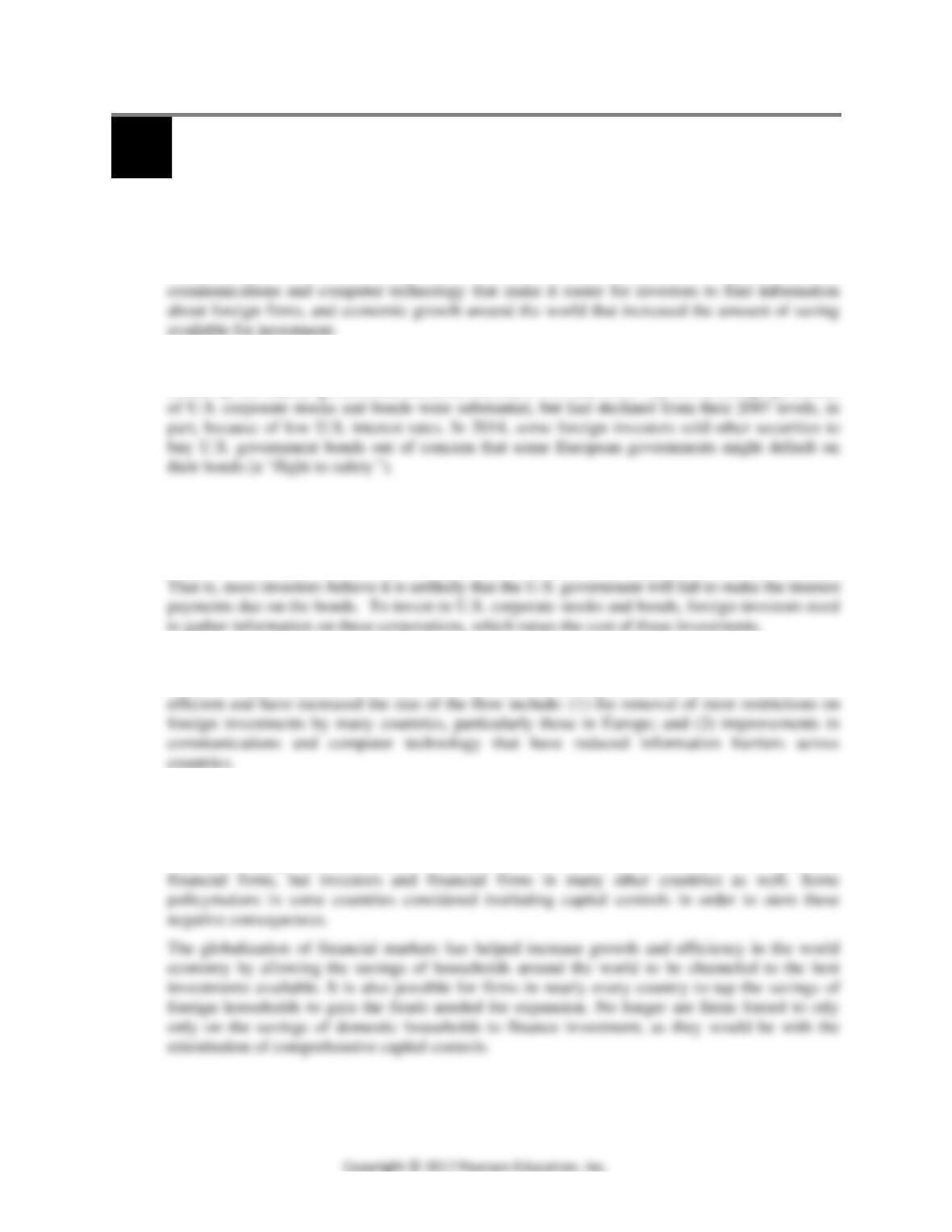
2.19 The following graph assumes that he Chinese central bank pegs the exchange rate for the yuan
below the market equilibrium exchange rate. This implies that the yuan is undervalued.
Compared to the equilibrium exchange rate an undervalued yuan will increase exports and
2.20 a. A “competitive devaluation” refers to the Chinese central bank decreasing the exchange rate
of the yuan relative to the dollar in order to increase its exports by their lowering the prices of
the exports in foreign currencies. Some of China’s increased export revenue would be at the
expense of exports that other countries would otherwise have been able to make.
484 CHAPTER 19 | The International Financial System
19.3
International Capital Markets
Learning Objective: Discuss the growth of international capital markets.
Review Questions
3.1 The main factors behind the globalization of capital markets were the removal of restrictions by
European governments on foreign investments in financial markets, the improvements in
3.2 A dramatic increase in foreign purchases of stocks and bonds issued by corporations and bonds
issued by the federal government occurred between 1995 and 2007. By 2014, foreign purchases
Problems and Applications
3.3 Foreign investors are more likely to buy government bonds than corporate bonds or stocks
because it is widely believed that U.S. government securities are largely free from default risk.
3.4 Economic growth relies on the funds households save being available for capital investment.
Aspects of globalization that have made the flow of saving from households to firms more
3.5 With the globalization of financial markets, financial securities issued in one country are held by
investors and firms in many other countries. If a financial crisis causes those securities to decline
in value, the negative consequences will be felt widely. As an example, the sharp decline in the
value of mortgage-backed securities issued in the United States hurt not only U.S. investors and
CHAPTER 19 | The International Financial System 485
Real-Time Data Exercises
D19.1 a. The exchange rates are quoted as units of foreign currency per U.S. dollar. On October 16,
2015, the exchange rates were 119.60 yen per U.S. dollar, 6.3523 yuan per U.S. dollar, and
16.3820 Mexican pesos per U.S. dollar.
b. The price of a Big Mac in terms of U.S. dollars in Japan is ¥300/¥119.60 = $2.51, in China
D19.2 a. Since 1981, the Chinese yuan has depreciated against the dollar. The exchange rate was
1.5341 yuan to the dollar in January 1981 and 6.3523 yuan to the dollar in October 2015.
D19.3 a. Over the past five years, net foreign purchases of long-term U.S. securities have been quite
volatile: (I) August 2010: $118.0 billion (II) August 2015: −$35.0 billion.
Solutions to Chapter 19 Appendix
Review Questions
19A.1 Under the gold standard, the exchange rate between two currencies was determined by the
quantity of gold in each currency. The gold standard collapsed during the Great Depression
486 CHAPTER 19 | The International Financial System
19A.4 Capital controls are limits on the flow of foreign exchange and financial investment across
countries.
30A.5 The International Monetary Fund provided loans to central banks that were short of dollar
Problems and Applications
19A.7 With the $4 = £1 exchange rate, you would buy gold in London for £1 per ounce and sell the gold
in the New York for $5. You could then exchange $4 for £1, and have a $1 profit per ounce of
gold. You could make an unlimited profit by buying gold in London and shipping it to New York.
With the $6 = £1 exchange rate, you would buy gold in the United States for $5 per ounce and
19A.11 The author was incorrect about what the United States abandoned in the 1970s. It was the Bretton
Woods fixed exchange rate system that the United States abandoned rather than the gold
standard, which the United States abandoned in 1933. Two problems led to the collapse of the
Bretton Woods system. First, the total number of dollars held by foreign central banks had
19A.12 a. By using the phrase “zealous money printing” the writer of this column means that the
Federal Reserve increased the money supply more than the increase in U.S. real GDP in the
1960s. Inflation results when a country’s money supply increases more rapidly than the rate
of output.
CHAPTER 19 | The International Financial System 487
b. Some of the dollars created in the 1960s were used to buy imports from other countries. As
foreign central banks converted these dollars into their own currencies, central banks held
19A.13 The Bretton Woods system broke down because countries were not able to maintain exchange
rates that were either above or below equilibrium exchange rates. In other words, fixed exchange
rates are difficult to maintain in the long run. By pegging their currencies to the dollar, East Asian
countries were following a fixed exchange rate policy.
19A.14 The other countries in the Bretton Woods system fixed their exchange rates against the dollar.
When the United States initiated inflationary monetary policy, the theory of purchasing power
19A.15 For a country to leave its currency to the “whims of the markets” means that the currency floats
with its exchange rate determined by demand and supply. A floating exchange rate makes doing
Real-Time Data Exercises
D19A.1 a. On April 1, 1968 the price of gold was $38 per ounce. On October 19, 2015 the price of gold
was $1,171.65 per ounce. Under the Bretton Woods system, the United States pledged to buy