608 Chapter 19
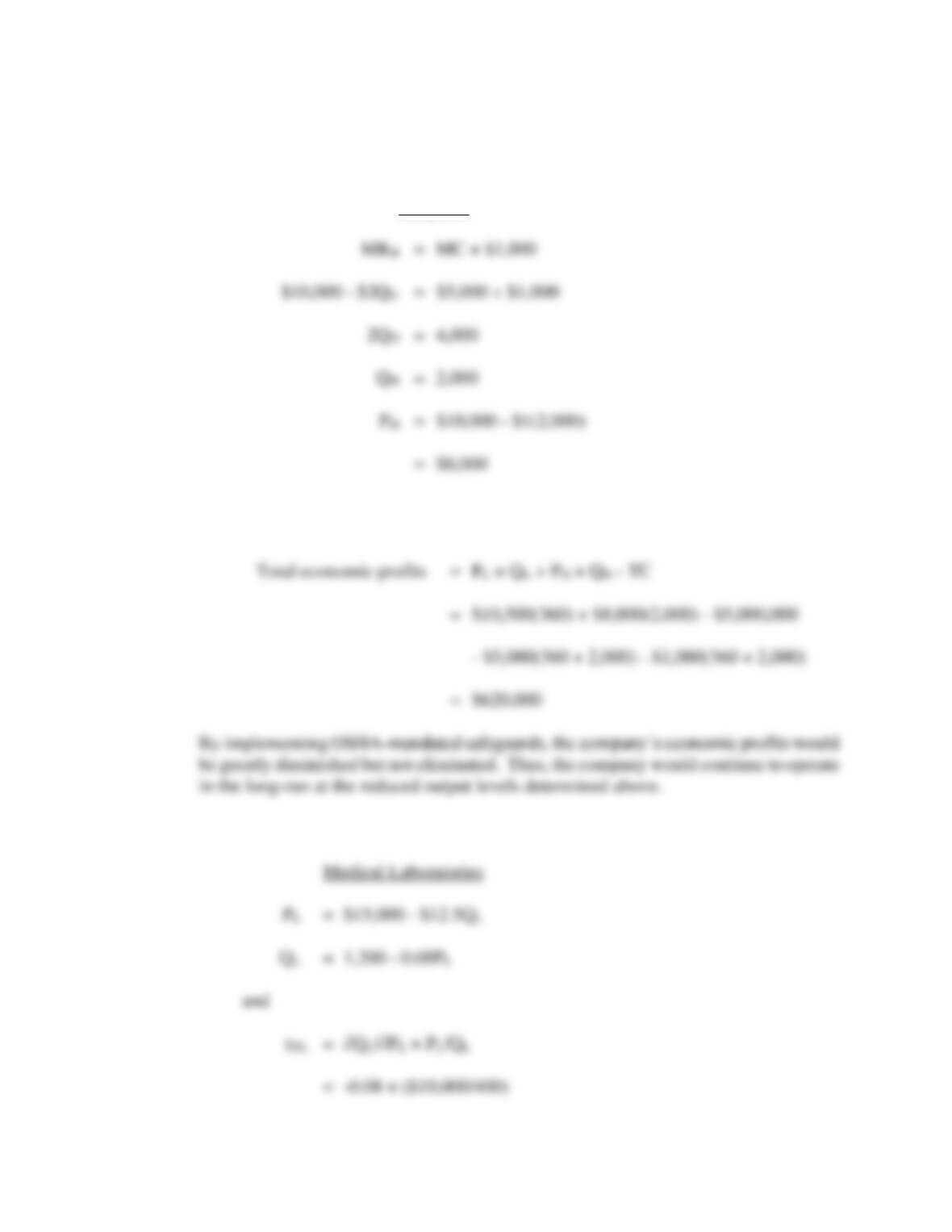
Hospitals
Long-run implications can be inferred by considering the profit implications of
implementing OSHA standards.
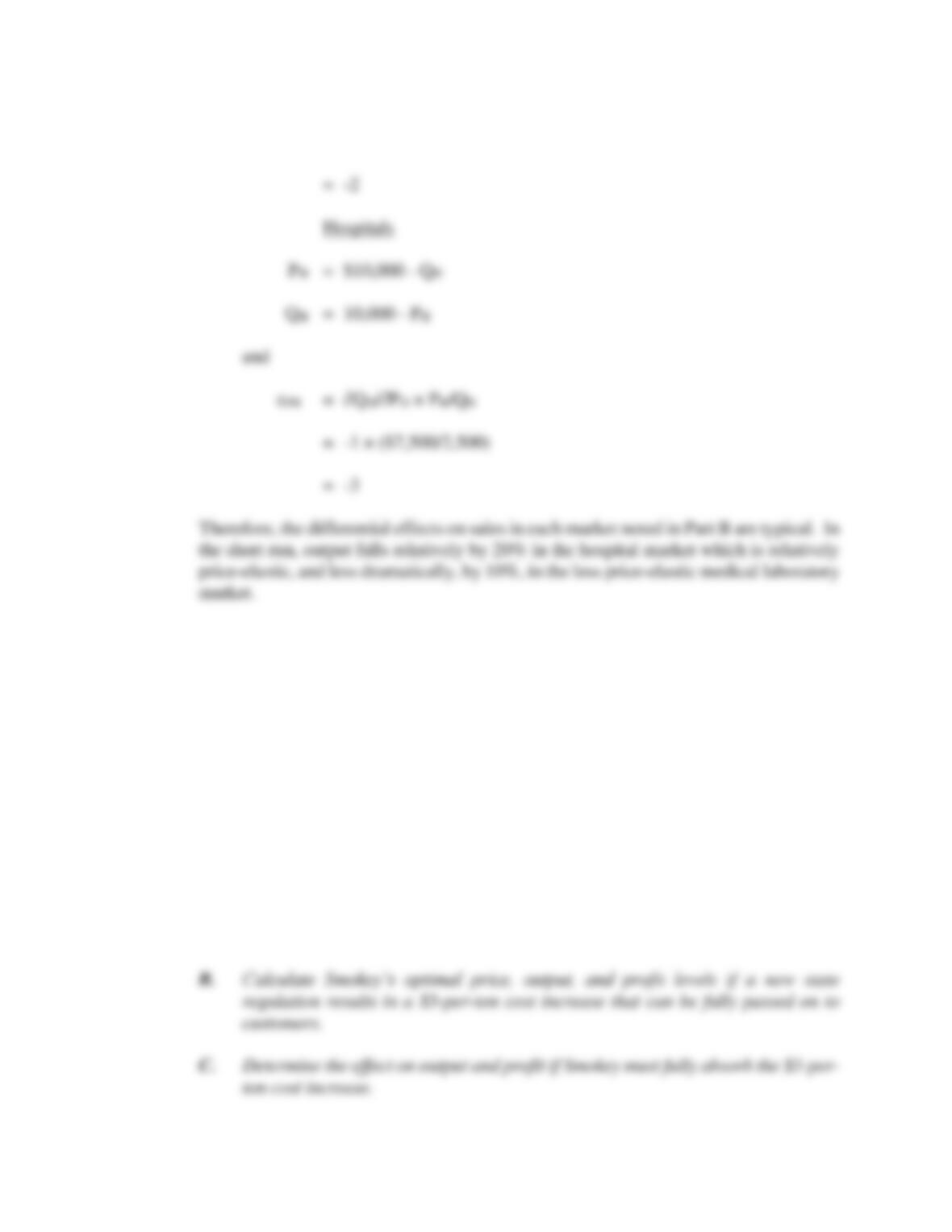
C. From part A:
Government in the Market Economy 609
P19.4 Incidence of Regulation Costs. The Smokey Mountain Coal Company sells coal to
electric utilities in the southeast. Unfortunately, Smokey’s coal has a high particulate
content, and, therefore, the company is adversely affected by state and local regulations
governing smoke and dust emissions at its customers’ electricity-generating plants.
Smokey’s total and marginal cost relations are
TC = $1,000,000 + $5Q + $0.0001Q2
MC =
TC/
Q = $5 + $0.0002Q
where Q is tons of coal produced per month and TC includes a risk-adjusted normal rate
of return on investment.
A. Calculate Smokey’s profit at the profit-maximizing activity level if prices in the
industry are stable at $25 per ton and therefore P = MR = $25.

610 Chapter 19
P19.4 SOLUTION
A. Set MR = MC to find the profit maximizing activity level:
B. If the $5 regulation-induced cost increase can be fully passed on to customers, then MR
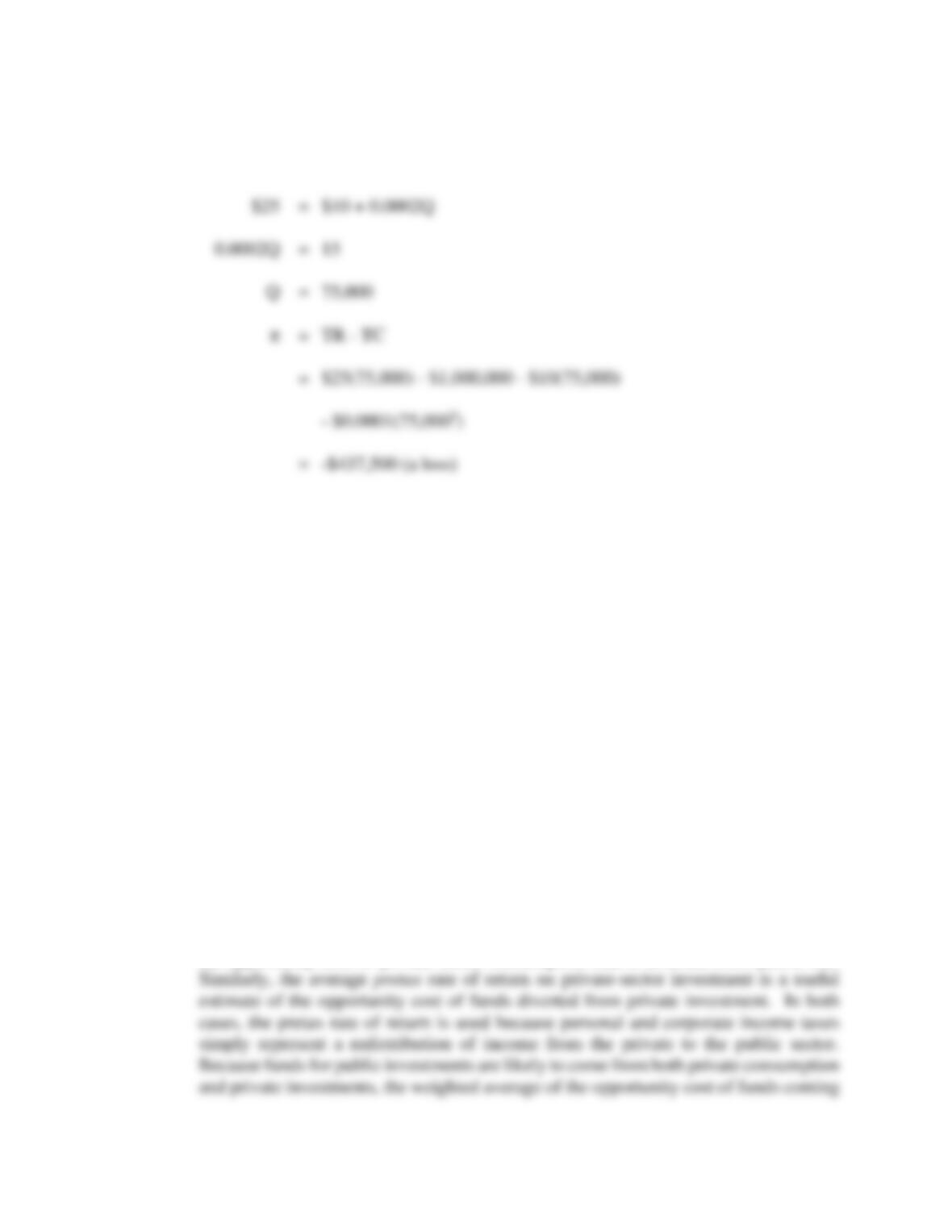
C. In the short-run, prices remain stable at P = MR = $25 and Smoky will be forced to
Government in the Market Economy 611
P19.5 Social Rate of Discount. Because resources for social programs and public-sector
investment projects come from private-sector consumption and/or investment,
economists typically advocate the use of a social rate of discount that reflects this
private-sector opportunity cost. A good estimate of the opportunity cost of funds
diverted from private consumption is the rate of return on government securities that is
available to individual investors. Similarly, the average rate of return on private
investments can be taken as the opportunity cost of private-sector investment funds.
A. Should pretax or after-tax rates of return be used to estimate the opportunity cost
of resources diverted from the private sector to fund social programs or
public-sector investment projects? Why?
B. Assume that the rate of return on long-term government bonds is 8%, a typical
after-tax return on investment in the private sector is 10%, the marginal corporate
and individual tax rate is 30%, and consumption averages 95% of total income.
Based on the information provided, calculate an economically appropriate social
rate of discount.
P19.5 SOLUTION
A. The average pretax rate of return on government securities is a conservative estimate of
the opportunity cost of private-sector consumption that is diverted from public use.
612 Chapter 19
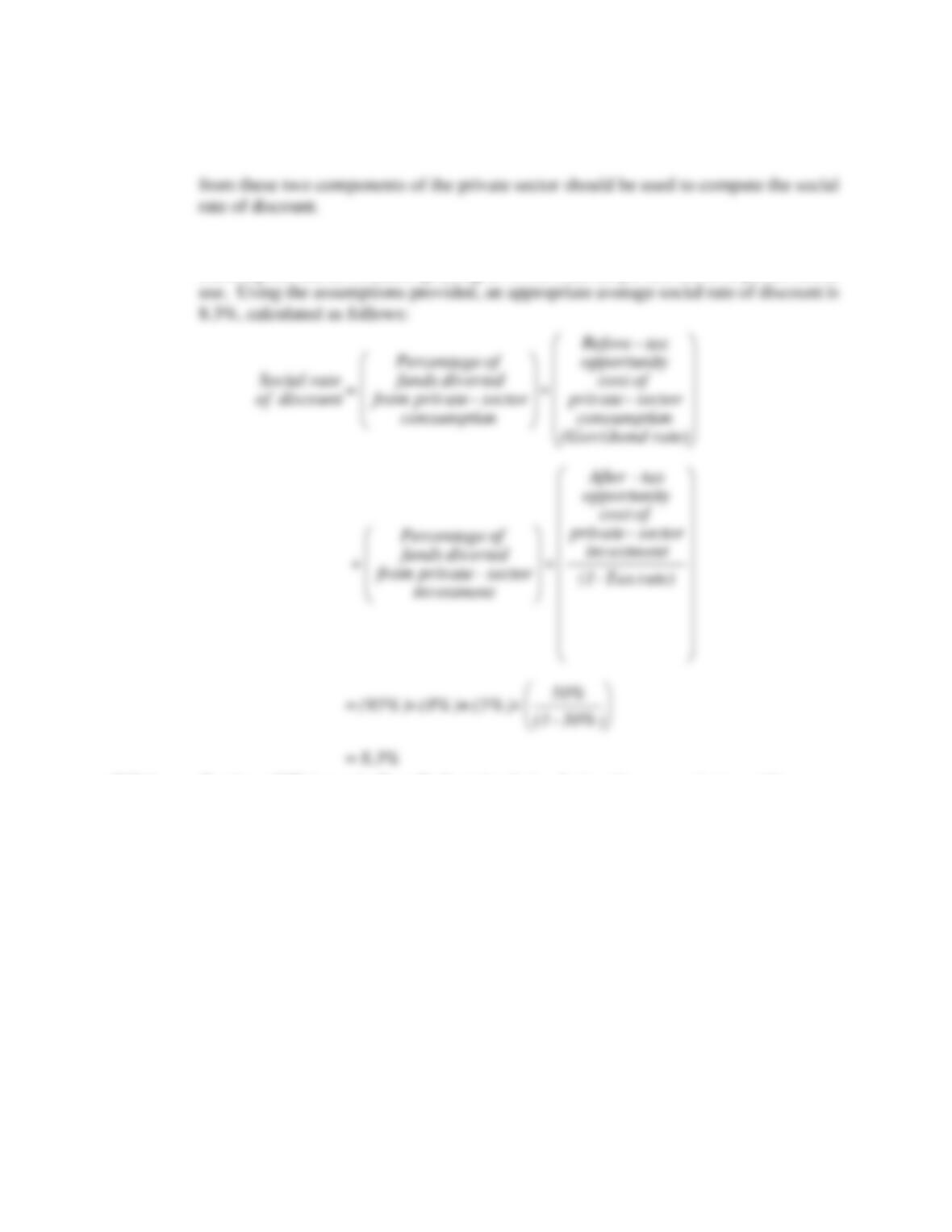
B. The appropriate social rate of discount is a weighted average of the opportunity cost of
consumption and investment spending diverted from the private sector to public-sector
P19.6 Equity v. Efficiency in Benefit-Cost Analysis. In benefit-cost analysis, public-sector
managers seek to learn if society as a whole will be better off by the adoption of a
specific social program or public-sector investment project. Rather than seeking to
maximize profits or the value of the firm, public-sector managers use benefit-cost
analysis to maximize, or at least move toward a maximization of, the excess of marginal
social benefits over marginal social costs. With this goal in mind, from an efficiency
perspective, the distribution of any social net present-value is of no importance. For
example, when the city of Denver sponsors Denver International Airport at an initial
cost of $3.5 billion, it makes no difference whether the city pays the entire cost or
whether the city, the state of Colorado, and the federal government split these costs.
Similarly, if the city of Denver is motivated by the desire to lure business and tourist
traffic from Chicago or Los Angeles, the benefits of increased economic activity in
Denver that has merely shifted from other transportation centers should not be counted.
In both instances, the proper concern is the increase in aggregate social wealth, not
aggregate local wealth.
Government in the Market Economy 613
A. Assume that the city of Denver and local airline customers must pay only 10% of
the costs of Denver International Airport, with the federal government picking up
the other 90% of the tab. Describe how a local benefit-cost analysis of the airport
project might be distorted by this cost-sharing arrangement.
B. Under the federal revenue sharing program, the federal government collects tax
revenues that are then returned to states and other local units of government to
support a wide variety of social programs. Can you see any problems for an
efficient allocation of public expenditures when the spending and taxing authority
of government is divided in this manner?
C. Can the equity and efficiency implications of social programs and public-sector
investment projects be completely separated?
P19.6 SOLUTION
A. An impartial and balanced consideration of the marginal social benefits and marginal
social costs of public-sector investment projects can be severely distorted by
614 Chapter 19
C. As a practical matter, it may not be politically or socially possible to completely separate
the equity and efficiency implications of social programs and public-sector investment
projects. In their role as consultants to policy makers in the public sector, economists
P19.7 Benefit-Cost Analysis. Highway crashes continue to claim the lives of thousands of
Americans. Grim statistics underscore the need for better laws, stricter enforcement,
and safer driving behavior. In 2006, approximately 43,300 persons died on the nation’s
highways. Alcohol-related fatalities accounted for 41.4 percent of the total. The
majority of passenger vehicle occupants killed in crashes were not wearing safety belts.
As a practical matter, it is important to recognize that most highway fatalities are
preventable. Using current technology, highway fatalities could be substantially
reduced by draconian laws against drunk driving, mandatory seat belts, and strictly
enforced speed limits. Needless to say, popular opposition would be intense. Speed
limits as high as 75 mph on major highways are popular because consumers derive
significant economic and social benefits from swift automobile transportation.
However, by failing to sharply reduce or eliminate highway fatalities, speed limit policy
places a finite and measurable value on human life.
A. From an economic standpoint, explain how public policy sets a dollar value on
human life. Is it efficient to do so?
B. Are there equity considerations one must weigh in judging the fairness of dollar
estimates of the value of human life?
P19.7 SOLUTION
A. The economic valuation of human life has consequences for a broad range of
management decisions in both the private and public sectors. For example, companies
must decide how much to spend to make their products safer and to enhance the safety
of the work environment. Government agencies must determine the amount to spend on
Government in the Market Economy 615
Several different methods have been proposed over the years for calculating the
value of a human life. The human capital approach, determines the value of a human
life as the discounted present value of a person’s expected lifetime earnings. An obvious
disadvantage of this approach is that it is one-dimensional; by focusing only on earning
An alternative approach is to estimate life values from actual economic behavior.
One study derived estimates based on people’s willingness to pay extra for houses
located in areas with lower levels of pollution. Another study estimated life values from
data on the risk versus time tradeoffs connected with automobile seat belt usage (those
who buckle up and those who do not). Credible estimates have been developed using
lives can be saved for as little as $100,000 to $800,000, consumers appear willing, if not
eager, to embrace necessary regulation. Health and safety regulation becomes much
more controversial when the cost of saving human life soars. Life-value estimates based
on labor-market studies average in the $3 million range. A wide range of life-value
estimates, falling between $650,000 and $7.5 million, are used by different Federal
616 Chapter 19
In addition to the direct costs associated with pain and suffering, other indirect
costs of chicken pox have the potential to add meaningfully to the economic benefits of
a vaccine. When researchers in the Journal of the American Medical Association
included indirect costs of chicken pox, such as work days lost when parents stay home to
P19.8 Privatization. In Massachusetts, a state education law authorized the establishment of
charter schools. Charter schools are public schools that receive state funding as well as
some measure of autonomy from local school boards and the rules that govern
conventional schools. As a result, students and educators in Boston face the ready
prospect of classrooms with politicians as lecturers, academic instruction aided by yoga,
school doors open from dawn to dusk, and public schools run on a for-profit basis.
Charter schools already are operating in Minnesota and California, and five other
states promise to join the trend with recently enacted charter-school legislation.
Advocates of such schools argue that they provide badly needed competition for existing
public schools. Under the charter-school concept, anyone with a good education idea
gets access to government funding, so long as they can attract and effectively train
students.
Government in the Market Economy 617
A. Explain how breaking the public-school monopoly on access to public funding
could help improve the quality of public- and private-school primary education.
B. Explain why primary-school privatization might not create such benefits.
P19.8 SOLUTION
A. Both public-sector and private-sector monopoly have the potential to lead to inefficiency
and waste. In the case of primary education in the U.S., significant evidence exists to
suggest that the public school monopoly on public funding has led to poor quality,
inefficiency and waste. Failing to meet the basic expectations of primary education, the
B. Clearly, private-sector bidding for the right to provide government services does not
always occur under perfectly competitive conditions. When private contractors have
been used to offer schooling, build roads or provide other public services in small towns,
618 Chapter 19
P19.9 Economics of Health Care. The United States spends more per person on health care
than any other country in the world. Still, recent studies show that the United States
ranks relatively low in the overall quality of health care provided. France is often
described as providing its citizens with the globe’s best health care. Japan wins the
distinction as having the world’s healthiest people. Although good at expensive care,
like open-heart surgery, the U.S. healthcare delivery system is often described as poor at
low-cost preventive care.
A. Explain the role of public and private insurance in making the demand for
health-care different from the demand for many other services.
B. Consumers buy healthcare to improve their health and well-being, but research
suggests only a weak connection between health-care spending and health.
Explain why there might be only a weak link between health-care expenditures
and health.
C. Why is health-care spending rising rapidly on a worldwide basis? Is robust
growth in healthcare spending likely to continue?
P19.9 SOLUTION
A. Health-care demand is different from the demand for many other services because most
B. Consumers buy health-care to improve their health and well-being, but recent research
suggests that the connection between health-care and health is not a simple one.
Government in the Market Economy 619
group that may be more strongly affected by improvements in medical technology, is
rapidly increasing.
capita have also declined by about one-third, in part because of greater use of seat belts.
Despite the many medical advances of recent years, cures for many diseases have
yet to be discovered and new diseases continue to emerge. For example, the rate of
mortality from breast cancer has not improved since 1950 despite the development of
new screening methods and treatment therapies. Acquired immune deficiency
C. Rapid growth in health-care spending is somewhat surprising because countries around
the world have very different systems for financing and furnishing health-care services.
As health-care expenditures continue to rise, each of these countries is considering a
variety of proposals for health-care reform. In some cases, these reform proposals
include incorporating features of U.S. health-care financing and provision. The United
620 Chapter 19
P19.10 Health-Care Reform. Public support dropped for a Medicare prescription-drug law
endorsed by President George W. Bush and passed by a Republican-controlled
Congress following withering criticism from Democrats. Democrats were upset that the
law prevented Medicare from negotiating lower prices from drug manufacturers and
prohibited the purchase of cheaper medicines from Canada. The Congressional Budget
Office projected the 10-year cost at $395 billion, but Medicare officials quickly raised
that figure to $534 billion over ten years. Meanwhile, conservatives argued that
expensive drug benefits will encourage employers to drop existing coverage for retirees.
A. Explain how Medicare prescription-drug benefits might have the unintended effect
of increasing drug prices.
B. Explain how Medicare prescription-drug benefits might affect the supply of new
and innovative drugs.
P19.10 SOLUTION
A. Medicare prescription drug benefits bring an important new buyer into the market for
prescription drugs: the Federal government. Such a law could initially result in lower
Government in the Market Economy 621
B. In the short run, surging demand for prescription drugs can produce a windfall for the
drug companies, and spur interest in developing new and innovative drug therapies. In
price and/or profit controls.
Members of Congress often declare that drug manufacturers can afford to reduce
their prices because they earn unreasonably high profits. What they often neglect to
mention is that the process of discovering and successfully marketing new prescription
drugs is fraught with risk. A high rate of return on investment in the industry is
622 Chapter 19
CASE STUDY FOR CHAPTER 19
Oh, Lord, Won’t You Buy Me a Mercedes-Benz (Factory)?1
In 1993, Alabama emerged victorious as the site of Mercedes-Benz AG’s first U.S. car plant. States
like Alabama are vying more desperately than ever to lure new industrial jobs and hold on to those
that they have. To start with, they give away millions of dollars in free land. After that come fat
checks for site clearance, training, even employee salaries. Both foreign and domestic companies
are finding ingenious ways to cash in.
Mercedes initially had so little interest in Alabama that Mercedes’ site-selection team
did not even plan to visit the state. Of more than 20 states that Mercedes looked at seriously, it
governments and utilities to promise to buy large quantities of the four-wheel-drive recreational
vehicles that the new factory would produce. Mercedes officials even asked the states to pick up the
salaries of its 1,500 workers for their first year or so on the job, at a cost of $45 million. The
workers would be in a training program and would not be producing anything, Mercedes explained.
Although North Carolina and other state officials said no, Alabama said yes, even to the salary
request. Alabama economic development officials argued that the Mercedes project simply was
worth more to Alabama than it was to any other state.
When Mercedes found North Carolina proposing to build a $35 million training center
at the company’s plant, the German automaker enticed Alabama to more than match the North
Government in the Market Economy 623
available in advance in the form of an interest–free loan. Mercedes officials also say Alabama’s
promised education spending was double any other state’s promise. Alabama officials even agreed
to place Mercedes’ distinctive emblem atop a local scoreboard in time for the big, televised
Alabama-Tennessee football game. The price? Why, free, of course. In all, Alabama wound up
promising Mercedes over $300 million in incentives, which economic development experts called a
record package for a foreign company.
Critics complain that Alabama subsidies used to land the Mercedes-Benz deal represent
an egregious example of “corporate welfare.” During recent years, as many as 44 of the 50 states
have stepped up to offer economic incentives for corporations to relocate, rebuild, or remain in their
jurisdictions. Detractors argue that handouts given corporations by local, state, and federal
governments in the form of subsidies, grants, low-interest loans, or free government service amounts
A. With $300 million in state aid to attract 1,500 new jobs, the initial marginal social cost
to Alabama taxpayers of attracting the Mercedes plant was $200,000 per job. Estimate
the minimum marginal social benefit required to make this a reasonable expenditure
from the perspective of Alabama taxpayers. Do the facts of this case lead you to believe
that it is more likely that Alabama underbid or overbid for this project? Explain.
B. Does the fact that the bidding process for the Mercedes plant took place at the state and
local level of government have any implications for the amount of inducements offered?
624 Chapter 19
D. Critics contend that taxpayers in Alabama were denied the opportunities provided by
alternate privately-directed capital investment projects because the state chose to
redirect public and private investment toward the Mercedes plant project. Instead of
enjoying an efficient increase in business activity among a number of smaller
enterprises, employees, taxpayers, and consumers are left with a large and potentially
inefficient state-directed investment in the auto plant. Do you agree? Why or why not?
CASE STUDY SOLUTION
A. With $300 million in state aid to attract 1,500 new jobs, the minimum marginal social
benefit required to make this a reasonable expenditure from the perspective of Alabama
taxpayers is that same $300 million, or $200,000 per job. From an economic
Whether or not Alabama underbid or overbid for this project is a matter of
conjecture. However, there is at least some reason to believe that the State may have in
fact overbid. In support of this notion, the bidding among the various states was
ferocious. For example, when North Carolina failed to match Alabama’s tax breaks,
Commerce Secretary Phillips says, contacts with Mercedes cooled. For its part,
Government in the Market Economy 625
social benefit required to make this a reasonable expenditure from the perspective all
taxpayers is that same $300 million, or $200,000 per job. From a benefit-cost
perspective, at least $300 million, or $200,000 per job, in local, state, and national
benefits would have to be generated to justify this expenditure. What is different from
the problem faced by Alabama officials is that, from a Federal government perspective,
the movement of jobs among North Carolina, South Carolina or Alabama is largely
immaterial.
What is important from a Federal government perspective is job creation not job
shifting among the states, or from established employers to new employers. The
C. A benefit-cost analysis of the Alabama-Mercedes project could account for any potential
erosion of in the local tax base at the state and local level as a potential cost or reduction
D. This is a controversial question posed in the interest of spurring debate. From an
efficiency perspective, the principal question centers on whether a single, large
626 Chapter 19
In addition, once a business organization like Mercedes-Benz enjoys the ease of
operating in a subsidized economic environment, it becomes likely that the firm will
Supporters of government-financed economic incentives for corporations to
relocate, rebuild or remain in their jurisdictions see such advantages as merely directed
tax cuts. Corporations don’t pay taxes, people do. Corporate taxes are taxes that place