Chapter 19 (8)
International Monetary Systems:
An Historical Overview
◼ Chapter Organization
Macroeconomic Policy Goals in an Open Economy
Internal Balance: Full Employment and Price Level Stability
External Balance: The Optimal Level of the Current Account
Box: Can a Country Borrow Forever? The Case of New Zealand
Classifying Monetary Systems: The Open-Economy Monetary Trilemma
The Interwar Years, 1918–1939
The Fleeting Return to Gold
International Economic Disintegration
Case Study: The International Gold Standard and the Great Depression
The Bretton Woods System and the International Monetary Fund
Goals and Structure of the IMF
118 Krugman/Obstfeld/Melitz • International Economics: Theory & Policy, Tenth Edition
The External Balance Problem of the United States under Bretton Woods
Case Study: The End of Bretton Woods, Worldwide Inflation, and the Transition to Floating Rates
The Mechanics of Imported Inflation
Assessment
The Case for Floating Exchange Rates
What Has Been Learned Since 1973?
Monetary Policy Autonomy
Symmetry
The Exchange Rate as an Automatic Stabilizer
◼ Chapter Overview
This is the first of four international monetary policy chapters. These chapters complement the preceding
theory chapters in several ways. They provide the historical and institutional background students require
to place their theoretical knowledge in a useful context. The chapters also allow students, through study of
historical and current events, to sharpen their grasp of the theoretical models and to develop the intuition
those models can provide. (Application of the theory to events of current interest will hopefully motivate
students to return to earlier chapters and master points that may have been missed on the first pass.)
Chapter 19 (8) International Monetary Systems: An Historical Overview 119
Underlying each of these exchange rate systems is the “open economy trilemma,” the observation that you
can have two, but never three, of the following: exchange rate stability, independent monetary policy, and
free capital mobility. Whereas the gold standard traded independent monetary policy for exchange rate
stability and capital mobility, the Bretton Woods system allowed for autonomous monetary policy by
limiting capital flows, and the modern floating era sacrifices exchange rate stability for the other two
goals. The price-specie-flow mechanism described by David Hume shows how the gold standard could
ensure convergence to external balance. You may want to present the following model of the price-specie-
flow mechanism. This model is based upon three equations:
1. The balance sheet of the central bank. At the most simple level, this is just gold holdings equals the
money supply: G = M.
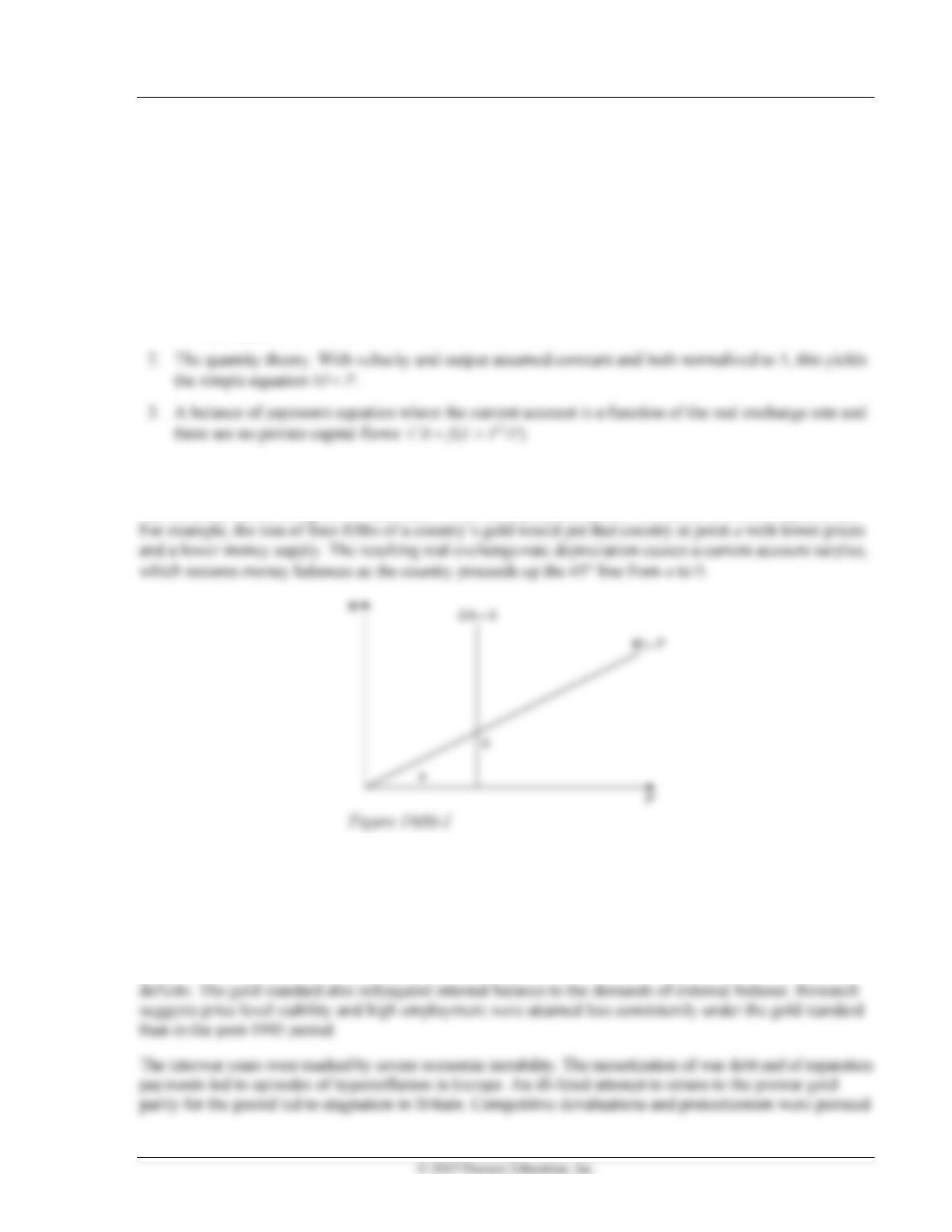
These equations can be combined in a figure like the one below. The 45 line represents the quantity theory,
and the vertical line is the price level where the real exchange rate results in a balanced current account.
The economy moves along the 45 line back toward the equilibrium point 0 whenever it is out of equilibrium.
The automatic adjustment process described by the price-specie-flow mechanism is expedited by following
“rules of the game” under which governments contract the domestic source components of their monetary
bases when gold reserves are falling (corresponding to a current-account deficit) and expand when gold
reserves are rising (the surplus case).
In practice, there was little incentive for countries with expanding gold reserves to follow the “rules of the
game.” This increased the contractionary burden shouldered by countries with persistent current account
120 Krugman/Obstfeld/Melitz • International Economics: Theory & Policy, Tenth Edition
© 2015 Pearson Education, Inc.
in a futile effort to stimulate domestic economic growth during the Great Depression. These beggar-thy-
neighbor policies provoked foreign retaliation and led to the disintegration of the world economy. As one
of the case studies shows, strict adherence to the gold standard appears to have hurt many countries during
the Great Depression.
countries with temporary balance of payments problems.
A formal discussion of internal and external balance introduces the concepts of expenditure-switching and
expenditure-changing policies. The Bretton Woods system, with its emphasis on infrequent adjustment
of fixed parities, restricted the use of expenditure-switching policies. Increases in U.S. monetary growth to
finance fiscal expenditures after the mid-1960s led to a loss of confidence in the dollar and the termination
These advantages must be matched with the experience of countries running floating exchange rate regimes.
Floating exchange rates should give countries greater autonomy over monetary policy. However, the
evidence suggests that changes in monetary policy in one country do get transmitted across borders,
limiting autonomy. Second, exchange rates have become less stable. For example, in the mid 1970s, the
United States chose to pursue monetary expansion to fight a recession, whereas Germany and Japan
contracted their money supplies to counter inflation. As a result, the dollar sharply depreciated against these
currencies. The symmetry benefit of floating rates is also limited by the fact that the dollar still serves as the
world’s reserve currency, much as it did under Bretton Woods. Although floating rates do work as
automatic stabilizers, the effects may be unevenly distributed within countries. For example, the U.S.
fiscal expansion of the 1980s appreciated the dollar, limiting inflation overall. However, U.S. farmers were
Chapter 19 (8) International Monetary Systems: An Historical Overview 121
◼ Answers to Textbook Problems
1. a. Because it takes considerable investment to develop uranium mines, you would want a larger
current-account deficit to allow your country to finance some of the investment with foreign
savings.
2. Because the marginal propensity to consume out of income is less than 1, a transfer of income from B
to A increases savings in A and decreases savings in B. Therefore, A has a current account surplus and
3. Changes in parities reflected both initial misalignments and balance of payments crises. Attempts to
return to the parities of the prewar period after the war ignored the changes in underlying economic
4. A monetary contraction, under the gold standard, will lead to an increase in the gold holdings of the
contracting country’s central bank if other countries do not pursue a similar policy. All countries cannot
succeed in doing this simultaneously because the total stock of gold reserves is fixed in the short run.
5. The increase in domestic prices makes home exports less attractive and causes a current account deficit.
This diminishes the money supply and causes contractionary pressures in the economy, which serve
to mitigate and ultimately reverse wage demands and price increases.
6. An increase in the world interest rate leads to a fall in a central bank’s holdings of foreign reserves as
domestic residents trade in their cash for foreign bonds. This leads to a decline in the home country’s
122 Krugman/Obstfeld/Melitz • International Economics: Theory & Policy, Tenth Edition
7. Capital account restrictions insulate the domestic interest rate from the world interest rate. Monetary
policy, as well as fiscal policy, can be used to achieve internal balance. Because there are no offsetting
capital flows, monetary policy, as well as fiscal policy, can be used to achieve internal balance. The
costs of capital controls include the inefficiency, which is introduced when the domestic interest rate
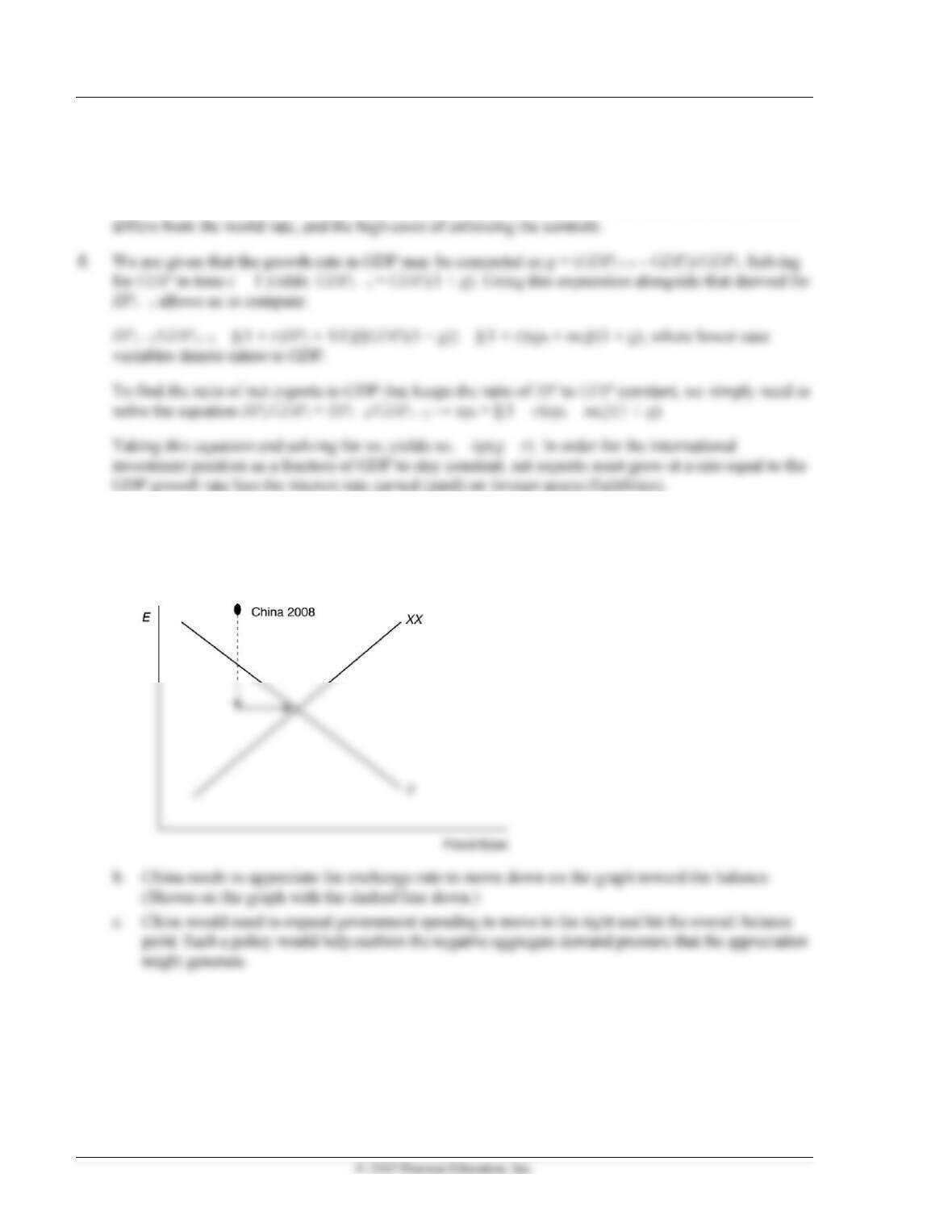
9. a. We know that China has a very large current-account surplus, placing them high above the XX
line. They also have moderate inflationary pressures (described as “gathering” in the question,
implying they are not yet very strong). This suggests that China is above the II line but not too far
above it. It would be placed in zone 1 (see below).
Chapter 19 (8) International Monetary Systems: An Historical Overview 123
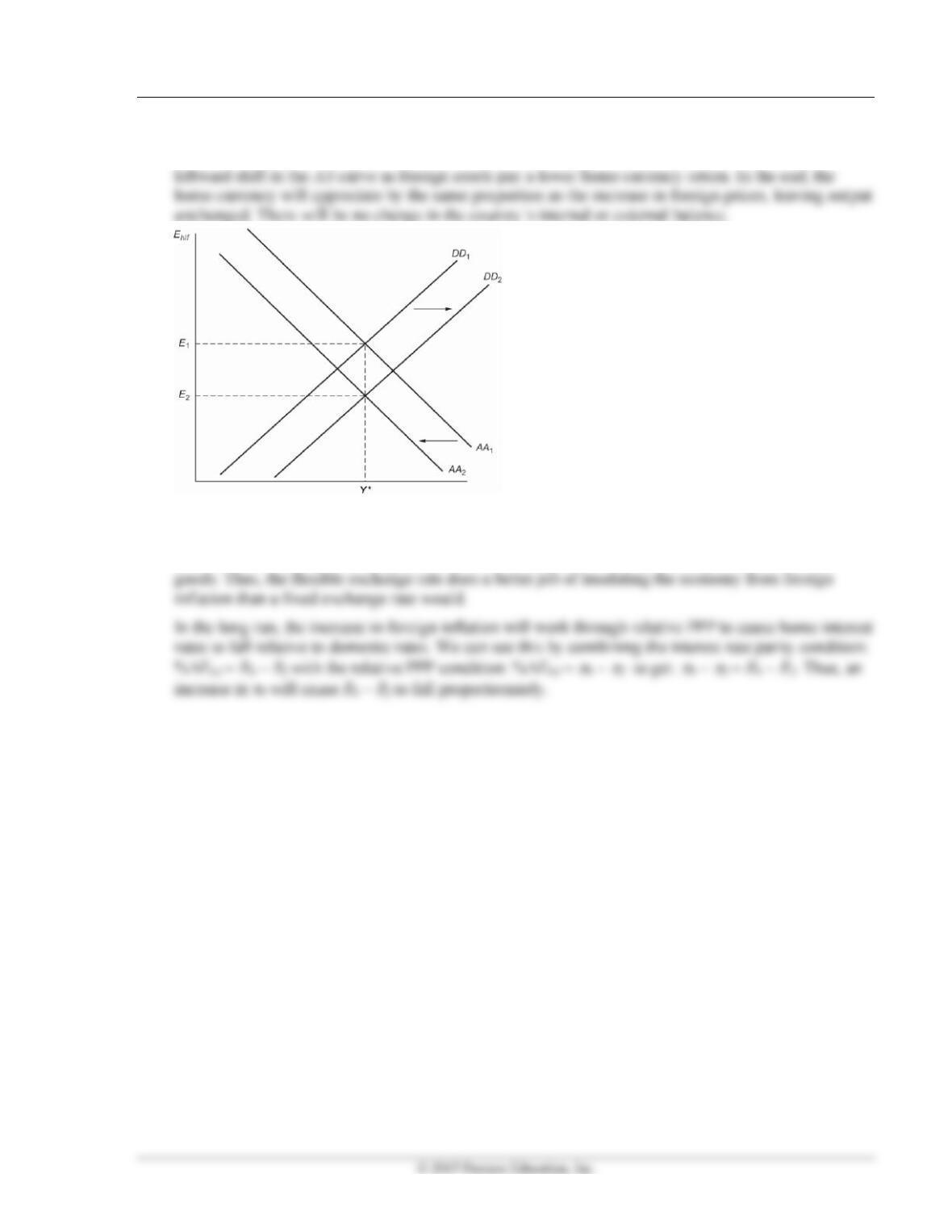
10. The increase in foreign prices will shift the DD curve out to the right as demand for home products
increases (exports rise, imports fall). If the expected exchange rate also falls, then there will be a
11. An increase in the foreign inflation rate should lead to a short-run appreciation of the domestic currency
as consumers shift their consumption toward relatively cheaper domestic goods. The appreciation of
the domestic currency will mitigate the effects of foreign inflation by reducing the price of imported
124 Krugman/Obstfeld/Melitz • International Economics: Theory & Policy, Tenth Edition
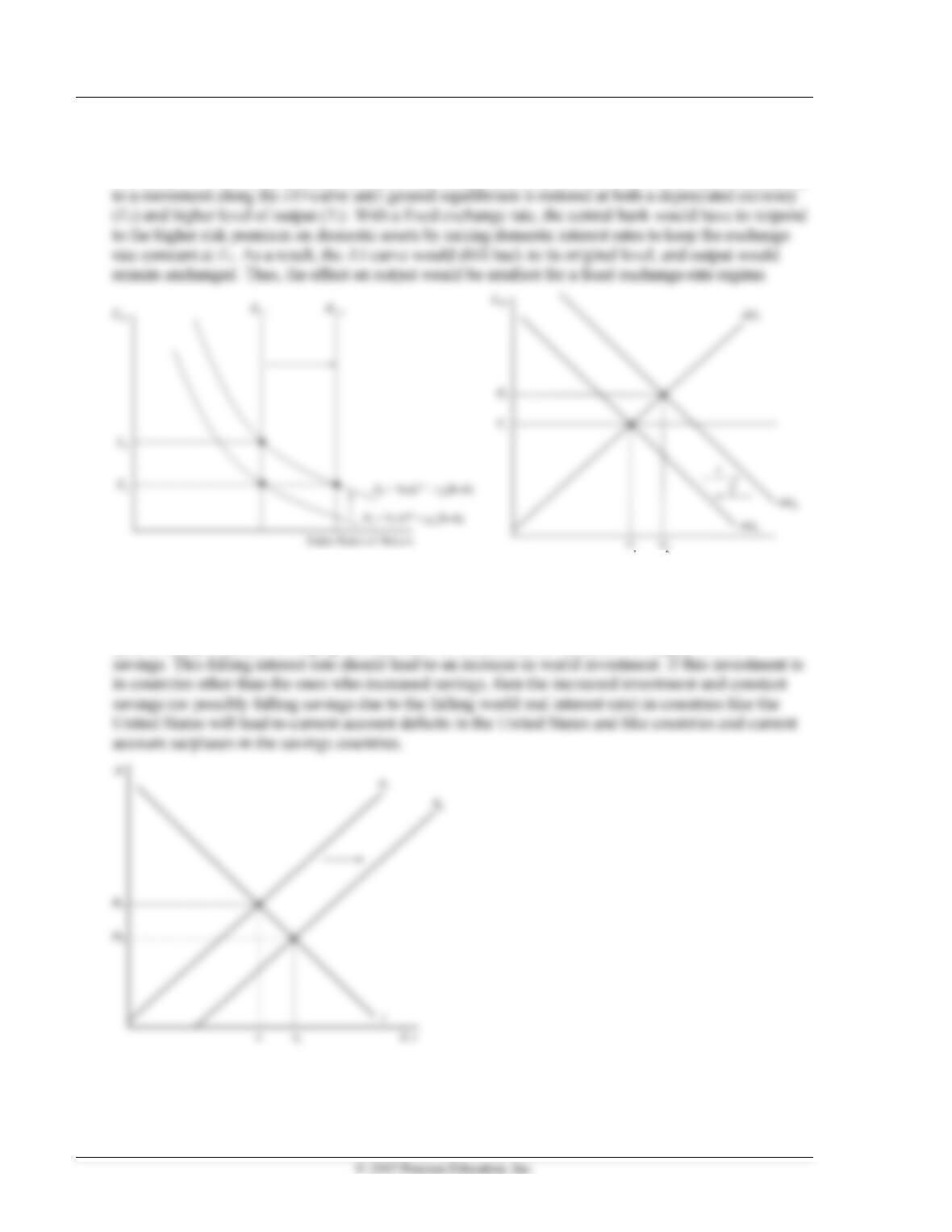
12. An increase in the risk premium on domestic assets will shift the AA curve to the right, reflecting the
fact that asset market equilibrium is now attained at a higher exchange rate (depreciated domestic
currency). With floating exchange rates, the depreciated currency will stimulate export demand, leading
13. The simple model of savings and investment against the real interest rate can be drawn as shown
below. The increase in world savings can be shown as a rightward shift in the savings schedule. The
result is that the world real interest rate falls and the amount of savings and investment rises. We can
think of the “global savings glut” story here. World interest rates went down as large-scale savings
(public and private), in emerging market countries in particular, increased the supply of world
Chapter 19 (8) International Monetary Systems: An Historical Overview 125
14. The table below shows U.S. money market interest rates and inflation rates from 1970 to 1976.
You can find these data in the IMF’s International Financial Statistics, available in most libraries.
Assuming that expected inflation equals actual inflation, we can generate the real interest rates.
Year
Nominal Interest Rate
(percent per year)
Inflation
(percent per year)_
Real Interest Rate
(percent per year)
1970
7.2
5.9
1.3
1971
4.7
4.3
0.4
1972
4.4
3.3
1.1
1973
8.7
6.2
2.5
15. If other central banks sell dollars for euros, then it is equivalent to a sterilized sale of dollars because
neither the United States nor any other central bank’s asset side of the balance sheet has changed.
Thus, the money supply is unchanged everywhere. On the other hand, there is a larger supply of
dollar assets relative to euro assets in circulation than before. If this is not viewed as a signal of U.S.
16. Students may find navigating the Australian Bureau of Statistics website challenging, given the large
volume of information available on this site. That said, once the data has been collected, the solution
to this problem is fairly straightforward.
From problem 8, we know that the international investment position as a share of GDP will be