452 CHAPTER 18 | Macroeconomics in an Open Economy
Solving the Problem
Step 1: Review the chapter material.
This problem is about the effect of fiscal policy and monetary policy, so you may want to
Step 2: If the United States had a closed economy, would the Federal Reserve have to
lower the federal funds rate by more or less than 50 basis points in order to have
the same effect on aggregate demand as in an open economy?
Because the United States has an open economy, open market operations that reduce the
Step 3: Explain for which value of the MPI, 0.10 or 0.20, an income tax cut would have
the greater impact on aggregate demand.
In an open economy, the larger the value of the MPI the larger the increase in imports as GDP
Extra Making
the
Connection
Fiscal and Monetary Policy Face New Challenges after
2007–2009
The financial crisis and the recession of 2007–2009 presented unprecedented challenges to the Federal
Reserve. It may take years before the Fed gets a final report card for its performance. As the United States
economy began to show new life in late 2009, investors were uncertain about the future. “There has been
a lot of disappointment with the way the U.S. credit crisis was handled,” says Claire Dissaux, managing
CHAPTER 18 | Macroeconomics in an Open Economy 453
However, movement away from the dollar as a reserve currency seemed unlikely in the near future.
Attempts by China to coax foreign companies to conduct transactions with yuan, rather than dollars, have
yet to meet much success. Corporate executives said it is difficult to buy and sell in yuan because of the
Extra Economics in Your Life:
Should You Buy Euro Bonds?
Question: A friend of yours mentions he read about a European Commission’s proposal to sell euro-zone
bonds. These bonds would replace some or all of the bonds offered by each of the euro-zone national
governments. Assume that euro bonds are offered for sale to investors and that the yield on these bonds is
greater than the yield on U.S Treasury bonds with the same maturity. Assume that there is no default risk
on both types of bonds. Would the euro bonds be a better investment than U.S. Treasury bonds?
Answer: Although the euro bonds offer a higher interest rate than Treasury bonds, there is one other
Extra AN INSIDE LOOK News Article to Use in Class
454 CHAPTER 18 | Macroeconomics in an Open Economy
Solutions to End-of-Chapter Exercises
18.1
The Balance of Payments: Linking the United States to the
International Economy
Learning Objective: Explain how the balance of payments is calculated.
Review Questions
1.1 Leaving aside the statistical discrepancy and the capital account, both of which are small, the
current account plus the financial account equals the balance of payments, which always equals
zero.
1.3 a. The current account records the value of a country’s net exports (exports of goods and
services minus imports of goods and services), net income on investments (income received
on foreign investments minus income payments on investments), and net transfers.
b. The following answers explain why in each case a country is likely to have a deficit in its
current account. Note that because net exports are part of a country’s current account,
Problems and Applications
1.4 With a current account deficit, France would have experienced a net capital inflow because
having a current account deficit means that France must have run a financial account surplus. A
country running a financial account surplus experiences a net capital inflow.
CHAPTER 18 | Macroeconomics in an Open Economy 455
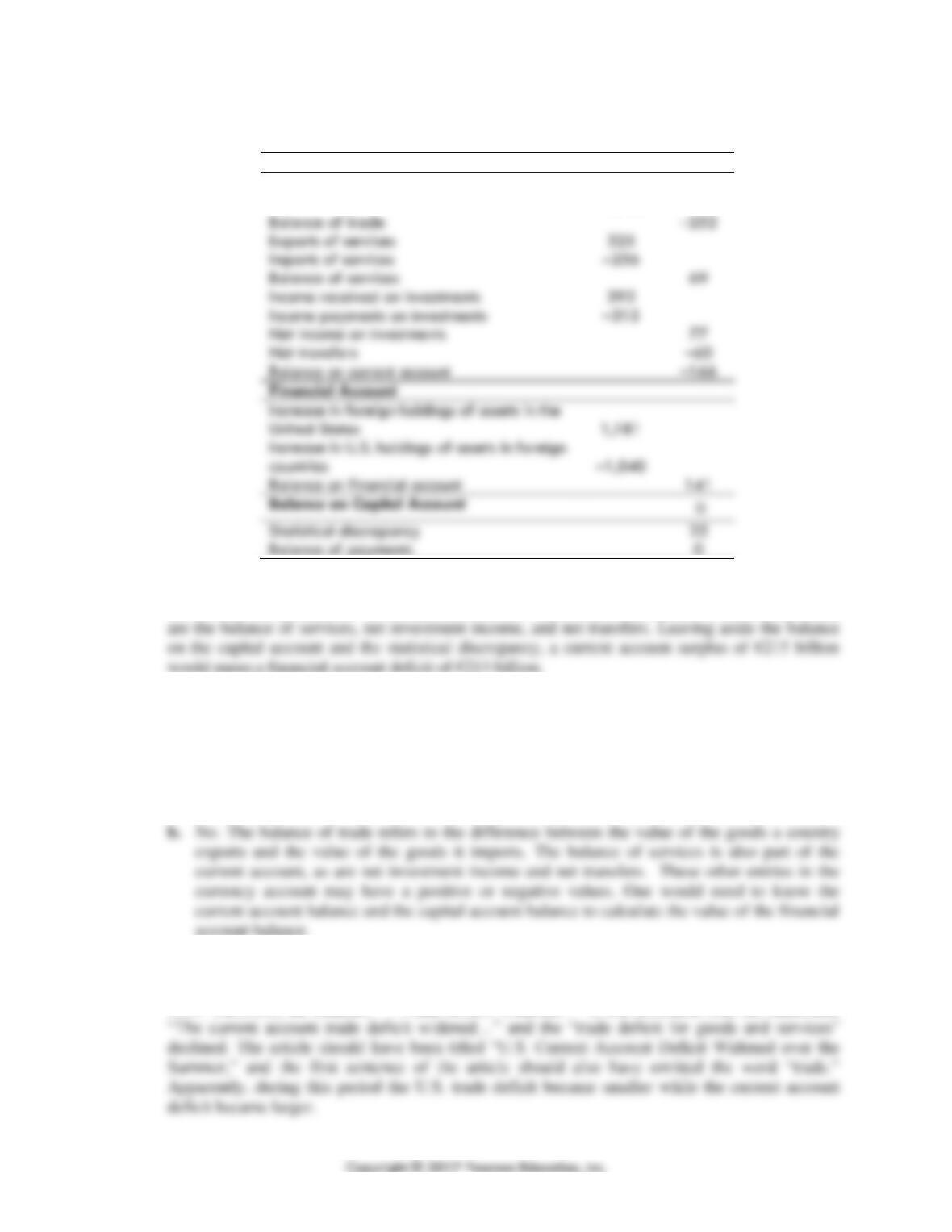
1.5 The best way to answer this question is by placing the values given into a table like Table 18.1:
Current Account
Exports of goods
$856
Imports of goods
−1,108
Balance of trade
Exports of services
Imports of services
Balance of services
Income received on investments
Income payments on investments
Net income on investments
Net transfers
Balance on current account
Financial Account
United States
countries
Balance on financial account
Statistical discrepancy
Balance of payments
1.6 The reason Germany’s current account surplus was smaller than its trade surplus is that the sum
of the other components in the current account other than trade was negative. These components
1.7 No. It is always true that a country’s current account surplus (or deficit) will be offset by a deficit
(or surplus) of the same amount on its capital and financial accounts.
1.8 a. You should agree. A country’s balance of payments equals the sum of its current account
balance, its financial account balance, and its capital account balance. This sum must always
equal zero, allowing for the statistical discrepancy.
1.9 The value of the current account includes the value of the trade deficit (the difference between
exports of goods and imports of goods), as well as the other entries listed in Table 18.1 on page
1019. Therefore, the headline “…Trade Deficit Widened…” is not consistent with the statements
456 CHAPTER 18 | Macroeconomics in an Open Economy
1.10 A country running a current account deficit must also run a financial account surplus. If the
18.2
The Foreign Exchange Market and Exchange Rates
Learning Objective: Explain how exchange rates are determined and how changes in
exchange rates affect the prices of imports and exports.
Review Questions
2.1 The reciprocal: $1/¥125, or $0.008 = ¥1
2.2 The euro depreciated against the dollar because it will take more euros to purchase a dollar.
2.3 Foreign firms and households demand U.S. dollars in exchange for foreign currency to buy U.S.
Problems and Applications
2.5 1.9558 marks = 1 euro and 2.0938 marks = 1 dollar. First, convert the euro and the dollar
exchange rates in terms of 1 German mark: (1/1.9558) euros = 1 mark, or 0.5113 euros = 1 mark,
2.6 a. A “weakening of the euro” refers to a depreciation of the euro against the U.S. dollar and
other currencies. As a result, it will take more euros to purchase a dollar or other currency.
b. Quantitative easing refers to a central bank buying securities (such as Treasury notes and
mortgage-backed securities in the United States) with maturities longer than the short-term
CHAPTER 18 | Macroeconomics in an Open Economy 457
2.7 a. ¥95 = £0.64 or ¥148.44 = £1
b. The dollar has appreciated against the yen because it now takes more yen to buy a dollar.
2.8 An increase in interest rates in Europe will make financial investments in Europe more attractive
to U.S. investors. The higher European interest rates will cause the supply of dollars to shift to the
right, as U.S. investors exchange dollars for euros. The shift of the supply curve will cause the
exchange rate for the dollar to fall. In the following graph, the exchange rate falls from €1 to €2.
2.9 a. The dollar appreciated against the yen because now takes more yen to purchase a dollar.
b. Events (ii) and (iii) could have caused the shift in demand shown in the graph: (i) would
2.10 Unlike Fuji Heavy Industries, which produces most of its cars in Japan, Honda produces most of
458 CHAPTER 18 | Macroeconomics in an Open Economy
2.11 a. Central banks use monetary policy to reduce the rate of inflation by increasing interest rates.
Reports of “muted inflation data”–suggesting that inflation was less of a concern than it had
2.12 a. “Dollar strengthening” means an increase in the exchange rate between the dollar and other
foreign currencies.
2.13 U.S.-based firms such as Apple and Yum Brands earn significant sales revenue in China. They
18.3
The International Sector and National Saving and Investment
Learning Objective: Define and apply the saving and investment equation.
Review Questions
3.1 Net exports equal net foreign investment, assuming that net exports are roughly equal to the
current account balance. When a country’s net exports are negative, households, firms, and the
government must have sold assets and borrowed (negative foreign investment) from foreign
Problems and Applications
3.4 As shown by the saving and investment equation, S = I + NFI, saving by people outside of the
United States (assuming no change in foreign public saving) either goes toward their country’s
CHAPTER 18 | Macroeconomics in an Open Economy 459
3.7 You should disagree. The statement is incorrect because national saving as a percentage of GDP
is not equal to domestic investment as a percentage of GDP due to the presence of net foreign
3.8 The four equations become:
( )
private
.
S Y TR C T
= + − −
( )
3.9 Investment in the United States was greater than saving in the late 1990s, so net foreign
investment was negative. Net foreign investment equals net exports, which approximately
equals the current account balance. Negative net foreign investment implies a current account
deficit.
18.4
The Effect of a Government Budget Deficit on Investment
Learning Objective: Explain the effect of a government budget deficit on investment in
an open economy.
Review Questions
4.1 National saving increases when the government runs a budget surplus unless private saving
decreases by the amount of the budget surplus, which is unlikely. The twin-deficits idea is that a
460 CHAPTER 18 | Macroeconomics in an Open Economy
4.2 The exchange rate of the dollar for other currencies was high, which increased the foreign
currency price of U.S. exports. As a result, U.S. exports declined.
Problems and Applications
4.4 a. Holding other factors constant, a country running a budget surplus will have low interest
rates, which would imply that it will have a currency that is decreasing in value.
b. Holding other factors constant, a county that has a currency that is increasing in value would
4.5 High interest rates raise the foreign exchange value of a country’s currency, decreasing net
exports and increasing current account deficits.
4.6 Because domestic investment equals national saving minus net foreign investment (I = S − NFI),
4.7 The willingness of foreign investors and companies to purchase financial and physical assets in
4.8 a. Yes. India’s budget deficit could raise interest rates, which increases the foreign exchange
value of the Indian rupee, decreasing net exports and increasing the current account deficit.
b. Foreign investment provides the funds for India to run a current account deficit. Ignoring the
small capital account, the current account deficit equals the financial account surplus. India’s
CHAPTER 18 | Macroeconomics in an Open Economy 461
18.5
Monetary Policy and Fiscal Policy in an Open Economy
Learning Objective: Compare the effectiveness of monetary policy and fiscal policy in
an open economy and in a closed economy.
Review Questions
5.1 A policy channel is a way in which monetary or fiscal policy affects the domestic economy. In an
5.2 In an open economy, changes in interest rates that result from monetary policy will not only
affect investment spending and consumer spending on durable goods, but also net exports through
5.3 Fiscal policy has a smaller effect in an open economy than in a closed economy because of a
larger crowding out effect. In an open economy, through its effect on interest rates, fiscal policy
Problems and Applications
5.4 An open economy is an economy that has interactions in trade of finance with other countries.
Fiscal policy in Peru is likely to be less effective than it would be in a less open economy. The
crowding out effect of an expansionary fiscal policy would be higher in a more open economy.
5.5 a. For a closed economy, higher interest rates reduce domestic investment spending and
purchases of consumer durables in the short run so that real GDP declines.
462 CHAPTER 18 | Macroeconomics in an Open Economy
5.7 In a closed economy, an expansionary fiscal policy directly increases aggregate demand, leading
to increases in real GDP and the price level. An expansionary fiscal policy also results in
Real-Time Data Exercises
D18.1 a. The value of the euro declined from 1.2677 dollars per euro in October 2014 to 1.1262
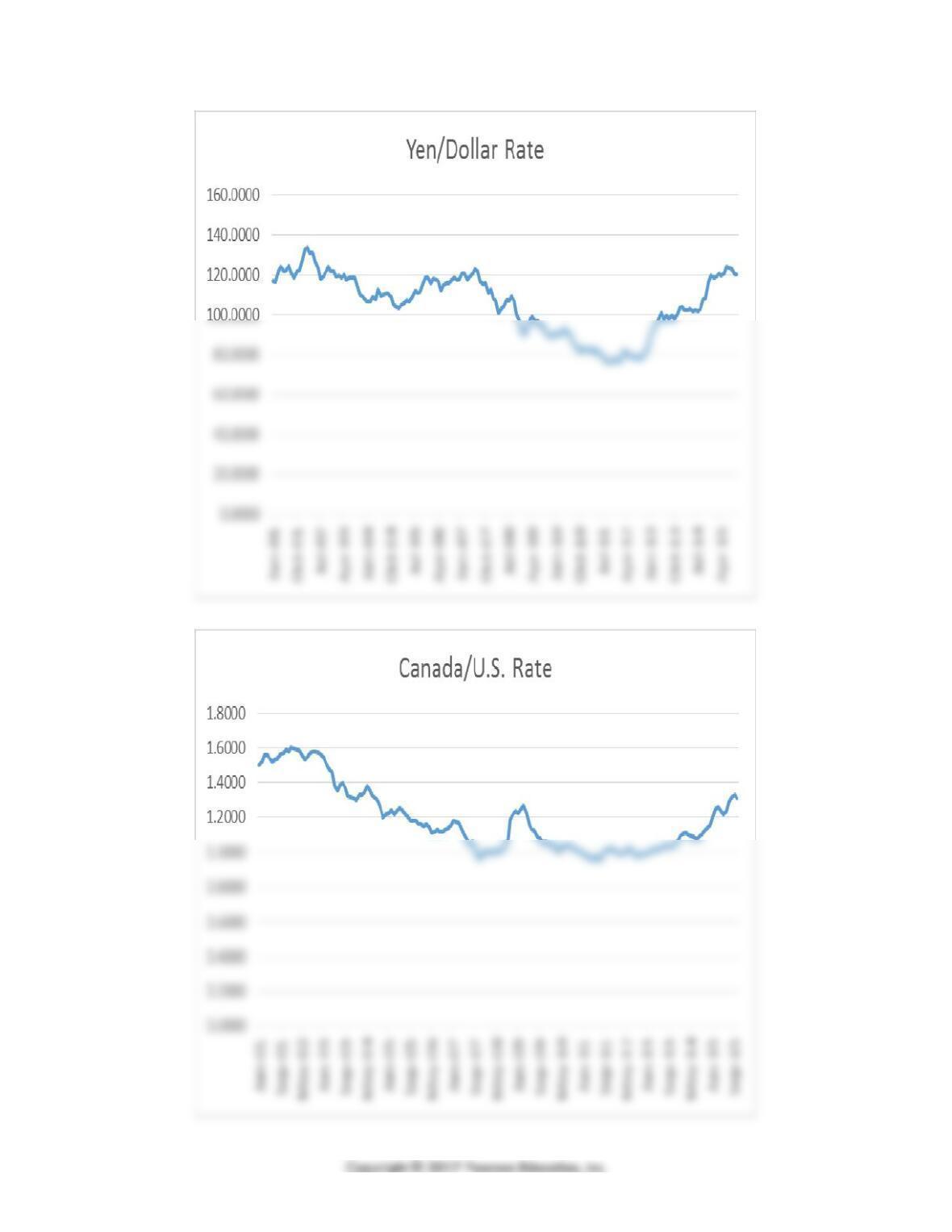
D18.2 See the following graphs of the U.S. dollar-euro exchange rate, the yen-U.S. dollar exchange rate,
and the Canadian dollar-U.S. dollar exchange rate. Note that the U.S. dollar-euro exchange rate is
U.S. dollars per euro, the yen-U.S. dollar exchange rate is yen per U.S. dollar, and the Canadian
dollar-U.S. dollar exchange rate is Canadian dollars per U.S. dollar.
CHAPTER 18 | Macroeconomics in an Open Economy 463
464 CHAPTER 18 | Macroeconomics in an Open Economy
a. The euro reached its highest value in July 2008.
D18.3 a. The long-term trend in the exchange value of the dollar from 1973 to October 2015 has been
downward. The depreciation of the dollar over this period tended to increase U.S. net exports,
D18.4 From August 2014 to August 2015, the Japanese/U.S. foreign exchange rate went from 102.94
D18.5 From August 2014 to August 2015, the Japanese/U.S. foreign exchange rate went from 102.94
yen to the dollar to 123.00 yen to the dollar, and U.S. imports of goods from Japan went from