CHAPTER 18 | Macroeconomics in an
Open Economy
Brief Chapter Summary and Learning Objectives
18.1 The Balance of Payments: Linking the United States to the International
Economy (pages 1018–1022)
18.2 The Foreign Exchange Market and Exchange Rates (pages 1023–1030)
Explain how exchange rates are determined and how changes in exchange rates affect
18.3 The International Sector and National Saving and Investment
18.4 The Effect of a Government Budget Deficit on Investment
(pages 1033–1036)
18.5 Monetary Policy and Fiscal Policy in an Open Economy
(pages 1036–1037)
Compare the effectiveness of monetary policy and fiscal policy in an open economy and
in a closed economy.
▪ In a closed economy, the main effect of lower interest rates is on domestic investment
CHAPTER 18 | Macroeconomics in an Open Economy 439
Key Terms
Balance of payments, p. 1018. The record of a
country’s trade with other countries in goods,
services, and assets.
nonfinancial assets.
Closed economy, p. 1018. An economy that has
no interactions in trade or finance with other
countries.
Currency appreciation, p. 1025. An increase in
the market value of one currency relative to
another currency.
Financial account, p. 1019. The part of the
balance of payments that records purchases of
assets a country has made abroad and foreign
purchases of assets in the country.
country’s currency.
Open economy, p. 1018. An economy that has
interactions in trade or finance with other
countries.
Real exchange rate, p. 1030. The price of
domestic goods in terms of foreign goods.
Chapter Outline
IBM Sings the Dollar Blues
In 2015, IBM was well into a transition from manufacturing hardware to selling cloud-based computing
software services. IBM has offices throughout Europe, Latin America, Asia and Africa. As a result, the
company’s profits are affected by fluctuations in the value of the dollar in exchange for other currencies.
440 CHAPTER 18 | Macroeconomics in an Open Economy
18.1
The Balance of Payments: Linking the United States to the International
Economy (pages 1018–1022)
Learning Objective: Explain how the balance of payments is calculated.
Nearly all economies are open economies. An open economy is an economy that has interactions in trade
or finance with other countries. A closed economy is an economy that has no interactions in trade or
finance with other countries. A good way to understand the interactions between one economy and other
economies is through the balance of payments, which is the record of a country’s trade with other
countries in goods, services, and assets. The balance of payments contains three accounts: the current
account, the financial account and the capital account.
A. The Current Account
The current account is the part of the balance of payments that records a country’s net exports, net
income on investments, and net transfers. Any payments received by U.S. residents are positive numbers
B. The Financial Account
The financial account is the part of the balance of payments that records purchases of assets a country
has made abroad and foreign purchases of assets in the country. The financial account records long-term
flows of funds into and out of a country. There is a capital outflow from the United States when an
investor in the United States buys a bond issued by a foreign company or government or when a U.S. firm
builds a factory in another country. There is a capital inflow into the United States when a foreign
C. The Capital Account
The capital account is the part of the balance of payments that records relatively minor transactions, such
as migrants’ transfers and sales and purchases of nonproduced, nonfinancial assets. Prior to 1999 the
capital account recorded all the transactions now included in both the financial account and the capital
account.
D. Why Is the Balance of Payments Always Zero?
The sum of the current account balance, financial account balance, and the capital account balance equals
CHAPTER 18 | Macroeconomics in an Open Economy 441
Foreign investment in the United States and additions to foreign holdings of dollars both show up as
positive entries in the U.S. financial account. Therefore, a current account deficit must be exactly offset
by a financial account surplus, leaving the balance of payments equal to zero.
Extra Making
the
Connection
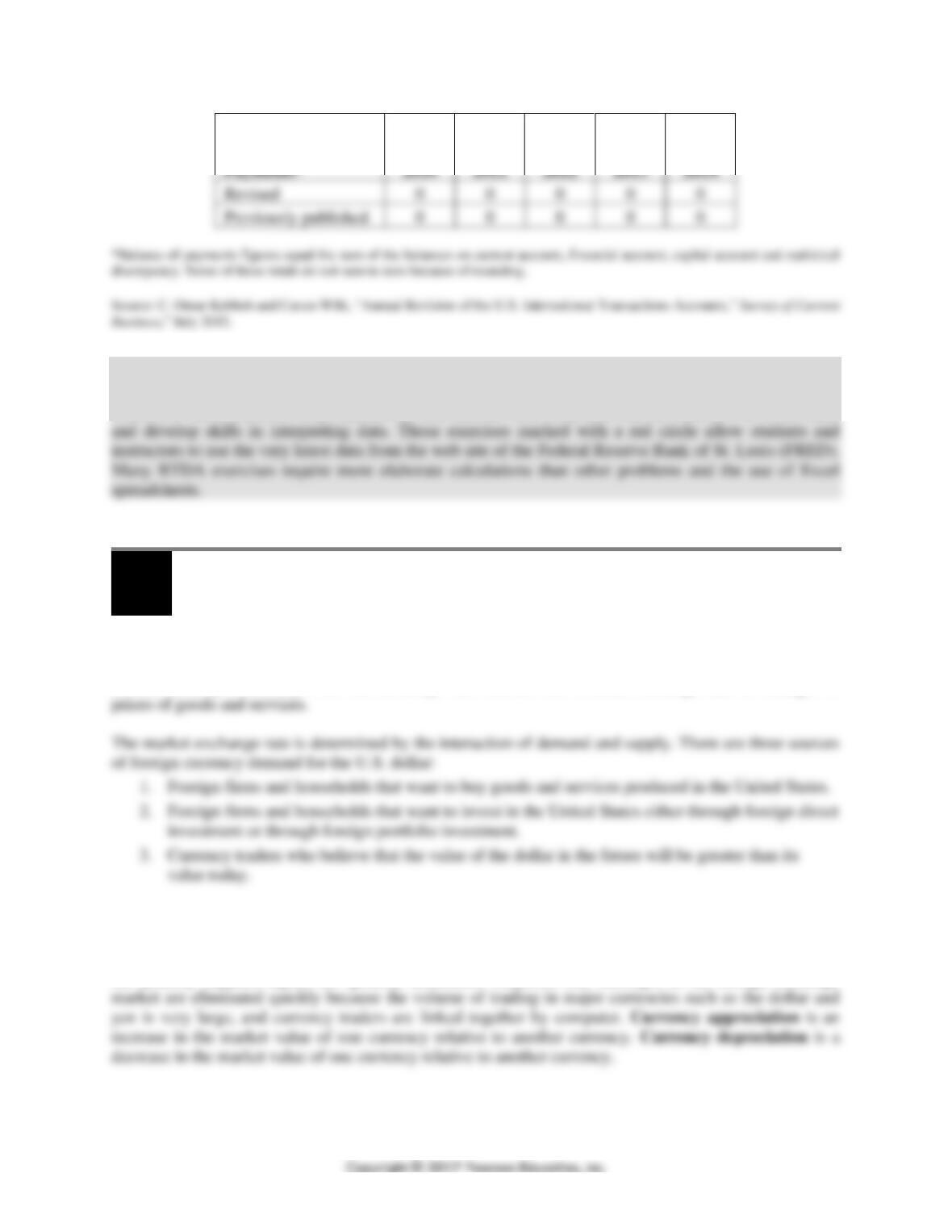
The BEA Revises Balance of Payments Statistics
Revisions to Current-Account, Financial Account, Capital Account and Statistical Discrepancy,
2010–2014
(billions of dollars)
Balance on
Current Account
2010
2011
2012
2013
2014
Revised
−442.0
−460.4
−449.7
−376.8
−389.5
Previously published
−443.9
−459.3
−460.7
−400.3
−410.6
Balance on
Capital Account
2010
2011
2012
2013
2014
Revised
Previously published
442 CHAPTER 18 | Macroeconomics in an Open Economy
Balance of
Teaching Tips
The end of the chapter in the main text includes a special category of exercises titled Real-Time Data
Exercises. These exercises help students become familiar with a key data source, learn how to locate data,
18.2
The Foreign Exchange Market and Exchange Rates (pages 1023–1030)
Learning Objective: Explain how exchange rates are determined and how changes in
exchange rates affect the prices of imports and exports.
A multinational corporation may sell its products in many different countries and receive payments in
many different currencies. The nominal exchange rate is the value of one country’s currency in terms of
another country’s currency. The real exchange rate corrects the nominal exchange rate for changes in
A. Equilibrium in the Market for Foreign Exchange
The demand curve for dollars in exchange for a foreign currency has the normal downward slope, while
the supply curve has the normal upward slope. Equilibrium occurs in the foreign exchange market where
the quantity supplied equals the quantity demanded. Surpluses and shortages in the foreign exchange
CHAPTER 18 | Macroeconomics in an Open Economy 443
B. How Do Shifts in Demand and Supply Affect the Exchange Rate?
Three main factors cause the demand and supply curves in the foreign exchange market to shift:
1. Changes in the demand for U.S.-produced goods and services and changes in the demand for
foreign produced goods and services.
Some buyers and sellers in the foreign exchange market are speculators, who are currency traders who
buy and sell foreign exchange in an attempt to profit from changes in exchange rates. The demand curve
for dollars shifts to the right when incomes in a foreign country rise, when interest rates in the U.S. rise,
C. Some Exchange Rates Are Not Determined by the Market
Some currencies have fixed exchange rates that do not change over long periods. A country’s central bank
must intervene in the foreign exchange market to buy and sell its currency to keep the exchange rate
fixed.
D. How Movements in the Exchange Rate Affect Exports and Imports
A depreciation of the domestic currency will increase exports and decrease imports, thereby increasing
E. The Real Exchange Rate
The relative prices of two countries’ goods are determined by two factors: The relative price levels in the
two countries, and the nominal exchange rate between the two countries’ currencies. Economists combine
444 CHAPTER 18 | Macroeconomics in an Open Economy
Extra Solved Problem 18.2
Why Did Honda Move Some Production to the United States?
In 2012, an executive at Honda Motor Company announced that the firm would be moving more of its car
production from Japan to the United States. A newspaper article stated:
Solving the Problem
Step 1: Review the chapter material.
Review the chapter material. This problem is about changes in the value of a currency, so you
may want to review the section “How Movements in the Exchange Rate Affect Exports and
Imports” on page 1027.
Step 2: Answer part (a) by explaining what the article means by the “strength of the yen.”
Extra Credit: Of course, Honda executives were aware that if the value of the yen declined against the
dollar—as it did beginning in late 2012—they would be better off producing in Japan the cars they
planned to sell in the United States. With a weak yen, they would be able to sell their cars in the United
States for a lower dollar price, gaining sales from companies that produce cars in the United States. But
the executives also knew that moving more production to the United States would allow them to plan
better and to stabilize their profits because their sales would no longer depend on fluctuations in the
exchange rate.
Question
When a country’s currency appreciates, is it generally good news or bad news for the country’s
consumers? Is it generally good news or bad news for the country’s businesses? Explain your reasoning.
CHAPTER 18 | Macroeconomics in an Open Economy 445
Answer
When a country’s currency appreciates, it will take more of a foreign currency to purchase one unit of the
Extra Making
the
Connection
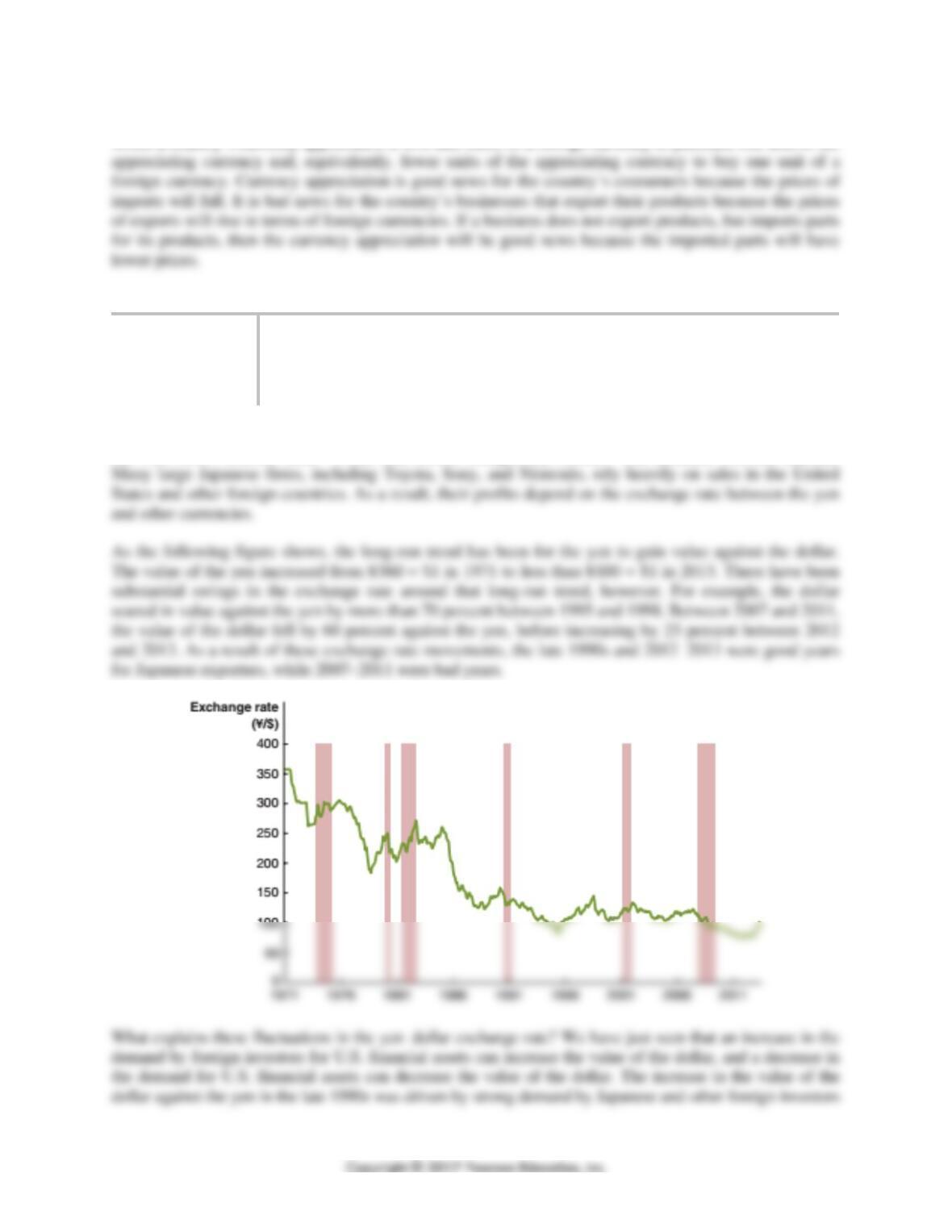
Japan Rides the Yen Roller Coaster
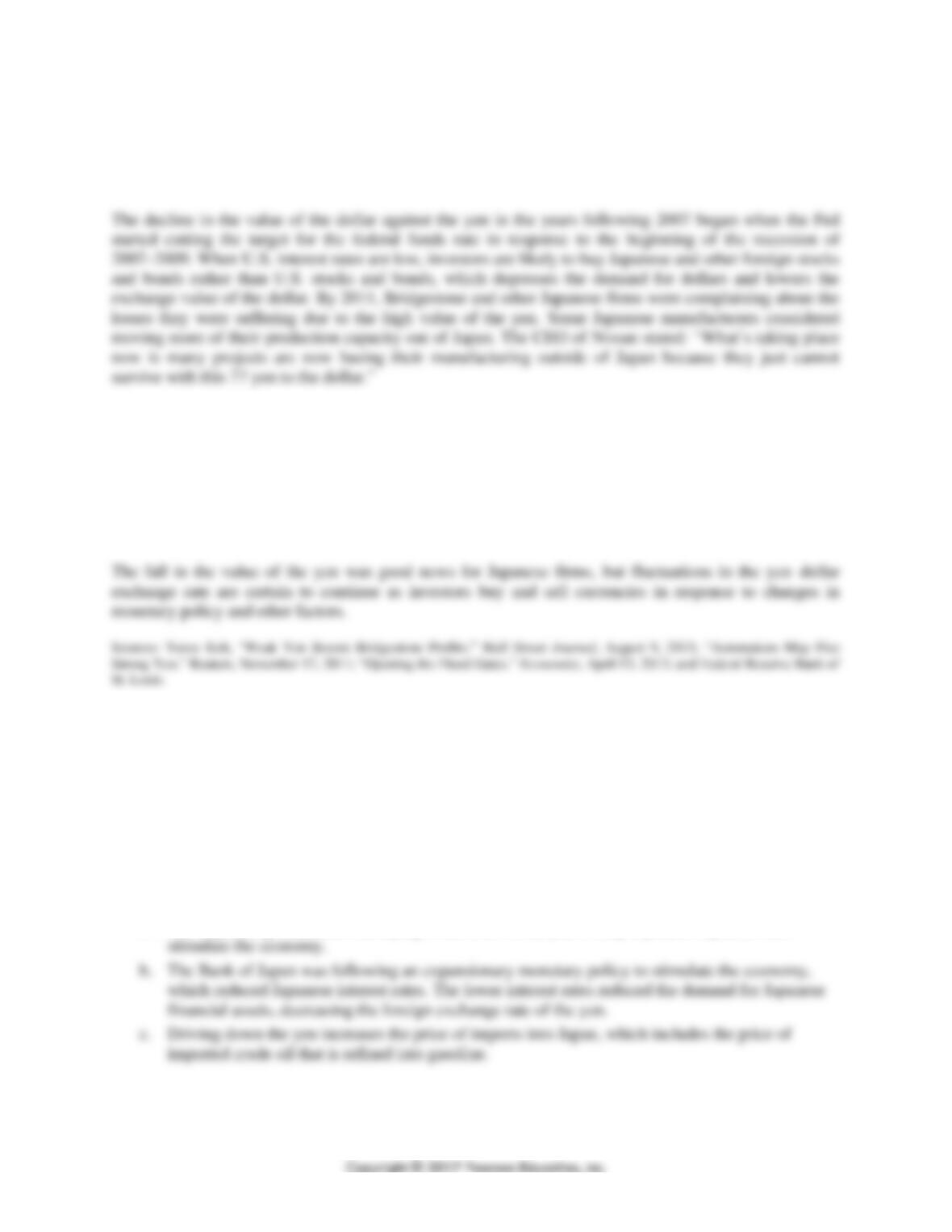
Bridgestone, headquartered in Tokyo, Japan, is the world’s largest tire manufacturer. A 2013 headline in
the Wall Street Journal read: “Weak Yen Boosts Bridgestone Profits.” The headline was not unusual.
446 CHAPTER 18 | Macroeconomics in an Open Economy
for U.S. stocks and bonds, particularly U.S. Treasury securities. This increase in demand was not primarily
due to higher U.S. interest rates but to problems in the international financial system that we will discuss in
Chapter 19. Many investors considered U.S. financial assets a safe haven in times of financial problems
because the investors believed the U.S. Treasury was unlikely to default on its bonds.
The decline in the value of the yen after 2012 occurred as a result of the Japanese central bank, the Bank
of Japan, following an expansionary monetary policy. When Shinzo Abe was elected prime minister in
late 2012, he appointed a new governor of the Bank of Japan who pledged to double the Bank’s holdings
of Japanese government bonds and to buy other assets. Investors expected that the result would be lower
nominal Japanese interest rates and a higher inflation rate, reducing the real return from owning Japanese
financial assets. In response, investors sold Japanese financial assets and bought U.S. financial assets,
causing the value of the yen to decline against the dollar.
Question
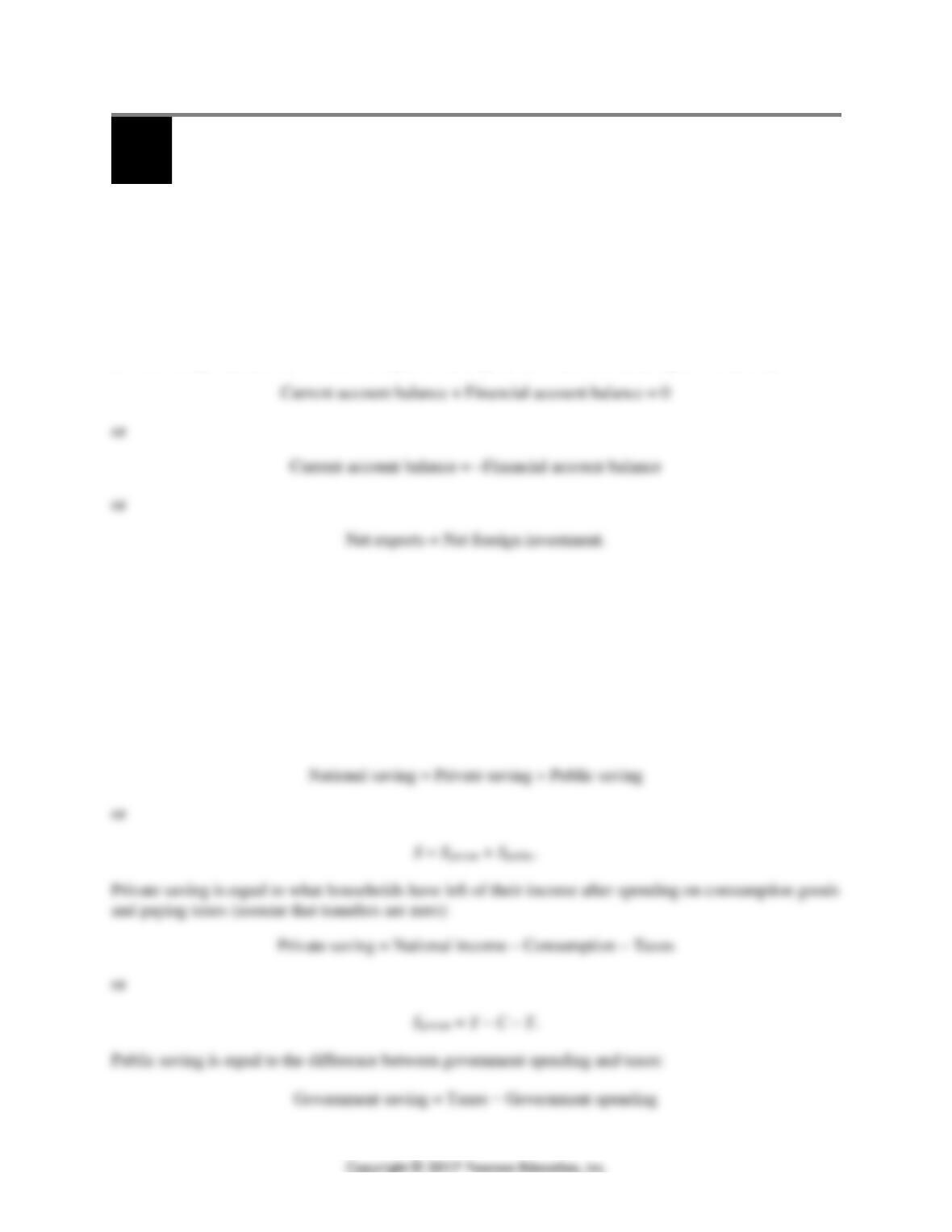
An article in the Economist notes that gasoline prices in Japan were increasing “because of the
government’s efforts to drive down the yen.”
a. Why was the Japanese government trying to drive down the yen?
b. What actions was the Japanese government taking to drive down the yen?
c. Why would driving down the yen have increased gasoline prices in Japan?
Source: “Man with Plan,” Economist, July 20, 2013.
Answer
a. The Japanese government was trying to drive down the yen to help Japanese exporters and
CHAPTER 18 | Macroeconomics in an Open Economy 447
18.3
The International Sector and National Saving and Investment
(pages 1031–1033)
Learning Objective: Define and apply the saving and investment equation.
A. Net Exports Equal Net Foreign Investment
When a country imports more than it exports the country must finance the difference by selling assets or
by borrowing. When a country sells more assets to foreigners than it buys from foreigners, or when it
borrows more from foreigners than it lends to foreigners, the country experiences a net capital inflow and
a financial account surplus. When imports are greater than exports, net exports are negative, and there
will be net capital inflow as people in the United States sell assets and borrow to pay for the excess of
imports over exports. Therefore, net capital flows will be equal to net exports (but with the opposite sign),
and net foreign investment will also be equal to net exports (and with the same sign). In summary:
This equation tells us that countries that import more than they export must borrow more from abroad
than they lend abroad. If net exports are negative, net foreign investment will also be negative by the
same amount.
B. Domestic Saving, Domestic Investment, and Net Foreign Investment
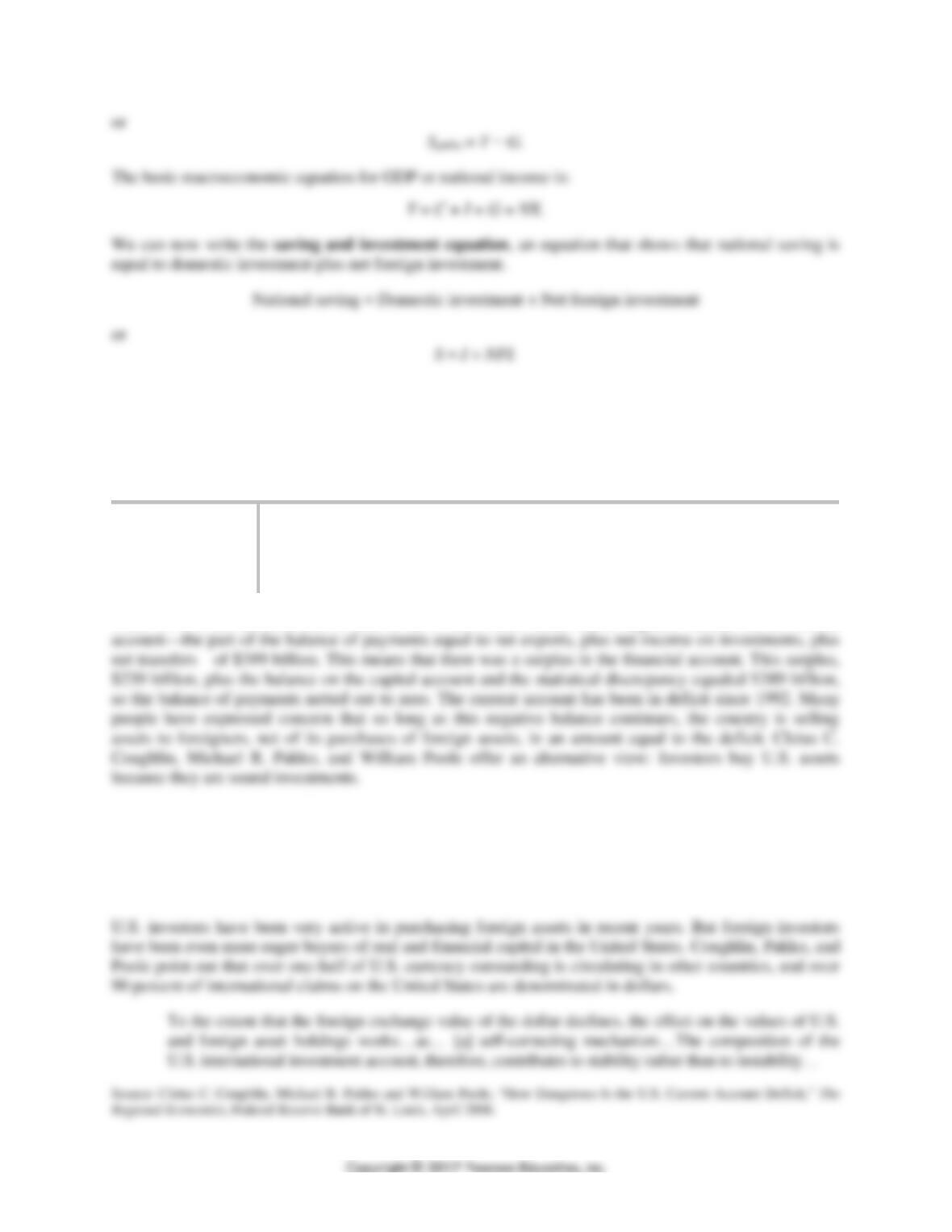
The total saving in any economy is equal to saving by the private sector plus saving by the government
sector (public saving). When the government runs a budget surplus by spending less than it receives in
taxes, it is saving. When the government runs a budget deficit, public saving is negative. We can write the
following equation for the level of saving in the economy:
448 CHAPTER 18 | Macroeconomics in an Open Economy
This equation is an identity because it must always be true, given the definitions we used. The saving and
investment equation tells us that a country’s saving will be invested either domestically or overseas. A
country such as the United States that has negative net foreign investment must be saving less than it is
investing domestically.
Extra Making
the
Connection
Question: A Current Account Deficit or a Financial Account
Surplus?
Answer: Both
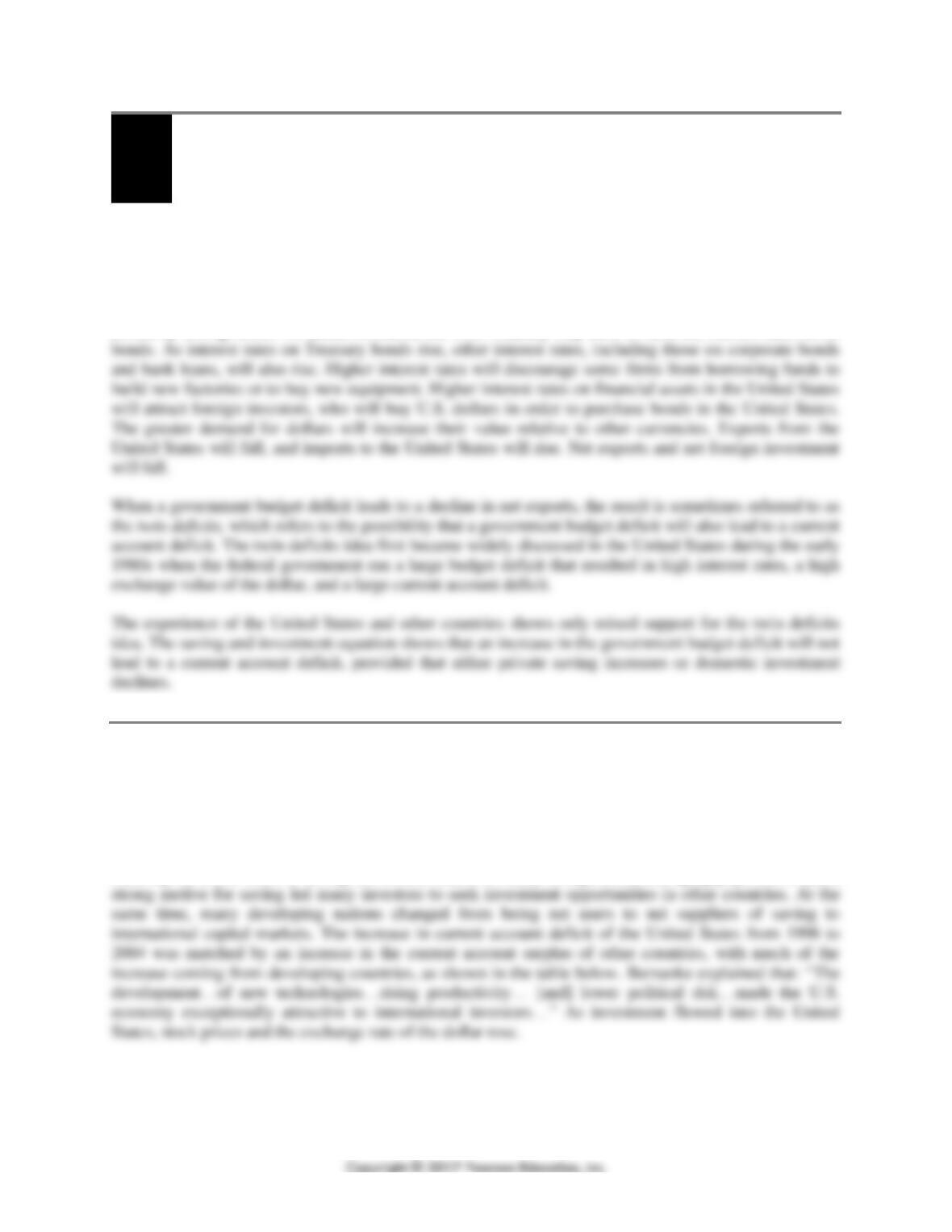
Table 18.1 in the textbook shows that in 2014 the United States had a negative balance on its current
One could argue that the deficit on the current account is the result of a financial account surplus, rather
than that the financial account surplus is the result of the current account deficit. As the demand by
foreign investors for U.S. assets increases, the exchange rate of the dollar is greater than it would
otherwise be. A stronger dollar reduces exports and increases imports, which results in a greater deficit in
the current account.
CHAPTER 18 | Macroeconomics in an Open Economy 449
18.4
The Effect of a Government Budget Deficit on Investment
(pages 1033–1036)
Learning Objective: Explain the effect of a government budget deficit on investment in
an open economy.
When the government runs a budget deficit, national saving will decline unless private saving increases
by the amount of the budget deficit. As the saving and investment equation shows, the result of a decline
in national saving must be a decline in either domestic investment or net foreign investment.
If the federal government runs a budget deficit, the U.S. Treasury must raise an amount equal to the
deficit by selling bonds. To attract investors, the U.S. Treasury may have to raise the interest rates on its
Extra Solved Problem 18.4
U.S. Budget Deficits and Investment
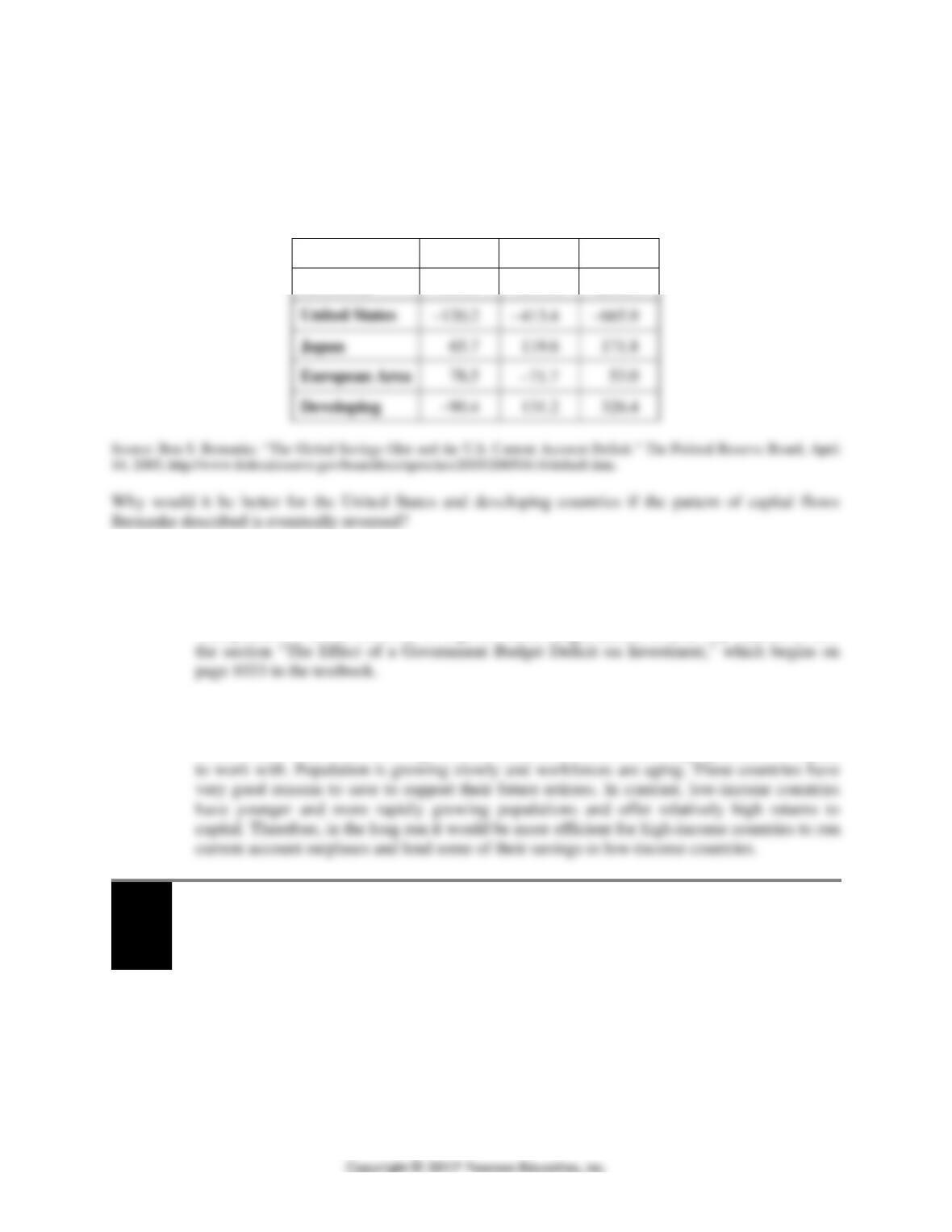
In a 2005 speech, Ben Bernanke, shortly before he became chairman of the Federal Reserve, offered an
explanation for changes that had occurred in the federal budget and current account of the United States.
He explained that in the previous decade there had been a large increase in saving worldwide, which
made up for a low level of saving the United States. In many foreign countries, aging populations and a
450 CHAPTER 18 | Macroeconomics in an Open Economy
Bernanke argued that the pattern of international capital flows he described—the developing world
lending large amounts of saving to developed countries—has some benefits but could prove
counterproductive if the pattern were to persist.
Global Account Balances
(billions of dollars)
Countries
1996
2000
2004
Industrial
$41.5
−$331.5
−$400.3
Solving the Problem
Step 1: Review the chapter material.
This problem is about the effect of a government budget deficit, so you may want to review
Step 2: Why would it be better for the United States and developing countries if the pattern
of capital flows Bernanke described is eventually reversed?
In the United States and other high-income countries, workers have large quantities of capital
18.5
Monetary Policy and Fiscal Policy in an Open Economy
(pages 1036–1037)
Learning Objective: Compare the effectiveness of monetary policy and fiscal policy in
an open economy and in a closed economy.
Economists refer to the ways in which monetary and fiscal policy affect the domestic economy as policy
channels. An open economy has more policy channels than does a closed economy.
A. Monetary Policy in an Open Economy
When the Federal Reserve engages in an expansionary monetary policy, it buys Treasury securities to
lower interest rates and stimulate aggregate demand. In a closed economy, the main effect of lower
CHAPTER 18 | Macroeconomics in an Open Economy 451
B. Fiscal Policy in an Open Economy
To engage in an expansionary fiscal policy, the federal government increases its purchases or cuts taxes.
Increases in government purchases directly increase aggregate demand. Tax cuts increase aggregate
demand by increasing household disposable income and business income. An expansionary fiscal policy
may result in higher interest rates. In a closed economy, the main effect of higher interest rates is to
Extra Solved Problem 18.5
Monetary and Fiscal Policy in a Recession
Assume that the United States, an open economy, has slipped into a recession. Policymakers consider two
different strategies for increasing aggregate demand. First, the Federal Reserve can use open market
operations to lower the federal funds rate by 0.5 percent (50 basis points). Second, Congress and the
president can pass legislation to cut income taxes.
a. If the United States were a closed economy, would the Federal Reserve have to lower the federal