interactive activity
Chapter 18
International
Macroeconomics
1. How would the following transactions be categorized in the U.S. balance of pay-
ments accounts? Would they be entered in the current account (as a payment to
or from a foreigner) or the financial account (as a sale of assets to or purchase of
assets from a foreigner)? How will the balance of payments on the current and
financial accounts change?
1. a. When the French importer buys the California wine, the transaction is entered
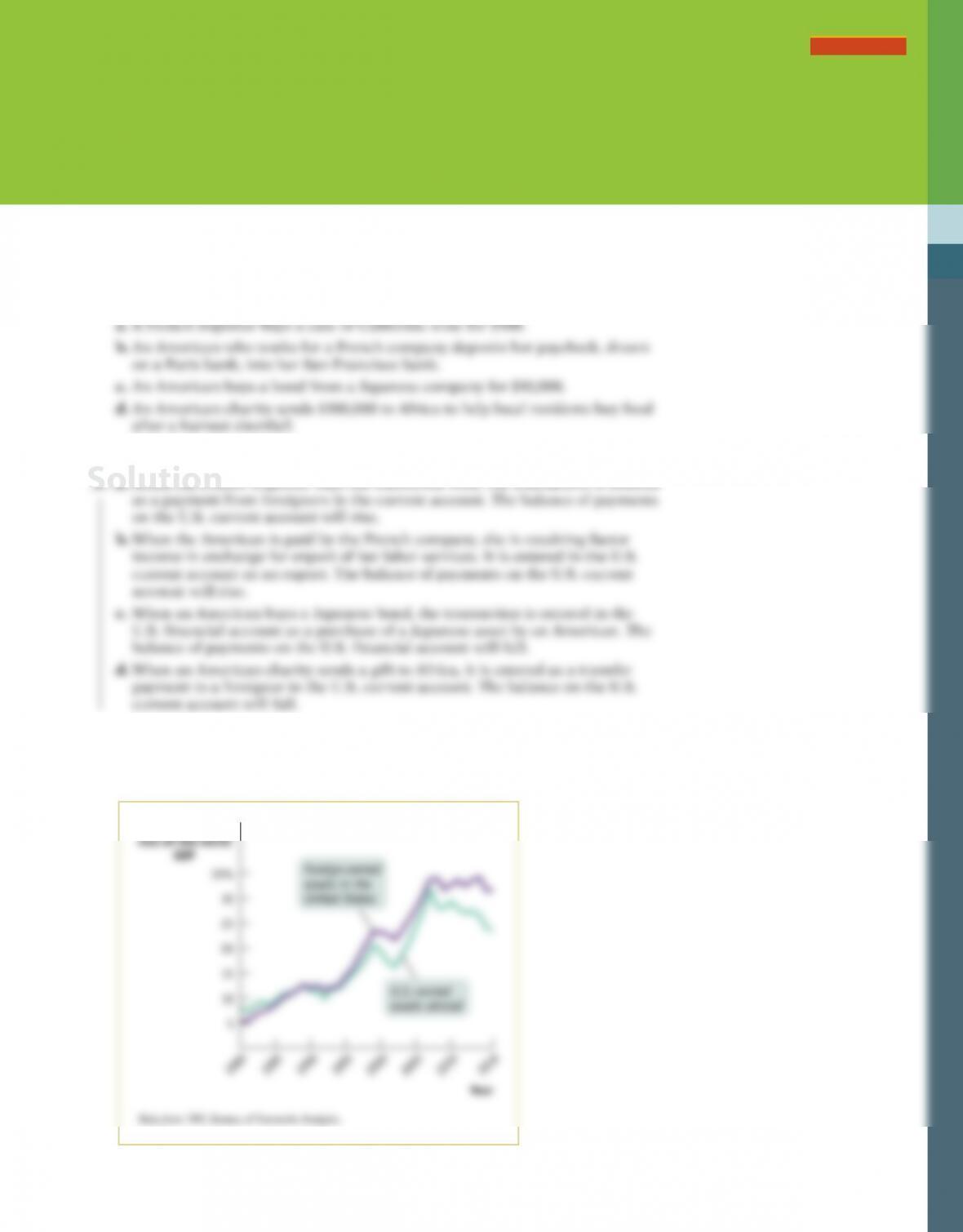
2. The accompanying diagram shows foreign-owned assets in the United States and
U.S.-owned assets abroad, both as a percentage of foreign GDP. As you can see
from the diagram, both increased around fivefold from 1980 to 2016.
Percent of
r
est-of-the-world
GDP
Foreign-owned
Solution
S-234 Chapter 18 InternatIonal MacroeconoMIcs
a. As U.S.-owned assets abroad increased as a percentage of foreign GDP, does
this mean that the United States, over the period, experienced net capital
outflows?
3. In the economy of Scottopia in 2016, exports equaled $400 billion of goods and
$300 billion of services, imports equaled $500 billion of goods and $350 billion
of services, and the rest of the world purchased $250 billion of Scottopia’s assets.
What was the merchandise trade balance for Scottopia? What was the balance
of payments on current account in Scottopia? What was the balance of payments
on financial account? What was the value of Scottopia’s purchases of assets from
the rest of the world?
3. In 2016, the merchandise trade balance was –$100 billion ($400 billion –
4. In the economy of Popania in 2016, total Popanian purchases of assets in the
rest of the world equaled $300 billion, purchases of Popanian assets by the rest
of the world equaled $400 billion, and Popania exported goods and services
equal to $350 billion. What was Popania’s balance of payments on financial
account in 2016? What was its balance of payments on current account? What
was the value of its imports?
4. In 2016, Popania’s balance of payments on financial account was +$100 billion
Solution
Solution
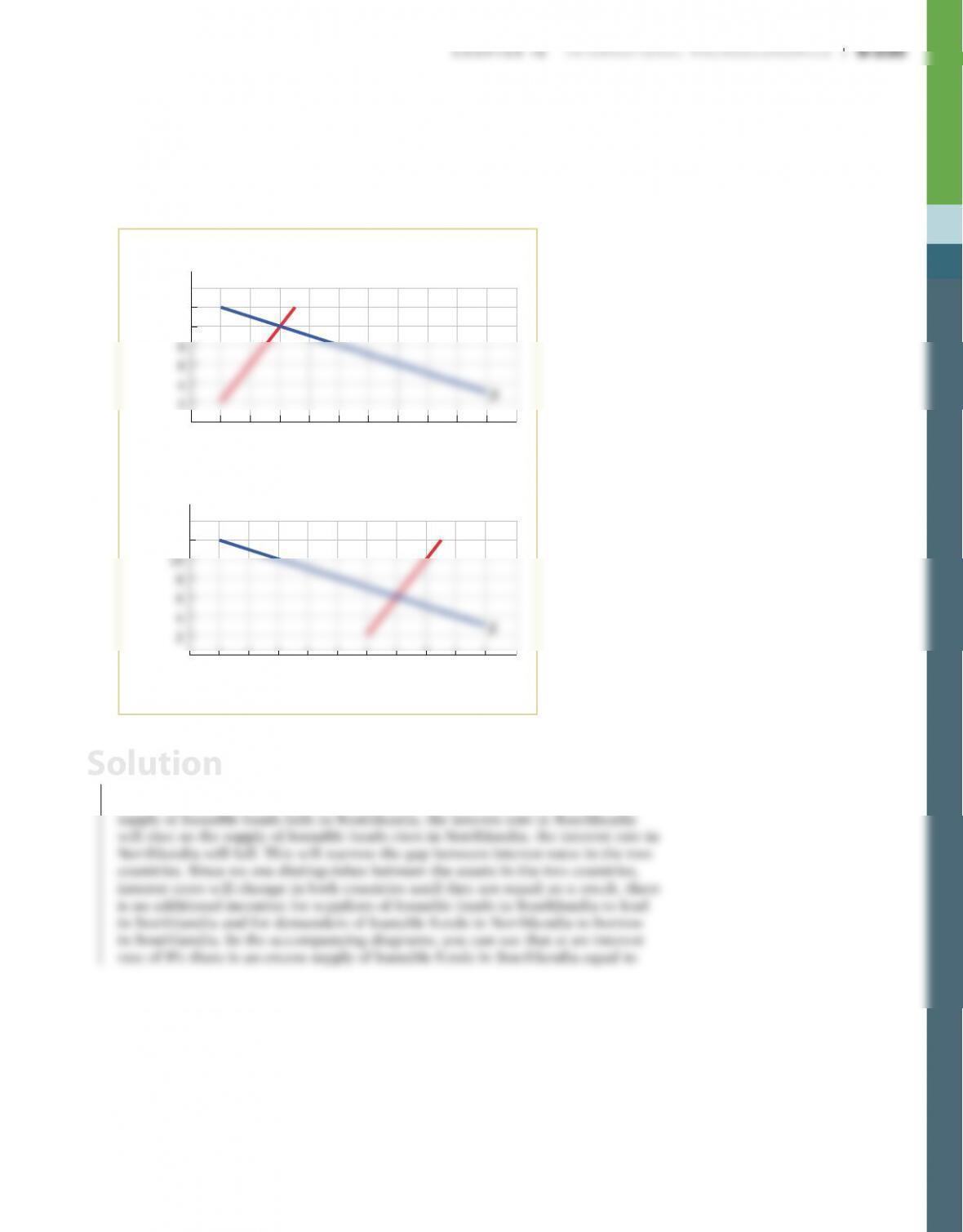
5. Suppose that Northlandia and Southlandia are the only two trading countries
in the world, that each nation runs a balance of payments on both current and
financial accounts equal to zero, and that each nation sees the other’s assets as
identical to its own. Using the accompanying diagrams, explain how the demand
and supply of loanable funds, the interest rate, and the balance of payments on
current and financial accounts will change in each country if international capi-
tal flows are possible.
100 2000 300 1,000900800700400 500 600
12%
10
Interest
rate
(a) Northlandia
(b) Southlandia
Quantity of loanable funds
S
100 2000 300 1,000900800700400 500 600
12%
Inter
est
rate
Quantity of loanable funds
S
5. Since the interest rate is 10% in Northlandia and 6% in Southlandia, demanders
of loanable funds in Northlandia will want to borrow in Southlandia and sup–
pliers of loanable funds in Southlandia will want to lend in Northlandia. As the
Solution
S-236 Chapter 18 InternatIonal MacroeconoMIcs
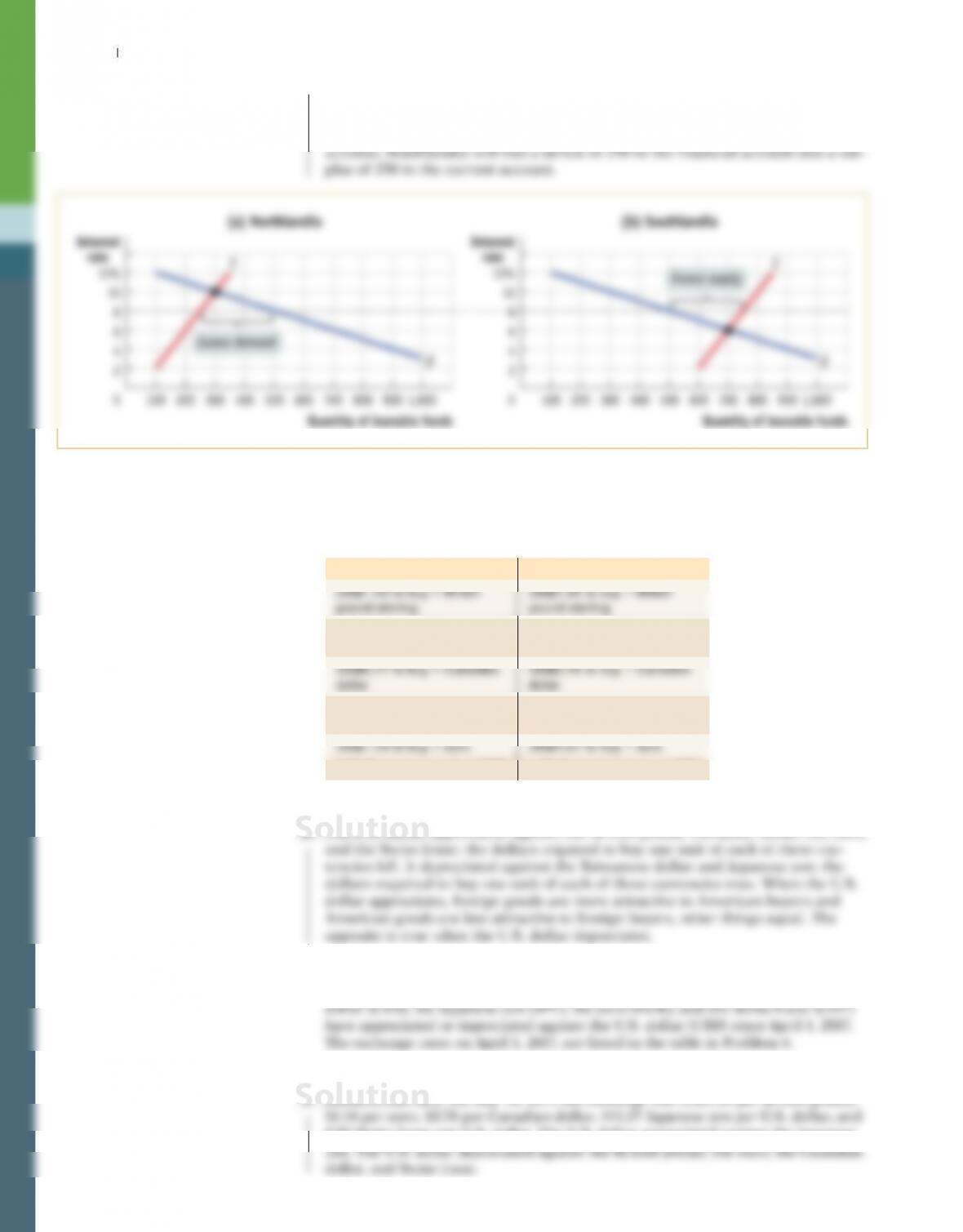
250 and an excess demand for loanable funds in Northlandia equal to 250. So
the two countries will both end up with an interest rate of 8%. Northlandia will
run a surplus of 250 in the financial account and a deficit of 250 in the current
100 2000 300 1,000900800700400 500 600
10
8
6
4
2
Quantity of loanable funds
D
100 2000 300 1,000900800700400 500 600
10
8
6
4
2
Quantity of loanable funds
D
Excess demand
6. Based on the exchange rates for the trading days of 2016 and 2017 shown in the
accompanying table, did the U.S. dollar appreciate or depreciate over the year?
Did the movement in the value of the U.S. dollar make American goods and ser-
vices more or less attractive to foreigners?
April 1, 2016 April 1, 2017
32.26 Taiwan dollars to buy
US$1
30.40 Taiwan dollars to buy
US$1
112.09 Japanese yen to buy
US$1
111.39 Japanese yen to buy
US$1
0.96 Swiss franc to buy US$1 1.00 Swiss franc to buy US$1
6. The U.S. dollar appreciated against the British pound, Canadian dollar, the euro,
7. Go to http://fx.sauder.ubc.ca. Using the table labeled “The Most Recent Cross-Rates
of Major Currencies,” determine whether the British pound (GBP), the Canadian
0.97 Swiss franc per U.S. dollar. The U.S. dollar appreciated against the Japanese
Solution
8. In January 2001, the U.S. federal funds rate was 6.5%, falling to 2% in November
2004. During the same period, the marginal lending rate at the European Cen-
tral Bank fell from 5.75% to 3%.
a. Considering the change in interest rates over the period and using the loanable
funds model, would you have expected funds to flow from the United States to
Europe or from Europe to the United States over this period?
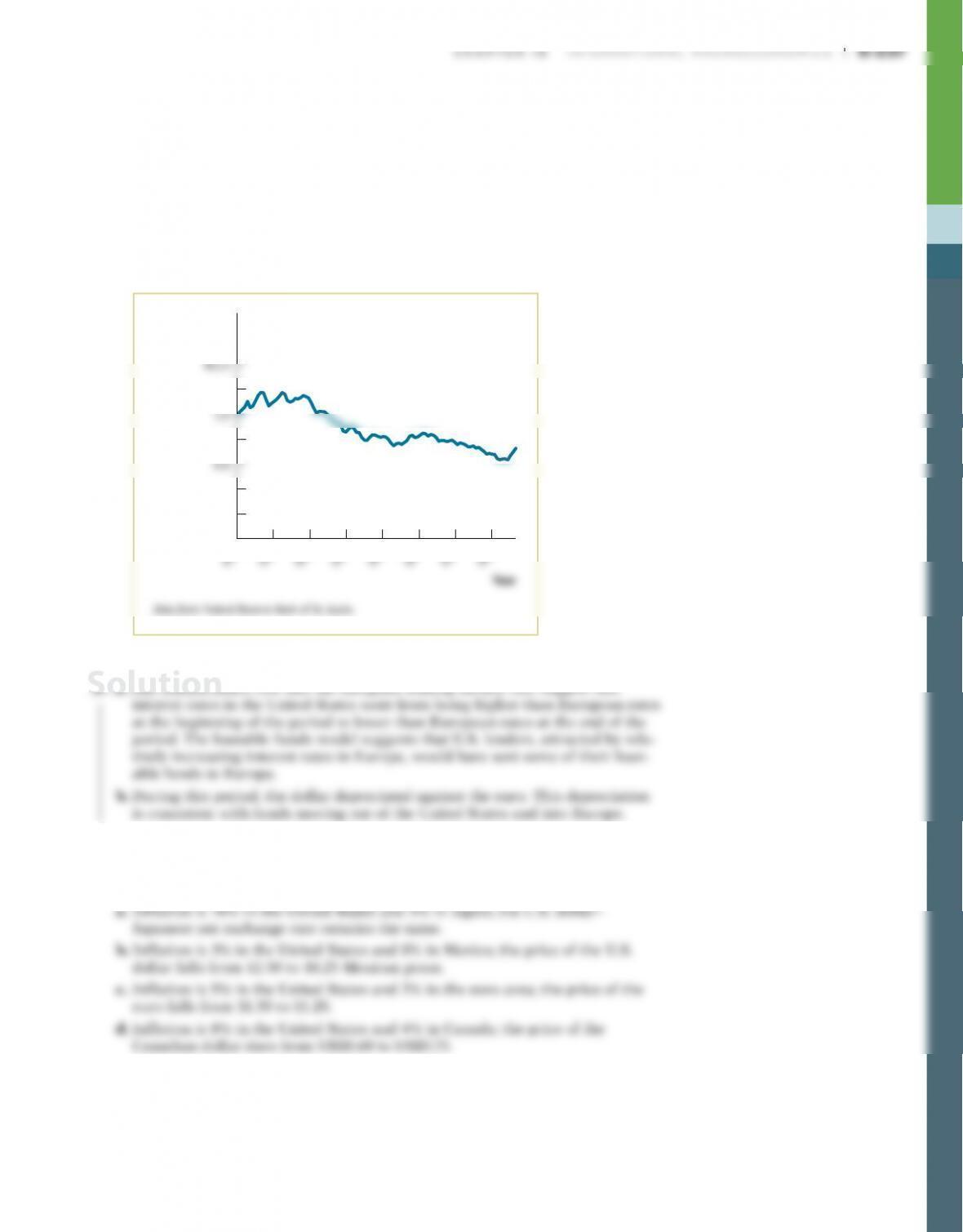
b. The accompanying diagram shows the exchange rate between the euro and the
U.S. dollar from January 1, 2001, through September 2008. Is the movement of
the exchange rate over the period January 2001 to November 2004 consistent
with the movement in funds predicted in part a?
1.2
0.8
0.4
0.2
Exchange rate
(euros per
U.S. dollar)
2001
2002
2003
2004
2005
2006
2007
2008
9. a. If inflation is 10% in the United States and 5% in Japan, and the U.S. dollar–
Japanese yen exchange rate remains the same, Japanese goods and services
will be more attractive than U.S. ones.
b. If inflation is 3% in the United States and 8% in Mexico, and the price of the
U.S. dollar falls from 12.50 to 10.25 Mexican pesos, both the lower inflation
and the depreciation of the dollar (appreciation of the peso) make American
goods more attractive.
10. Starting from a position of equilibrium in the foreign exchange market under a
fixed exchange rate regime, how must a government react to an increase in the
demand for the nation’s goods and services by the rest of the world to keep the
exchange rate at its fixed value?
11. Suppose that Albernia’s central bank has fixed the value of its currency, the
bern, to the U.S. dollar (at a rate of US$1.50 to 1 bern) and is committed to that
exchange rate. Initially, the foreign exchange market for the bern is also in equi-
librium, as shown in the accompanying diagram. However, both Albernians and
Solution
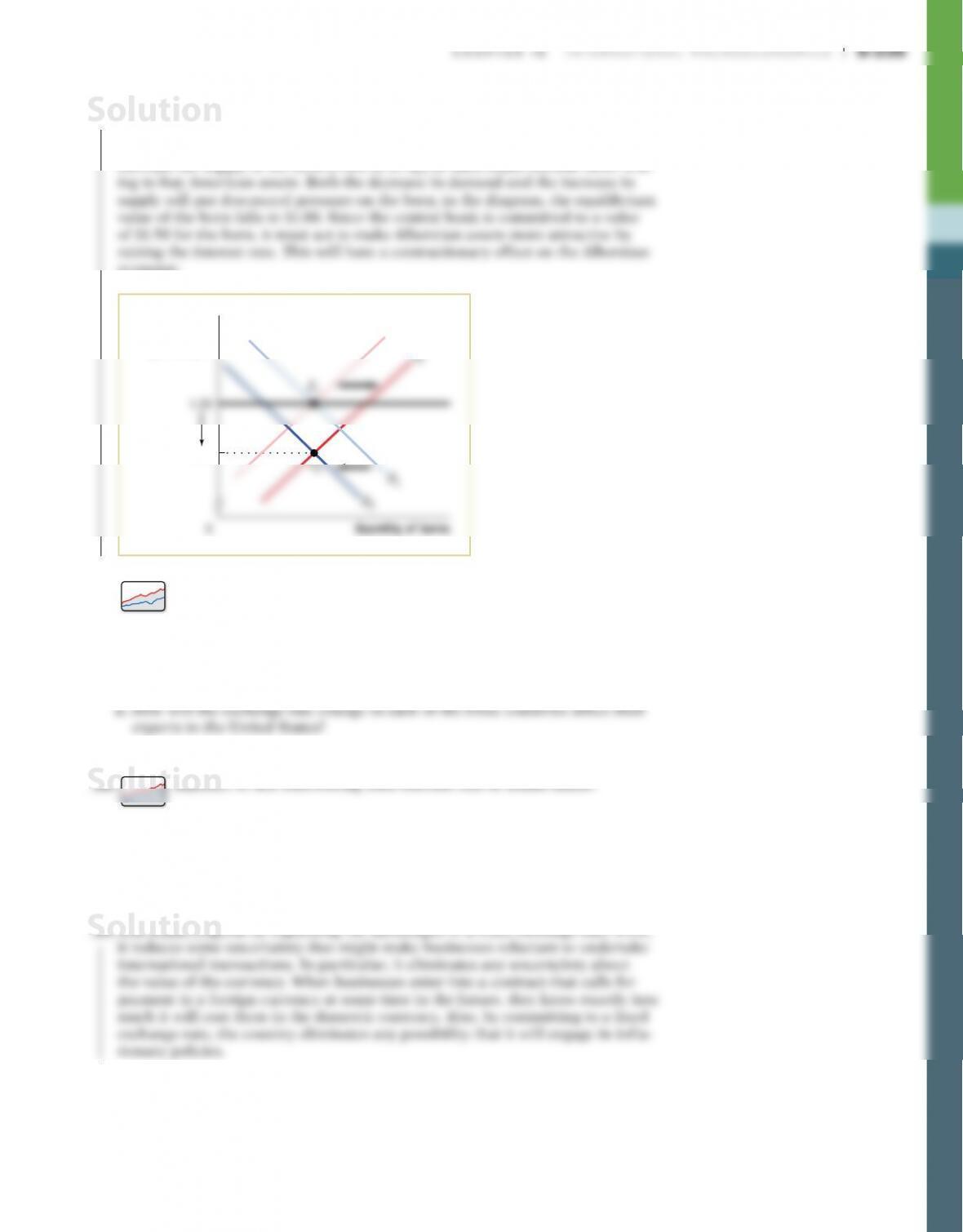
11. If both Albernians and Americans begin to believe that the Albernian assets are
risky, this will reduce the demand for the bern (from D1 to D2 in the accompa-
nying diagram), as Americans become less willing to buy Albernian assets, and
increase the supply of the bern (from S1 to S2), as Albernians become more will-
economy.
S1
Exchange rate
(U.S. dollars
per bern)
0Quantity of berns
S2
12. Access the Discovering Data exercise for Chapter 18 online to answer
the following questions.
a. Using the most current data available, how has the exchange rate changed for
Mexico, the United Kingdom, and Switzerland?
b. By how much did each of these three currencies appreciate and depreciate
against the U.S. dollar?
12. Answers to this Discovering Data exercise can be found online.
13. Your study partner asks you, “If central banks lose the ability to use discretion-
ary monetary policy under fixed exchange rates, why would nations agree to a
fixed exchange rate system?” How do you respond?
Solution
Solution
S-240 Chapter 18 InternatIonal MacroeconoMIcs
Solution
WORK IT OUT Interactive step-by-step help with solving this
problem can be found online.
14. Suppose the United States and Japan are the only two trading countries in
the world. What will happen to the value of the U.S. dollar if the following
occur, other things equal?
14. a. If Japan relaxes import restrictions, Japanese residents will demand more U.S.