CHAPTER 18
Inflation, the Phillips Curve, and
Central Bank Commitment
KEY IDEAS IN THIS CHAPTER
2. The Freidman-Lucas money surprise model predicts a positive relationship between
3. The model also predicts that the Phillips curve is unstable, as it shifts with the
changes in the expected inflation rate.
5. The central bank learning hypothesis provides a more plausible explanation than the
central bank commitment hypothesis, as it seems difficult to argue that the Bank of
NEW IN THE FOURTH EDITION
1. All data and graphs have been updated.
TEACHING GOALS
Phillips curves play a prominent role in New Keynesian analysis, so it is useful to know
whether they are observed in the data or not. One way to generate a Phillips curve, not
unlike the mechanism at work in sticky price models, is in a Friedman-Lucas money
surprise model, studied in this chapter. The most important points in this chapter are that
a) stable Phillips curves, if they exist at all, are only short-run phenomena, and that b)
policymakers’ attempts to exploit the Phillips curve may lead to a permanent increase in
inflation and at best a temporary increase in aggregate output.
The primary subject of this chapter is to develop a positive theory of inflation. In the
short run, central banks face a given level of expected inflation. Over time, policy
behaviour affects the future course of expectation formation. The interplay of central
Chapter 18: Inflation, the Phillips Curve, and Central Bank Commitment
bank behaviour and the behaviour of the public generates the equilibrium rate of
CLASSROOM DISCUSSION TOPICS
Public discussion periodically focuses on whether the Bank of Canada should be given
less discretion. This topic was given more attention during the 1970s and early 1980s
when the Bank of Canada allowed the rate of inflation become higher than what the
public was willing to tolerate. On the one hand, if the Bank of Canada is charged only
with controlling the rate of inflation and given clear performance standards, theory
suggests the rate of inflation will remain closer to its preferred level. On the other hand,
discretion may be needed for the Bank of Canada to respond properly to macroeconomic
disturbances. How do students feel about giving the Bank of Canada less discretion? How
does the answer to this question depend on students’ judgments about the validity of
competing theories of the business cycle?
There is some conflict between the Friedman-Lucas money surprise model of the Phillips
curve and the assumed properties of central bank preferences. In particular, the model
assumes that the central bank always prefers higher output. However, if the Friedman-
Lucas model is correct, then aggregate output can be above trend only when workers are
fooled into working more hours than they would actually prefer. Can increases in output
due to erroneous decisions be welfare improving? Is it possible that a more Keynesian-
style model of the Phillips curve is a better justification for these preferences? Are there
other factors that might cause the socially optimal level of aggregate output to be higher
than the level of output consistent with equality between actual inflation and expected
inflation? What might these factors be?
Most countries’ tax systems are not perfectly indexed for inflation. They impose taxes on
nominal, not real, returns on investments (bonds and stocks), which distorts the prices on
those assets. Also, capital gains are taxed in nominal terms, so investors may pay a big
tax on assets whose value has not increased in real terms.
To see this in a simple example (with the simplifying assumption that the real return, not
the after-tax real return, is fixed), consider two cases in which there is a 30% tax rate.
Instructor’s Manual for Macroeconomics, Fourth Canadian Edition
seems consistent with the data.) A solution to this problem is to adjust capital values for
inflation before taxing them.
Mortgage loans are most often made at fixed rates for long terms. When inflation is
positive, the constant nominal payment over time is much higher in real terms early in the
life of the loan and lower in real terms later in the life of the loan, because of a higher
A numerical example illustrates this. Consider a $100,000, 30-year mortgage. In case A
the inflation rate is 0% and the nominal interest rate is 5%. The monthly payment is $540,
the real value of which is constant over time. Using the 28% rule used by lenders (that a
person’s mortgage payment shouldn’t exceed 28% of income), a person requires an
OUTLINE
1. The Phillips Curve
a) The Work of A.W. Phillips
b) The Phillips Curve in Canada
i) A Stable Phillips Curve: 1962–1979 and 1990–2005
c) The Behaviour of Phillips Curves across Time and Space
i) Phillips Curves do not Exist in all Data Sets
ii) Phillips Curves Appear to Shift over Time
2. Money Surprises and the Phillips Curve
3. A Positive Theory of Inflation
a) Central Bank Preferences
b) Central Bank Maximization for Given Expectations
Chapter 18: Inflation, the Phillips Curve, and Central Bank Commitment
c) Long-Run Equilibrium
d) The Role of Commitment
i) Time Inconsistency
4. Central Bank Learning
5. Central Bank Commitment
a) The Bank of Canada
b) Commitment to Low Inflation in Hong Kong (Macroeconomics in Action 17.2)
TEXTBOOK QUESTION SOLUTIONS
Problems
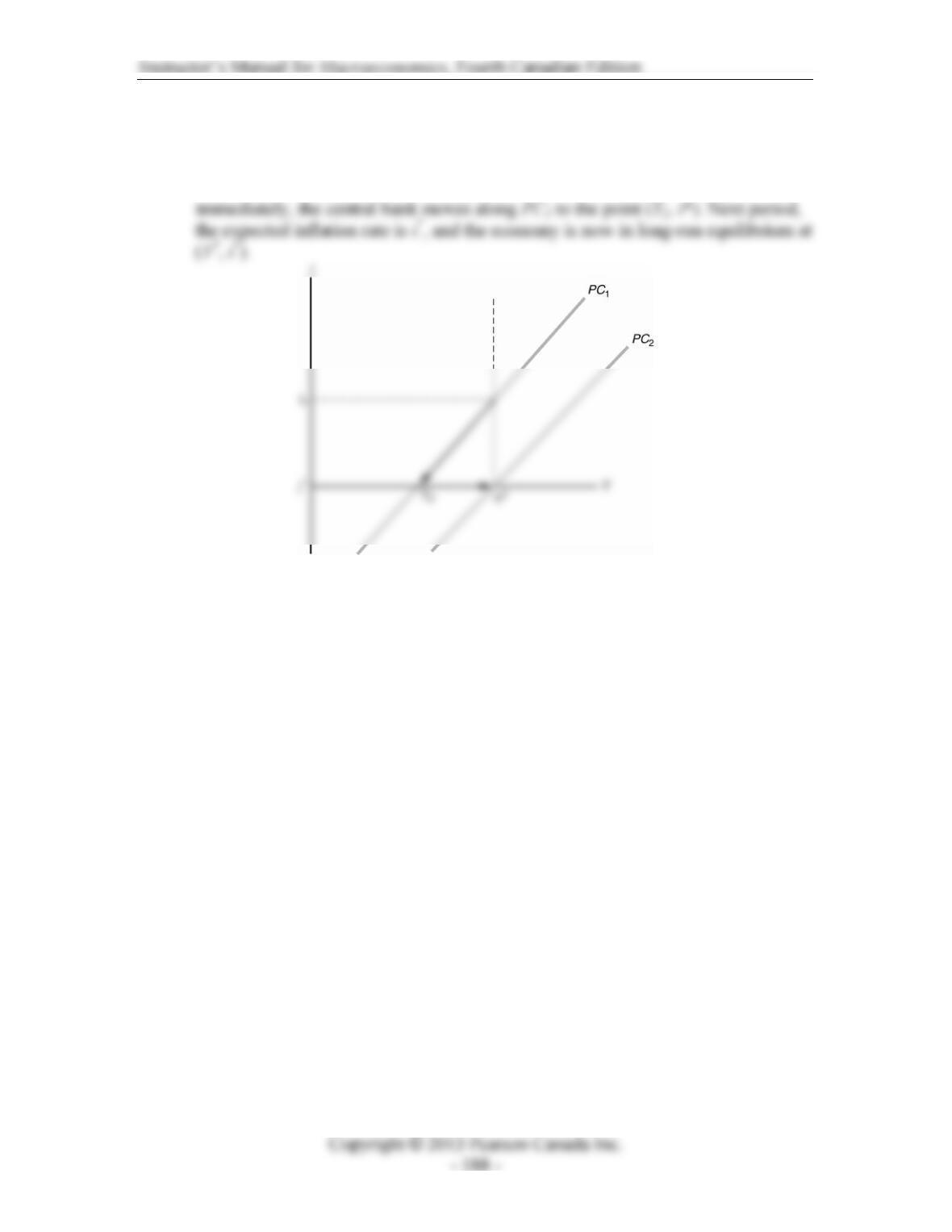
1. Initially, the inflation rate is equal to i* and aggregate output is equal to YT. The
initial Phillips curve is PC1. To exploit PC1 optimally, the central bank adopts the
inflation rate i1, and the level of aggregate output increases to Y1. In the next
Figure 17.1
2. Disinflation.
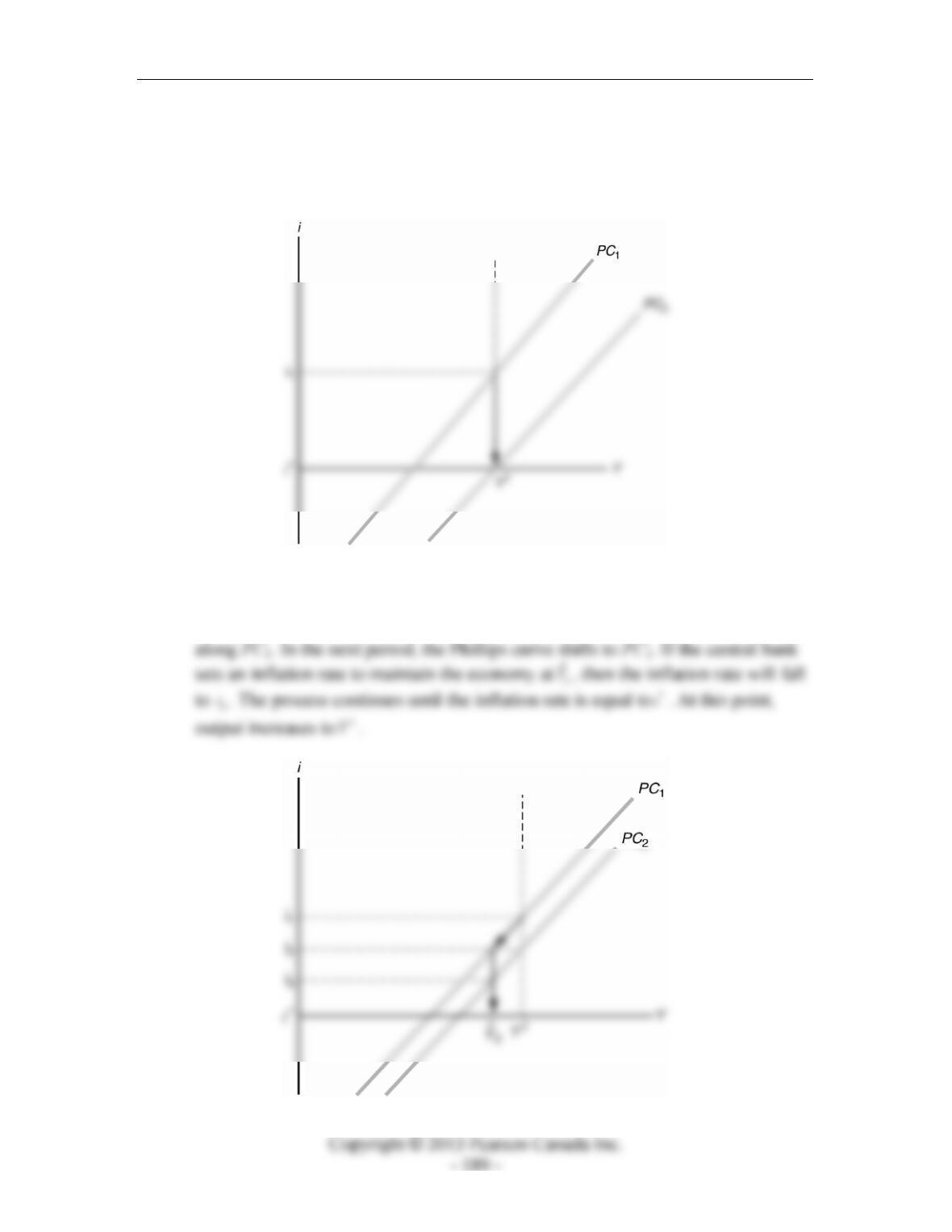
a) The economy starts at the point (YT, i1) in Figure 17.2a. The expected rate of
inflation is i1, and the relevant Phillips curve is PC1. To reduce inflation to i*
Figure 17.2a
Chapter 18: Inflation, the Phillips Curve, and Central Bank Commitment
b) With rational expectations, the expected rate of inflation immediately declines to
i*. The economy immediately moves to the point (YT, i*) in Figure 17.2b.
Therefore, the economy does not have to endure a period of low output to end the
excessive inflation.
Figure 17.2b
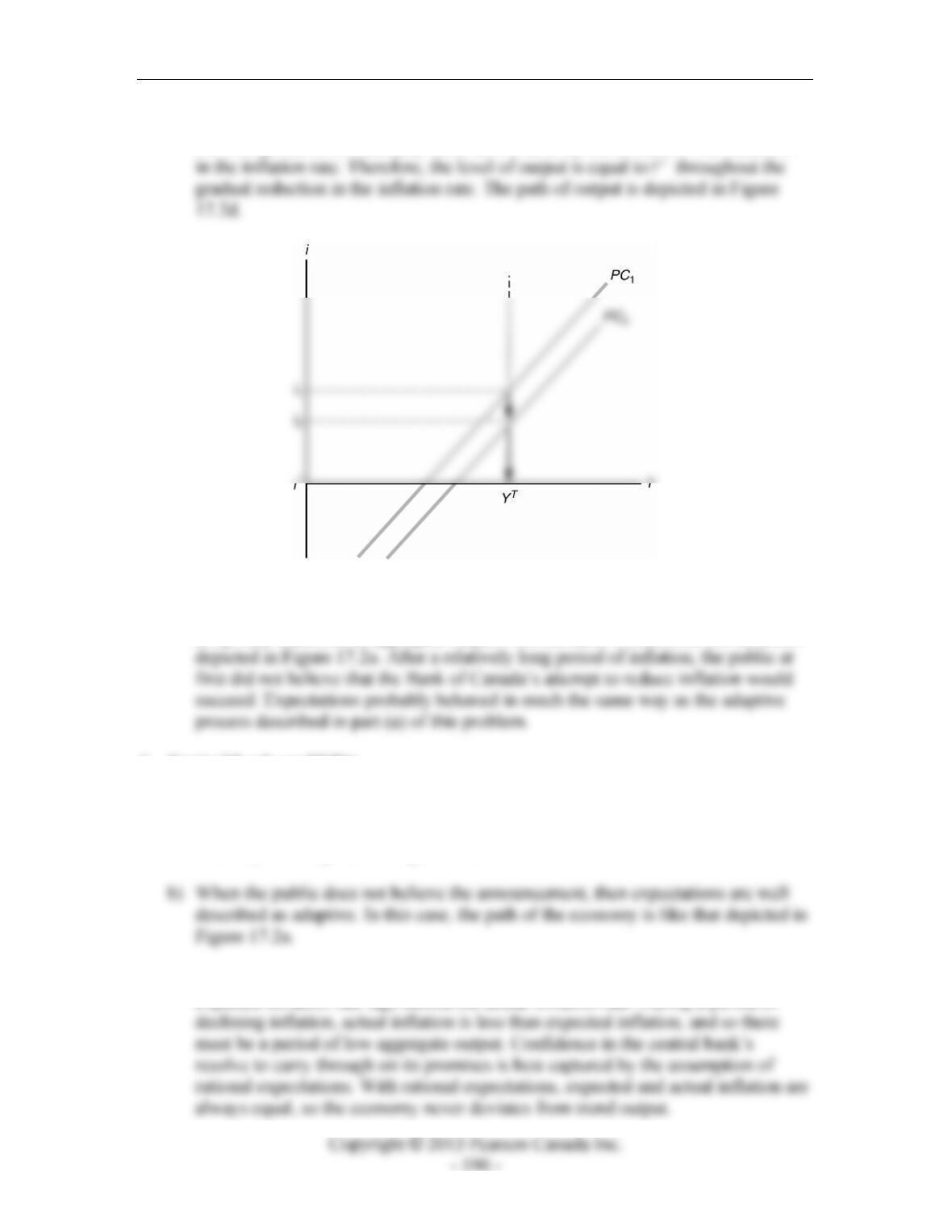
c) The economy starts at the point (YT, i1) in Figure 17.2c. If the central bank first
reduces the inflation rate to 2
i, and expectations are adaptive, output declines to 2
ˆ
Y,
Figure 17.2c
Instructor’s Manual for Macroeconomics, Fourth Canadian Edition
If expectations are rational, then with each gradual step down in the inflation rate,
the Phillips curve immediately shifts downwards by the amount of the reduction
Figure 17.2d
d) In the early 1980s, the inflation rate fell dramatically, and there was a large,
temporary reduction in aggregate output. This scenario is much like the transition
3. Central bank credibility.
a) When the public has confidence that the central bank will follow through on its
promise, then expectations are well described as rational. Movement in the
economy is as depicted in Figure 17.2b.
c) When expectations are slow to adapt, there is a period of time during which the
expected inflation rate lags behind the actual inflation rate. During a period of