Mishkin • Instructor’s Manual for The Economics of Money, Banking, and Financial Markets, Twelfth Edition 201
Chapter 18
ANSWERS TO QUESTIONS
1. If the Federal Reserve sells dollars in the foreign exchange market but conducts an offsetting
open market operation to sterilize the intervention, what will be the effect on international
reserves, the money supply, and the exchange rate?
The sale of dollars involves a purchase of foreign assets which means that both international
2. If the Federal Reserve buys dollars in the foreign exchange market but does not sterilize the
intervention, what will be the impact on international reserves, the money supply, and the
exchange rate?
The purchase of dollars involves a sale of foreign assets, which means that international
3. For each of the following, identify whether they increase or decrease the current account
balance:
a. An American citizen’s purchase of an airline ticket from Air France
decrease
4. Suppose that you travel to Cali (Colombia), where the exchange rate is 1 USD to 2,900
Colombian pesos. As you enter a McDonald’s restaurant, you realize you need 17,400
Colombian pesos to buy a Big Mac. Assuming a Big Mac sells for $5 in the United States,
would you say that the Colombian peso is over- or undervalued in terms of PPP?
Since the exchange rate is 1 USD to 2,900 COP (Colombian Pesos), a Big Mac should sell
5. Refer to the previous exercise. Which type of foreign market intervention must the central
bank of Colombia conduct to keep the exchange rate at a level where the currency is not
under- or overvalued in terms of PPP?
To eliminate the overvaluation in terms of PPP, the exchange rate for the Columbian peso
6. What would be the effect of a devaluation on a country’s imports and exports? If a country
imports most of the goods included in the basket of goods and services used to calculate the
CPI, what do you think the effect will be on this country’s inflation rate?
When a country devalues its currency, the fixed exchange rate is set at a lower level, meaning
that the central bank will no longer exchange domestic currency at the previous (higher)
exchange rate. This means that foreigners with the same amount of foreign currency can get
7. Under the gold standard, if Britain became more productive relative to the United States,
what would happen to the money supply in the two countries? Why would the changes in the
money supply help preserve a fixed exchange rate between the United States and Britain?
The increase in British productivity would create a tendency for the pound to appreciate
relative to the dollar. The higher value of the pound would now cause Americans to exchange
8. What is the exchange rate between dollars and Swiss francs if one dollar is convertible into
1/20 ounce of gold and one Swiss franc is convertible into 1/40 ounce of gold?
9. “Inflation is not possible under the gold standard.” Is this statement true, false, or
uncertain? Explain your answer.
10. What are some of the disadvantages of China’s pegging the yuan to the dollar?
There are several disadvantages to China’s exchange rate strategy. First, diversification is a
problem in that the Chinese own a very large amount of U.S. assets, including low-yielding
11. If a country’s par exchange rate was undervalued during the Bretton Woods fixed exchange
rate regime, what kind of intervention would that country’s central bank be forced to
undertake, and what effect would the intervention have on the country’s international reserves
and money supply?
12. Why might a country that is suffering a recession not want to intervene in the foreign
exchange market if its currency is overvalued? Assume this country participates in a fixed
exchange rate regime.
When a country is engaged in a fixed exchange rate regime, it has a commitment to intervene
in the foreign exchange market to maintain the system of fixed exchange rates. However, the
13. “If a country wants to keep its exchange rate from changing, it must give up some control
over its monetary policy.” Is this statement true, false, or uncertain? Explain your answer.
14. Why is it that in a pure, flexible exchange rate system, the foreign exchange market has no
direct effect on the money supply? Does this mean that the foreign exchange market has no
effect on monetary policy?
15. Why did the exchange-rate peg lead to difficulties for the countries in the ERM after the
German reunification?
16. How can exchange-rate targets lead to a speculative attack on a currency?
17. The IMF does not enjoy a great reputation in many countries that were recipients of IMF
loans or bailouts. Explain why many citizens were not happy with the role played by the IMF.
In general, IMF loans provided to help countries cope with either financial or currency crises
18. How can the long-term bond market help reduce the time-inconsistency problem for
monetary policy? Can the foreign exchange market also perform this role?
The long-term bond market can help reduce the time-inconsistency problem because
19. “Balance-of-payments deficits always cause a country to lose international reserves.” Is this
statement true, false, or uncertain? Explain your answer.
20. What are the key advantages of exchange-rate targeting as a monetary policy strategy?
21. When is exchange-rate targeting likely to be a sensible strategy for industrialized countries?
When is exchange-rate targeting likely to be a sensible strategy for emerging market
countries?
22. What are the advantages and disadvantages of currency boards and dollarization over a
monetary policy that uses only an exchange-rate target?
9.64% overvalued.
Mishkin • Instructor’s Manual for The Economics of Money, Banking, and Financial Markets, Twelfth Edition 206
ASWERS TO APPLIED PROBLEMS
23. Suppose the Federal Reserve purchases $1,000,000 worth of foreign assets.
a. If the Federal Reserve purchases the foreign assets with $1,000,000 in currency, show
the effect of this open market operation, using T-accounts. What happens to the monetary
base?
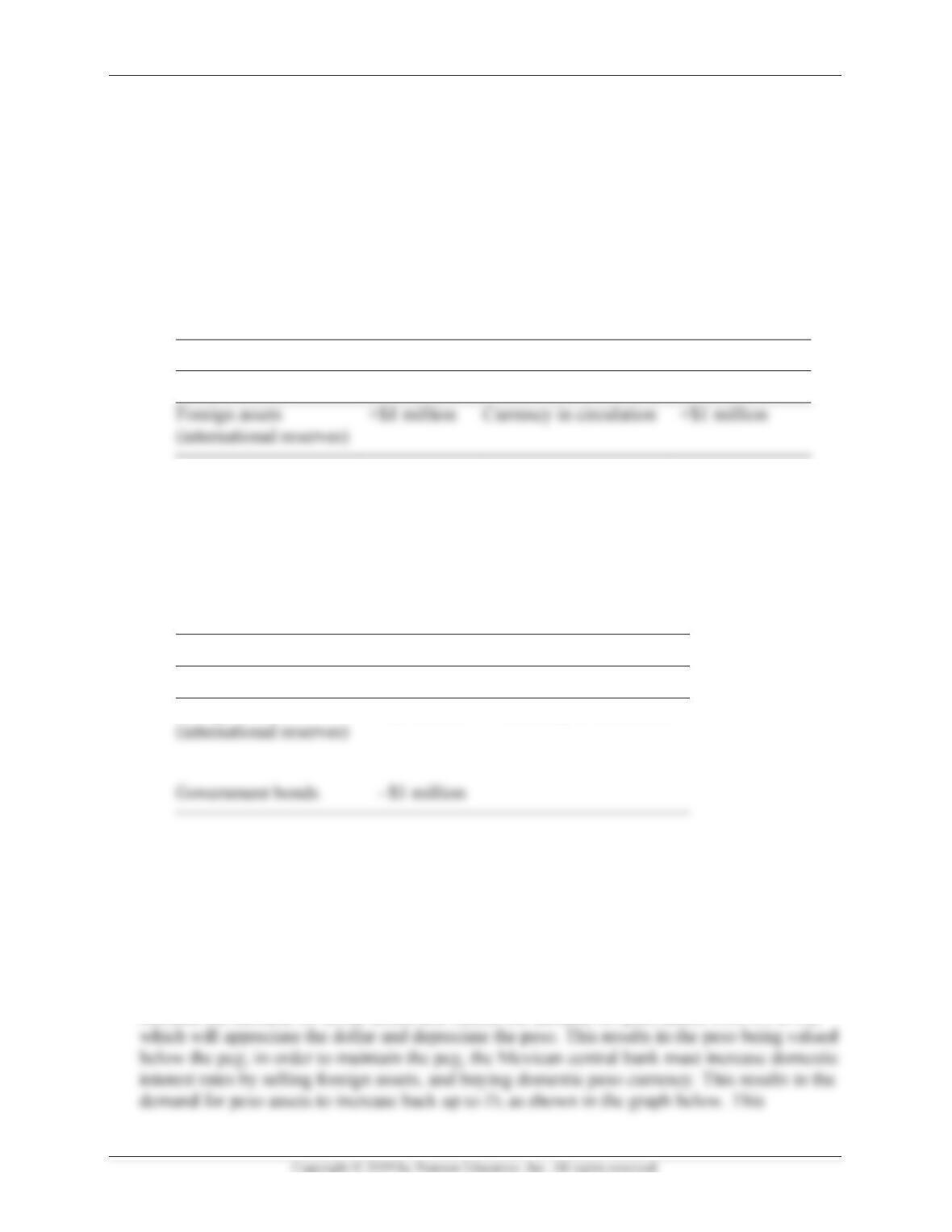
The Fed’s assets increase by $1 million, and it increases currency in circulation by $1
million. This results in the monetary base increasing by $1 million.
Federal Reserve System
Assets Liabilities
b. If the Federal Reserve purchases the foreign assets by selling $1,000,000 in T-bills, show
the effect of this open market operation, using T-accounts. What happens to the monetary
base?
The Fed’s assets increase by the increased foreign assets, but this is offset by a decrease
in T-bill holdings of the same amount. Overall, the Fed’s assets are unchanged, and its
liabilities and hence the monetary base are also unchanged.
Federal Reserve System
Assets Liabilities
Foreign assets
+$1 million Currency in circulation
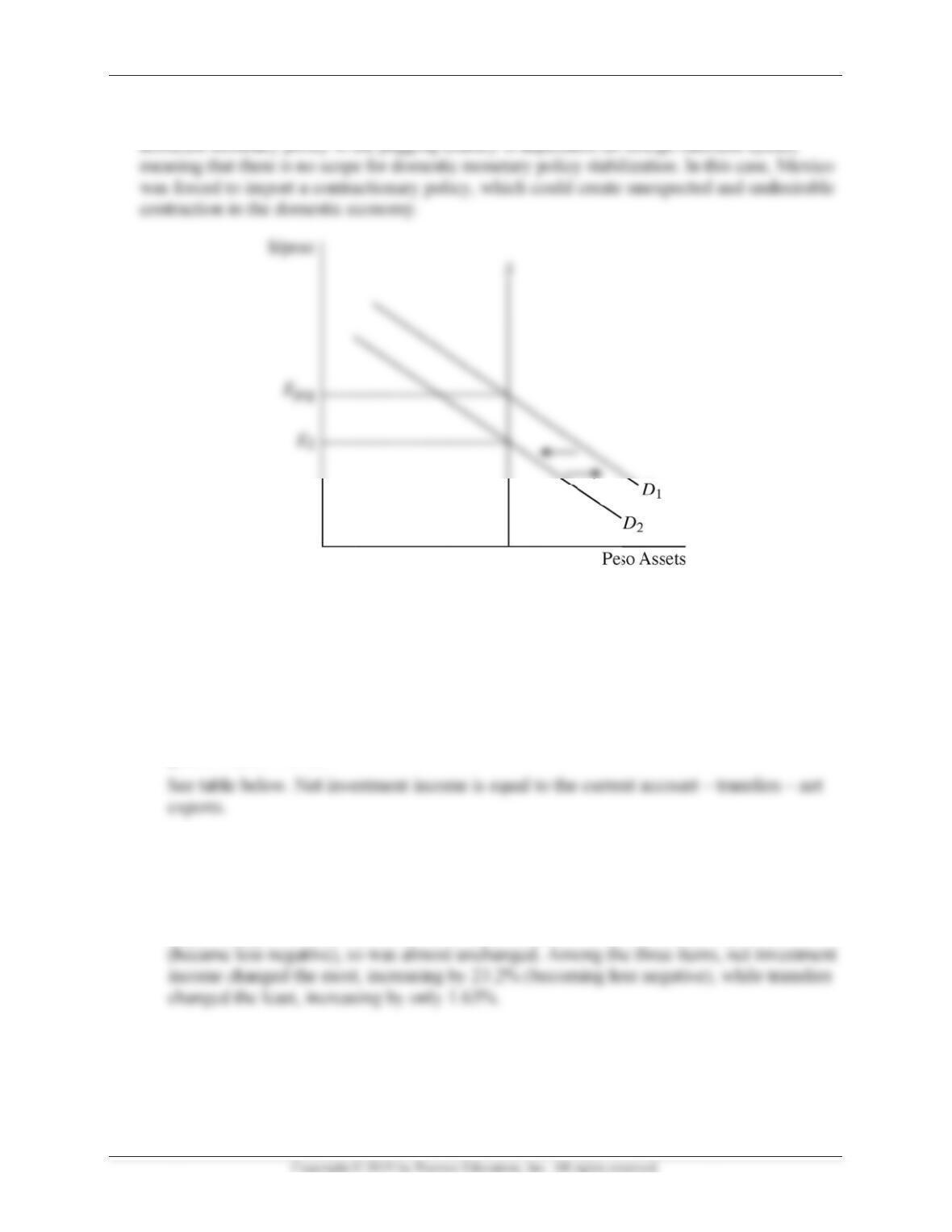
24. Suppose the Mexican central bank chooses to peg the peso to the U.S. dollar and commits to
a fixed peso/dollar exchange rate. Use a graph of the market for peso assets (foreign
exchange) to show and explain how the peg must be maintained if a shock in the U.S.
economy forces the Fed to pursue contractionary monetary policy. What does this say about
the ability of central banks to address domestic economic problems while maintaining a
pegged exchange rate?
An increase in U.S. interest rates as a result of the contractionary monetary policy will
increase the demand for dollar assets and reduce the demand for peso assets from D1 to D2,
Mishkin •
dem
o
ANSW
E
1.
Go t
o
(NE
T
a.
C
q
b.
C
o
n
h
o
n
I
n
I
nstructor’s Ma
n
o
nstrates on
e
E
RS TO D
A
o
the St. Lou
T
EXP), tran
sf
C
alculate ne
t
u
arter a ye
a
C
alculate th
e
n
e year ear
l
a
d the larg
e
n
e had the s
n
percentag
e
n
ual for The Ec
o
e
of the mai
n
A
TA ANAL
Y
is Federal
R
sf
ers, (A123
R
t
investment
a
r earlier.
e
percentage
l
ier. Which
o
e
st effect in
p
mallest effe
c
e
terms, the
c
o
nomics of Mon
e
n
disadvanta
g
Y
SIS PRO
B
R
eserve FR
E
R
C1Q027S
B
income for
t
change in t
h
o
ne of the th
r
p
ercentage t
e
c
t?
c
urrent acco
u
e
y, Banking, an
d
g
es to peggi
B
LEMS
E
D database,
B
EA) and th
e
t
he most rec
h
e current a
r
ee items m
a
e
rms on the
c
u
nt balance
d
Financial Mar
k
i
ng the dom
e
,
and find d
a
e
current ac
c
ent quarter
a
a
ccount bala
n
a
king up the
change of t
h
declined by
k
ets, Twelfth E
d
e
stic currenc
y
a
ta on net e
xp
c
ount balan
c
available, a
n
nce from th
e
current ac
c
h
e current a
c
less than o
n
d
ition
y
in that
xp
orts
c
e (NETFI).
n
d for the s
a
e
same quar
t
c
ount balanc
c
count? Wh
i
n
e percent
207
a
me
t
er
e
i
ch
e
e
c
c
e
e
b
i
Mishkin • Instructor’s Manual for The Economics of Money, Banking, and Financial Markets, Twelfth Edition 208
Current
Account
Balance
($Bil.) Transfers
Net
Exports
Net
Investment
Income
2017:Q1 487.4 281.1 582.8 185.7
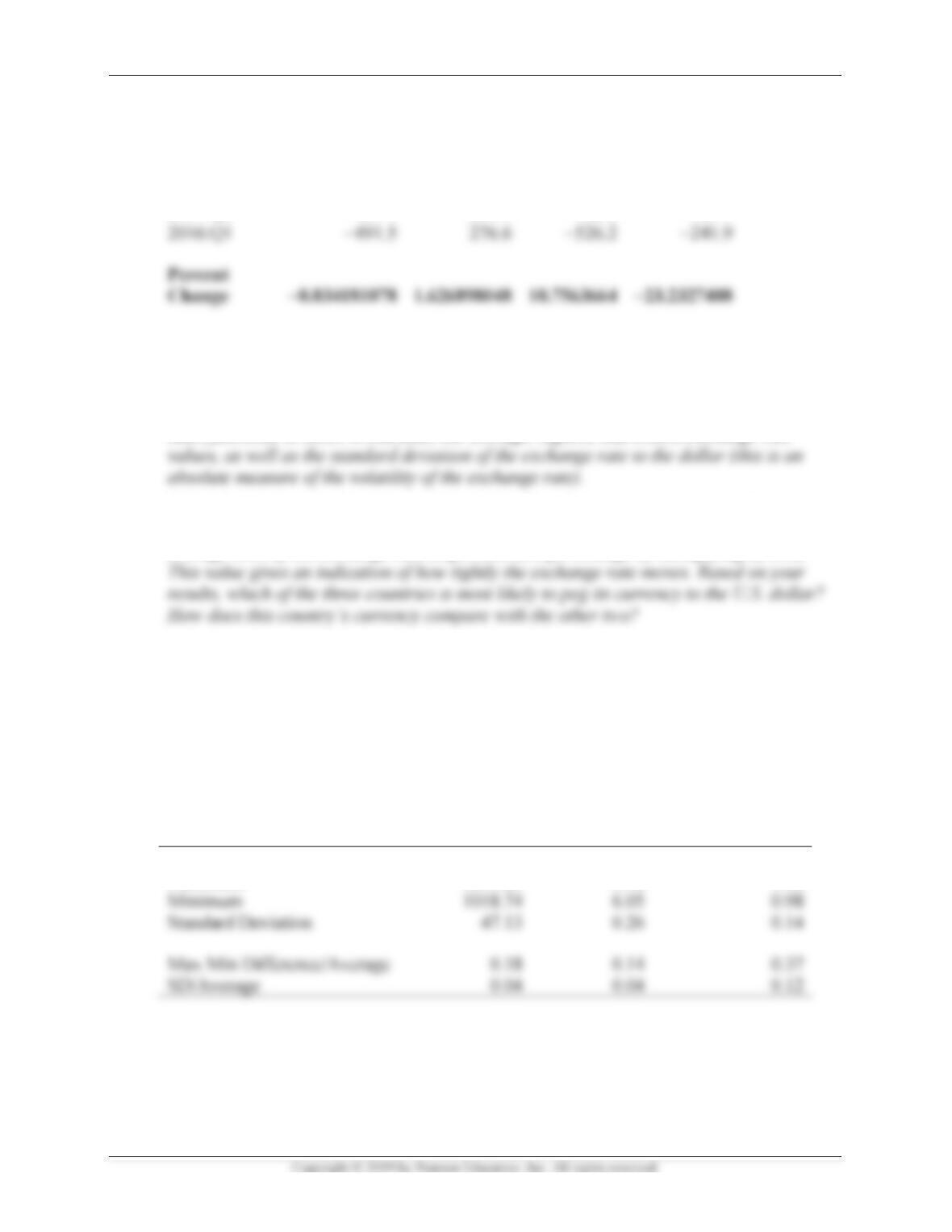
2. Go to the St. Louis Federal Reserve FRED database and find data on the monthly U.S. dollar
exchange rate to the Chinese yuan (EXCHUS), the Canadian dollar (EXCAUS), and the
South Korean won (EXKOUS). Download the data into a spreadsheet.
a. For the most recent five-year period of data available, use the average, max, min, and
stdev functions in Excel to calculate the average, highest, and lowest exchange rate
b. Using the maximum and minimum values of each exchange rate over the last five years,
calculate the ratio of the difference between the maximum and minimum values to the
average level of the exchange rate (expressed as a percentage by multiplying by 100).
c. Calculate the ratio of the standard deviation to the average exchange rate over the last
five years (expressed as a percentage by multiplying by100). This value gives an
indication of how volatile the exchange rate is. Based on your results, which of the three
currencies is most likely to be pegged to the U.S. dollar? How does this currency
compare with the other two?
a. See table below for July 2012 to July 2017.
South
Korean Won
Chinese
Yuan Canadian Dollar
Average 1113.04 6.37 1.18
Maximum 1216.23 6.92 1.42
Mishkin • Instructor’s Manual for The Economics of Money, Banking, and Financial Markets, Twelfth Edition 209
b. (b) See table above. The Chinese yuan has a much smaller band that it moves in
relative to the average value; at only 14% of the average, this is slightly smaller than