Chapter 18
Policies and Prospects for Global Economic Growth
◼ Overview
The chapter begins with a discussion of the circumstances under which population growth can either help
or hinder economic growth. The importance of economic and political freedom and their relationship to
economic growth is examined. The next section examines the role of capital in economic growth. The
◼ Learning Objectives
After studying this chapter, students should be able to:
• 18.1 Explain why population growth can have uncertain effects on economic growth
• 18.2 Understand why the existence of dead capital retards investment and economic growth in much
of the developing world
◼ Outline
I. Labor Resources and Economic Growth: Important determinants of economic growth are growth
of labor and capital and the rate of increase of labor and capital productivity. This section examines
the conditions necessary for population growth to be translated into economic growth.
A. Basic Arithmetic of Population Growth and Economic Growth: The growth rate of per
capita real GDP is equal to the rate of growth of real GDP minus the population growth rate.
1. How Population Growth Can Contribute to Economic Growth: Immigration can
increase real GDP faster than population if they increase the labor force participation rate.
2. Whether Population Growth Hinders or Contributes to Economic Growth Depends
on Where You Live: There are countries, such as Saudi Arabia, where rapidly increasing
B. The Role of Economic Freedom: Economic freedom is expressed as the right to own private
property and to exchange goods, services, and financial assets with minimal government
C. The Role of Political Freedom: Political freedom is the right to openly support and
democratically select national leaders. It seems less important than economic freedom in
II. Capital Goods and Economic Growth: In general, capital is necessary for economic growth. In
many developing countries, one of the most significant problems people face that retards economic
growth is dead capital, which is any capital resource that lacks clear title of ownership. Because
people have difficulties exchanging, insuring, and legally protecting their rights to it, it is not
readily allocated to its most productive use.
A. Dead Capital and Inefficient Production: Because people who unofficially own capital goods
are commonly constrained in using them efficiently, large amounts of capital goods are not
employed in their highest valued use.
1. Dead Capital and Economic Growth: In developing countries, the existence of dead
2. Government Inefficiencies, Investment, and Growth: A major factor that contributes to
III. A Recent Shift in Global Growth Trends: Emerging nations are developing countries that have
adopted policy changes that have generated sufficiently increased economic growth to move those
nations closer to advanced-nation status.
A. Changing Growth Rates: Emerging and Development versus Advanced Nations: Between the
B. An Economic Growth Reversal: 1981-2000 versus 2000-2017: Since 2000, secular stagnation
1. Average Economic Growth Rates Prior to 2000: Over the 1981−1999 period, the rate of
2. Average Growth Rates After 2000: Over the 2000−2017 period, advanced nations
IV. Private International Financial Flows as a Source of Global Growth: One approach to promoting
greater economic growth in developing countries is to rely on private markets to direct capital
goods to their best uses.
A. Private Investment in Developing Nations: Net private international flows of funds to
developing countries have averaged over $150 billion per year since 2005 (equal to about
B. Obstacles to International Investment: The major problems of financial markets in developing
countries are related to the problem of asymmetric information.
1. Asymmetric Information as a Barrier to Financing Global Growth: The problem here
is that institutions that make loans or investors who hold stocks and bonds have less
information than those who seek to use the funds. Adverse selection arises when those who
2. Incomplete Information and International Financial Crises: An international financial
crisis exists when there is a rapid withdrawal of foreign investments and loans from a
V. International Institutions and Policies for Global Growth: Since 1945, the world’s governments
have taken an active role in supplementing private markets through the World Bank and the
International Monetary Fund.
A. The World Bank: A multinational agency that specializes in making loans to about 100
B. The International Monetary Fund: The International Monetary Fund (IMF) is an
274 Miller • Economics Today, Nineteenth Edition
C. The World Bank and the IMF: Problems and Proposals: In recent years, economists have
questioned IMF and World Bank policymaking.
1. Asymmetric Information and the World Bank and IMF: Lending policies of both
organizations can make the adverse selection problem worse.
2. Rethinking Long-Term Development Lending: Many economists argue that promoting
3. Alternative Institutional Structures for Limiting Financial Crises: Proposals range
◼ Points to Emphasize
Population Growth and Economic Growth
Population growth is associated with increased per capita real GDP as well as decreasing per capita real
GDP. An increase in the labor force, a consequence of population growth in the long run, may increase
Freedom and Economic Growth
It is important to recognize that a lack of economic freedom retards economic growth because there are
few incentives for people to use resources efficiently. Generally what this means is that property rights in
Capital and Economic Growth
Generally, economists argue that an increase in the amount of capital will cause economic growth by
increasing resources available to produce real GDP, ceteris paribus. When clear title to such capital exists,
Private Financial Flows and the Issue of Dead Capital
Private financial flows come from developed countries that have well-developed systems of property
Chapter 18 Policies and Prospects for Global Economic Growth 275
◼ For Those Who Wish to Stress Theory
Saving, International Capital Flows, and Economic Growth
Economists note that capital investment requires saving. Other things held constant, an increase in the
saving rate will increase investment. The problem often faced by developing countries is that income
levels are so low that the saving rate is very low. As a result, the investment rate is low. The rate of growth
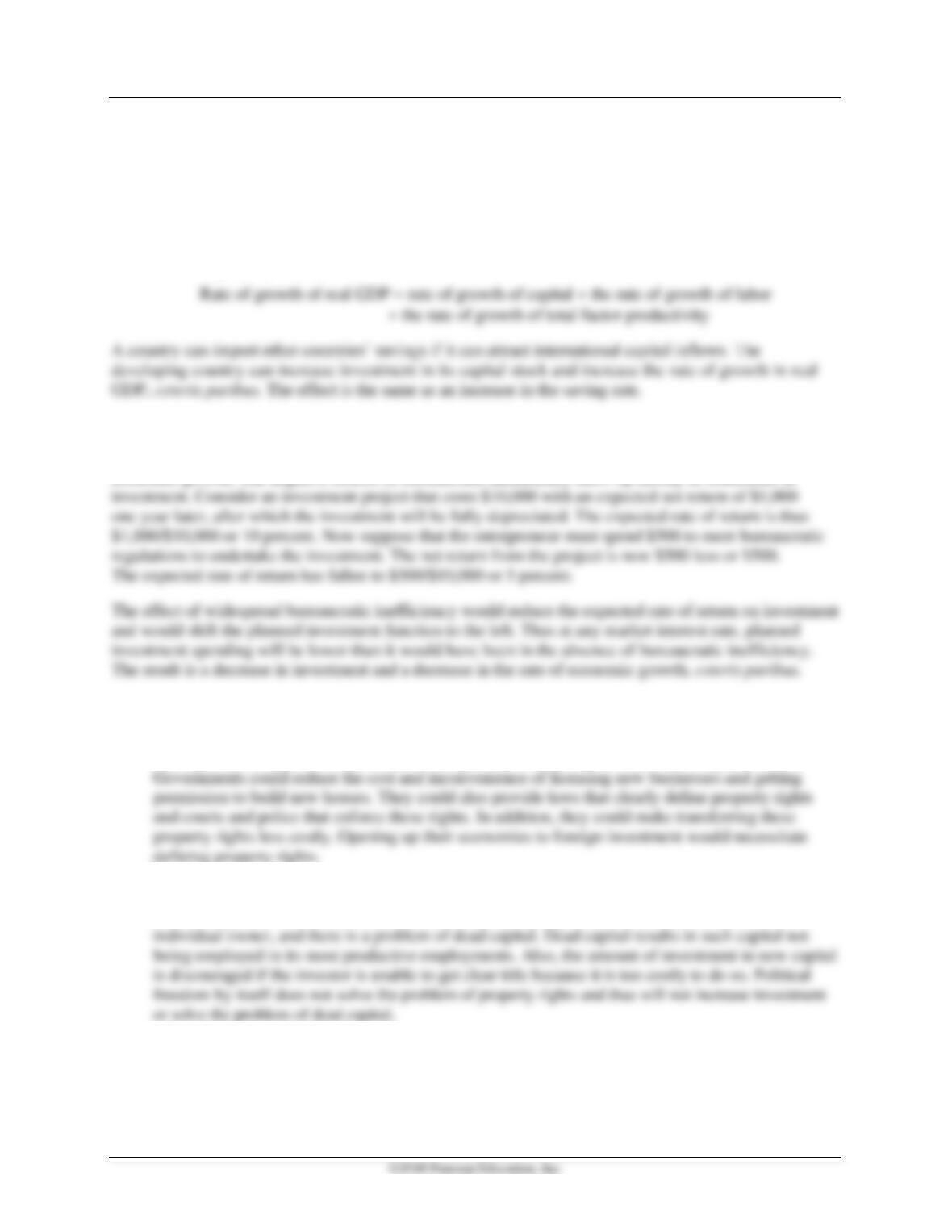
of real GDP is given by the expression:
The Effects of Inefficient Regulation on Investment
As the text notes, those countries with higher bureaucratic inefficiency indexes have lower rates of
economic growth. The negative effects of bureaucratic inefficiency show up mostly as reductions in
◼ Further Questions for Class Discussion
1. What government policies could reduce the quantity of dead capital in less-developed nations?
2. Why does economic freedom seem to be more important than political freedom in causing
economic growth? Without economic freedom, property rights are not clearly vested in an
3. Is World Bank lending to developing countries likely to increase economic growth in those
countries as much as would be the case if the same amount was provided by private investors and
banks? According to the text, the World Bank specializes in extending long-term loans for capital
276 Miller • Economics Today, Nineteenth Edition
uses and the rate of economic growth would be higher.
4. Could lending by the World Bank to governments in less-developed countries hinder market
reforms? Lending to governments in poor countries allows them to fund projects that the market
5. Could financial crises be eliminated or reduced in severity if the International Monetary Fund
and World Bank let it be known that they would not bail out the foreign lenders (banks)? Yes.
6. France’s population was 59,049,360 in 2006 and 65,630,692 in 2012. Which would be greater
under these circumstances, the rate of growth of real GDP or the rate of growth of per capita real
GDP? According to the text, the formula for the rate of growth of per capita real GDP is:
Rate of growth of per capita real GDP = rate of growth in real GDP − rate of growth of population
◼ Answers to Questions for Critical Analysis
Nudging the World’s Poor to Make Different Choices (p. 399)
Some international policymakers argue that the world’s poor require stronger “nudges,” such as
policies that prevent them from making “bad” choices. How might stronger nudges limit economic
freedom and potentially slow economic growth? (Hint: Does reducing the range of people’s choices
expand or limit their economic freedom?)
Reducing the range of people’s choices limits their economic freedom, and thus stronger nudges that limit
economic freedom might potentially slow economic growth.
Chapter 18 Policies and Prospects for Global Economic Growth 277
Indian Farmers Confront “Dead Land” Problems (p. 401)
Why do you suppose that many observers regard India’s agricultural productivity issues related to
land use as analogous to the problems arising from dead capital?
Myanmar Ends Monopolies’ Control of Financial Information to Spur Foreign
Investment (p. 405)
What types of asymmetric information problems might have existed as a consequence of the control
that Myanmar’s protected natural monopolies exercised over allocation of investors’ funds?
◼ You Are There
Will Renewable Energy “Leapfrog” African Nations to Higher Economic Growth?
(p. 409)
1. In terms of the basic arithmetic of economic growth, through what mechanism do
improvements in labor and capital productivity help to boost the rate of growth of per
capita real GDP?
2. How might Africa’s productivity improvements help to explain the recent growth reversal
between advanced nations and developing and emerging countries?
◼ Issues and Applications
China’s One-Child Policy Relaxed – To Promote Economic Growth? (pp. 409–410)
1. Why does the fact that population growth has ambiguous effects on real GDP growth
complicate the Chinese government’s efforts to accomplish its growth objective?
2. In principle, how could a nation maintain a relatively high rate of economic growth even if
it also has a relatively high range of population growth?
◼ Research Project
2. For one view regarding what China’s current population trends might mean for its future pool of
◼ Answers to Problems
18-1. A country’s real GDP is growing at an annual rate of 3.1 percent, and the current rate of
growth of per capita real GDP is 0.3 percent per year. What is the population growth rate
in this nation?
Population growth rate = real GDP growth rate − rate of growth of per capita real
GDP = 3.1 percent − 0.3 percent = 2.8 percent.
18-2. The annual rate of growth of real GDP in a developing nation is 0.3 percent. Initially, the
country’s population was stable from year to year. Recently, however, a significant increase
in the nation’s birthrate has raised the annual rate of population growth to 0.5 percent.
a. What was the rate of growth of per capita real GDP before the increase in population
growth?
b. If the rate of growth of real GDP remains unchanged, what is the new rate of growth of
per capita real GDP following the increase in the birthrate?
18-3. A developing country has determined that each additional $1 billion of net investment in
capital goods adds 0.01 percentage point to its long-run average annual rate of growth of
per capita real GDP.
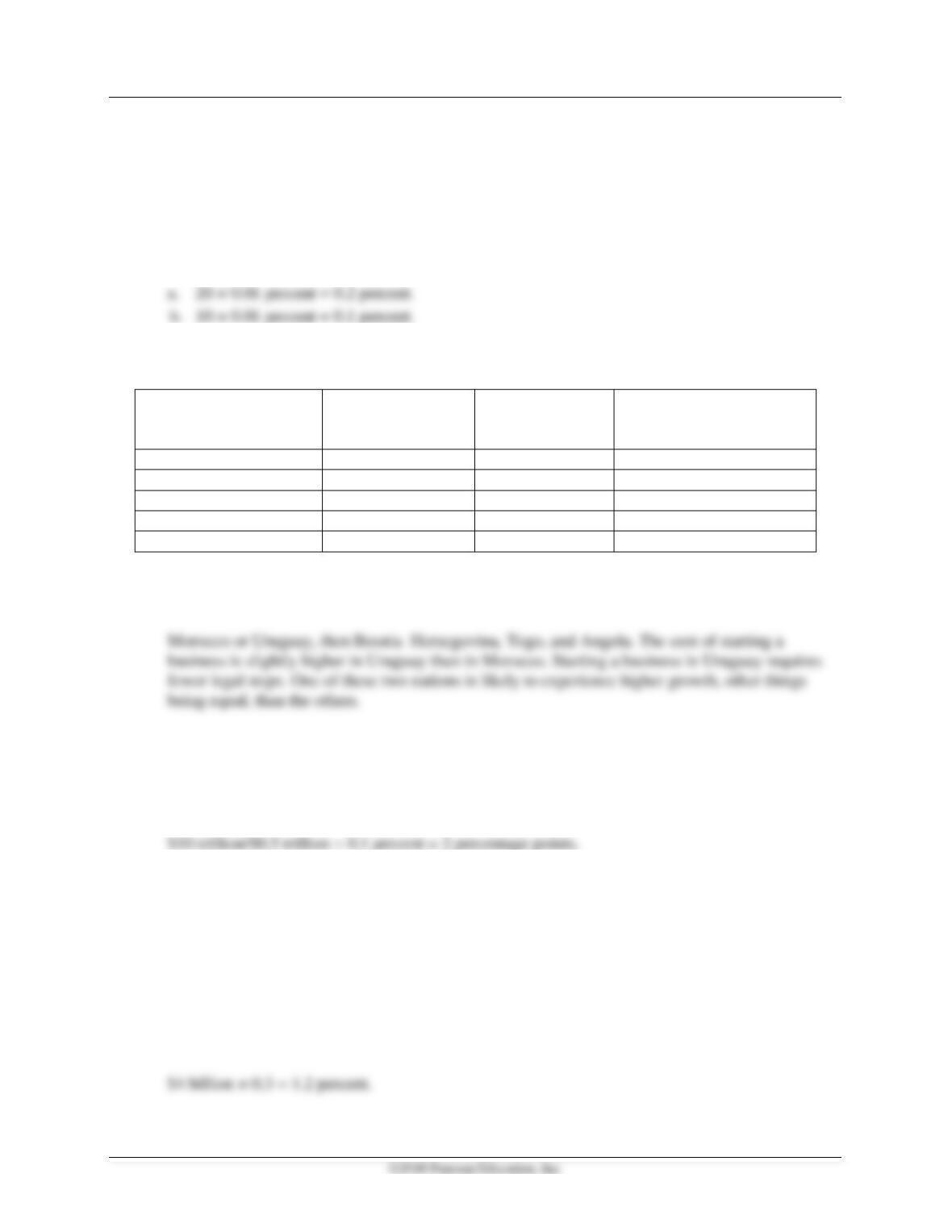
a. Domestic entrepreneurs recently began to seek official approval to open a range of
businesses employing capital resources valued at $20 billion. If the entrepreneurs
undertake these investments, by what fraction of a percentage point will the nation’s
long-run average annual rate of growth of per capita real GDP increase, other things
being equal?
Chapter 18 Policies and Prospects for Global Economic Growth 279
b. After weeks of effort trying to complete the first of 15 stages of bureaucratic red tape
necessary to obtain authorization to start their businesses, a number of entrepreneurs
decide to drop their investment plans completely, and the amount of official investment
that actually takes place turns out to be $10 billion. Other things being equal, by what
fraction of a percentage point will this decision reduce the nation’s long–run average
annual rate of growth of per capita real GDP from what it would have been if
investment had been $20 billion?
18-4. Consider the estimates that the World Bank has assembled for the following nations:
Country
Legal steps
required to start a
business
Days required
to start a
business
Cost of starting a
business as a percentage
of per capita GDP
Angola
14
146
838%
Bosnia-Herzegovina
12
59
52%
Morocco
11
36
19%
Togo
14
63
281%
Uruguay
10
27
47%
Rank the nations in order, starting with the one you would expect to have the highest rate
of economic growth, other things being equal. Explain your reasoning.
18-5. Suppose that every $500 billion of dead capital reduces the average rate of growth in
worldwide per capita real GDP by 0.1 percentage point. If there is $10 trillion in dead
capital in the world, by how many percentage points does the existence of dead capital
reduce average worldwide growth of per capita real GDP?
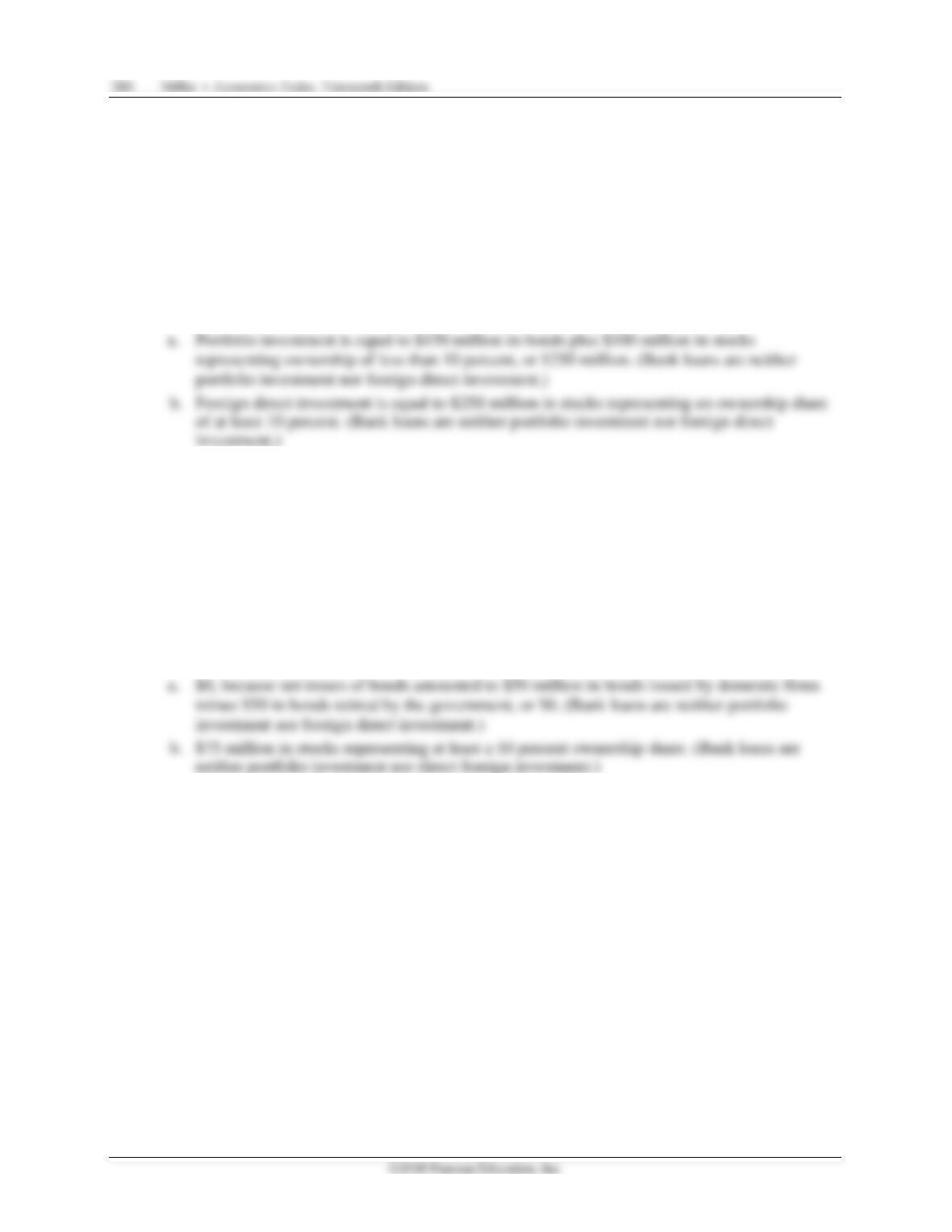
18-6. Assume that each $1 billion in net capital investment generates 0.3 percentage point of the
average percentage rate of growth of per capita real GDP, given the nation’s labor
resources. Firms have been investing exactly $6 billion in capital goods each year, so the
annual average rate of growth of per capita real GDP has been 1.8 percent. Now a
government that fails to consistently adhere to the rule of law has come to power, and firms
must pay $100 million in bribes to gain official approval for every $1 billion in investment
in capital goods. In response, companies cut back their total investment spending to $4
billion per year. If other things are equal and companies maintain this rate of investment,
what will be the nation’s new average annual rate of growth of per capita real GDP?
18-7. During the past year, several large banks extended $200 million in loans to the government
and several firms in a developing nation. International investors also purchased $150
million in bonds and $350 million in stocks issued by domestic firms. Of the stocks that
foreign investors purchased, $100 million were shares that amounted to less than a 10
percent interest in domestic firms. This was the first year this nation had ever permitted
inflows of funds from abroad.
a. Based on the investment category definitions discussed in this chapter, what was the
amount of portfolio investment in this nation during the past year?
b. What was the amount of foreign direct investment in this nation during the past year?
18-8. Last year, $100 million in outstanding bank loans to a developing nation’s government were
not renewed, and the developing nation’s government paid off $50 million in maturing
government bonds that had been held by foreign residents. During that year, however, a
new group of banks participated in a $125 million loan to help finance a major government
construction project in the capital city. Domestic firms also issued $50 million in bonds and
$75 million in stocks to foreign investors. All of the stocks issued gave the foreign investors
more than 10 percent shares of the domestic firms.
a. What was gross foreign investment in this nation last year?
b. What was net foreign investment in this nation last year?
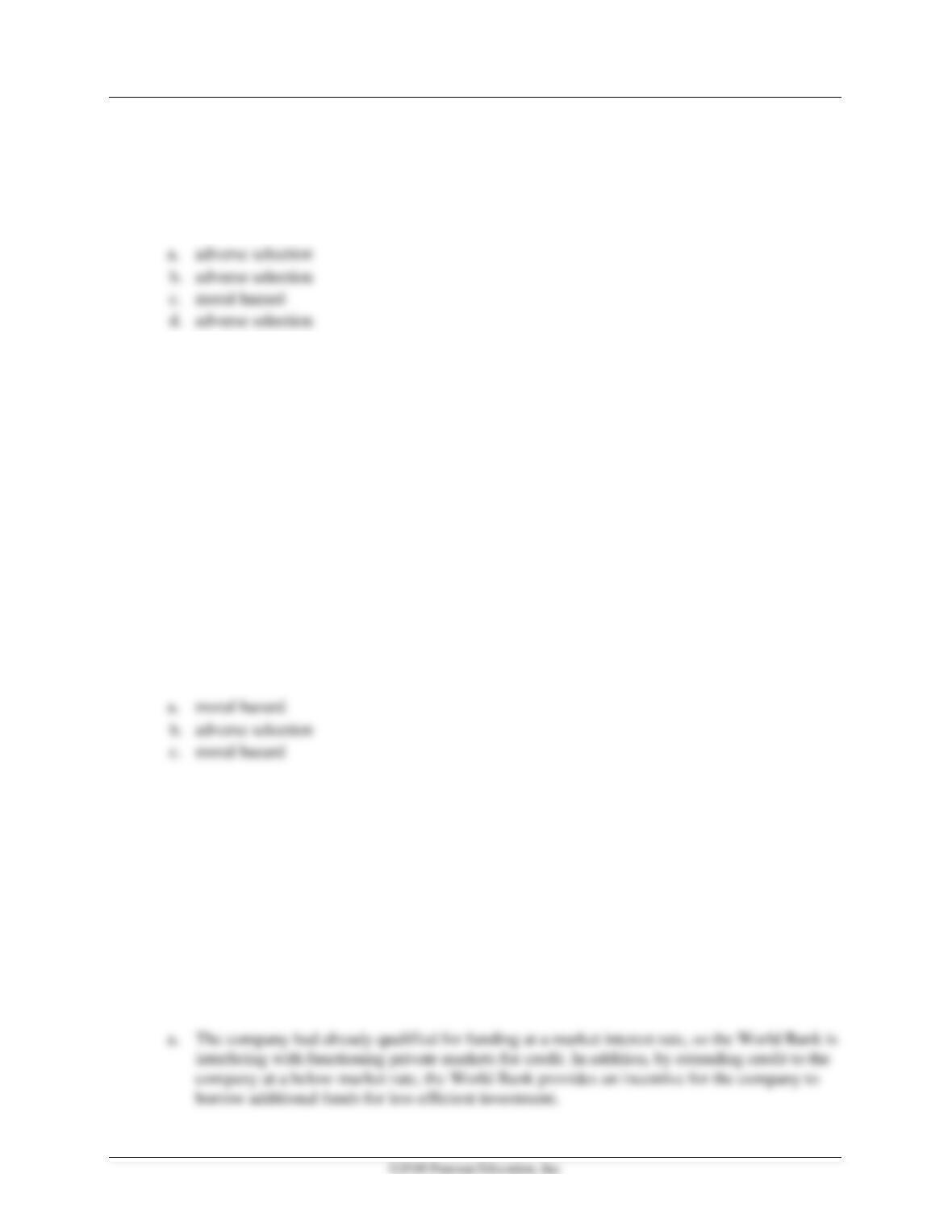
18-9. Identify which of the following situations currently faced by international investors are
examples of adverse selection and which are examples of moral hazard.
a. Among the governments of several developing countries that are attempting to issue
new bonds this year, it is certain that a few will fail to collect taxes to repay the bonds
when they mature. It is difficult, however, for investors considering buying government
bonds to predict which governments will experience this problem.
b. Foreign investors are contemplating purchasing stock in a company that, unknown
to them, may have failed to properly establish legal ownership over a crucial capital
resource.
c. Companies in a less developed nation have already issued bonds to finance the purchase
of new capital goods. After receiving the funds from the bond issue, however, the
company’s managers pay themselves large bonuses instead.
Chapter 18 Policies and Prospects for Global Economic Growth 281
d. When the government of a developing nation received a bank loan three years ago, it
ultimately repaid the loan but had to reschedule its payments after officials misused the
funds for unworthy projects. Now the government, which still has many of the same
officials, is trying to raise funds by issuing bonds to foreign investors, who must decide
whether or not to purchase them.
18-10. Identify which of the following situations currently faced by the World Bank or the
International Monetary Fund are examples of adverse selection and which are examples of
moral hazard.
a. The World Bank has extended loans to the government of a developing country to
finance construction of a canal with a certain future flow of earnings. Now, however, the
government has decided to redirect those funds to build a casino that may or may not
generate sufficient profits to allow the government to repay the loan.
b. The IMF is considering extending loans to several nations that failed to fully repay loans
they received from the IMF during the past decade but now claim to be better credit
risks. Now the IMF is not sure in advance which of these nations are unlikely to fully
repay new loans.
c. The IMF recently extended a loan to a government directed by democratically elected
officials that would permit the nation to adjust to an abrupt reduction in private flows of
funds from abroad. A coup has just occurred, however, in response to newly discovered
corruption within the government’s elected leadership. The new military dictator has
announced tentative plans to disburse some of the funds in equal shares to all citizens.
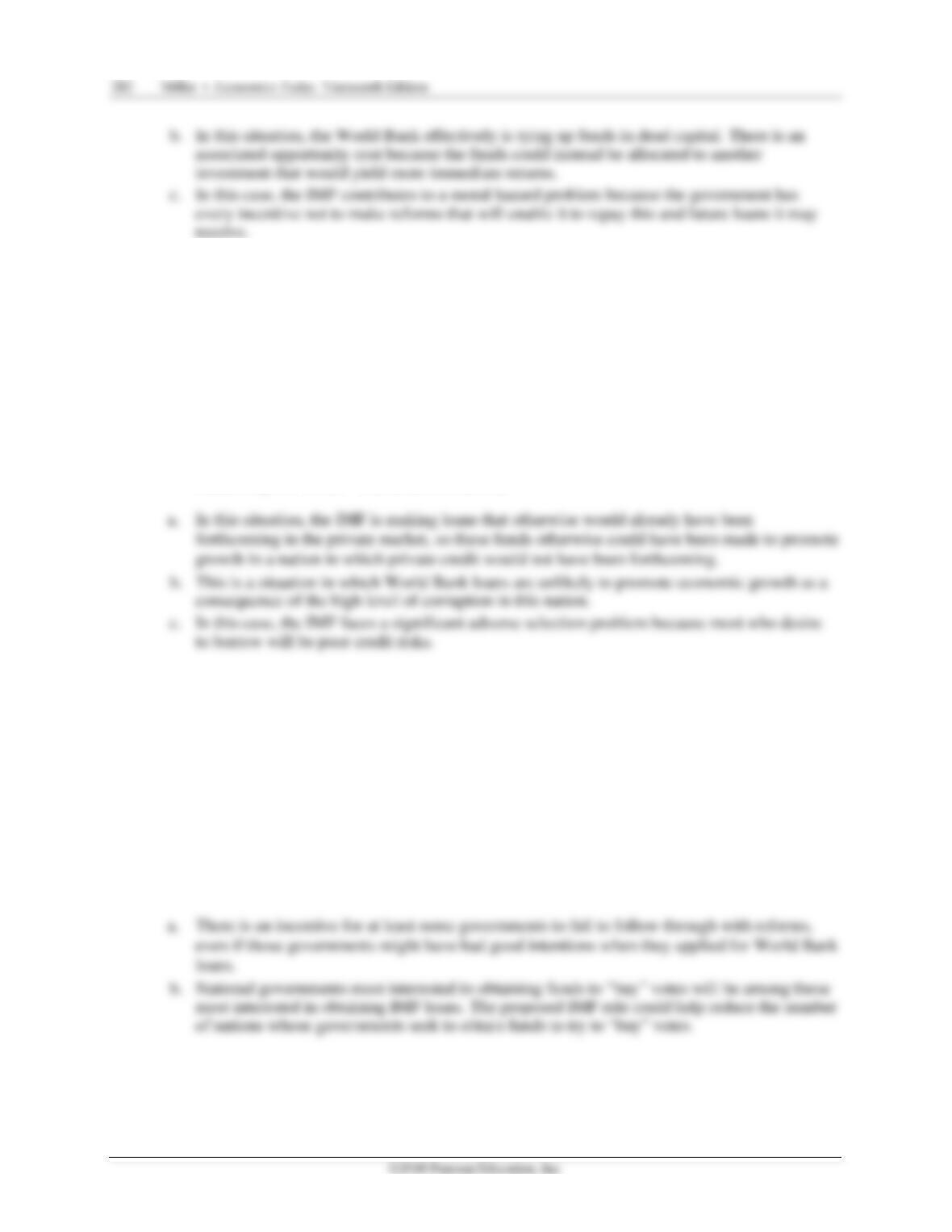
18-11. For each of the following situations, explain which of the policy issues discussed in this
chapter relates to the stance the institution has taken.
a. The World Bank offers to make a loan to a company in an impoverished nation at a
lower interest rate than the company had been about to agree to pay to borrow the same
amount from a group of private banks.
b. The World Bank makes a loan to a company in a developing nation that has not yet
received formal approval to operate there, even though the government approval
process typically takes 15 months.
c. The IMF extends a loan to a developing nation’s government, with no preconditions, to
enable the government to make already overdue payments on a loan it had previously
received from the World Bank.
18-12. For each of the following situations, explain which of the policy issues discussed in this
chapter relates to the stance the institution has taken.
a. The IMF extends a long-term loan to a nation’s government to help it maintain publicly
supported production of goods and services that the government otherwise would have
turned over to private companies.
b. The World Bank makes a loan to companies in an impoverished nation in which
government officials typically demand bribes equal to 50 percent of companies’ profits
before allowing them to engage in any new investment projects.
c. The IMF offers to make a loan to banks in a country in which the government’s rulers
commonly require banks to extend credit to finance high-risk investment projects
headed by the rulers’ friends and relatives.
18-13. Answer the following questions concerning proposals to reform long-term development
lending programs currently offered by the IMF and World Bank.
a. Why might the World Bank face moral hazard problems if it were to offer to provide
funds to governments that promise to allocate the funds to major institutional reforms
aimed at enhancing economic growth?
b. How does the IMF face an adverse selection problem if it is considering making loans to
governments in which the ruling parties have already shown predispositions to try to
“buy” votes by creating expensive public programs in advance of elections? How might
following an announced rule in which the IMF cuts off future loans to governments that
engage in such activities reduce this problem and promote increased economic growth
in nations that do receive IMF loans?
18-14. Consider Table 18-1. Based on the basic arithmetic of economic growth, what were the
average annual rates of real GDP growth since 1990 for those nations experiencing positive
rates of annual growth of per capita real GDP?
18-15. Take a look at Table 18-1. Based on the basic arithmetic of economic growth, what were the
average annual rates of real GDP growth since 1990 for those nations experiencing negative
rates of annual growth of per capita real GDP?
18-16. Consider Figure 18–1. Average rates of population growth have been higher over the entire
period covered by the figure in nearly all emerging and developing nations than in
advanced nations. What does this tell us about a comparison of the average rate of growth
of real GDP since 2000 in emerging and developing nations compared with advanced
nations?
18-17. Take a look at Figure 18-1, and read the related text that discusses the exact values of the
average growth rates displayed in the figure. Over the entire interval since 1981, which
group of countries has experienced a higher rate of economic growth: emerging and
developing nations or advanced nations?
18-18. Suppose that a foreign resident is contemplating buying 5 percent of the shares of a company
based in a developing nation but is experiencing difficulty determining whether the firm is
riskier than others in that country. What type of investment is this foreign resident
considering, and what type of asymmetric information problem is he or she experiencing?
18-19. Suppose that a foreign resident has bought 20 percent of the shares of a company based in a
developing nation but is experiencing difficulty determine whether the firm has responded
to this purchase by engaging in risker behavior. What type of investment has this foreign
resident undertaken, and what type of asymmetric information problem is she or he
experiencing?
◼ Selected References
De Soto, Hernando, The Mystery of Capital: Why Capitalism Triumphs in the West and Fails Everywhere
Else, New York: Basic Books, 2001.