Chapter 18 – Antitrust Policy and Regulation
18-1
Chapter 18 Antitrust Policy and Regulation
QUESTIONS
1. Both antitrust policy and industrial regulation deal with monopoly. What distinguishes the two
approaches? How does government decide to use one form of remedy rather than the other? LO1,
LO3
Answer: One of the goals of government in a market economy is to promote competition
as a way of achieving efficiency. One approach is to maintain competition by using
2. Describe the major provisions of the Sherman and Clayton acts. What government entities are
responsible for enforcing those laws? Are firms permitted to initiate antitrust suits on their own
against other firms? LO1
Answer: Sherman Act: Section 1 prohibits conspiracies to restrain trade; Section 2
outlaws monopolization. Clayton Act (as amended by Celler-Kefauver Act of 1950):
3. Contrast the outcomes of the Standard Oil and U.S. Steel cases. What was the main antitrust
issue in the DuPont cellophane case? In what major way do the Microsoft and Standard Oil cases
differ? LO2
Answer: In the Standard Oil case the government ruled that Standard Oil has
monopolized the petroleum industry through abusive and anticompetitive actions.
Chapter 18 – Antitrust Policy and Regulation
18-2
4. Why might one administration interpret and enforce the antitrust laws more strictly than
another? How might a change of administrations affect a major monopoly case in progress? LO2
Answer: One administration might take an active antitrust perspective, believing that
government intervention is necessary to stop the anticompetitive and sometimes illegal
5. How would you expect antitrust authorities to react to: LO2
a. A proposed merger of Ford and General Motors.
b. Evidence of secret meetings by contractors to rig bids for highway construction projects.
c. A proposed merger of a large shoe manufacturer and a chain of retail shoe stores.
d. A proposed merger of a small life‐insurance company and a regional candy manufacturer.
e. An automobile rental firm that charges higher rates for last‐minute rentals than for rentals
reserved weeks in advance.
Answer: (a) They would block this horizontal merger (violation of Section 7 of the
Clayton Act).
(b) They would charge these firms with price fixing (violation of Section 1 of the
Sherman Act).
6. Suppose a proposed merger of firms would simultaneously lessen competition and reduce unit
costs through economies of scale. Do you think such a merger should be allowed? LO2
Answer: Abstracting from other issues (for example, the relative sizes of the two firms in
the market), such a merger should only be allowed if it can be shown that price
Chapter 18 – Antitrust Policy and Regulation
7. In the 1980s, PepsiCo Inc., which then had 28 percent of the soft‐drink market, proposed to
acquire the Seven‐Up Company. Shortly thereafter the Coca‐Cola Company, with 39 percent of
the market, indicated it wanted to acquire the Dr Pepper Company. Seven‐Up and Dr Pepper each
controlled about 7 percent of the market. In your judgment, was the government’s decision to
block these mergers appropriate? LO2
Answer: The government’s decision was justified. Each of the proposed merged
companies would have resulted in a Herfindahl index of well over 1800, the guideline
8. Why might a firm charged with violating the Clayton Act, Section 7, try arguing that the
products sold by the merged firms are in separate markets? Why might a firm charged with
violating Section 2 of the Sherman Act try convincing the court that none of its behavior in
achieving and maintaining its monopoly was illegal? LO2
Answer: Section 7 of the Clayton Act prohibits the acquisition of stocks of competing
corporations when the outcome would be less competition. By arguing that the products
9. “The social desirability of any particular firm should be judged not on the basis of its market
share but on the basis of its conduct and performance.” Make a counterargument, referring to the
monopoly model in your statement. LO2
Answer: Market share is a good indication of a firm’s monopoly power. A firm with
substantial monopoly power will likely use the power to restrict output, charge high
Chapter 18 – Antitrust Policy and Regulation
18-4
10. What types of industries, if any, should be subjected to industrial regulation? What specific
problems does industrial regulation entail? LO3
Answer: Industries composed of firms with natural monopolies conditions are most
likely to be subjected to industrial regulation. Regulation based on “fair–return” prices
creates disincentives for firms to minimize costs since cost reductions lead regulators to
11. In view of the problems involved in regulating natural monopolies, compare socially optimal
(marginal‐cost) pricing and fair‐return pricing by referring again to Figure 10.9. Assuming that a
government subsidy might be used to cover any loss resulting from marginal‐cost pricing, which
pricing policy would you favor? Why? What problems might such a subsidy entail? LO3
Answer: Many of the regulatory problems associated with fair-return pricing also apply
to a policy of marginal-cost pricing. In the unlikely case that a marginal-cost pricing
policy does not entail public subsidies, it is subject to fewer regulatory problems. While
12. How does social regulation differ from industrial regulation? What types of benefits and costs
are associated with social regulation? LO4
Answer: Industrial regulation is concerned with prices, output, and profits in specific
industries, whereas social regulation deals with the broader impact of business on
Chapter 18 – Antitrust Policy and Regulation
18-5
13. Use economic analysis to explain why the optimal amount of product safety may be less than
the amount that would totally eliminate risks of accidents and deaths. Use automobiles as an
example. LO4
Answer: To produce an automobile that would totally eliminate the risk of accidents and
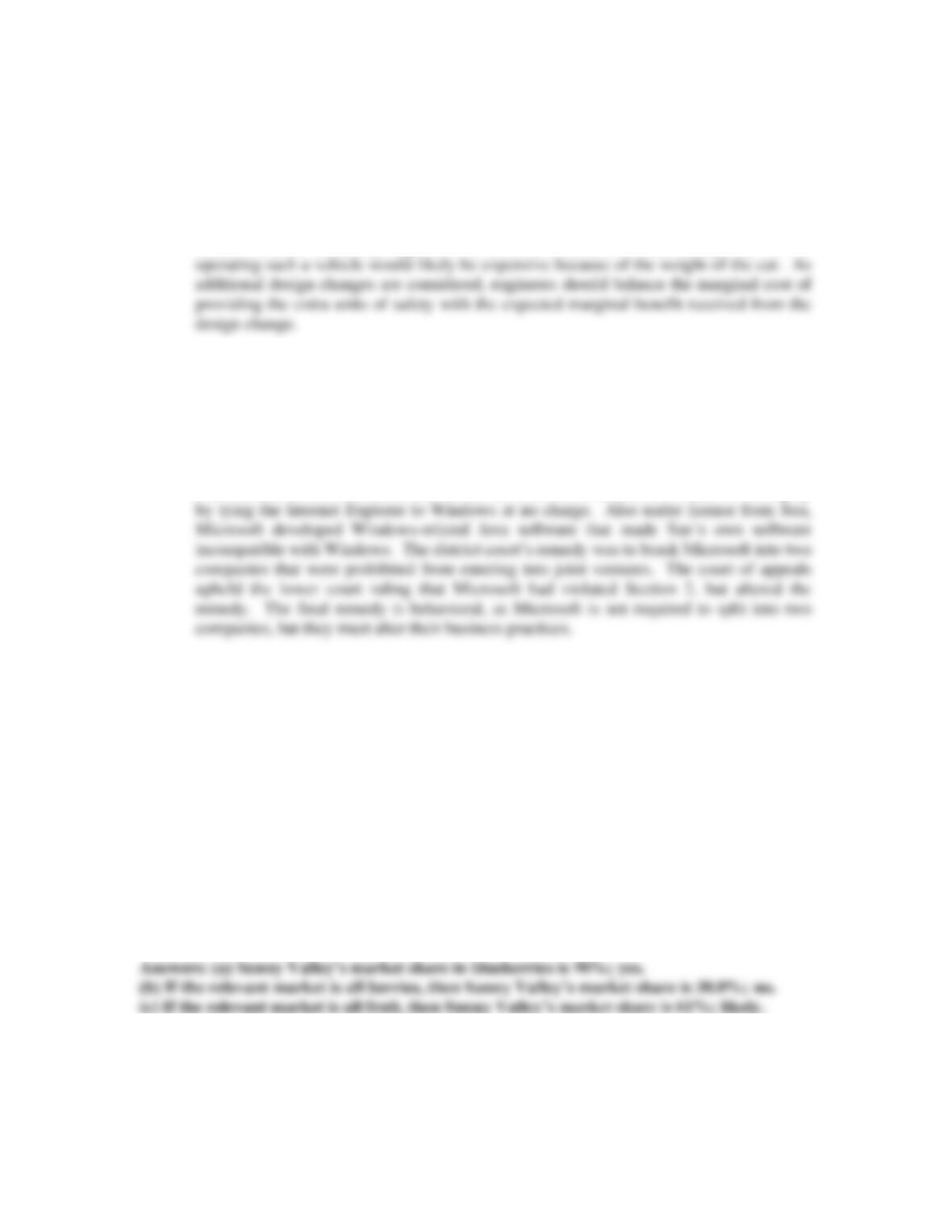
death would be extremely expensive in terms of materials. Additionally, the cost of
14. LAST WORD Under what law and on what basis did the Federal district court find Microsoft
guilty of violating the antitrust laws? What was the initial district court’s remedy? How did
Microsoft fare with its appeal to the court of appeals? Was the final remedy in the case a
structural remedy or a behavioral remedy?
Answer: Microsoft was found guilty of violating Section 2 of the Sherman Act. The
court ruled that Microsoft had taken unlawful actions to maintain its Windows monopoly
PROBLEMS
1. Suppose that there are only three types of fruit sold in the United States. Annual sales are 1
million tons of blueberries, 5 million tons of strawberries, and 10 million tons of bananas.
Suppose that of those total amounts, the Sunny Valley Fruit Company sells 900,000 tons of
blueberries, 900,000 tons of strawberries, and 7.9 million tons of bananas. LO2
a. What is Sunny Valley’s market share if the relevant market is blueberries? If a court applies the
“90‐60‐30 rule” when considering just the blueberry market, would it rule that Sunny Valley is a
monopoly?
b. What is Sunny Valley’s market share if the relevant market is all types of berries? Would the
court rule Sunny Valley to be monopolist in that market?
c. What if the relevant market is all types of fruit? What is Sunny Valley’s market share, and
would the court consider Sunny Valley to be a monopolist?
Chapter 18 – Antitrust Policy and Regulation
18-6
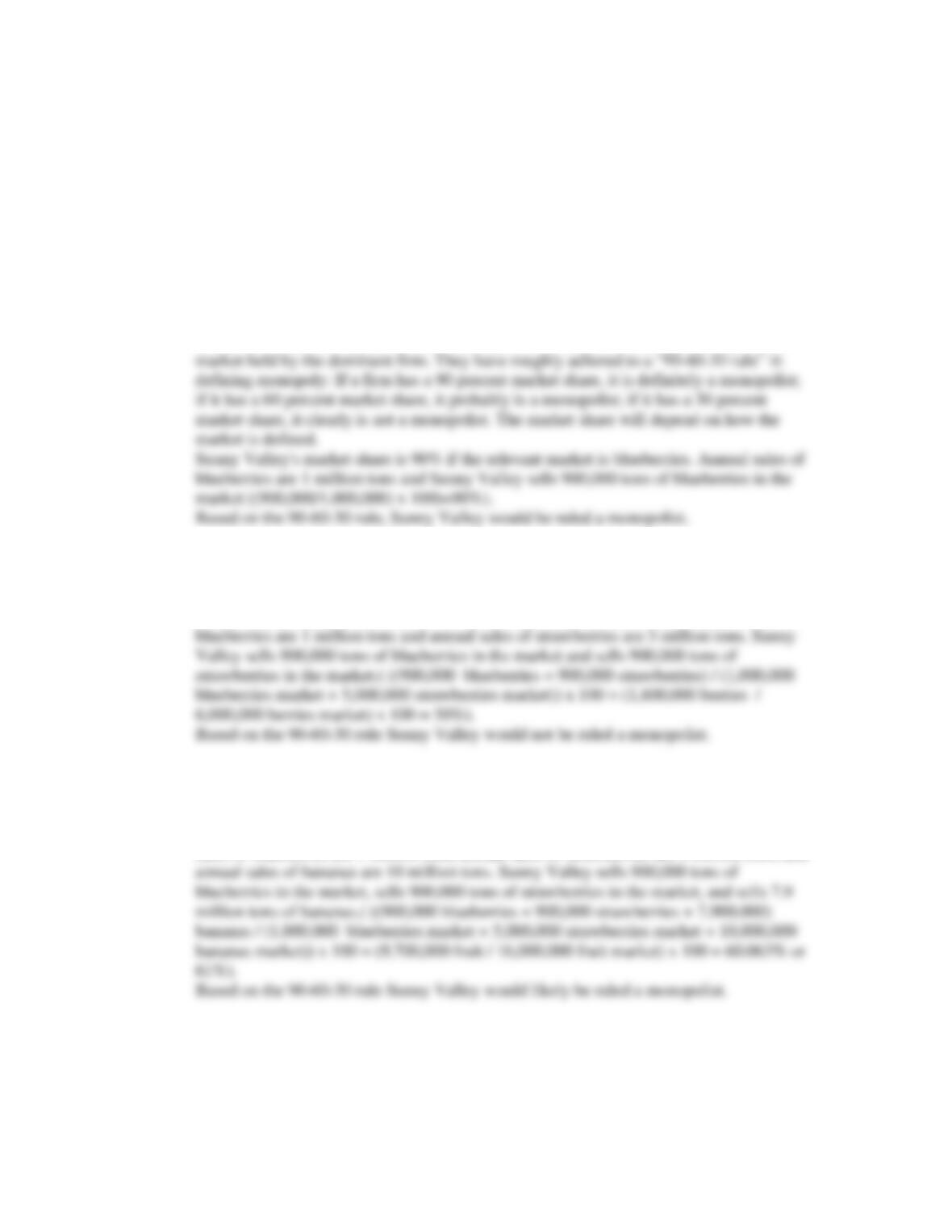
Feedback: Consider the following example. Annual sales are 1 million tons of
blueberries, 5 million tons of strawberries, and 10 million tons of bananas. Suppose that
of those total amounts, the Sunny Valley Fruit Company sells 900,000 tons of
blueberries, 900,000 tons of strawberries, and 7.9 million tons of bananas.
Part a:
What is Sunny Valley’s market share if the relevant market is blueberries? If a court
applies the “90‐60‐30 rule” when considering just the blueberry market, would it rule that
Sunny Valley is a monopoly?
Courts often decide whether or not market power exists by considering the share of the
Part b:
What is Sunny Valley’s market share if the relevant market is all types of berries? Would
the court rule Sunny Valley to be monopolist in that market?
Sunny Valley’s market share is 30% if the relevant market is all berries. Annual sales of
Part c:
What if the relevant market is all types of fruit? What is Sunny Valley’s market share and
would the court consider Sunny Valley to be a monopolist?
Sunny Valley’s market share is 61% if the relevant market is all types of fruit. Annual
sales of blueberries are 1 million tons, annual sales of strawberries are 5 million tons, and
2. Carrot Computers and its competitors purchase touch screens for their handheld computers
from several suppliers. The six makers of touch screens have market shares of, respectively, 19
percent, 18 percent, 14 percent, 16 percent, 20 percent, and 13 percent. LO2
a. What is the Herfindahl index for the touch screen manufacturing industry?
Chapter 18 – Antitrust Policy and Regulation
18-7
b. By how much would a proposed merger between the two smallest touch screen makers
increase the Herfindahl index? Would the government be likely to challenge that proposed
merger?
c. If Carrot Computers horizontally merges with its competitor Blueberry
Handhelds, by how much would the Herfindahl index change for the touch screen industry?
Feedback: Consider the following example. Carrot Computers and its competitors
purchase touch screens for their handheld computers from several suppliers. The six
makers of touch screens have market shares of, respectively, 19 percent, 18 percent, 14
percent, 16 percent, 20 percent, and 13 percent.
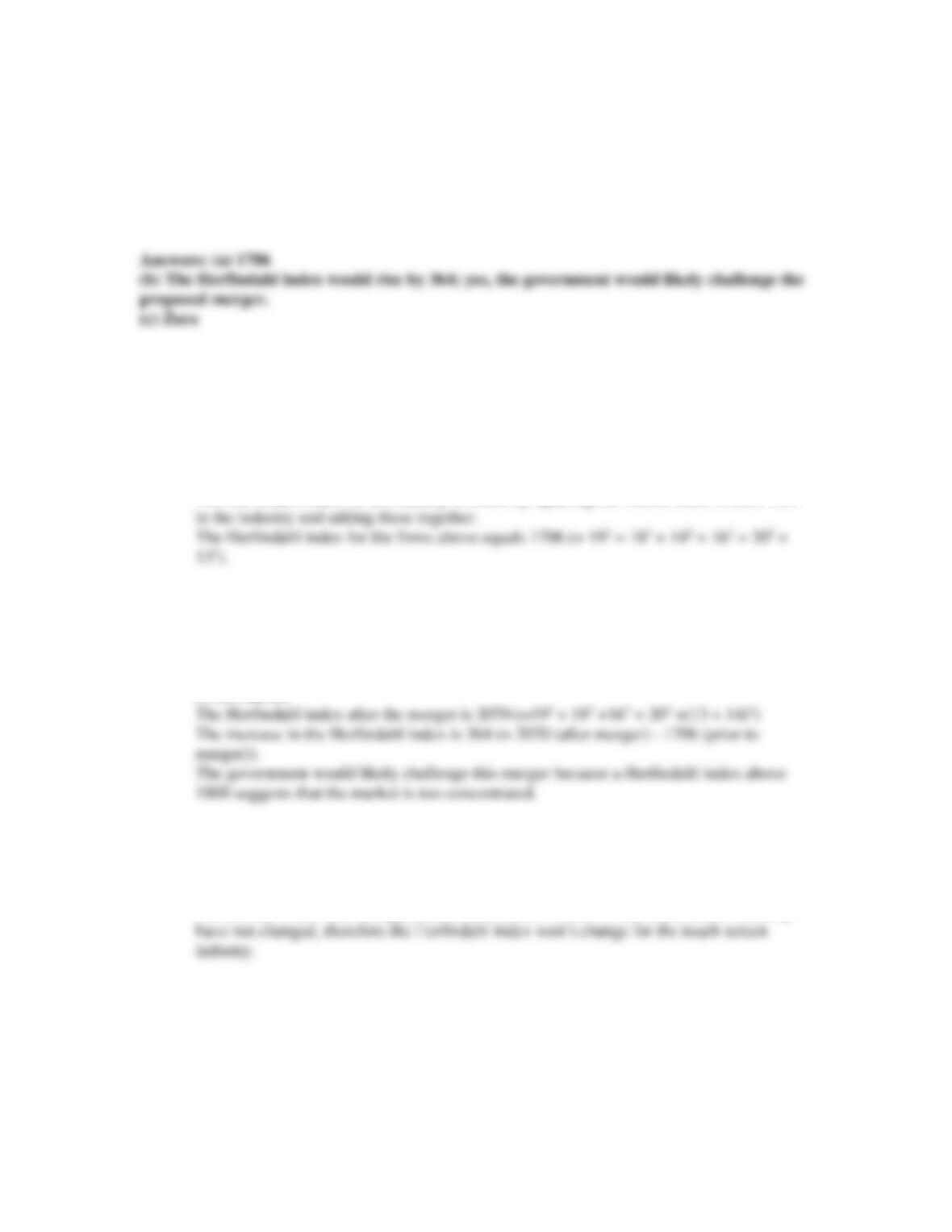
Part a:
What is the Herfindahl index for the touch screen manufacturing industry?
The Herfindahl index for an industry is found by squaring the market share of each firm
Part b:
By how much would a proposed merger between the two smallest touch screen makers
increase the Herfindahl index? Would the government be likely to challenge that
proposed merger?
The two smallest firms make up 13% and 14%, thus if they merge they will make up 27%
of the market.
Part c:
If Carrot Computers horizontally merges with its competitor Blueberry
Handhelds, by how much would the Herfindahl index change for the touch screen
industry?
The answer is zero (no change) because the market shares for the touch screen industry