Chapter 18:
1. What would be the labor force participation rate if:
a. The _____________ population = 200 million, the labor force = 160 million, and employment = 140
million?
b. The _____________ population = 200 million, the labor force = 140 million, and employment = 120
million?
c. Starting from the situation in (a), what would happen to the labor force participation rate if 30 million
people lost their jobs and all of them exited the labor force?
Answer: The labor force participation rate would become 55% (110 million/200 million).
d. Starting from the situation in (a), what would happen to the labor force participation rate if employment
rose from 140 million to 150 million?
2. Answer the following questions about unemployment:
a. If a country has a noninstitutional population of 200 million and a labor force of 160 million, and 140
million people were employed, what is its labor force participation rate and its unemployment rate?
b. If 10 million new jobs were created in the country, and it attracted 20 million of the people previously
not in the labor force into the labor force, what would the new labor force participation rate and new
unemployment rate be?
Answer: Its labor force participation rate would be 90 percent (180 million÷ 200 million)
c. Beginning with the situation in part (a), if 10 million unemployed people became discouraged and
stopped looking for work, what would the new labor force participation rate and new unemployment rate
be?
d. Beginning with the situation in part (a), if 10 million current workers retired but their jobs were filled by
others still in the labor force, what would the new labor force participation rate and new unemployment
rate be?
3. Which of the following individuals would economists consider unemployed?
a. Sam looked for work for several weeks but has now given up his search and is going back to college.
Answer: Sam is a discouraged worker who is not actively seeking work, and therefore not
considered unemployed.
b. A 14-year-old wants to mow lawns for extra cash but is unable to find neighbors willing to hire her.
Answer: The fourteen year old is under 16 years of age and not considered part of the
c. A factory worker is temporarily laid off but expects to be called back to work soon.
d. A receptionist, who works only 20 hours per week, would like to work 40 hours per week.
e. A high school graduate is spending the summer backpacking across the country rather than seeking
work.
4. Identify whether each of the following reflects seasonal, structural, frictional, or cyclical unemployment.
c. A salesperson quits a job in California and seeks a new sales position after moving to New York.
d. An employee is fired due to poor job performance and searches the want ads each day for work.
5. Which type of unemployment would be affected with the following changes? Would it go up or down?
6. Answer the following questions about reasons for unemployment:
a. In a severe recession, what would tend to happen to the number of people in each of the following
categories?
b. In good economic times, why might the number of job leavers, reentrants, and new entrants all
increase?
Answer: Good job prospects would tend to increase the number of job leavers by making
7. a. What is the relationship between the natural rate of unemployment and frictional, structural,
and cyclical unemployment?
Answer: The natural rate of unemployment equals the sum of frictional and structural
b. What would happen to both unemployment and the natural rate of unemployment if:
i. cyclical unemployment increases.
ii. frictional unemployment increases.
iii. structural unemployment falls and cyclical unemployment rises by the same amount.
iv. structural unemployment increases and cyclical unemployment decreases by a larger
amount.
v. frictional unemployment decreases and structural unemployment increases by the
same amount.
8. Unemployment benefits in many European countries tend to be both more generous and available for
longer periods than those in the United States. What impact do you think this is likely to have on the
unemployment rate in a European country? Why?
Answer: There is less incentive to find new employment once unemployed in Europe than
9. How can unions result in higher unemployment rates? How would the results differ for someone who
wants to be employed in the union sector as compared with someone who currently has a job in the union
sector?
Answer: If union bargaining raises the union wage above the equilibrium level, the
11. Answer the following questions about inflation:
a. What would be the effect of unexpected inflation on each of the following?
b. How would your answers change if the inflation was expected?
Answer: Workers, debtors, and creditors would be unaffected. If retirees stayed on their
12. Does anticipated inflation or unanticipated inflation discourage economic growth? Why?
Answer: Unanticipated inflation, because it creates additional uncertainty, complicates
13. Answer the following questions about the nominal and real interest rates:
a. What would be the real interest rate if the nominal interest rate were 14 percent and the inflation rate
were 10 percent? If the nominal interest rate were 8 percent and the inflation rate were 1 percent?
b. What would happen to the real interest rate if the nominal interest rate went from 9 percent to 15
percent when the inflation rate went from 3 percent to 10 percent? If the nominal interest rate went from
11 percent to 7 percent when the inflation rate went from 8 percent to 4 percent?
14. You borrow money at a fixed rate of interest to finance your college education. If the rate of inflation
unexpectedly slows down between the time you take out the loan and the time you begin paying it back,
is there a redistribution of income? Do you gain or lose? What if you already expected the inflation rate to
slow at the time you took out the loan? Explain.
Answer: If the slowing of the rate of inflation is unexpected, then there is a redistribution
15. How does an adjustable rate mortgage agreement protect lenders against inflation? Who bears the
inflation risk?
Answer: An adjustable rate mortgage protects lenders against inflation by guaranteeing
16. In 2000, a proposal was made in Santa Monica, California, to raise the minimum wage in the hotel
and shopping district ict the effect of such legislation on
unemployment in the hotel and shopping industries in Santa Monica. What would you expect to happen to
the unemployment rate in neighboring areas?
Answer: It is likely that such legislation would result in greater unemployment in that
17. Calculate a price index for 2005, 2006, and 2007 using the following information about prices. Let
the market basket consist of one pizza, two sodas, and three video rentals. Let the year 2005 be the
base year (with an index value of 100).
Year Price of a Pizza Price of a Soda Price of a Video Rental Price Index
2005 $9.00 $0.50 $2.00 100
2006 $9.50 $0.53 $2.24 108
2007 $10.00 $0.65 $2.90 125
How much inflation occurred between 2005 and 2006? Between 2005 and 2007?
18. Say that the bundle of goods purchased by a typical consumer in the base year consisted of 20
gallons of milk at a price of $1 per gallon and 15 loaves of bread at a price of $2 per loaf. What would the
price index be in a year in which
a. milk cost $2 per gallon and bread cost $1 per loaf?
Answer: 110
b. milk cost $3 per gallon and bread cost $2 per loaf?
c. milk cost $2 per gallon and bread cost $4 per loaf?
19. Indicate which of the following are true of the CPI and the GDP deflator:
CPI GDP Deflator
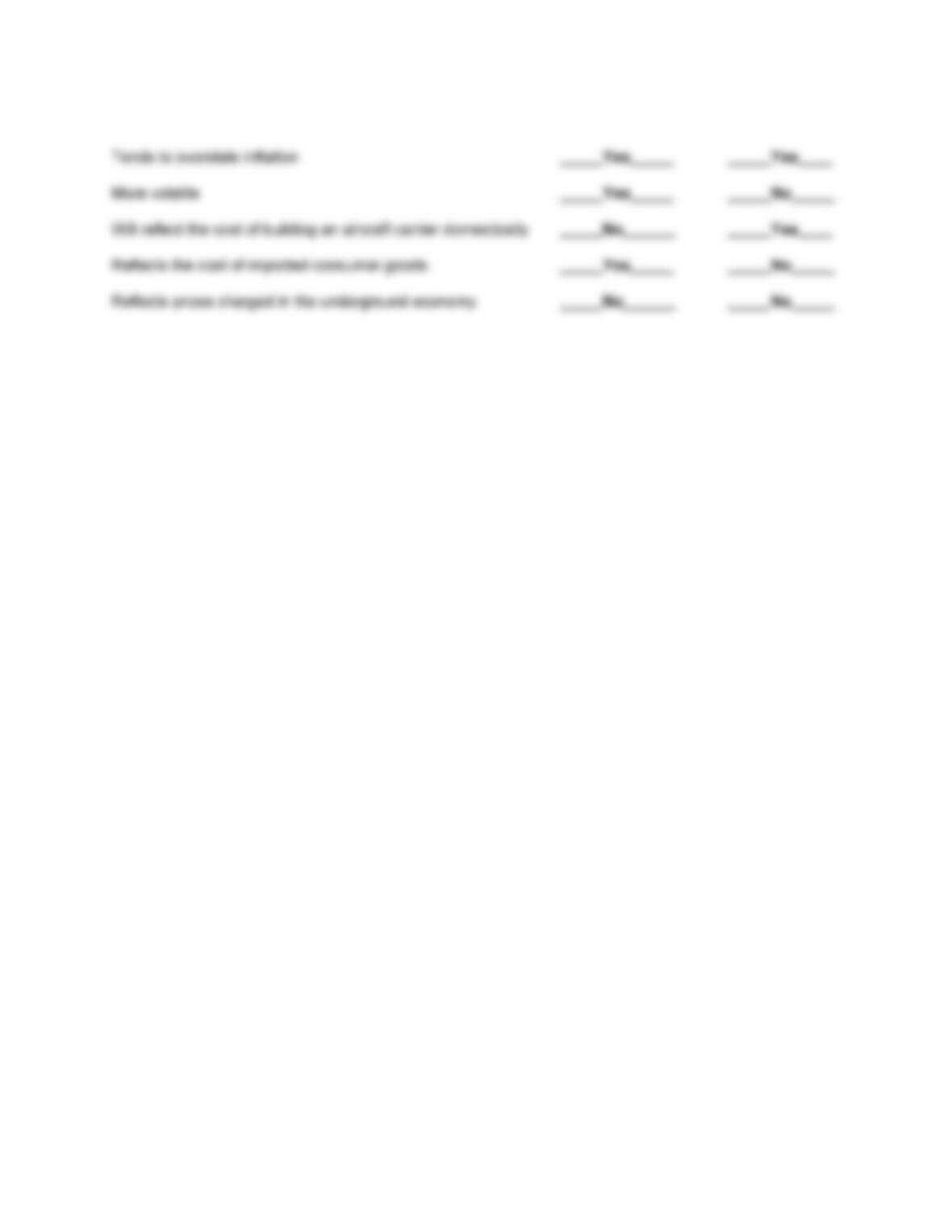
Chain weighted _____No______ _____Yes____