
Chapter 17:
1. How might each of the following affect the distribution of income in the near term?
a. There is a massive influx of low-skilled immigrants.
b. A new baby boom occurs.
Answer: In the event of a baby boom, some individuals would opt to become full–time
c. The new baby boomers enter their 20s.
Answer: When the babies in b) enter their twenties and begin working, the proportion of
d. The new baby boomers reach age 65 or older.
Answer: When the babies in b) reach age 65 or older, again the proportion of the
e. There is an increase in cash transfer payments, such as Supplemental Security Income.
Answer: An increase in cash transfer payments, which are focused on lower income
f. There is an increase in in-kind transfer payments, such as food stamps.
Answer: An increase in non-cash transfer payments, which are not counted in the official
2. Using the axes from a Lorenz curve, have the students draw
a. the Lorenz curve for perfect equality;
b. the Lorenz curve for perfect inequality;
c. a Lorenz curve for some inequality.
d. For the curve used in c, have the students show which ratio of areas equals the Gini coefficient.
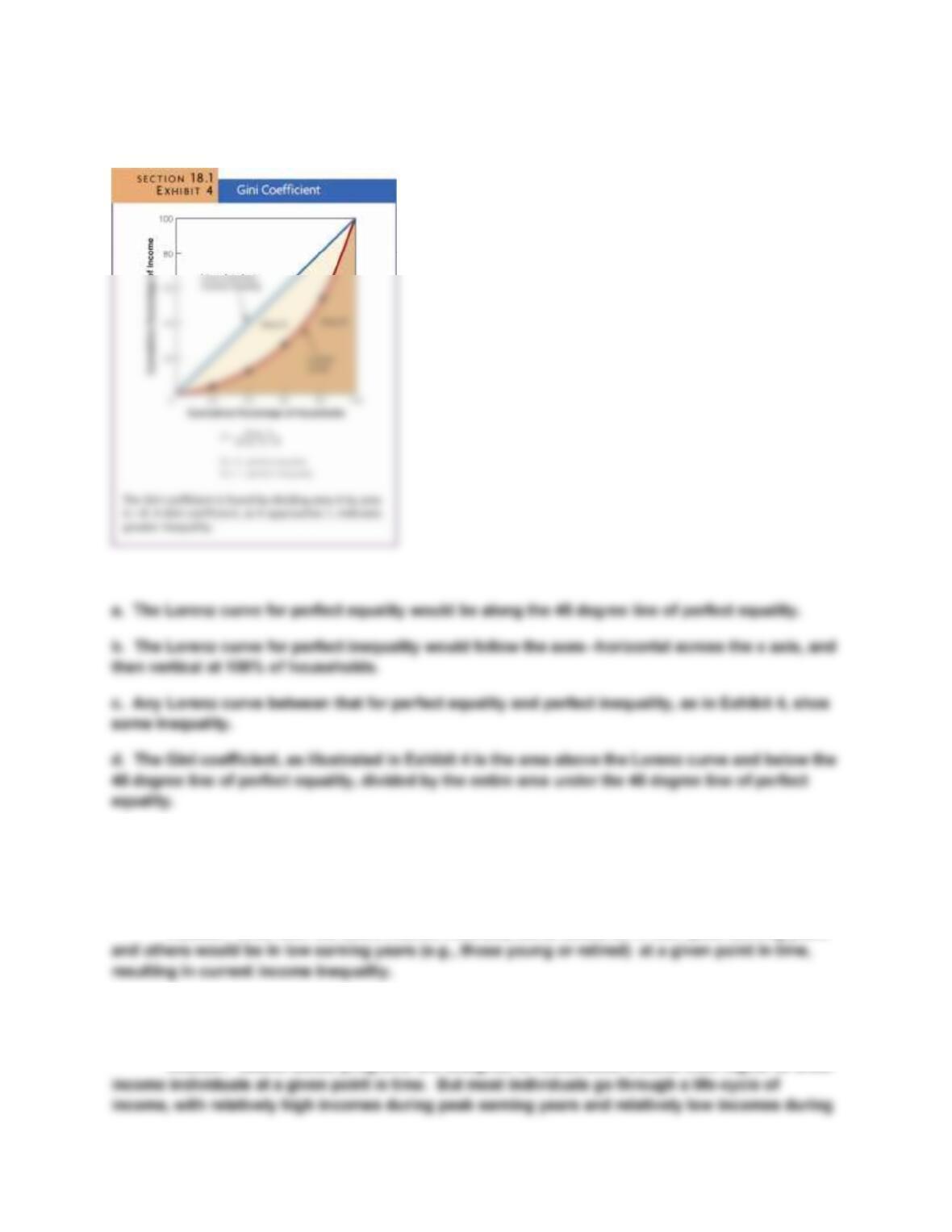
Answer: The Lorenz curve and Gini coefficient are best illustrated in terms of Section 18.1
Exhibit 4, page 485.
3. a. If every individual earned the same total income over his or her lifetime, why would we still see
inequality at a given point in time?
Answer: Even with the same lifetime incomes, some would be in their peak earning years
b. Why could means-tested income redistribution be described, at least in part, as redistributing
from you to yourself?
Answer: Means-tested programs are designed to redistribute income from higher to lower

4. If the permanent income hypothesis is true, why would inequality measured by current consumption
tend to be smaller than in equality measured by current income?
Answer: If the permanent income hypothesis is true, people would draw on their savings
higher to lower income individuals would increase total utility?
Answer: Diminishing marginal utility of income refers to an individual, who gets less
6. What factors might explain the differential in average income between males and females?
Answer: At least part of this wage differential can be explained by differences in
7. How might a significant reduction in the divorce rate affect the distribution of income?
Answer: A significant reduction in the divorce rate would increase the proportion of
8. a. How could in-kind transfers, such as food stamps, not reduce measured poverty or inequality?
Answer: Official measures of income do not include in-kind transfers, so that even though
b. How could food stamp benefit reductions as income rises cause the program to actually
decrease measured incomes of the poor and raise official poverty rates?
Answer: While the in-kind transfers are not officially counted as income, they impose
9. Consider two economies: one in which there is no redistribution of income by government and one in
which the government enforces equality of income among everyone. Evaluate the advantages and
disadvantages of each system. Which of these two alternatives would you prefer? Given the choice,
would you prefer a system of redistribution of income that lies somewhere between these two extremes?
Answer: In a system where there is no redistribution of income, there would be a greater
10. Why would large-scale government redistribution tend to reduce hours worked, savings and
investment, and human capital (education)?
Answer: Large-scale government redistribution of income reduces the after–tax and
11. Why might a regulated utility, which is restricted to keeping profits for less than they could have
earned, be more likely to discriminate than if its profits were not limited?
Answer: Firms that are allowed to keep all their profits pay a price for discrimination,
12. If a negative income tax was Tax = (30 percent x income) – $15,000:

a. What would be the tax/refund for a family earning $100,000 a year?
b. What would be the tax/refund for a family earning $50,000 a year?
c. What would be the tax/refund for a family earning $40,000 a year?
d. What would be the tax/refund for a family earning $10,000 a year?
13
care?
Answer: Calling something a right makes it difficult to discuss marginal tradeoffs (e.g.,
14. How can health care expenditures be viewed as similar to other investments in capital equipment and
education (human capital)?
15. Why would the percentage that health care consumers pay out of pocket be an important determinant
of how much care they receive?
Answer: The lower the percentage health care consumers pay out of pocket, the lower the
16. Why would the welfare cost of insurance be smaller, the more inelastic the demand for that type of
health care?
Answer: Insurance acts like a subsidy to health care for those insured. There will be less

17. How does an insurance company inviting voluntary participation in a plan face an adverse selection
problem?
Answer: The adverse selection problem arises here because those most likely to benefit
18. How can better care for potentially fatal diseases sharply increase the cost of health care?
Answer: Potentially fatal diseases can not only be very expensive to treat (e.g., with
19. Are the chemically ill more likely to demand health insurance because of moral hazard or adverse
selection?
Answer: Those who are chronically ill, who have more information about their health
20. Do health care innovations raise or lower the overall cost of health care?
Answer: It depends. Some raise the cost of health care (e.g., by making possible
21. If the selling of kidneys were legalized, predict the impact on the market for organ transplants using
supply and demand analysis. Why might the quantity supplied increase?
Answer: If the selling of kidneys were legalized, more kidneys would be supplied to the
22. Who is most likely to purchase a kidney? Who is most likely to sell a kidney? Would either party be
harmed?

Answer: Those most likely to purchase a kidney for transplant would be those with the
23. Decisions as to the allocation of human organs for transplant are based on characteristics such as
Transplant Resource Center of Maryland, http://www.mdtransplant.org/topicsa2.htm). Suppose you were
on a transplant committee that was permitted to consider other factors. Do you think that the life of a
person who is beloved by many family members and friends should be given greater weight than a
person with few friends? Should the chief executive officer of a major corporation be given preferential
How about Mickey Mantle, a famous baseball
player who battled alcoholism? Do these queries fall into the realm of normative or positive economic
analysis?
24. Is it inefficient that the United States spends a larger fraction of income on health care than the
fraction spent by other countries?
Answer: To the extent the U.S. spends a higher fraction on health care reflects such
25. How do higher deductibles act to reduce moral hazard problems, especially for small medical
expenses?
Answer: Higher deductibles mean that for small expenses, people are paying the full cost
lunch if you choose to eat it, is never likely to be a commercial success?
Answer: Those most likely to eat lunch would be those most likely to sign up for lunch
27. How does insuring all the workers at a given firm tend to reduce adverse selection problems? How
does requiring physical exams have a similar effect?
Answer: Group insurance (ensuring a diversity of health care statuses among those
28. Why does health insurance increase demand for the highest quality of care?
Answer: Insurance lowers the marginal cost of higher quality health care. For example, if
29. If genetic testing becomes widely practiced, is there an economic reason to fear the discovery of a
genetic predisposition toward a serious illness?
Answer: If genetic testing becomes widely practiced, the discovery of a genetic