S-247
interactive activity
Chapter 17
Public Goods and
Common Resources
1. The government is involved in providing many goods and services. For each
of the goods or services listed, determine whether it is rival or nonrival in
consumption and whether it is excludable or nonexcludable. What type of good
is it? Without government involvement, would the quantity provided be efficient,
inefficiently low, or inefficiently high?
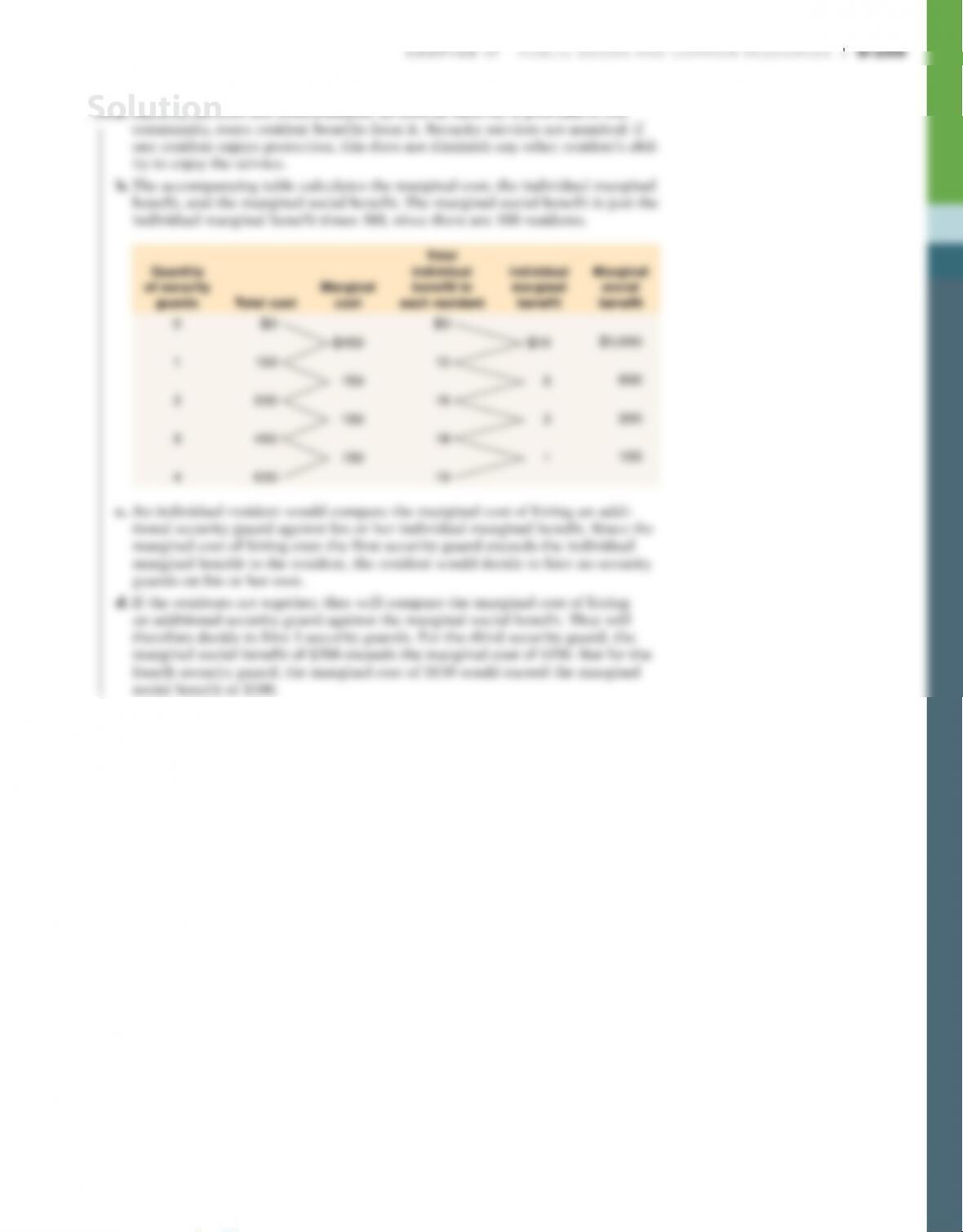
1. a. Street signs are nonrival in consumption (if I make use of a street sign, that
does not reduce your opportunity to use it) and nonexcludable (no one can
prevent another person from making use of a street sign). So street signs are a
public good. Because of the free-rider problem, the quantity provided privately
would be inefficiently low.
b. Amtrak rail service is rival in consumption (if I consume a seat, you cannot)
and excludable (you cannot consume the service if you do not have a ticket).
c. Regulations limiting pollution are nonrival in consumption (my benefit from
these regulations is not diminished by your benefit) and nonexcludable (people
d. A congested interstate highway without tolls is rival in consumption (if I use
the highway, I create a negative externality for you—more congestion; that is,
e. A lighthouse is nonrival in consumption (if I use the lighthouse to steer my
boat away from rocks, you can still use the same lighthouse) and nonexclud–
Solution
2. An economist gives the following advice to a museum director: “You should
introduce ‘peak pricing.’ At times when the museum has few visitors, you should
admit visitors for free. And at times when the museum has many visitors, you
should charge a higher admission fee.”
a. When the museum is quiet, is it rival or nonrival in consumption? Is it exclud-
able or nonexcludable? What type of good is the museum at those times? What
would be the efficient price to charge visitors during that time, and why?
2. a. When the museum is quiet, it is nonrival in consumption: one additional visi-
tor does not diminish any other visitor’s ability to enjoy the museum. Further-
more, the museum is excludable (if you don’t pay the entrance fee, you are not
b. When the museum is busy, it is rival in consumption: one additional visitor in
the museum diminishes any other visitor’s ability to enjoy the museum because
of overcrowding. The museum is still excludable (if you don’t pay the entrance
3. In many planned communities, various aspects of community living are subject
to regulation by a homeowners’ association. These rules can regulate house
architecture; require snow removal from sidewalks; exclude outdoor equip–
ment, such as backyard swimming pools; require appropriate conduct in shared
spaces such as the community clubhouse; and so on. Suppose there has been
3. Using efficiency as the goal, a regulation is warranted if it provides a public
good or if it conserves a common resource. The enjoyment of pleasing and
harmonious architecture and snow removal from sidewalks are examples of
public goods: they are nonexcludable and nonrival in consumption. A clubhouse
is a common resource: it is nonexcludable but rival in consumption. So it pro–
Solution
Solution
4. The accompanying table shows Tanisha’s and Ari’s individual marginal benefit of
different amounts of street cleanings per month. Suppose that the marginal cost
of street cleanings is constant at $9 each.
Quantity of
street cleanings
per month
Tanisha’s
individual
marginal benefit
Ari’s individual
marginal benefit
0
$10 $8
a. If Tanisha had to pay for street cleaning on her own, how many street clean-
ings would there be?
b. Calculate the marginal social benefit of street cleaning. What is the optimal
number of street cleanings?
4. a. If Tanisha had to pay for street cleaning on her own, she would pay for the
street to be cleaned once: her individual marginal benefit of the first clean–
ing, $10, exceeds the marginal cost of $9. However, she would not pay for more
than one: her marginal benefit of the second cleaning is $6, less than the
marginal cost of $9.
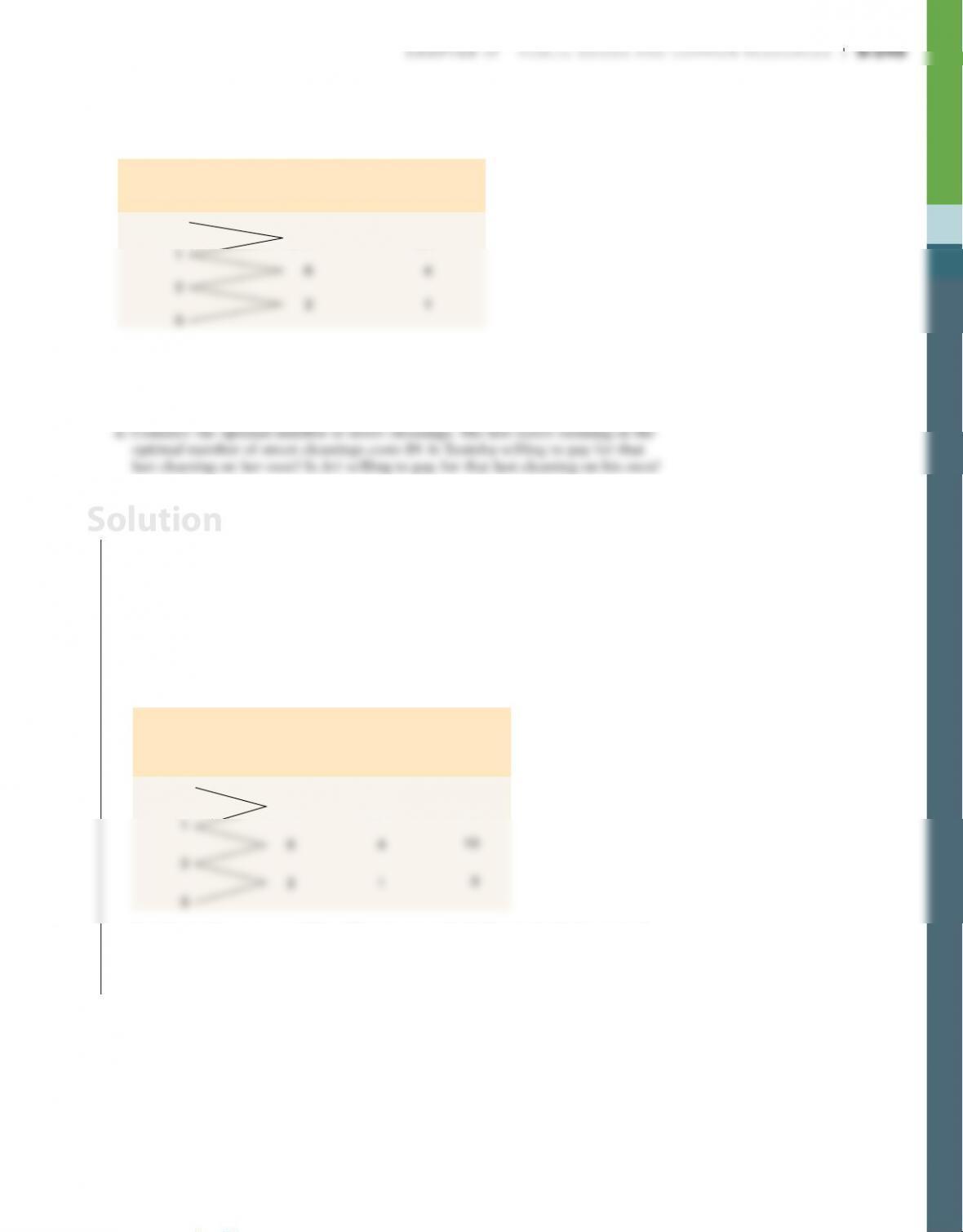
b. The accompanying table shows the marginal social benefit of street cleaning.
The optimal number of street cleanings is 2: the marginal social benefit of the
second cleaning is $10, which exceeds the marginal cost of $9. A third clean-
ing would be inefficient because its marginal social benefit is $3, less than the
marginal cost of $9.
Quantity of
street
cleanings
per month
Tanisha’s
individual
marginal
benefit
Ari’s
individual
marginal
benefit
Marginal
social
benefit
0
$10 $8 $18
c. Tanisha on her own would be willing to pay only $6 (her individual marginal
benefit) for the second cleaning. Ari on his own would be willing to pay only
$4 (his individual marginal benefit) for the second cleaning. So neither would
be individually willing to pay for the second cleaning.
Solution
S-250 Chapter 17 Public Goods and common ResouRces
5. Anyone with a radio receiver can listen to public radio, which is funded largely
by donations.
a. Is public radio excludable or nonexcludable? Is it rival in consumption or
nonrival? What type of good is it?
b. Should the government support public radio? Explain your reasoning.
5. a. Public radio is nonexcludable: anyone with a radio receiver can pick up the
radio waves. It is nonrival: if I listen to public radio, that does not diminish
your opportunity to listen to it also. So public radio is a public good.
b. As with all public goods, private markets lead to an inefficient quantity of the
good being supplied. The individual marginal benefit from a certain amount
of public radio programming is less than the marginal social benefit from that
c. Transmitting only to satellite radios, where a fee is charged for the service,
makes public radio excludable. So public radio is now an artificially scarce
good. The efficient price for receiving the satellite radio signal would be zero,
since the marginal cost is zero. But since a positive price is charged, only
6. Your economics professor assigns a group project for the course. Describe the
free-rider problem that can lead to a suboptimal outcome for your group. To
combat this problem, the instructor asks you to evaluate the contribution of your
peers in a confidential report. Will this evaluation have the desired effects?
6. Without the confidential evaluation, the grade a member of a group receives
7. The village of Upper Bigglesworth has a village “commons,” a piece of land on
which each villager, by law, is free to graze his or her cows. Use of the com-
mons is measured in units of the number of cows grazing on it. Assume that
the marginal private cost curve of cow-grazing on the commons is upward slop–
ing (say due to more time spent herding). There is also a marginal social cost
Solution
Solution
Chapter 17 Public Goods and common ResouRces S-251
a. Is the commons excludable or nonexcludable? Is it rival in consumption or
nonrival? What kind of good is the commons?
b. Draw a diagram showing the marginal social cost, marginal private cost, and
the marginal private benefit of cow-grazing on the commons, with the quan–
c. The villagers hire you to tell them how to achieve an efficient use of the com-
mons. You tell them that there are three possibilities: a Pigouvian tax, the
7. a. The commons is nonexcludable since, by law, each villager is free to send his
or her cows there. It is also rival in consumption, since the grass that one vil-
lager’s cow eats is no longer available for another villager’s cow. So the com-
mons is a common resource.
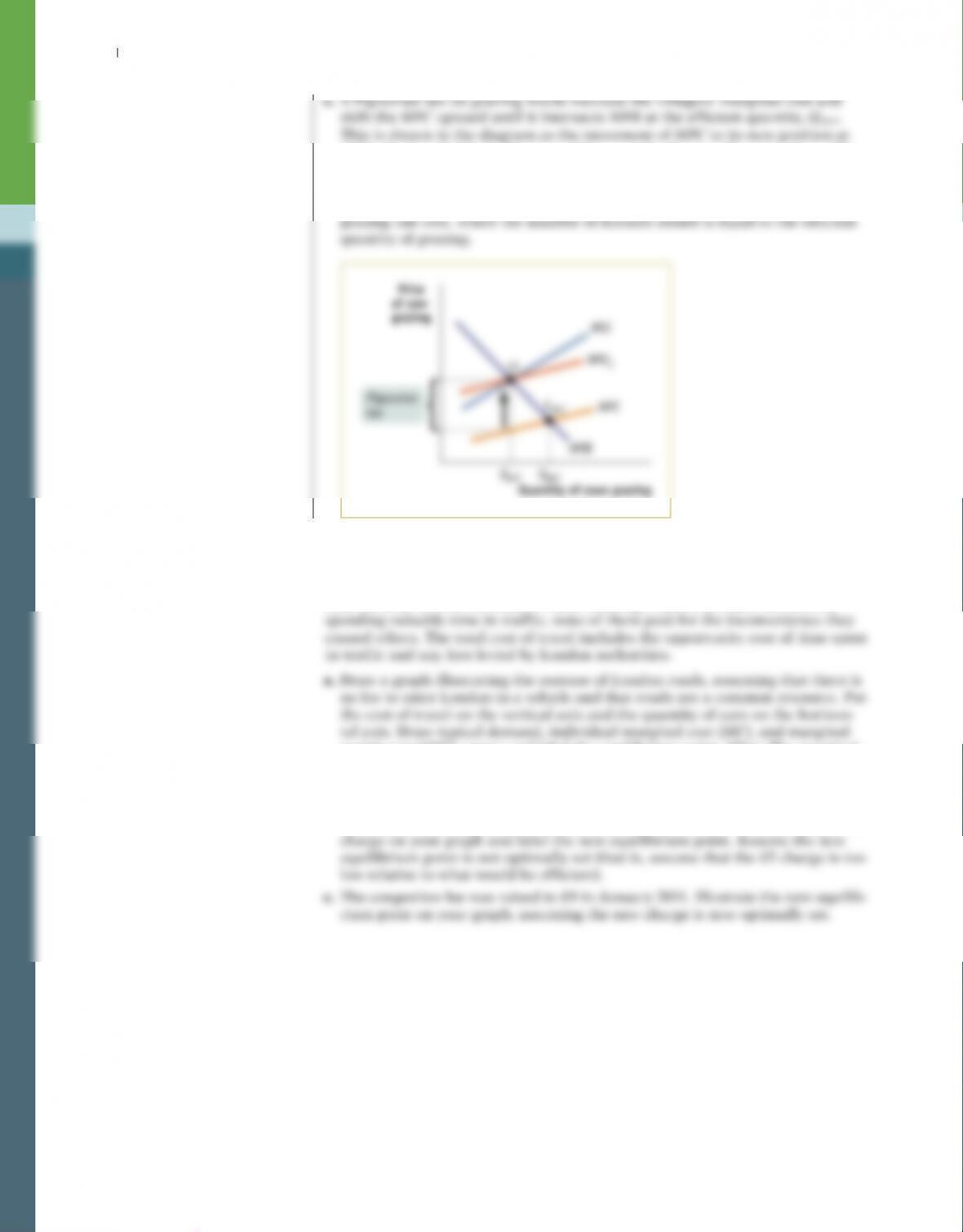
b. The accompanying diagram shows the marginal private cost to villagers of
cow-grazing on the commons, MPC. It is also the supply curve of cows for
grazing. It lies below the marginal social cost curve, MSC. MSC is higher than
QOPT QMKT
Price
of
cow-
gr
azing
Quantity of cows grazing
MSC
MPB
O
The outcome without government intervention is indicated by QMKT, the
quantity at which the marginal private benefit equals marginal private cost.
It is greater than the optimal, or efficient, equilibrium quantity, QOPT. That is,
Solution
S-252 Chapter 17 Public Goods and common ResouRces
MPC1. Each individual villager would now make the socially optimal, or effi-
cient, decision. Alternatively, ownership of the commons and the cows could
be assigned to one person. He or she would set the amount of grazing to the
efficient quantity. Last, villagers could create a system of tradable licenses for
QOPT QMKT
Quantity of cows grazing
8. Prior to 2003, the city of London was often one big parking lot. Traffic jams
were common, and it could take hours to travel a couple of miles. Each addi-
tional commuter contributed to the congestion, which can be measured by the
total number of cars on London roads. Although each commuter suffered by
social cost (MSC) curves and label the equilibrium point. (Hint: The marginal
cost takes into account the opportunity cost of spending time on the road for
individual drivers but not the inconvenience they cause to others.)
b. In February 2003, the city of London began charging a £5 congestion fee on
all vehicles traveling in central London. Illustrate the effects of this congestion
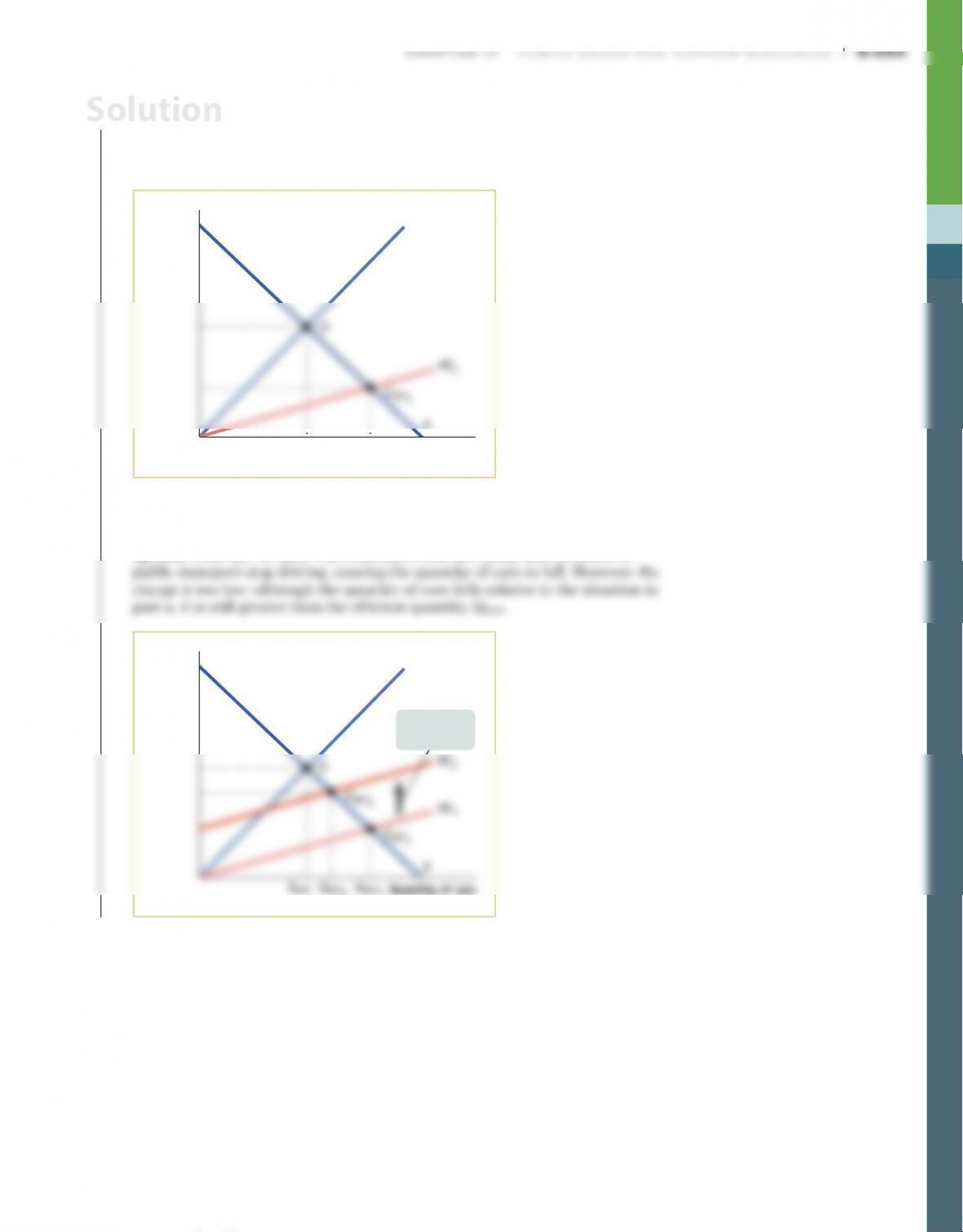
8. a. The accompanying diagram depicts the demand and individual marginal cost
(MC1) for using London roads. When no fees are levied for using the roads, the
equilibrium point is EMKT1. This is the usual market equilibrium when market
externalities are not corrected.
Cost of
travel
Quantity of car
s
D
QOPT QMKT
1
MSC
EMKT1
O
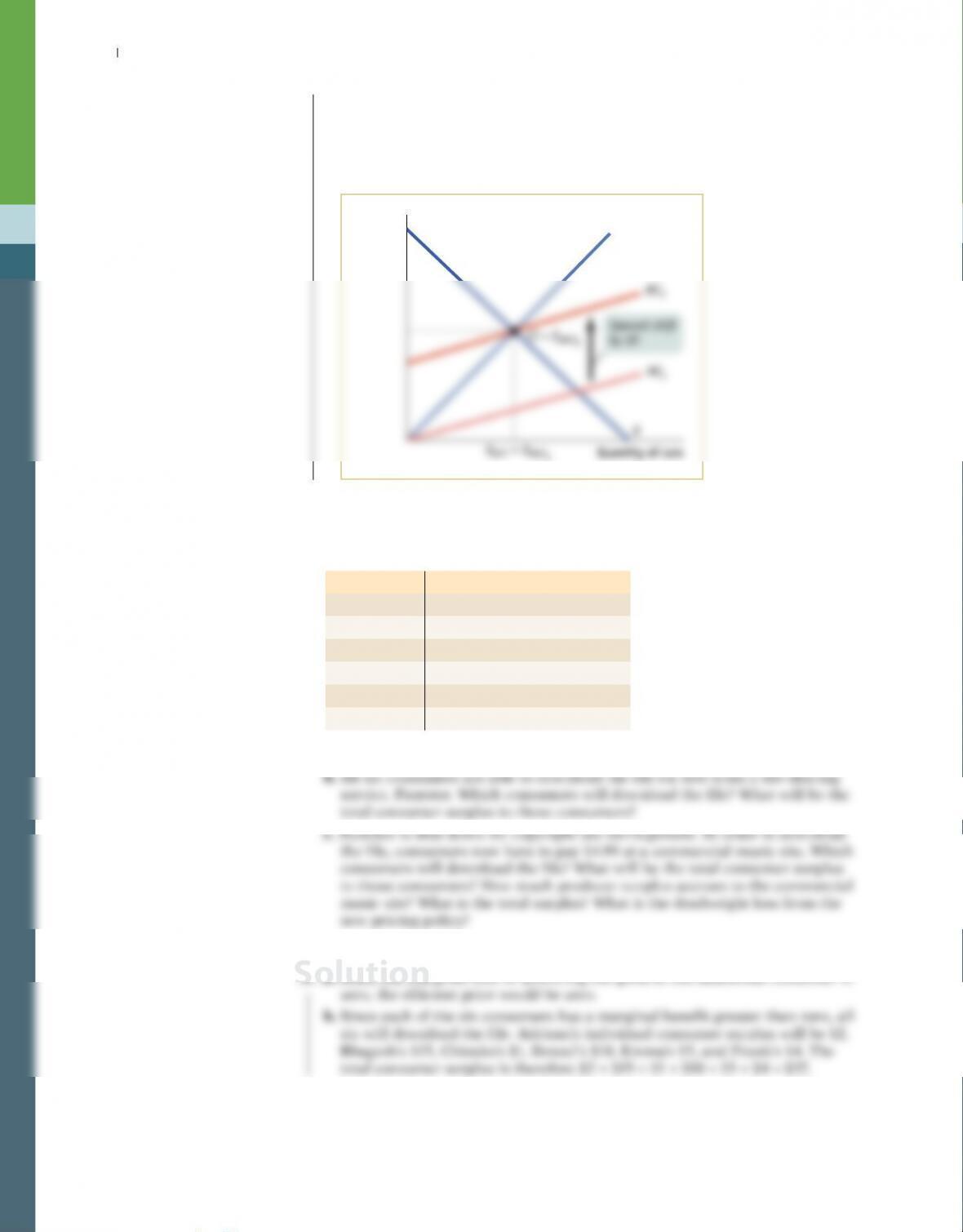
b. After the £5 fee is imposed, the market equilibrium moves as shown in the
accompanying diagram. The congestion charge effectively increases the cost
of traveling by car in central London, and the marginal cost curve shifts
upward, from MC1 to MC2. The commuters who are easily able to switch to
Cost of
travel
D
2
1
MC1
MC2
MSC
EMKT2
EMKT1
O
Upward shift
by £5
Solution
S-254 Chapter 17 Public Goods and common ResouRces
c. When the fee is raised to £9, the marginal cost curve moves farther up, to
MC3, and more people refrain from using central London roads as the equi-
librium quantity falls to the efficient quantity, QOPT. The charge of £9 is the
optimal Pigouvian tax in this case: it moves the equilibrium to the efficient
outcome, O.
Cost of
travel
Quantity of car
s
D
QOPT = QMKT
3
MC1
MC3
MSC
Upward shift
9. The accompanying table shows six consumers’ willingness to pay (his or her
individual marginal benefit) to download a Jay-Z album. The marginal cost of
making the file accessible to one additional consumer is constant, at zero.
Consumer Individual marginal benefit
Adriana $2
Bhagesh 15
Chizuko 1
Denzel 10
Emma 5
Frank 4
a. What would be the efficient price to charge for a download of the file?
9. a. Since the marginal cost of delivering the good to one additional consumer is
Solution
10. Butchart Gardens is a very large garden in Victoria, British Columbia, renowned
for its beautiful plants. It is so large that it could hold many times more visitors
than currently visit it. The garden charges an admission fee of $30. At this price,
1,000 people visit the garden each day. If admission were free, 2,000 people
would visit each day.
a. Are visits to Butchart Gardens excludable or nonexcludable? Are they rival in
consumption or nonrival? What type of good is it?
10. a. Visits to Butchart Gardens are excludable (there is an entrance fee) and
nonrival (the garden could hold many more visitors than it currently hosts, so
one visitor’s enjoyment of the park does not diminish another visitor’s enjoy-
ment). So visits to Butchart Gardens are an artificially scarce good.
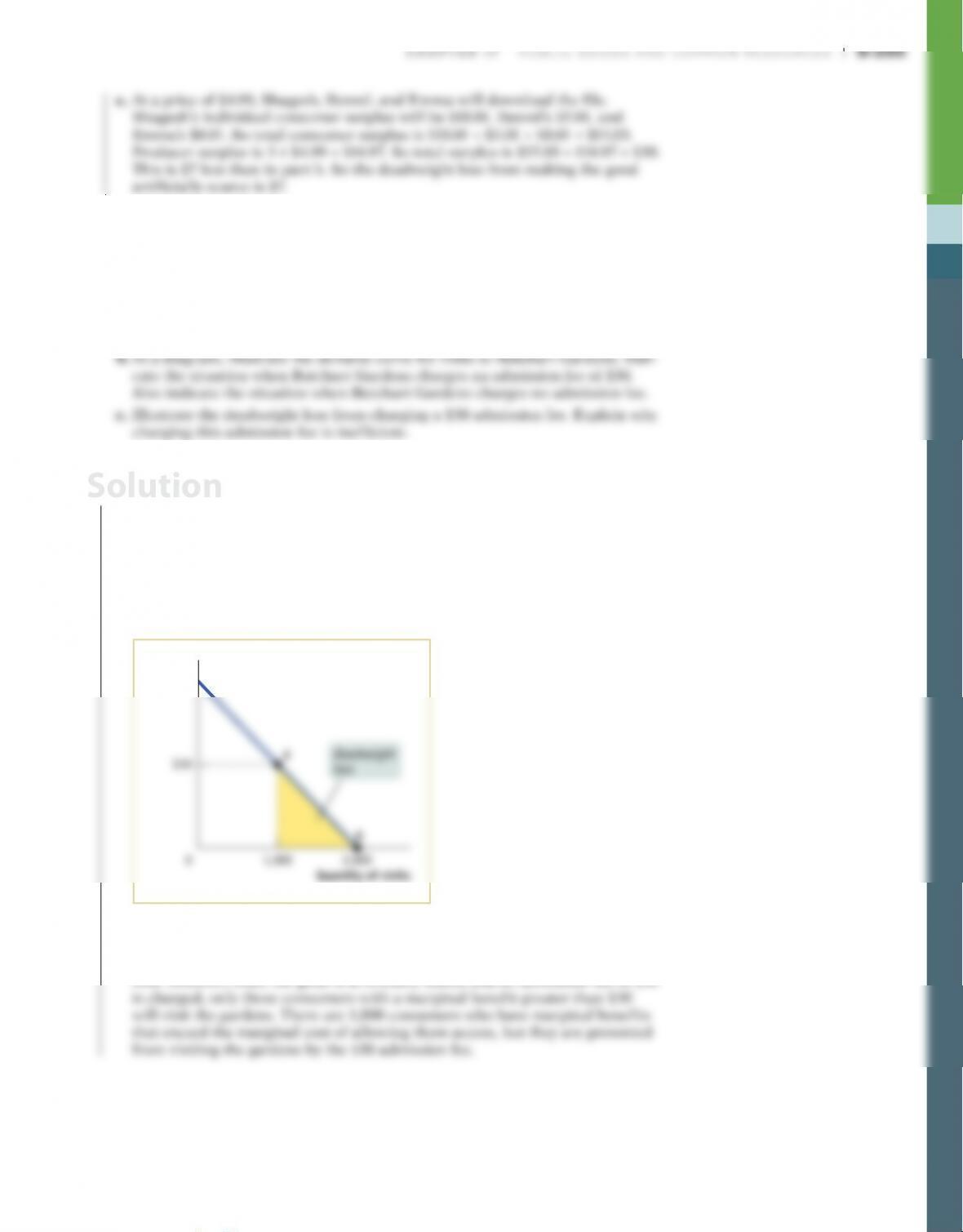
b. The demand curve is illustrated in the accompanying diagram. The situation
when Butchart Gardens charges a $30 admission fee is indicated by point A on
the demand curve. The situation when Butchart Gardens charges no admis-
sion fee is indicated by point B on the demand curve.
Price
of
visit
Quantity of visits
B
D
c. The deadweight loss from charging a $30 admission fee rather than no fee
is indicated by the shaded area in the diagram. Since the marginal cost of
admitting one more visitor is zero, it would be efficient to charge no admis–
sion. However, since the good is artificially scarce and an admission fee of $30
Solution
11. Software has historically been an artificially scarce good—it is nonrival because
the cost of replication is negligible once the investment to write the code is
made, but software companies make it excludable by charging for user licenses.
But then open-source software emerged, most of which is free to download and
can be modified and maintained by anyone.
a. Discuss the free-rider problem that might exist in the development of open-
source software. What effect might this have on quality? Why does this prob–
lem not exist for proprietary software, such as the products of a company like
Microsoft or Adobe?
12. In developing a vaccine for the SARS virus, a pharmaceutical company incurs
a very high fixed cost. The marginal cost of delivering the vaccine to patients,
however, is negligible (consider it to be equal to zero). The pharmaceutical com-
pany holds the exclusive patent to the vaccine. You are a regulator who must
decide what price the pharmaceutical company is allowed to charge.
a. Draw a diagram that shows the price for the vaccine that would arise if the
company is unregulated, and label it PM. What is the efficient price for the
vaccine? Show the deadweight loss that arises from the price PM.
b. On another diagram, show the lowest price that the regulator can enforce that
would still induce the pharmaceutical company to develop the vaccine. Label
it P*. Show the deadweight loss that arises from this price. How does it com-
pare to the deadweight loss that arises from the price PM?
12. a. If the company is unregulated, it will behave like a monopolist and choose a
Solution
S-258 Chapter 17 Public Goods and common ResouRces
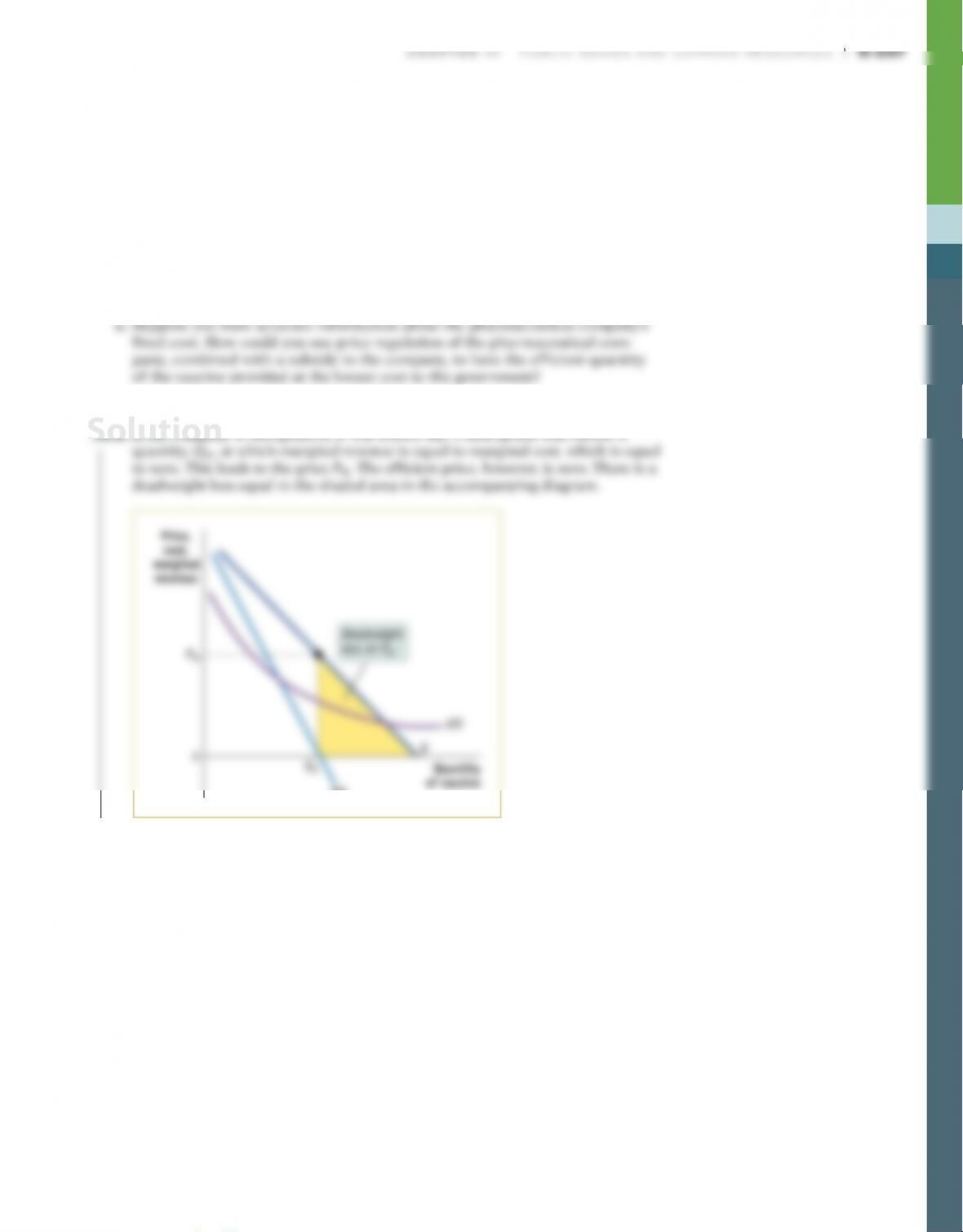
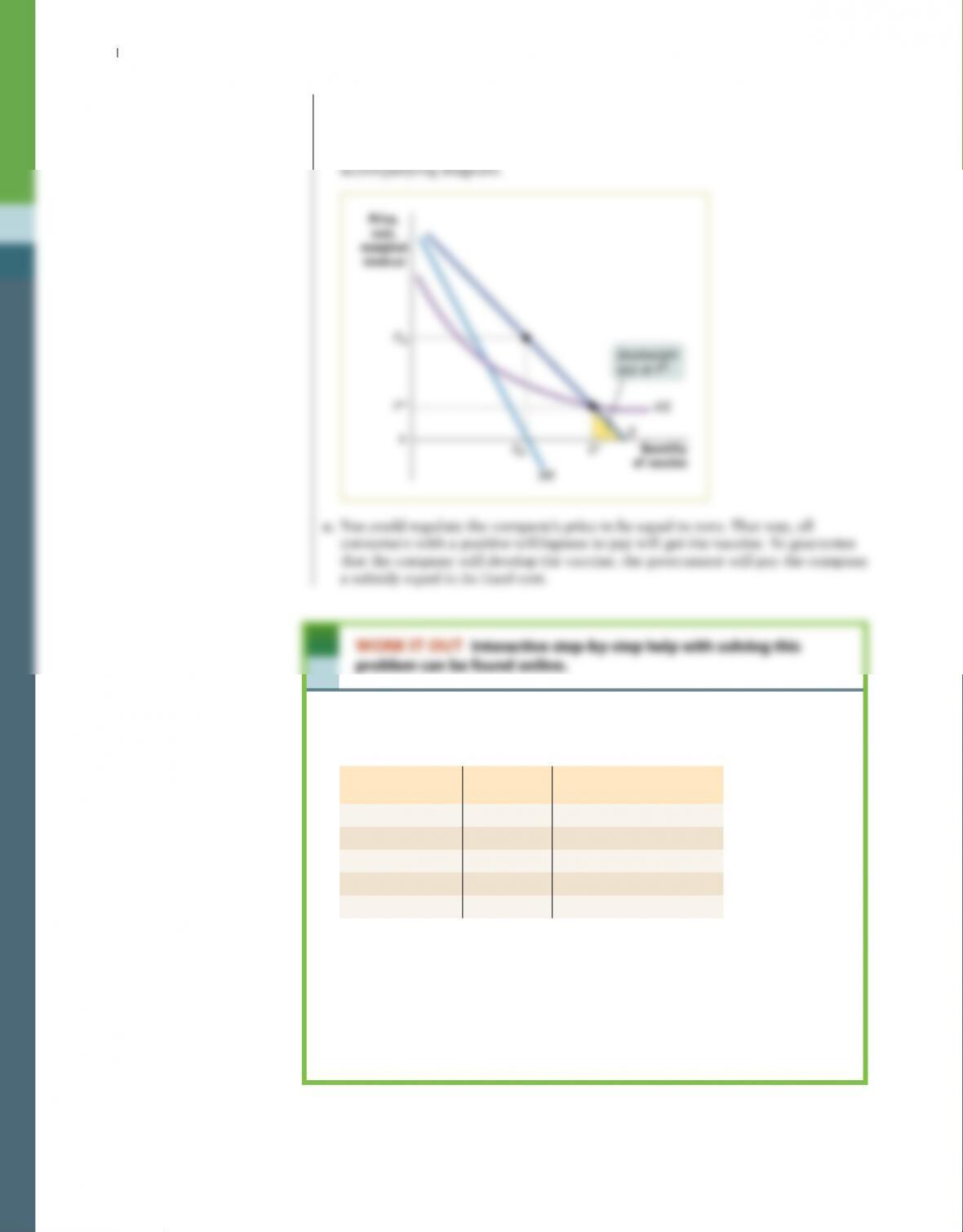
b. The lowest price that still induces the company to develop the vaccine is the
price at which the demand curve crosses the average total cost curve. At this
price, the company just breaks even. There is a smaller deadweight loss than
under the price PM. The deadweight loss is indicated by the shaded area in the
13. A residential community has 100 residents who are concerned about secu–
rity. The accompanying table gives the total cost of hiring a 24-hour security
service as well as each individual resident’s total benefit.
Quantity of
security guards Total cost
Total individual benefit
to each resident
0$0 $0
1150 10
2300 16
3450 18
4600 19
a. Explain why the security service is a public good for the residents of the
community.
b. Calculate the marginal cost, the individual marginal benefit for each
resident, and the marginal social benefit.
c. If an individual resident were to decide about hiring and paying for secu-
rity guards on his or her own, how many guards would that resident hire?
d. If the residents act together, how many security guards will they hire?