interactive activity
Chapter 17
Macroeconomics:
Eventsand Ideas
1. Since the crash of its stock market in 1989, the Japanese economy has seen
little economic growth and some deflation. The accompanying table from the
Organization for Economic Cooperation and Development (OECD) shows some
key macroeconomic data for Japan for 1991 (a “normal” year) and 1995–2003.
Year
Real GDP annual
growth rate
Short-term
interest rate
Government debt
(percent of GDP)
Government budget
deficit (percent of GDP)
1991 3.4% 7.38% 64.8% –1.81%
1996 3.4 0.59 93.9 5.07
1999 0.1 0.25 125.7 7.23
2001 0.4 0.12 142.3 6.13
2002 –0.3 0.06 149.3 7.88
a. From the data, determine the type of policies Japan’s policy makers undertook
at that time to promote growth.
b. We can safely consider a short-term interest rate that is less than 0.1% to effec–
tively be a 0% interest rate. What is this situation called? What does it imply
about the effectiveness of monetary policy? Of fiscal policy?
1. a. From the annual real GDP growth rate, we can see the slow growth of the
Japanese economy: the economy actually contracted in 1998 and 2002, with
minimal growth in 1999 and 2001. We can also see that policy makers used
expansionary monetary policy to spur the economy: short-term interest rates
b. During 2002 and 2003, the short-term interest rate in Japan was effectively
0%, a situation known as a liquidity trap. In this case, monetary policy is
Solution
S-226 Chapter 17 MacroeconoMics: events and ideas
2. The National Bureau of Economic Research (NBER) maintains the official
chronology of past U.S. business cycles. Go to its website at www.nber.org/cycles/
cyclesmain.html to answer the following questions.
a. How many business cycles have occurred since the end of World War II in
1945?
b. What was the average duration of a business cycle when measured from the
end of one expansion (its peak) to the end of the next? That is, what was the
average duration of a business cycle in the period from 1945 to 2009?
2. a. Answers will vary. But as of June 2017, there had been 11 business cycles since
was 68.5.
3. The fall of its military rival, the Soviet Union, in 1989 allowed the United States
to significantly reduce its defense spending in subsequent years. Using the data
in the following table from the Economic Report of the President, replicate
Figure 17-2 for the 1990–2000 period. Given the strong economic growth in the
United States during the late 1990s, why would a Keynesian see the reduction in
defense spending during the 1990s as a good thing?
Year
Budget deficit
(percent of GDP)
Unemployment
rate
1991 4.5 6.8
1993 3.9 6.9
1995 2.2 5.6
1997 0.3 4.9
1998 –0.8 4.5
Solution
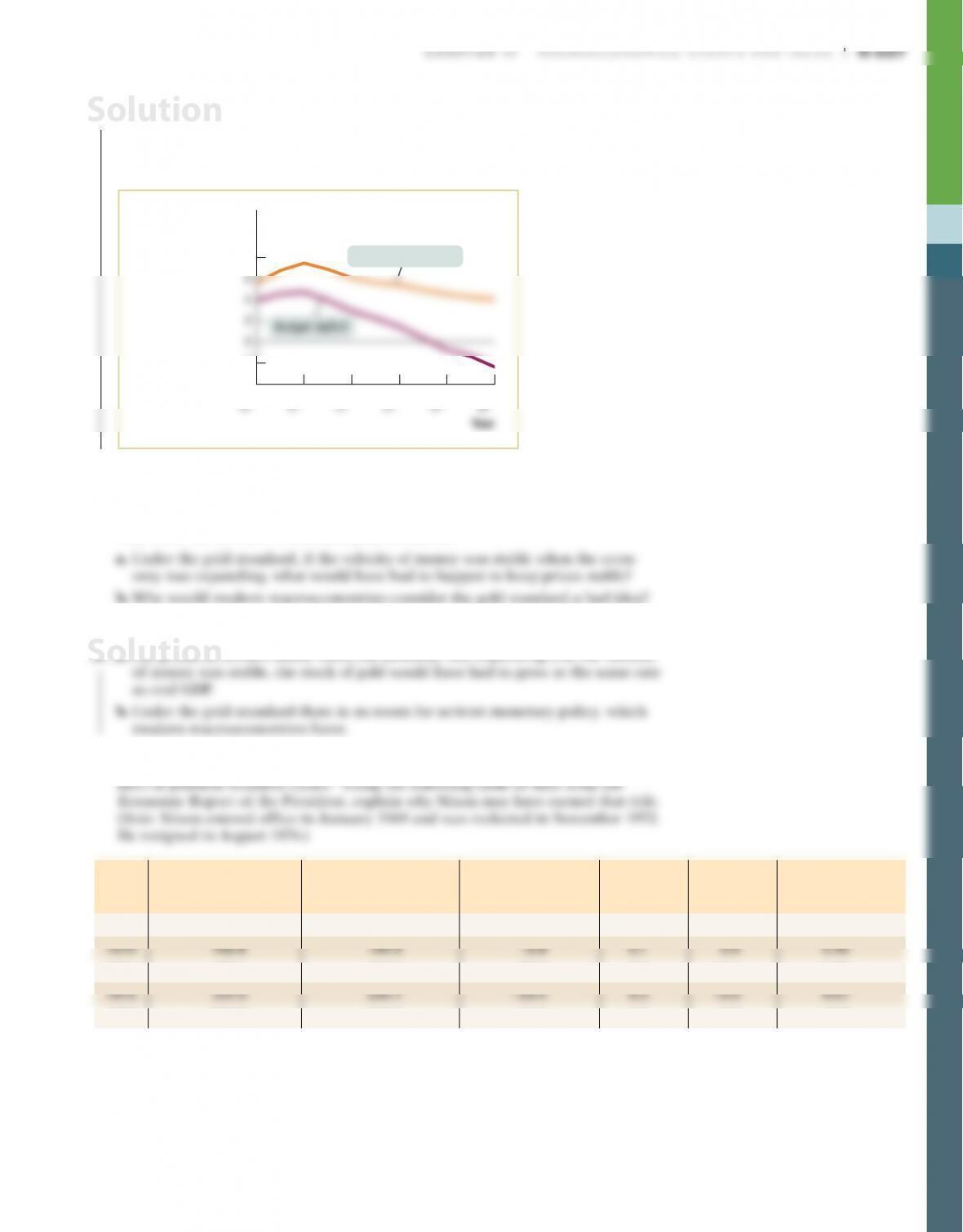
3. The accompanying diagram replicates Figure 17-2 for the 1990–2000 period. It
was fortunate that defense spending fell and the budget deficit declined dur-
ing this period because additional spending at a time of strong growth (and low
unemployment rates) would likely have created inflationary pressure.
Year
Unemployment rate,
budget deficit
(percent of GDP)
8%
–2
–4
1998
2000
1990
1992
1994
1996
Unemployment rate
4. In the modern world, central banks are free to increase or reduce the money
supply as they see fit. However, some people harken back to the “good old days”
of the gold standard. Under the gold standard, the money supply could expand
only when the amount of available gold increased.
4. a. For prices to remain stable when the economy was expanding and the velocity
5. The chapter notes that Kenneth Rogoff proclaimed Richard Nixon “the all-time
Year
Government receipts
(billions of dollars)
Government spending
(billions of dollars)
Government
budget balance
(billions of dollars) M1 growth M2 growth
3-month
Treasury bill rate
1969 $186.9 $183.6 $3.2 3.3% 3.7% 6.68%
1971 187.1 210.2 –23.0 6.5 13.4 4.35
1973 230.8 245.7 –14.9 5.5 6.6 7.04
Solution
Solution

5. The data indicate that President Nixon may have used fiscal and monetary
policy to aid his reelection efforts. From his first year in office, 1969, to his
reelection year, 1972, federal spending grew by 27% but federal receipts grew by
only 11%. Overall, the federal budget balance went from a $3.2 billion surplus
to a $23.4 billion deficit as a result of these expansionary fiscal policies. Nixon
also used expansionary monetary policy to increase his popularity. Both M1 and
6. The economy of Albernia is facing a recessionary gap, and the leader of that
nation calls together its best economists representing the classical, Keynesian,
6. In response to a recessionary gap in Albernia, the economists representing the
different views of the macroeconomy would make the following suggestions.
Classical: Do nothing. The recessionary gap will exist only in the short run, and
the only focus for policy makers is the long run.
Keynesian: The best policies to alleviate the recessionary gap are fiscal policies.
Although expansionary monetary policies can be effective in promoting
economic growth, they will not be very effective when the economy is in a deep
recession or depression, when the economy may face a liquidity trap.
Monetarist: The government should not engage in discretionary fiscal or mone–
tary policies because such policies can worsen economic fluctutations. GDP will
grow steadily without inflationary pressure if the money supply grows steadily.
7. Which of the following policy recommendations are consistent with the classical,
Keynesian, monetarist, Great Moderation consensus, expansionary austerity, and
secular stagnationist views of the macroeconomy?
Solution
Solution
7. a. Monetarists would support such a policy; they believe in a monetary policy
rule that allows the money supply to grow at the same rate as GDP. Since clas-
b. Classical economists would see the inflationary pressure as a short-run prob–
lem and would not advocate any policy; their view would be that the inflation-
ary pressure will not exist in the long run. Monetarists would also be reluctant
c. Classical economists would see a recessionary gap as a short-run problem and
would not advocate any policy; their view would be that the recessionary gap will
not exist in the long run. Monetarists would also be reluctant to endorse a short-
run discretionary monetary policy because they believe it will make the economy
d. Keynesians and followers of the Great Moderation consensus would disagree
with this policy recommendation. A balanced-budget rule would eliminate
the possibility of using discretionary fiscal policy whenever a recessionary or
expansionary gap exists. In fact, a balanced-budget rule would require that
the government employ contractionary fiscal policy during recessions (making
e. Only advocates of expansionary austerity would agree with this policy recom-
mendation, believing that reduced government spending would give the private
sector greater confidence in the economy. Increased confidence in the econ-
omy would thereby raise employment and GDP. All other viewpoints would
disagree, believing that this proposed policy would make the recession worse.
f. Secular stagnationists, Keynesian, and some new Keynesian macroeconomists
would support this policy, believing, as they do, that fiscal policy can be use–
ful during liquidity traps. Nearly all the other macroeconomic viewpoints,
g. Secular stagnationists would be most supportive of a monetary policy strategy
that results in a higher inflation rate today. They believe that targeting a higher
inflation rate would allow the economy to achieve a negative real interest
rate. Keynesian and some new Keynesian economists would also support this
8. Using a graph like Figure 17-3, show how a monetarist can argue that a con-
Solution
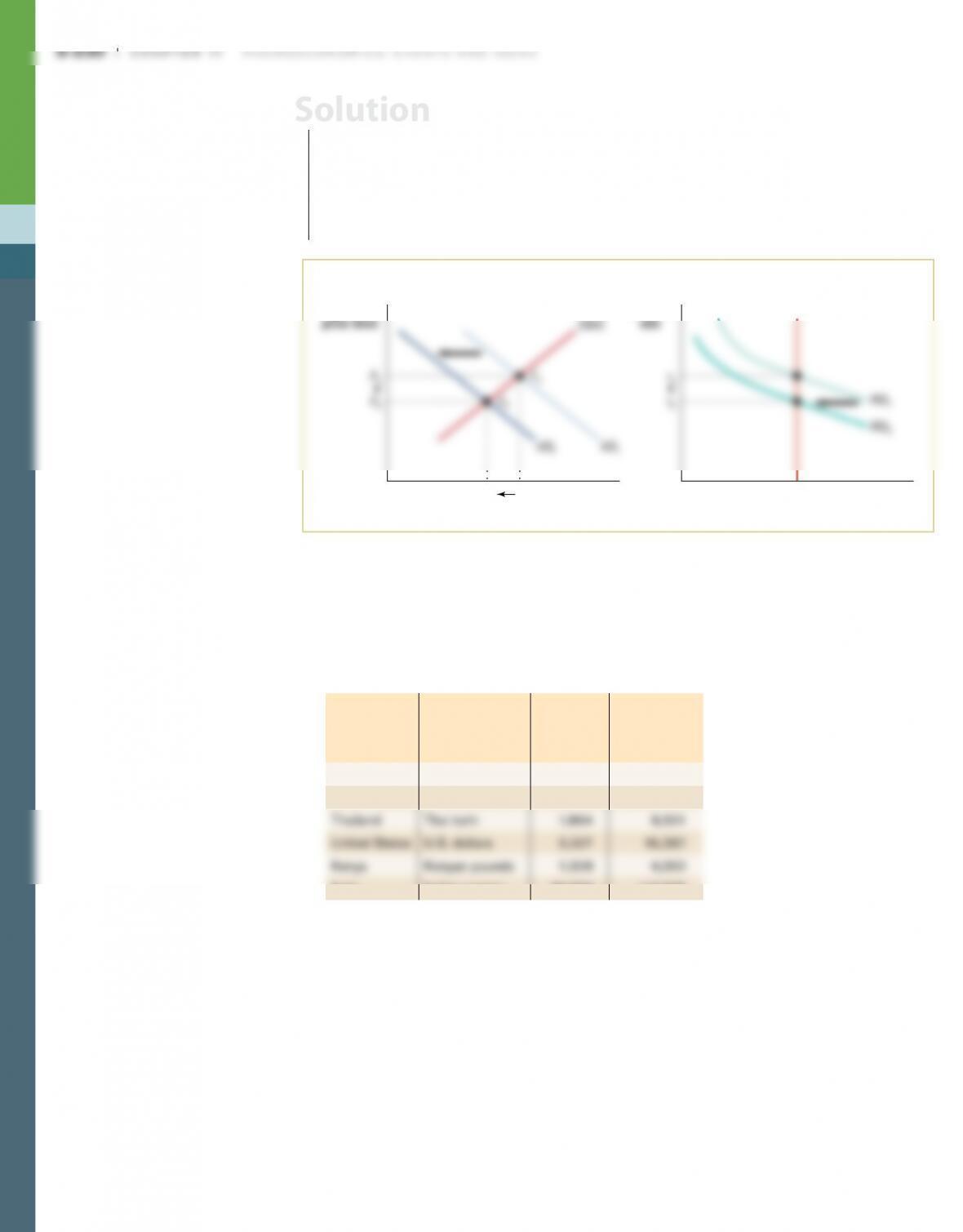
8. As you can see in the accompanying figure, contractionary fiscal policy shifts
the aggregate demand curve leftward, from AD1 to AD2, in panel (a). Corre–
spondingly, there is a decrease in money demand, and the money demand curve
shifts leftward, from MD1 to MD2, in panel (b). This leads to a fall in the interest
rate from r1 to r2, which has the effect of increasing investment spending and
expanding the economy. If the increase in investment spending is sufficient to
counteract the effect on real GDP of the contractionary fiscal policy, then the
monetarist is indeed correct.
Real GDP
A
ggregate
Y1
Y2
Quantity
of money
Interest
M
MS
Aggregate Demand Money Demand
9. Monetarists believed for a period of time that the velocity of money was stable
within a country. However, with financial innovation, the velocity began shift-
ing around erratically after 1980. As would be expected, the velocity of money is
different across countries depending upon the sophistication of their financial
systems—velocity of money tends to be higher in countries with developed finan-
cial systems. The following table provides money supply and GDP information in
2016 for six countries.
Country
National
currency
M1
(billions in
national
currency)
Nominal
GDP (billions
in national
currency)
Egypt Egyptian pounds 540 1,838
South Korea Korean won 734,412 1,466,788
India Indian rupees 20,059 113 ,575
Data from: Central Bank of Egypt; Bank of Korea; Bank of Thailand; Federal
Reserve Bank of St. Louis; Central Bank of Kenya; Reserve Bank of India.
Solution

Chapter 17 MacroeconoMics: events and ideas S-231
a. Calculate the velocity of money for each of the countries. The following table
shows GDP per capita for each of these countries in 2016 in U.S. dollars.
Country
Nominal GDP per capita
(U.S. dollars)
Egypt $3,685
South Korea 27,539
Thailand 5,899
Data from: IMF.
b. Rank the countries in descending order of GDP per capita and velocity of
money. Do wealthy countries or poor countries tend to “turn over” their
money more times per year? Would you expect wealthy countries to have more
sophisticated financial systems?
9. a. The velocity of money is defined as nominal GDP divided by the quantity of
money. For example, the velocity of money in Egypt is 1,838/540 = 3.4. The
velocity of money for each of the countries is shown in the accompanying table.
Country Velocity of money
Egypt 3.4
Kenya 3.1
India 5.7
b. Rank in descending order of velocity: India, Thailand, United States,
10. In response to the Great Recession, the Federal Reserve took drastic and
largely untested measures to stabilize both the financial system and macro–
economy. These measures caused the monetary base to increase from approxi–
Solution
10. Classical: the focus of classical economists is largely long-run outcomes of
monetary policy. Because they believe that changes in the money supply would
only increase the price level, classical economists would not support the Fed’s
large increase in the monetary base.
Real business cycle: these economistsbelieve that the short-run aggregate sup–
ply curve is vertical and that changes in the business cycle are largely the result
of shifts in aggregate supply. Thus, changes in demand have no effect on aggre–
gate output. Real business cycle economists would not be supportive of the
Fed’s policy.
Great Moderation consensus: rejecting the views of monetarists, these economists
believe that a central bank has the ability to change short-run output through
discretionary policy or by adopting a formal Taylor rule, and that the use of
monetary policy could prevent large recessions. But they would not necessarily
support the expansion of the monetary base because they do not think the econ-
omy could suffer from a major financial shock.
Solution