CHAPTER 17
Money, Banking, and Inflation
KEY IDEAS IN THIS CHAPTER
2. Commodity money or fiat money can overcome the double-coincidence-of-needs
problem by providing a universally acceptable medium of exchange.
3. The monetary intertemporal model predicts that a higher growth rate of money
4. In this model, an optimal long-run monetary policy for the central bank is to follow
5. The Diamond-Dybvig banking model has two equilibria: a no bank run equilibrium
7. However, there is a moral hazard problem associated with deposit insurance.
8. According to the too-big-to-fall doctrine, the implicit insurance of deposits and other
NEW IN THE FOURTH EDITION
2. All charts and tables have been updated to reflect new data.
TEACHING GOALS
In the modern world, the use of money as a social contrivance is largely taken for
granted. Although study of the mechanisms of trading may seem rather arcane, it may
Chapter 17: Money, Banking, and Inflation
open some students’ minds to the value of adopting a uniform medium of exchange.
Students should fully understand that a world of rugged individualism in which everyone
is self-sufficient is the most likely alternative to a monetary economy.
The level of the money supply is neutral. The growth rate of the money supply has
allocative effects on the economy. Continuous growth in the money supply causes
inflation. Inflation erodes money’s usefulness as a medium of exchange. As inflation
worsens, households substitute non-market activities, which require no money, for market
activities that do require money. Therefore, as the inflation rate increases, output and
employment decrease.
CLASSROOM DISCUSSION TOPICS
An important tenet of monetary economics is the dominance of monetary economies over
economies without a commonly accepted medium of exchange. Yet we still find the
existence of barter clubs. These clubs sometimes arrange direct one-for-one trades
between individuals or businesses that have a double coincidence of wants. Sometimes
they arrange three-way transactions similar to those depicted in Figure 15.2 in the text.
Some of these clubs utilize credits that circulate as a private medium of exchange
between members. To find some examples, suggest a Google™ search on the term
“barter.” Ask if any student has heard of such arrangements or even participated in them.
Are the users of these services irrational? Does the existence of such organizations
suggest that monetary exchange is becoming outdated?
The widespread use of computer technology has lowered the information costs associated
with barter exchange. But such technology also reduces the cost of engaging in monetary
transactions. Marketing materials provided by these exchanges emphasize that they allow
Instructor’s Manual for Macroeconomics, Fourth Canadian Edition
transactions. It is not likely that the foundations of monetary theory will become outdated
in the near future.
Most of today’s students have not had any personal experience with significant inflation.
Ask students if they ever worry about inflation. There may be students from other
countries (Russia, Eastern Europe, the former Yugoslavia, etc.) who have experienced
high inflation. Can anyone imagine a set of circumstances that would lead to a serious
Canadian inflation problem? Would students find more inflation objectionable? Do the
problems that students ascribe to inflation conform to theory, or are they more a figment
of confusion between real and nominal variables?
The Diamond-Dybvig model provides a useful framework for generating discussion
about financial stability, particularly in light of the recent financial crisis. In the United
States, some observers likened the freezing-up of credit markets, in particular the
reluctance of lenders to lend short-term to some investment banks, as being like a bank
OUTLINE
1. Alternative Forms of Money
a) Commodity Money
b) Circulating Private Bank Notes
c) Commodity-Backed Paper Money
2. Money and the Absence of a Double Coincidence of Wants
a) Barter and the Absence of a Double Coincidence of Wants
b) Commodity Money and Trade
c) Fiat Money and Trade
3. A Growing Money Supply and the Effects of Long-Run Inflation
a) Inflation Effects
CC
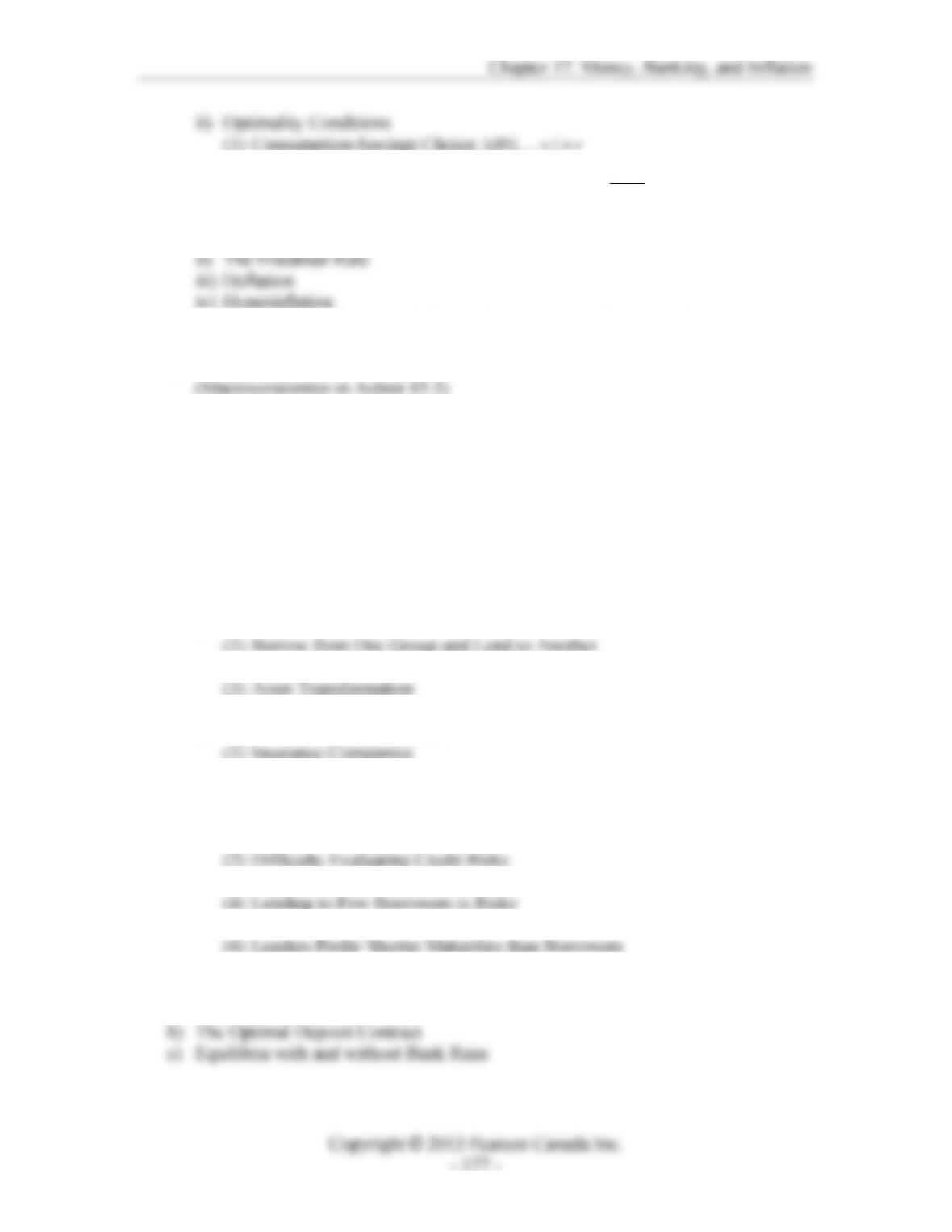
(2) Current Leisure-Consumption Choice: ,1
lC
w
MRS
R
=
+
b) A Change in the Growth Rate of the Money Supply
i) Output and Employment Effects
c) Money Growth, Inflation, and Output Growth Across Countries (Macroeconomics
in Action 15.2)
d) Should the Bank of Canada Reduce the Inflation Rate to Zero or Less?
4. Financial Intermediation and Banking
a) Properties of Assets
i) Rate of Return
ii) Risk
(1) Diversifiable
(2) Non-Diversifiable
iii) Maturity
iv) Liquidity
b) Financial Intermediation
i) Characteristics
(2) Diversified
(4) Information Processing
ii) Types of Financial Institutions
(2) Mutual Funds
(3) Depository Institutions
iii) Problems with Direct Lending
(1) Costly Matching
(3) Duplication in Credit Risk Evaluation
(5) Loans are Illiquid
5. The Diamond-Dybvig Model
a) Interrupted Production Processes
6. Deposit Insurance
a) Bank Failures in the Great Depression
b) Moral Hazard
c) Too-Big-to-Fail Policy
TEXTBOOK QUESTION SOLUTIONS
Problems
1. In this case, Type I traders would use the commodity money they produce (good 2) to
2. Consumes 1 Consumes 2 Consumes 3
Type I Type II Type III
Produces 3 Produces 1 Produces 2
3. Suppose that the central bank acquires K units of capital in the current period, and
issues M units of money to finance these purchases, so that
MK
P
=. (1)
Then, in the future period, the central bank earns rK from its holdings of capital, and
‘
and solving, we obtain
Chapter 17: Money, Banking, and Inflation
4. The fact that inflation alters the real opportunity cost of holding money is the only
source of real effects of inflation on the economy. Payment of interest on money
5. With the possibility of theft, the Friedman rule is no longer an optimal policy. In this
case, the nominal interest rate does not reflect the social cost of holding money, and it
6. Asset characteristics.
i) Works of art typically have a low (financial) rate of return. The only source of a
return is appreciation in the market price. Works of art are quite risky and are
ii) U.S. Treasury Bills have a low rate of return in comparison to other financial
iii) Shares in Microsoft have a high expected rate of return, although they are rather
risky, due to fluctuations in price and dividends. The maturity is effectively
iv) Loans to friends generally have a low rate of return as friends generally charge
Instructor’s Manual for Macroeconomics, Fourth Canadian Edition
v) Loans to General Motors likely have a rate of return in excess of Treasury Bills,
7. If the bank can suspend convertibility in this way, then it can always honour all of its
second-period commitments. Early consumers never wait to withdraw in the second
8. Production cannot be interrupted.
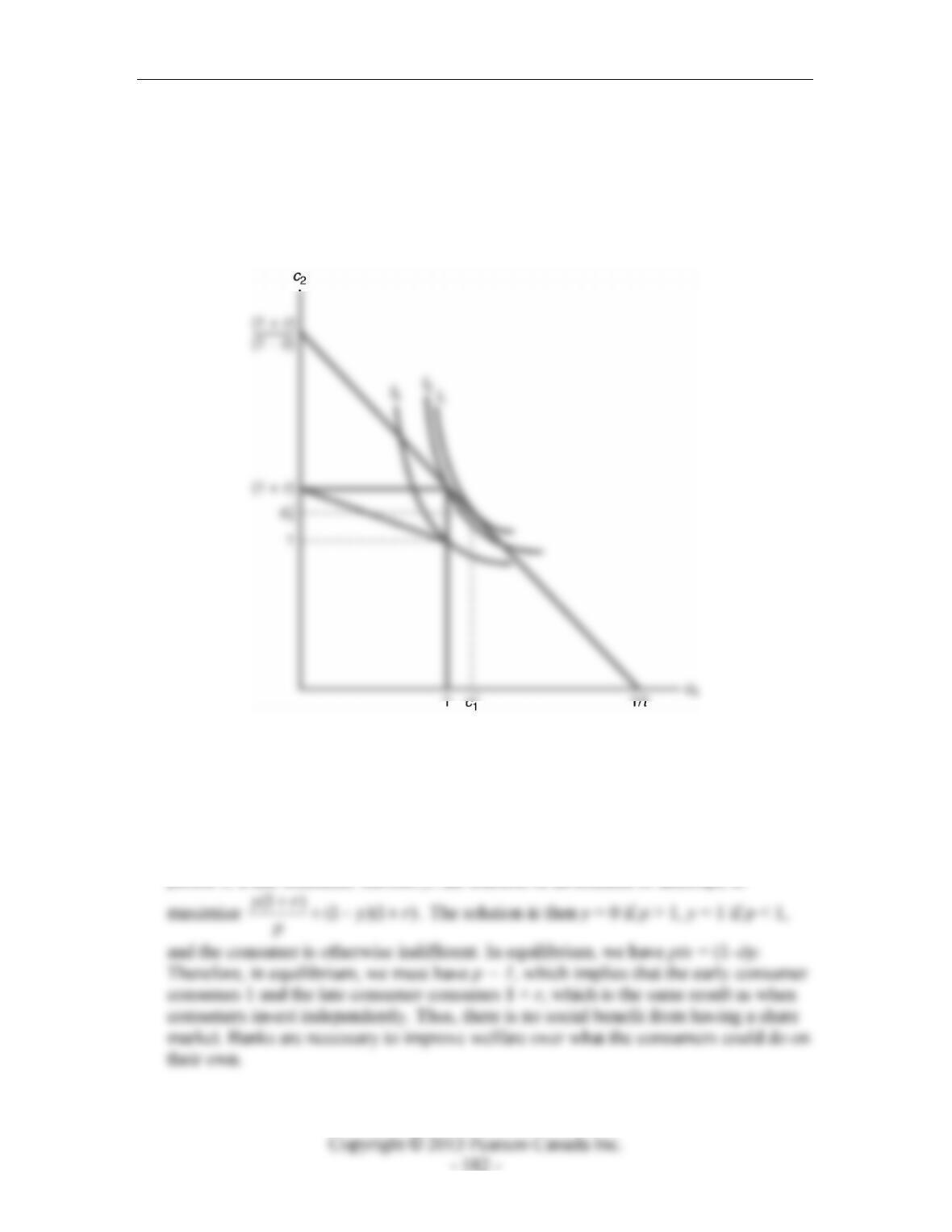
a) In the standard model, with no bank, the consumer has no reason not to commit
all of her resources to production. If the consumer turns out to be an early
consumer, production is interrupted and the consumer has 11c=. If the consumer
turns out to be a late consumer, production is completed and the consumer
has 21cr=+. In no case does the consumer consume less than one.
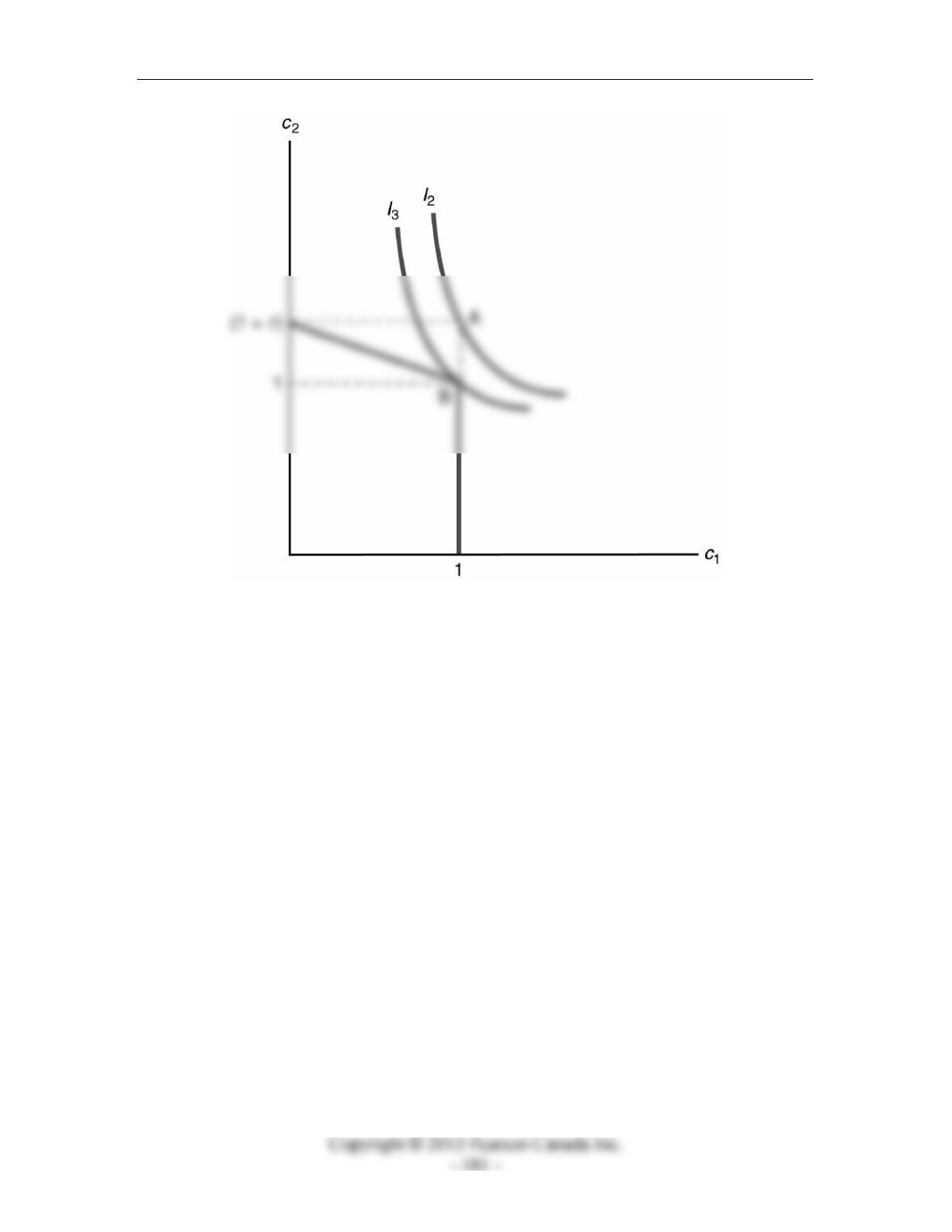
When production cannot be interrupted, the decision of how much to commit to
production becomes important. As long as the good is storable, the consumer can
choose to refrain from production, in which case she obtains 12
1cc==. Now
Chapter 17: Money, Banking, and Inflation
Figure 15.1a
Instructor’s Manual for Macroeconomics, Fourth Canadian Edition
b) As long as banks know the probability of individuals becoming early and late
consumers, the need to commit irreversibly to production does not affect the bank.
Precommitment does not matter when the bank knows in advance how much it
would need to interrupt. Therefore, the optimal bank contract is unchanged. This
possibility is added to Figure 15.1b, below. The optimal bank contract is the
point **
12
,cc.
Figure 15.1b
9. Each consumer will invest their entire endowment of 1 unit in the production
technology in period 0. In period 1, if an early consumer must choose the fraction of
the investment, x, to sell at the price p, and will interrupt the remaining fraction 1 – x
and consume it. The early consumer then chooses x to maximize pxx +−1, and the
solution is x = 0 if p < 1, x = 1 if p > 1, and the consumer is otherwise indifferent. In
period 1, a late consumer chooses y, the fraction of investment to interrupt, to
10. Moral hazard problems.
a) The child is more likely to report having trouble because having trouble is
rewarded with help.