
Chapter 17: Multinational Financial Management
Learning Objectives
481
Chapter 17
Multinational Financial Management
Learning Objectives
After reading this chapter, students should be able to do the following:
◆ Identify the primary reasons companies choose to go “global.”
◆ Explain how exchange rates work and interpret different exchange rate quotations.
◆ Discuss the intuition behind interest rate parity and purchasing power parity.
◆ Explain the different opportunities and risks that investors face when they invest overseas.
◆ Identify some specific challenges that a multinational corporation faces and discuss how they
influence its capital budgeting, capital structure, and working capital policies.

482
Lecture Suggestions
Chapter 17: Multinational Financial Management
Lecture Suggestions
This chapter presents an overview of multinational financial management, including exchange rates,
interest rate and purchasing power parity, international capital markets, multinational capital budgeting,
and international capital structures.
What we cover, and the way we cover it, can be seen by scanning the slides and Integrated Case
solution for Chapter 17, which appears at the end of this chapter’s solutions. For other suggestions
about the lecture, please see the “Lecture Suggestions” in Chapter 2, where we describe how we conduct
our classes.
DAYS ON CHAPTER: 3 OF 56 DAYS (50-minute periods)
Answers to End-of-Chapter Questions
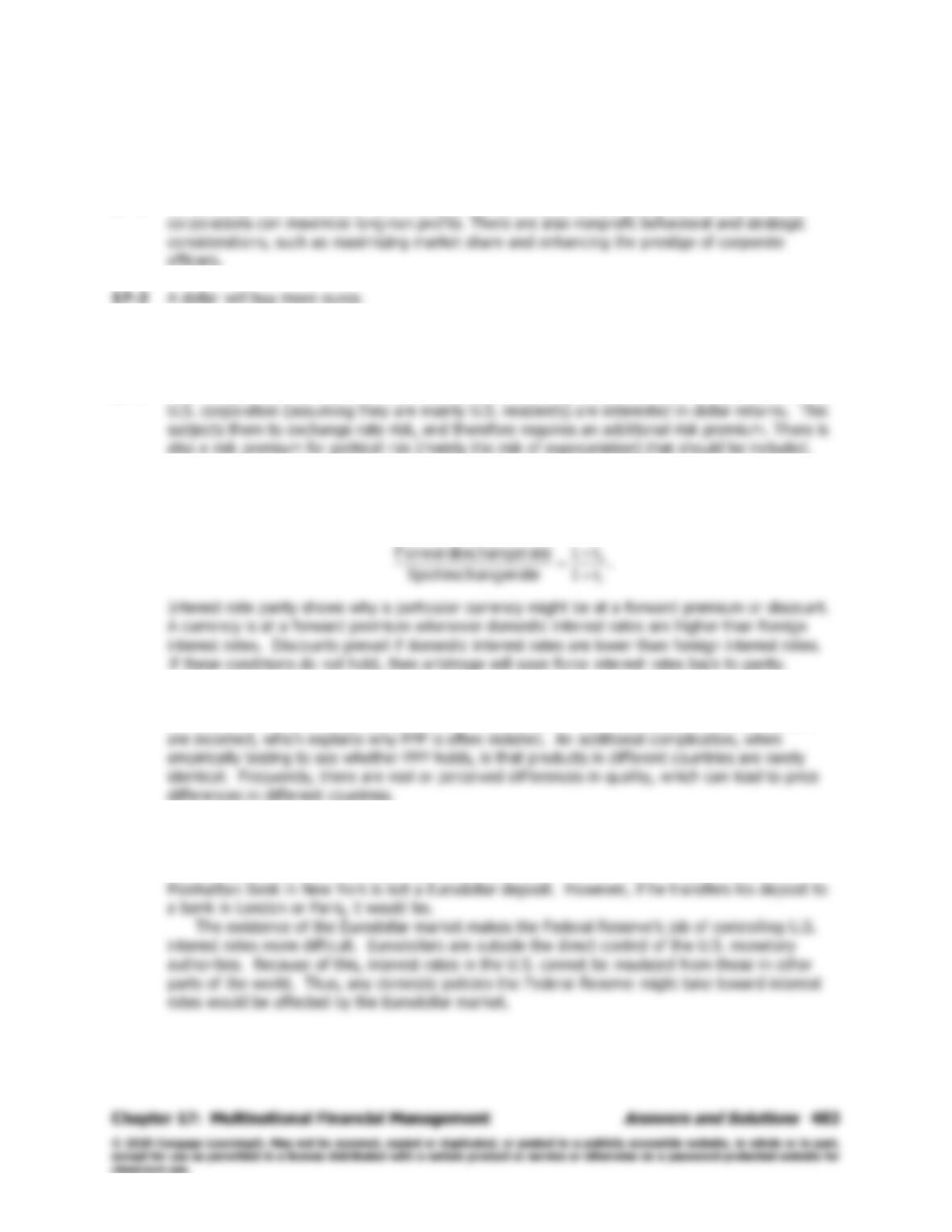
17-1 Considering differential labor costs abroad, transportation, tax advantages, and so forth, U.S.
17-3 There will be an excess supply of dollars in the foreign exchange markets, and thus, this will tend
to drive down the value of the dollar. Foreign investments in the United States will increase.
17-4 The foreign project’s cash flows must be converted to U.S. dollars, since the shareholders of the
17-5 No, interest rate parity implies that an investment in the U.S. with the same risk as a similar
investment in a foreign country should have the same return. Interest rate parity is expressed as
follows:
17-6 Purchasing power parity assumes there are neither transactions costs nor regulations that limit
the ability to buy and sell goods across different countries. In many cases, these assumptions
17-7 A Eurodollar is a dollar deposit in a foreign bank, normally a European bank. The foreign bank
need not be owned by foreigners—it only has to be located in a foreign country. For example, a
Citibank subsidiary in Paris accepts Eurodollar deposits. The Frenchman’s deposit at Chase
484
Answers and Solutions
Chapter 17: Multinational Financial Management
Solutions to End-of-Chapter Problems
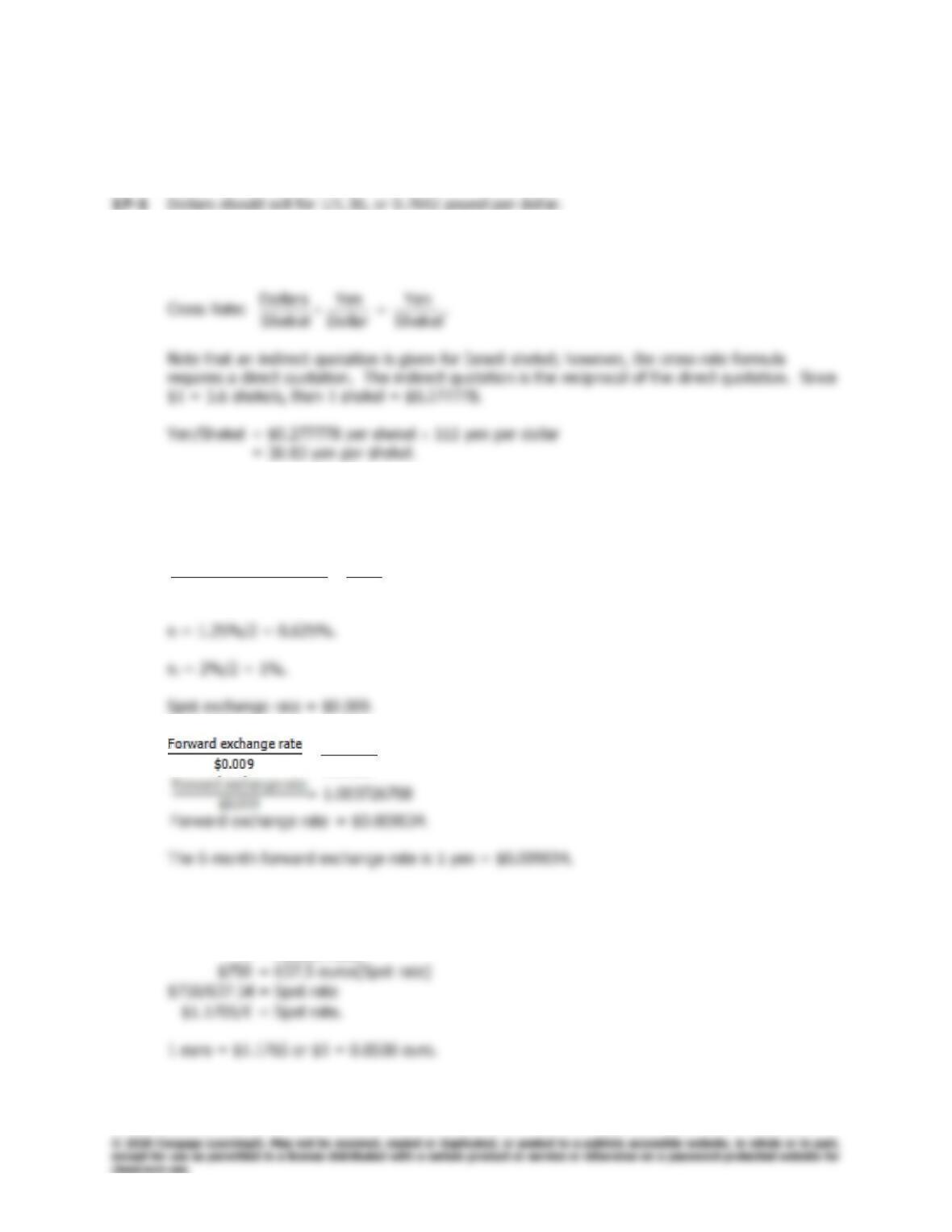
17-2 $1 = 3.6 Israeli shekels; $1 = 111 Japanese yen; Cross-exchange rate, yen/shekel = ?
17-3 rNOM, 6-month T-bills = 2%; rNOM of similar default-free 6-month Japanese bonds = 1.25%; Spot
exchange rate: 1 yen = $0.009; 6-month forward exchange rate = ?
.
r1
r1
rate exchangeSpot
rate exchange Forward
f
h
+
+
=
=
1.00625
1.01
17-4 U.S. T.V. = $750; EMU T.V. = 637.5 euros; Spot rate between euro and dollar = ?
Ph = Pf(Spot rate)
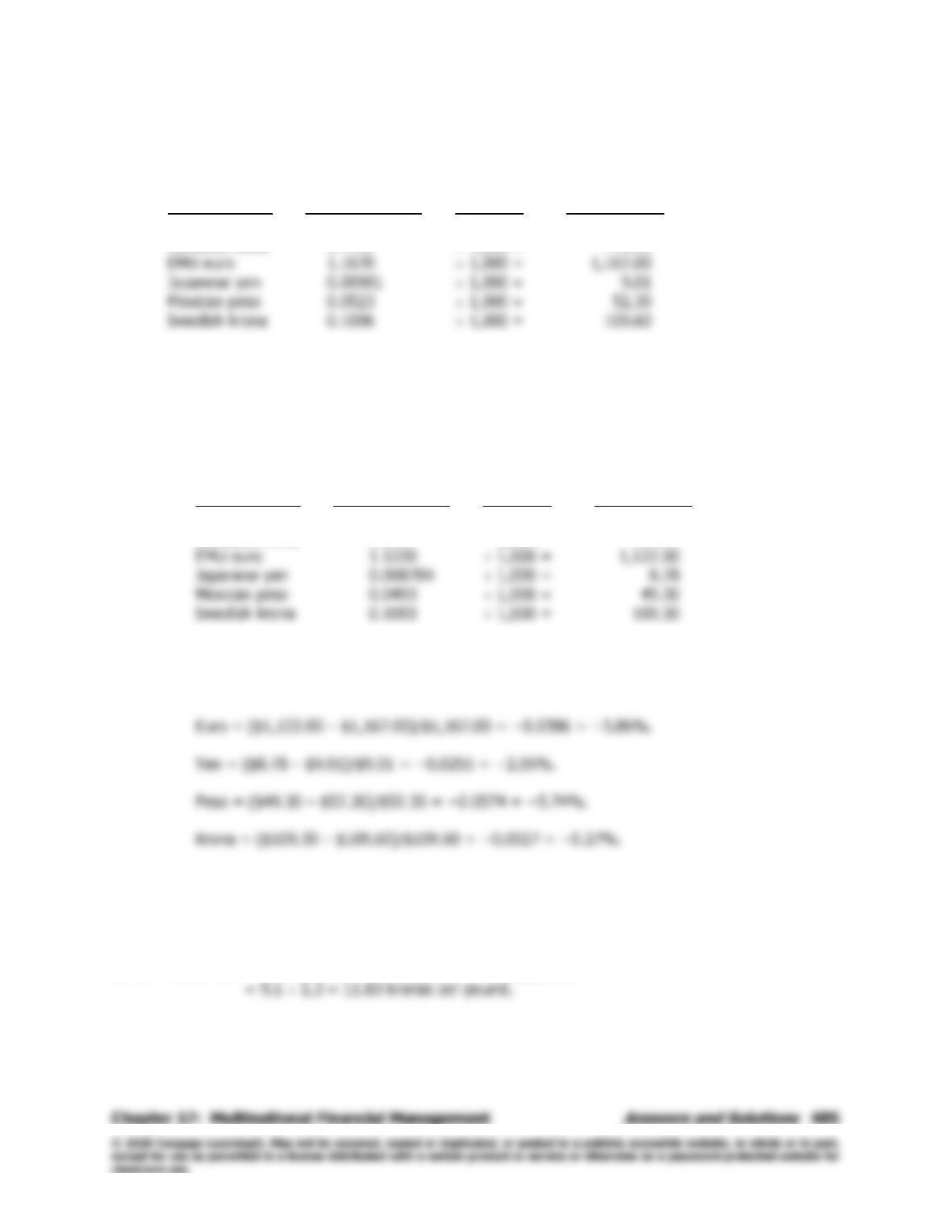
17-5 From Table 17.1:
U.S. Dollars
Required to
Buy One Unit of Purchase Price
Currency Foreign Currency 1,000 = in Dollars
British pound $1.3009 1,000 = $1,300.90
Canadian dollar 0.7702 1,000 = 770.20
17-6 a. The answer to this problem depends on the date it is assigned. If the exchange rates taken
from
The Wall Street Journal
on November 13, 2018 are used (for November 12th
transactions); then the following information is obtained:
U.S. Dollars
Required to
Buy One Unit of Purchase Price
Currency Foreign Currency 1,000 = in Dollars
British pound 1.2851 1,000 = $1,285.10
Canadian dollar 0.7547 1,000 = 754.70
b. Pound = ($1,285.10 – $1,300.90)/ $1,300.90 = −0.0121 = −1.21%.
Canadian dollar = ($754.70 – $770.20)/$770.20 = −0.0201 = −2.01%.
17-7 The price of krones is $0.16 today. A 4% appreciation will make it worth $0.1664 tomorrow. A
dollar will buy 1/0.1664 = 6.0096 krones tomorrow.
17-8 Cross rate = kronas/dollar dollars/pound = kronas/pound
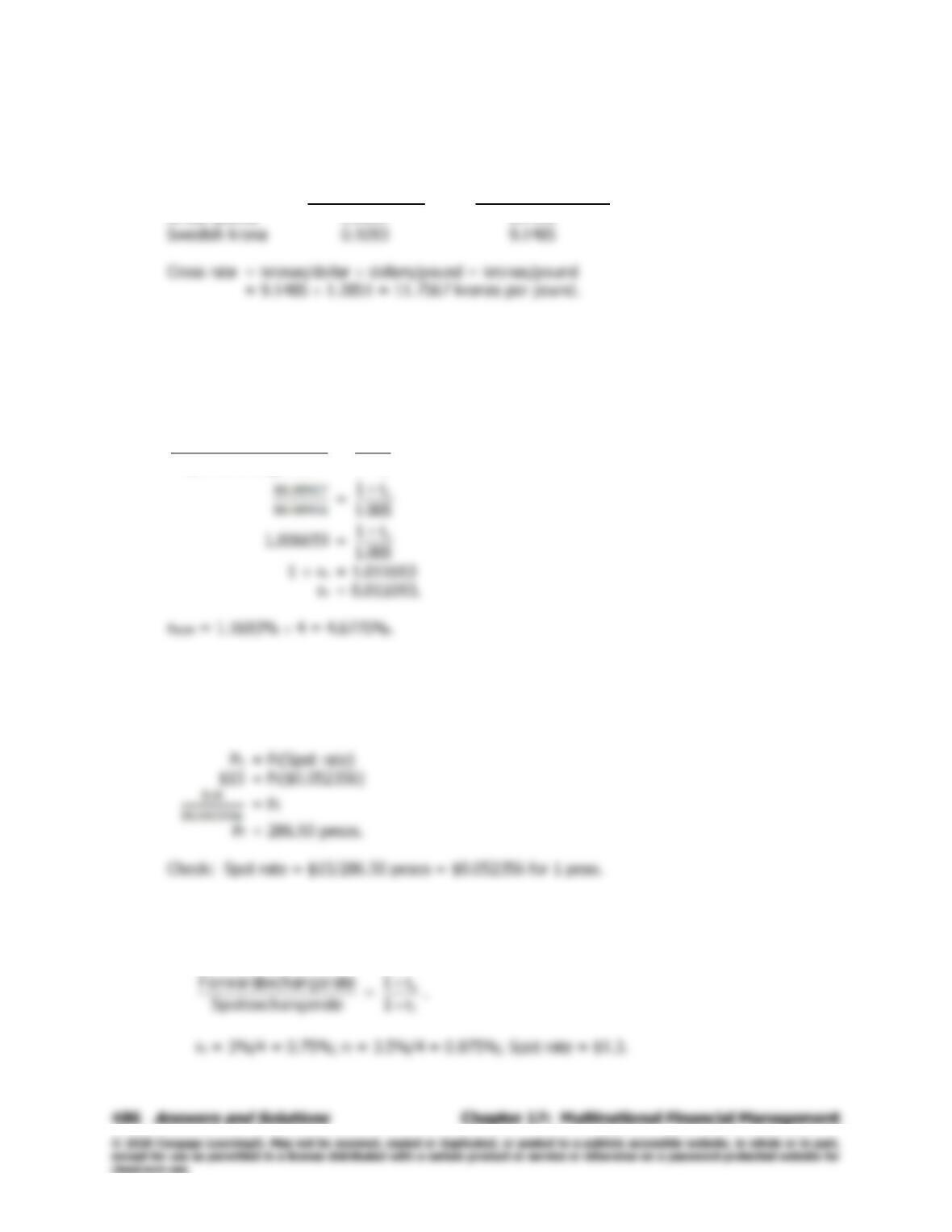
17-9 The answer to this question would depend upon the rates existing at the time the assignment is
made. Using the rates quoted in the Foreign Exchange table of
The Wall Street Journal
on
November 13, 2018 (for November 12th transactions):
U.S. $ Equivalent Currency per U.S. $
British pound 1.2851 0.7781
17–10 Spot rate: 1 yen = $0.00901; 90-day forward rate: 1 yen = $0.00907; rNOM of 90-day Japanese
risk-free securities = 2%; rNOM of 90-day U.S. risk-free securities = ?
rf = 2.0%/4 = 0.50%; rh = ?
rate exchangeSpot
rate exchange Forward
=
f
h
r1
r1
+
+
17–11 $1 = 19.1 pesos; CD = $15.00; Price of CD in Mexico = ?
1 Peso = 1/19.1 = $0.052356.
17–12 a. rNOM of 90-day U.S. risk-free securities = 3%; rNOM of 90-day British risk-free securities =
3.5%; Spot rate: 1 pound = $1.3; forward rate selling at premium or discount = ?
rate exchangeSpot
f
h
r1
r1
+
+
Chapter 17: Multinational Financial Management
Answers and Solutions
487
=
1.00875
1.0075
b. The forward rate is selling at a discount, since a pound buys fewer dollars in the forward
17–13 a. A$4,000,000/A$1.3767 = $2,905,498.66 $2,905,499, or
A$4,000,000 $0.7264 = $2,905,600. (Difference is due to rounding.)
b. A$4,000,000/A$1.3749 = $2,909,302.49 $2,909,302, or
17–14 The U.S. dollar liability of the corporation falls from $0.77(10,000,000) = $7,700,000 to
$0.70(10,000,000) = $7,000,000, corresponding to a gain of 700,000 U.S. dollars for the
corporation. However, the real economic situation might be somewhat different. For example,
17–15 a. The automobile’s value has increased because the dollar has declined in value relative to the
yen.
17–16 D1 = 2 pounds; Exchange rate = $1.3/pound; Pound depreciates 5% against $1. Dividend grows
at 10% and rs = 11%. 10 million shares outstanding.
488
Answers and Solutions
Chapter 17: Multinational Financial Management
17–17 a. If a U.S. based company undertakes the project, the rate of return for the project is a simple
calculation, as is the net present value.
b. According to interest rate parity, the following condition holds:
rate exchangeSpot
rate exchange Forward
=
Swiss
r1
r1
+
+
c. First, we must adjust the cash flows to reflect Sandrine’s home currency.
Year CF ($) CF (SFrancs)
0 -2,000 –1,940 (-2,000 × 0.97)
1 2,400 2,294.088 (2,400 × 0.95587)
Chapter 17: Multinational Financial Management
Comprehensive/Spreadsheet Problem
489
Comprehensive/Spreadsheet Problem
Note to Instructors:
The solution to this problem is not provided to students at the back of their text. Instructors
can access the
Excel
file on the textbook’s website.
17–18 a.
Input Data
Cost of component X (in Sfrancs) SFr. 165
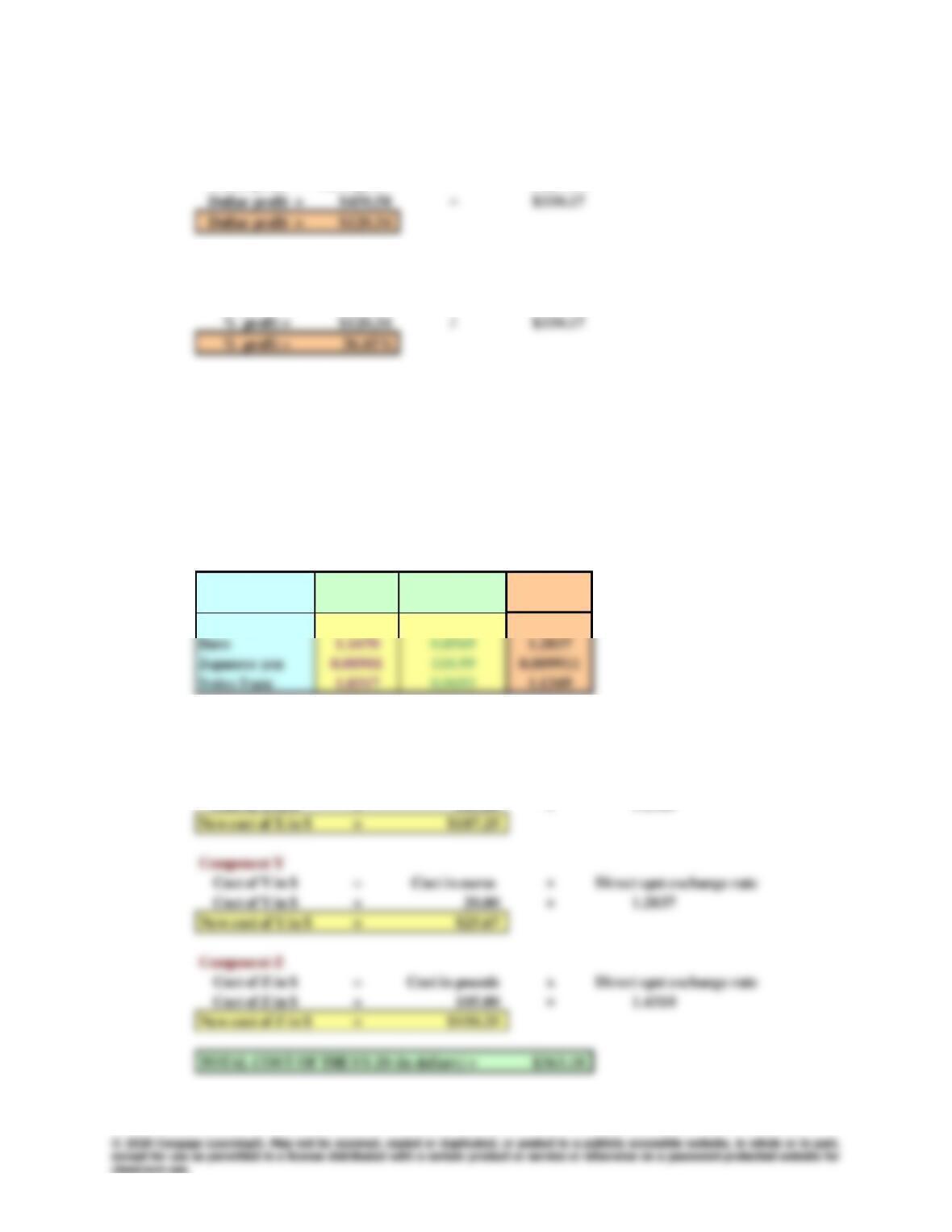
We will convert the cost of each component to dollars, and find the total cost of the SY-20. We will do the same
to find the dollar sale price.
Component X
Cost of X in $ = Cost in Sfrancs ×Direct spot exchange rate
490
Comprehensive/Spreadsheet Problem
Chapter 17: Multinational Financial Management
b.
The dollar profit from the sale of the SY-20 is simply the sales revenue minus the total cost.
Dollar profit = Sales price –Total cost
The percentage profit is determined as the dollar profit divided by the total cost.
% profit = $ profit / Total cost
c.
If the dollar was to weaken by 10% against all foreign currencies, that could be expressed by multiplying the
direct quotations of foreign exchange rates by (1 − % change), to reflect a 10% decrease in purchasing strength.
Since there is a weakening of the dollar, the % is negative.
Change in dollar strength against all currencies
–10%
We will reproduce the table from the top of the spreadsheet, but we will add a column for the new exchange rates.
Direct Indirect New Direct
Quotations Quotations Quotations
British pound 1.3009 0.7687 1.4310
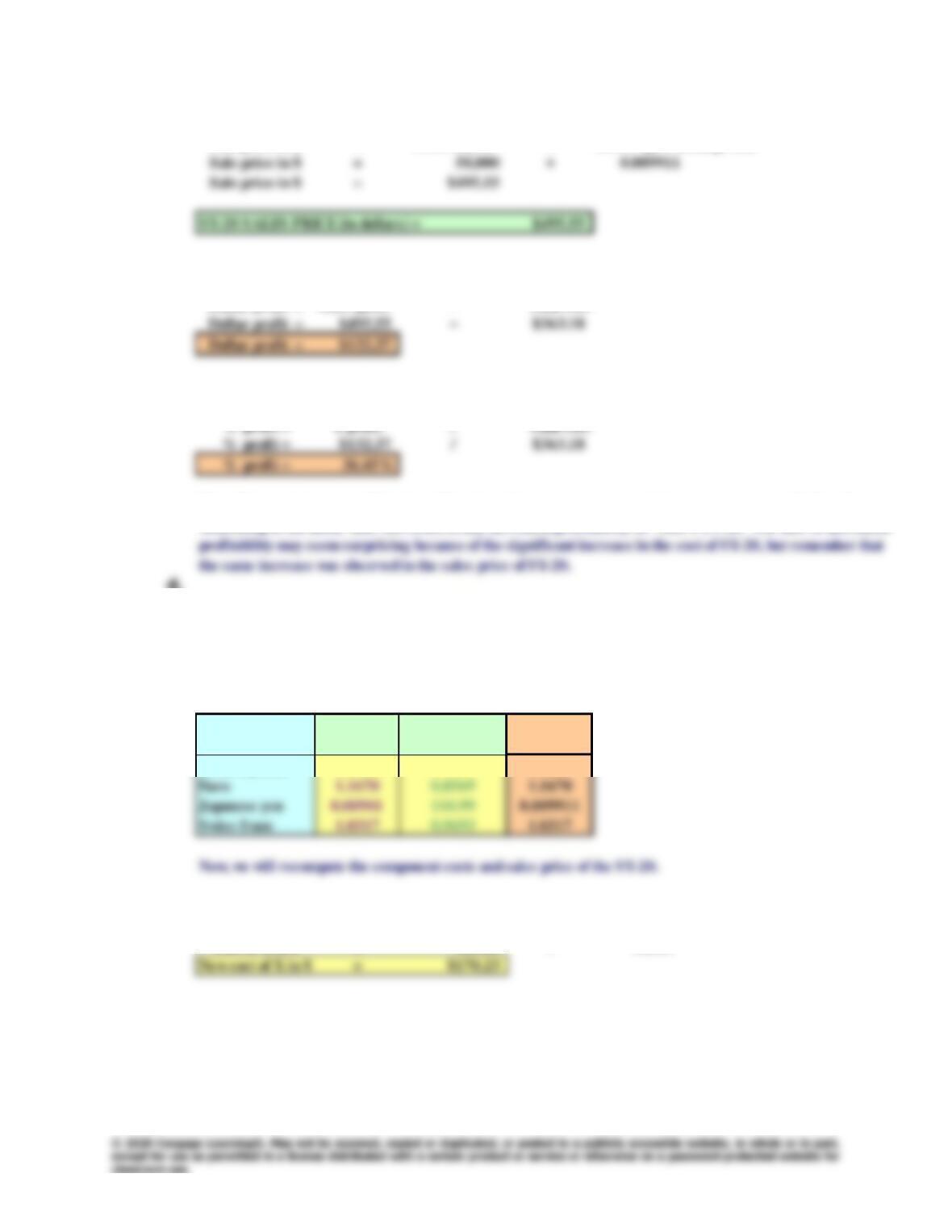
Now, we will recompute the component costs and sales price of the SY-20.
Component X
Cost of X in $ = Cost in Sfrancs ×Direct spot exchange rate
Cost of X in $ = 165.00 ×1.1349
Chapter 17: Multinational Financial Management
Comprehensive/Spreadsheet Problem
491
Revenue from sale of the SY-20
Sale price in $ = Price in yen ×Direct spot exchange rate
The dollar profit from the sale of the SY–20 is simply the sales revenue minus the total cost.
Dollar profit = Sales price –Total cost
The percentage profit is determined as the dollar profit divided by the total cost.
From this exercise, we see that since all costs and revenues are generated overseas, an across the board
weakening of the dollar does not result in any decreased profitability for Yohe’s SY-20. The lack of decreased
d.
Once again, we must reconstruct the currency table from the top of the worksheet. This time, however, we will
only be changing the exchange rate for the yen. Again, we will be multiplying the old rate by (1 − % change).
Since there is a weakening of the dollar, that % is a negative number.
Change in dollar strength against Japanese yen –10%
Direct Indirect New Direct
Quotations Quotations Quotations
British pound 1.3009 0.7687 1.3009
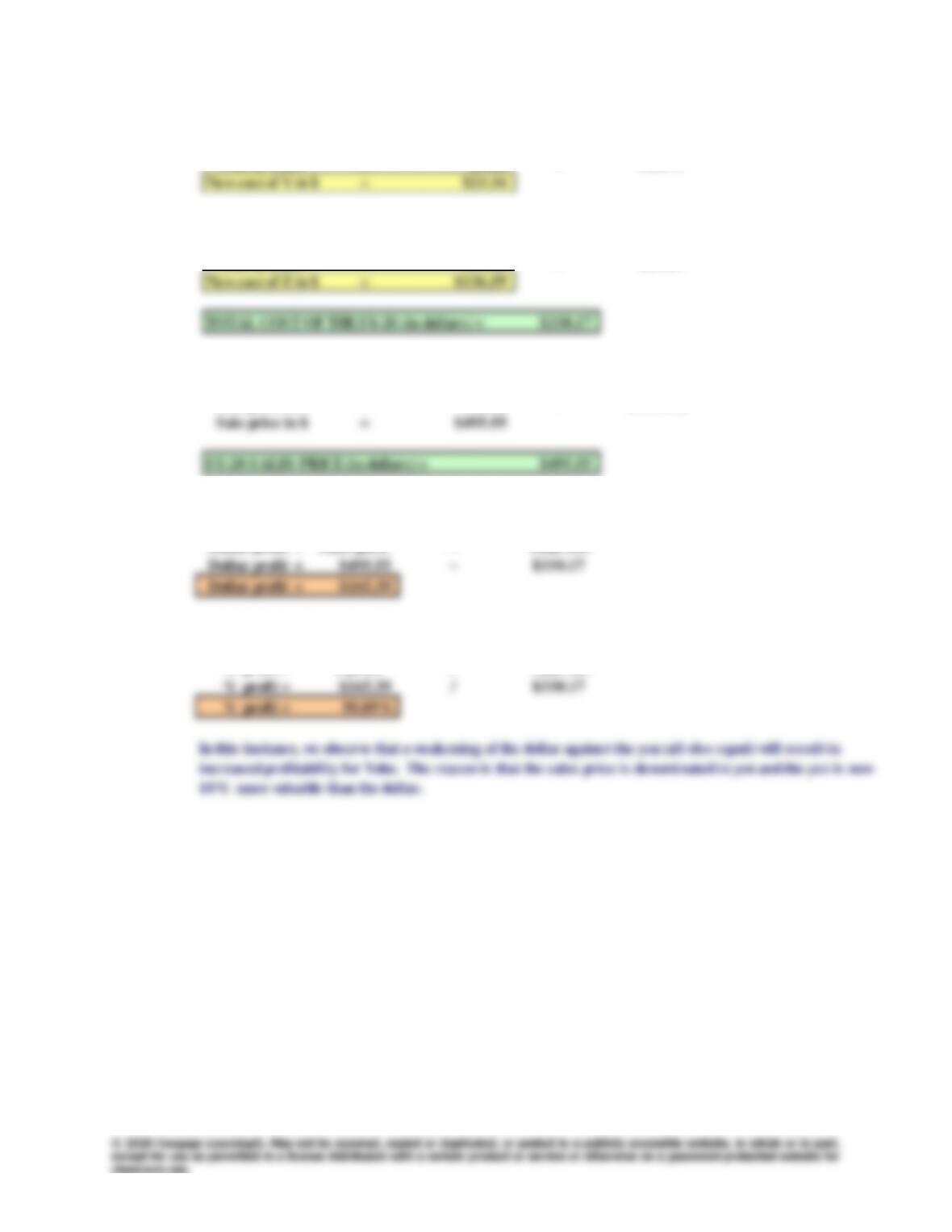
Component X
Cost of X in $ = Cost in Sfrancs ×Direct spot exchange rate
Cost of X in $ = 165.00 ×1.0317
492
Comprehensive/Spreadsheet Problem
Chapter 17: Multinational Financial Management
Component Y
Cost of Y in $ = Cost in euros ×Direct spot exchange rate
Cost of Y in $ = 20.00 ×1.1670
Component Z
Cost of Z in $ = Cost in pounds ×Direct spot exchange rate
Cost of Z in $ = 105.00 ×1.3009
Revenue from sale of the SY-20
Sale price in $ = Price in yen ×Direct spot exchange rate
Sale price in $ = 50,000 ×0.009911
The dollar profit from the sale of the SY–20 is simply the sales revenue minus the total cost.
Dollar profit = Sales price –Total cost
The percentage profit is determined as the dollar profit divided by the total cost.
% profit = $ profit / Total cost
Chapter 17: Multinational Financial Management
Comprehensive/Spreadsheet Problem
493
e.
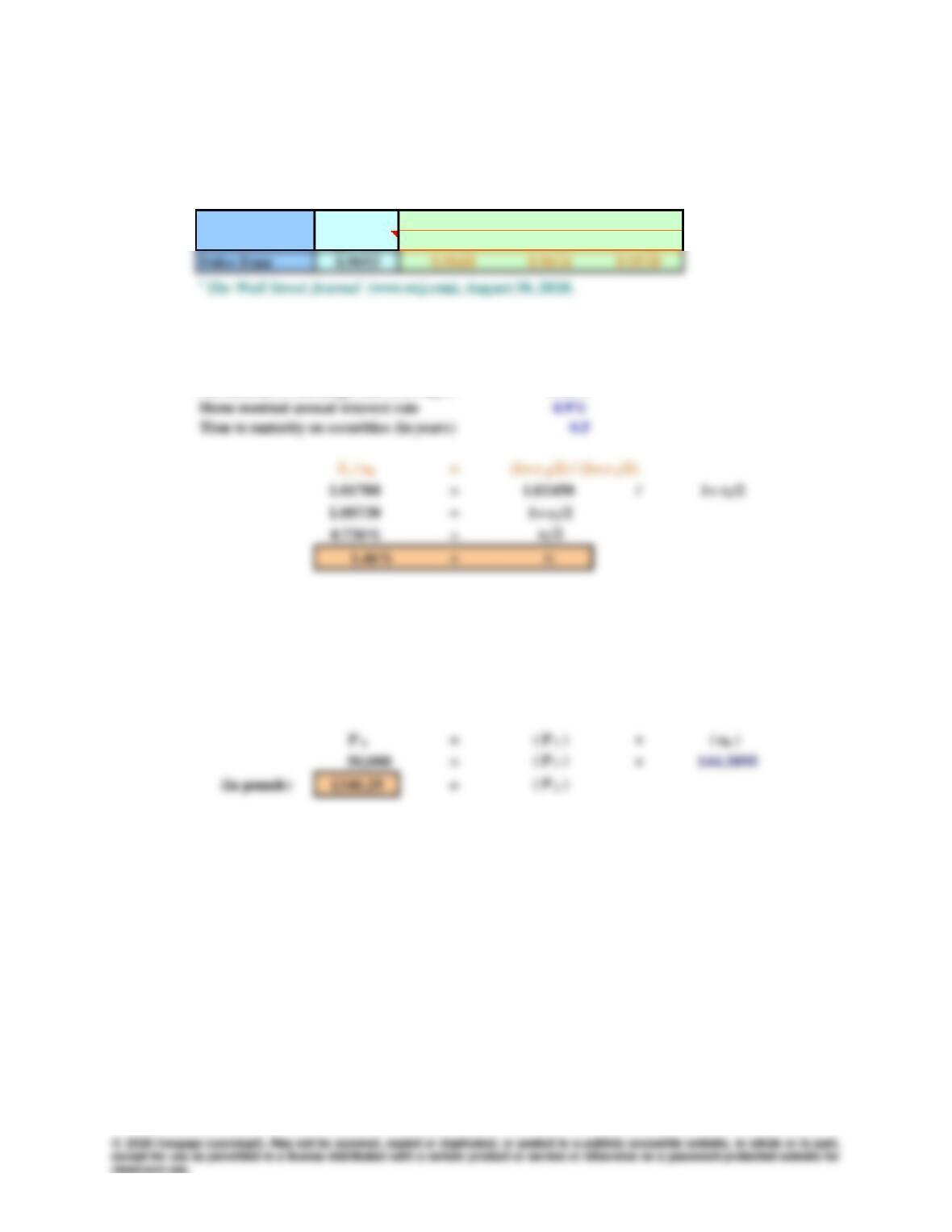
Applying interest rate parity, we can determine the return on 1-year securities in Switzerland.
TABLE 17.3 (abridged)
Forward exchange rates for the Swiss francc
Spot Rate 30 days 90 days 180 days
Using our knowledge of interest rate parity, the following problem is set up.
Note that the U.S. nominal rate is on an annual basis.
Spot direct exchange rate 1.0317
Forward direct exchange rate (180 days) 1.0493
Forward Rates
f.
Purchasing power parity allows us to establish the following problem.
Price in yen = 50,000
Yen/pound exchange rate = 144.3895

Integrated Case
17-19
Citrus Products Inc.
Multinational Financial Management
Citrus Products Inc. is a medium-sized producer of citrus juice drinks with
groves in Indian River County, Florida. Until now, the company has confined
its operations and sales to the United States; but its CEO, George Gaynor,
wants to expand into the Pacific Rim. The first step is to set up sales
subsidiaries in Japan and Australia, then to set up a production plant in Japan,
and finally to distribute the product throughout the Pacific Rim. The firm’s
financial manager, Ruth Schmidt, is enthusiastic about the plan, but she is
worried about the implications of the foreign expansion on the firm’s financial
management process. She has asked you, the firm’s most recently hired
financial analyst, to develop a 1-hour tutorial package that explains the basics
of multinational financial management. The tutorial will be presented at the
next board of directors meeting. To get you started, Schmidt has given you
the following list of questions:
A. What is a multinational corporation? Why do firms expand into
other countries?
Answer: [Show S17-1 through S17-4 here.] Use the examples given here
when discussing why firms “go international.”
1. To seek production efficiency. Companies in high-cost
countries are shifting production to low-cost regions. The